
4 Free Sports Calculators That Turn Raw Numbers Into Real Insights
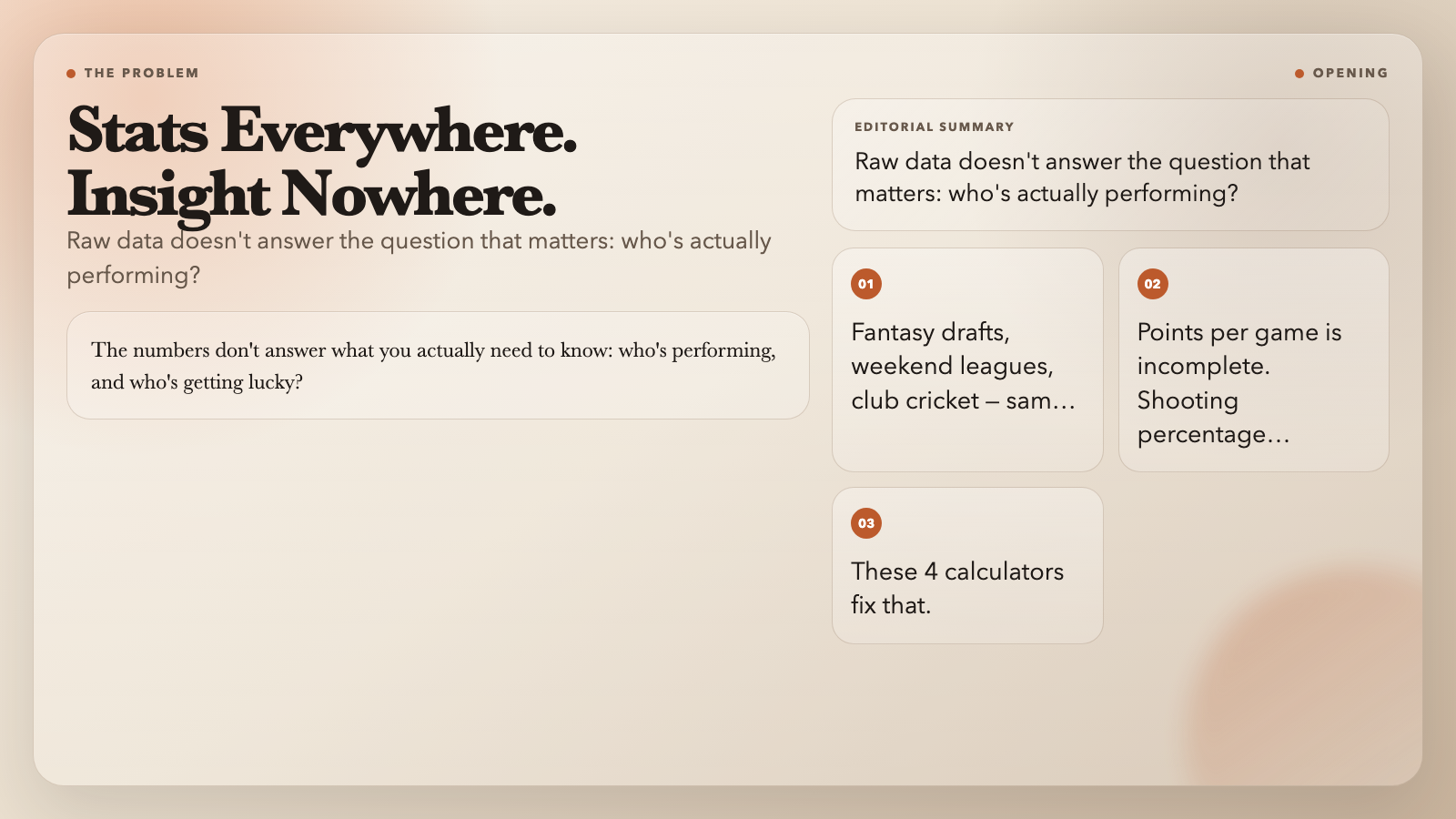
Your fantasy league draft is in three days. You have player stats in front of you. But the numbers don’t answer what you actually need to know: who’s performing, and who’s getting lucky?
The same problem hits weekend warriors, amateur runners, and casual cricket fans. Raw stats are everywhere. Making sense of them is rare.
These four free calculators take the stats you already have and return something more useful — ratings, predictions, and context that makes the numbers actually mean something.
Basketball Stats Calculator — Know What “Good Stats” Actually Looks Like
Most stat sheets show you what happened. This calculator tells you how good the player actually is.
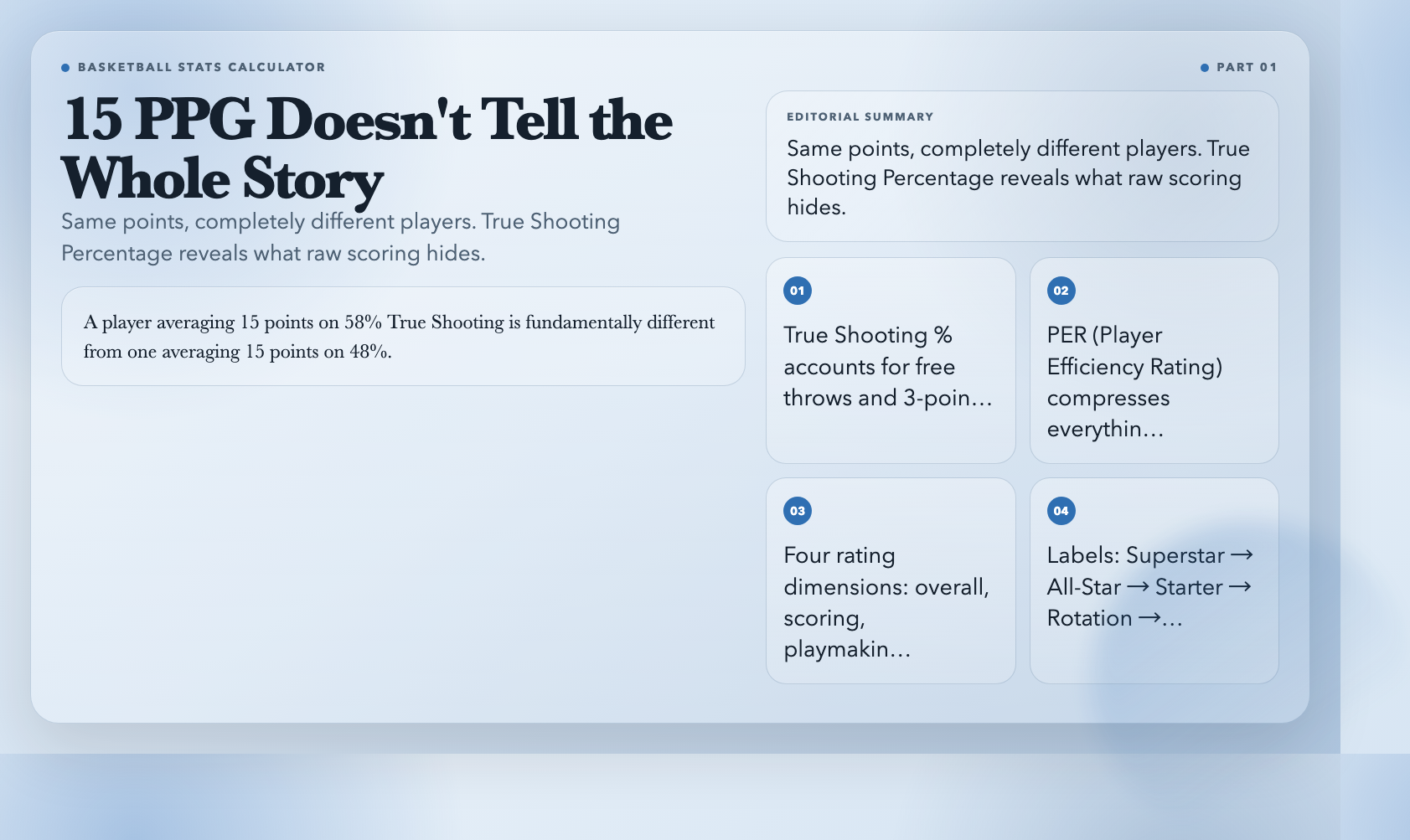
Input points, rebounds, assists, steals, blocks, turnovers, and field goal attempts. Get back per-game averages alongside True Shooting Percentage, Effective Field Goal Percentage, and Player Efficiency Rating (PER).
But it doesn’t just output numbers. It rates the player across four dimensions — overall, scoring, playmaking, and efficiency — with labels like “All-Star,” “Starter,” “Rotation Player,” and “Bench Player.”
This matters because points-per-game alone is misleading. A player averaging 15 points on 58% True Shooting is fundamentally different from one averaging 15 points on 48%. The calculator surfaces that difference instantly.
Use it when evaluating draft picks, comparing players across leagues, or settling arguments with friends.
Try it: Basketball Stats Calculator
Football Stats Calculator — The Metric That Actually Predicts Goal Involvement
Goals per game is the obvious stat. It’s also deeply incomplete.
Consider two strikers. Player A scores 0.5 goals per game and creates 1.2 chances per match. Player B scores 0.6 goals per game on fewer chances. Who is more valuable? The raw goals stat says Player B. The context says otherwise.
This calculator inputs goals, shots, shots on target, assists, and minutes played — and outputs goals per 90 minutes, shooting percentage, goal conversion rate, and goal involvement per game. It then rates the player on overall, scoring, efficiency, and playmaking dimensions.
Goal involvement per game cuts through the noise. It captures every scoring contribution, not just goals, giving you a fuller picture of offensive value. A midfielder with 8 goals and 12 assists in 30 games has a goal involvement of 0.67 per game — better than most strikers.
Try it: Football Stats Calculator
Marathon Time Predictor — Three Formulas, One Honest Answer
You’ve run a half marathon in 1:45. Now you want to know what you can finish a full marathon in.
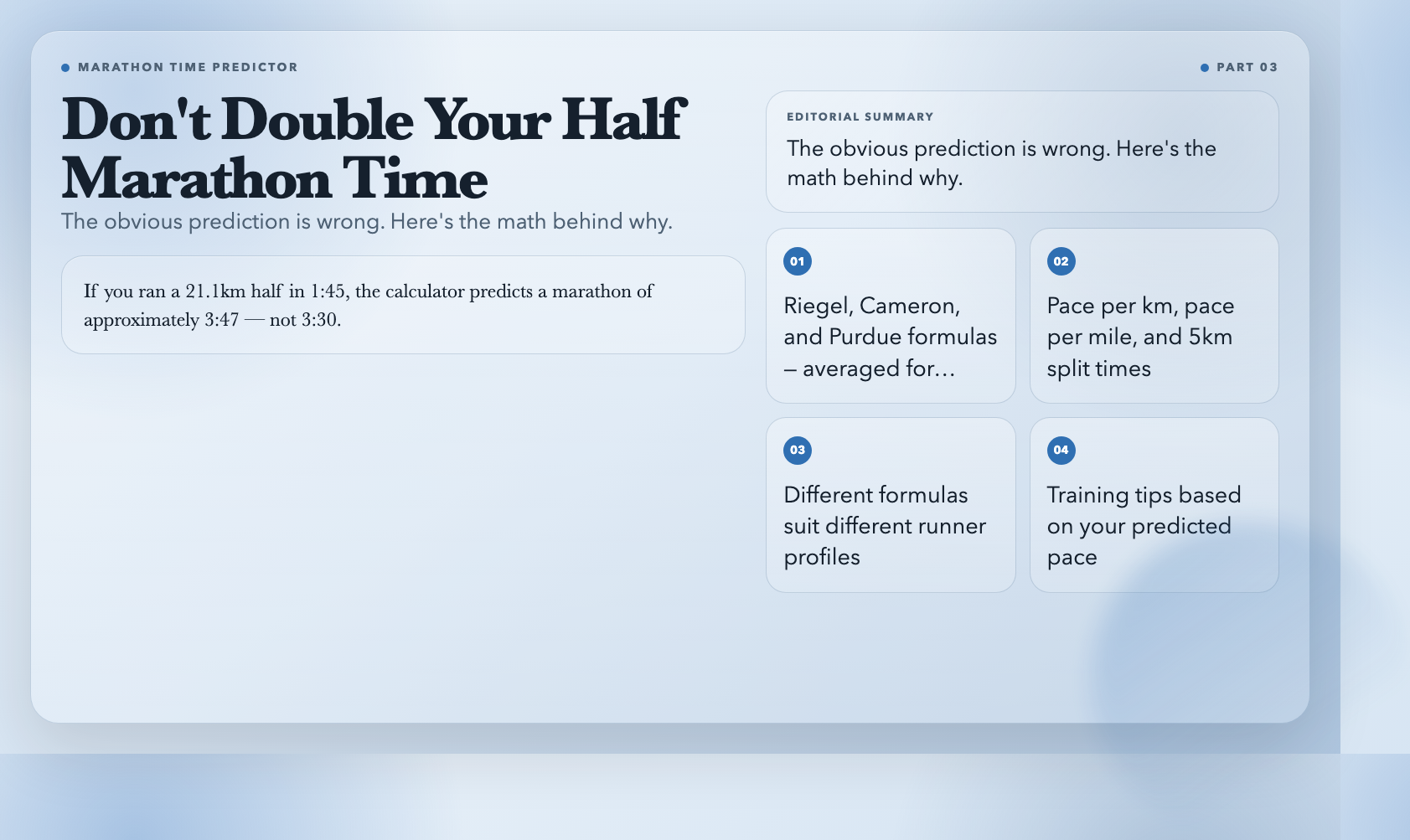
The obvious answer — 3:30 — is wrong. Runners consistently find that their full marathon time is worse than doubling the half predicts. Fatigue and pacing don’t scale linearly across 42 kilometers.
This calculator uses three predictive formulas — Riegel, Cameron, and Purdue — to estimate your marathon time from any recent race result. It outputs pace per kilometer, pace per mile, split times at every 5km checkpoint, and personalized training tips.
The key insight: each formula has a different error profile. Riegel tends to underestimate for slower runners. Cameron handles fatigue better at longer distances. The calculator averages all three for a more robust prediction than any single formula alone.
If you ran a 21.1km half in 1:45 (5:00/km pace), the calculator predicts a marathon of approximately 3:47 — not 3:30. That difference matters when you’re planning your race day nutrition, pacing strategy, and gear.
Try it: Marathon Time Predictor
Cricket Over Rate Calculator — Know Before the Umpire Tells You
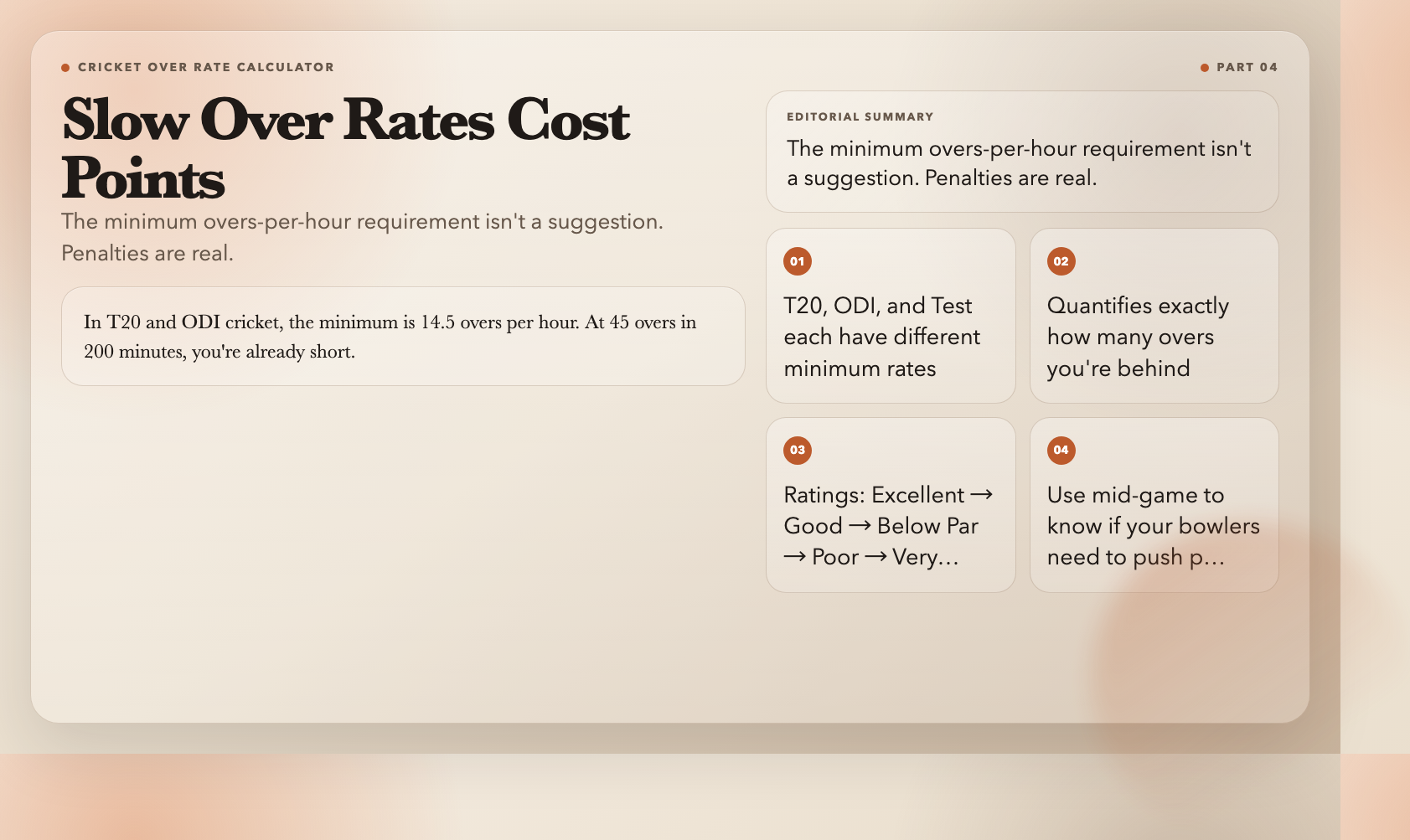
Slow over rates don’t just slow the game — they cost teams points. In competitive cricket, failing to bowl the required overs per hour triggers match penalties.
This calculator inputs overs bowled, minutes played, and match format (T20, ODI, or Test) — and tells you whether your bowling attack is on pace. It calculates your current overs per hour, compares it to the minimum required for your format, and tells you exactly how many overs you’re short.
In T20 and ODI cricket, the minimum is 14.5 overs per hour. If your team bowls 45 overs in 200 minutes, that’s 13.5 overs per hour — short of the requirement. The calculator quantifies that gap and tells you what to change.
For club captains and coaches, it prevents the situation where a post-match penalty announcement surprises everyone. Use it mid-game to track whether your bowlers need to push the pace.
Try it: Cricket Over Rate Calculator
Why These Tools Exist
Sports produce endless data. Most of it sits in spreadsheets without ever becoming insight.
These calculators share a purpose: they translate raw numbers into ratings, predictions, and context you can act on. They tell you what a stat line means, not just what it says.
Before your next draft, your next race registration, or your next club meeting where someone insists the over rate was “probably fine” — run the numbers first. Because usually, the numbers disagree.