# Einstein Used Pollen to Prove Atoms Exist. Here’s the Interactive Proof.
In 1827, botanist Robert Brown placed pollen grains in water and watched them through a microscope. They jittered. Zigged. Zagged. No two paths alike. Brown assumed it was alive—a property of organic matter. He was wrong. But he had stumbled onto one of the most profound observations in science: the visible proof of the invisible.
Those random jitters weren’t life. They were atoms.
The Problem Nobody Could Solve
Brown’s observation sat unexplained for 78 years. Scientists knew molecules existed—but nobody had ever seen one. Atoms were a hypothesis, not a fact. The jittering pollen was the closest thing to atomic evidence they had, but nobody could explain *why* particles behaved this way.
Then came 1905. Einstein published four papers that year. One was on special relativity. One was on the photoelectric effect (which earned him the Nobel Prize). One was on molecular dimensions. But the fourth—called “On the Motion of Small Particles Suspended in Stationary Liquids”—would change physics forever.
His argument was elegant. You can’t see atoms. But you can see what they do.
The Equation That Changed Everything
Einstein showed that the erratic movement of a particle wasn’t random chaos—it was statistical predictability hiding inside apparent randomness. The mean square displacement (MSD) of a particle grows linearly with time:
MSD = 2nDΔt
Where *D* is the diffusion coefficient, *n* is the dimensionality, and *Δt* is the time interval. This single formula connected the invisible world of molecules to the observable world of pollen and smoke.
The diffusion coefficient follows the Stokes-Einstein relation:
D = kBT / 6π η r
Where *kB* is Boltzmann’s constant (1.38 × 10⁻²³ J/K), *T* is temperature, *η* is viscosity, and *r* is particle radius. Increase temperature, and particles bounce more energetically. Increase particle size, and the motion dampens. A 5μm particle diffuses roughly 25× slower than a 1μm particle in the same fluid.
Try It Yourself: The Free Brownian Motion Simulator
The free Brownian Motion Simulatoron ElysiaTools lets you manipulate every variable in Einstein’s equation:
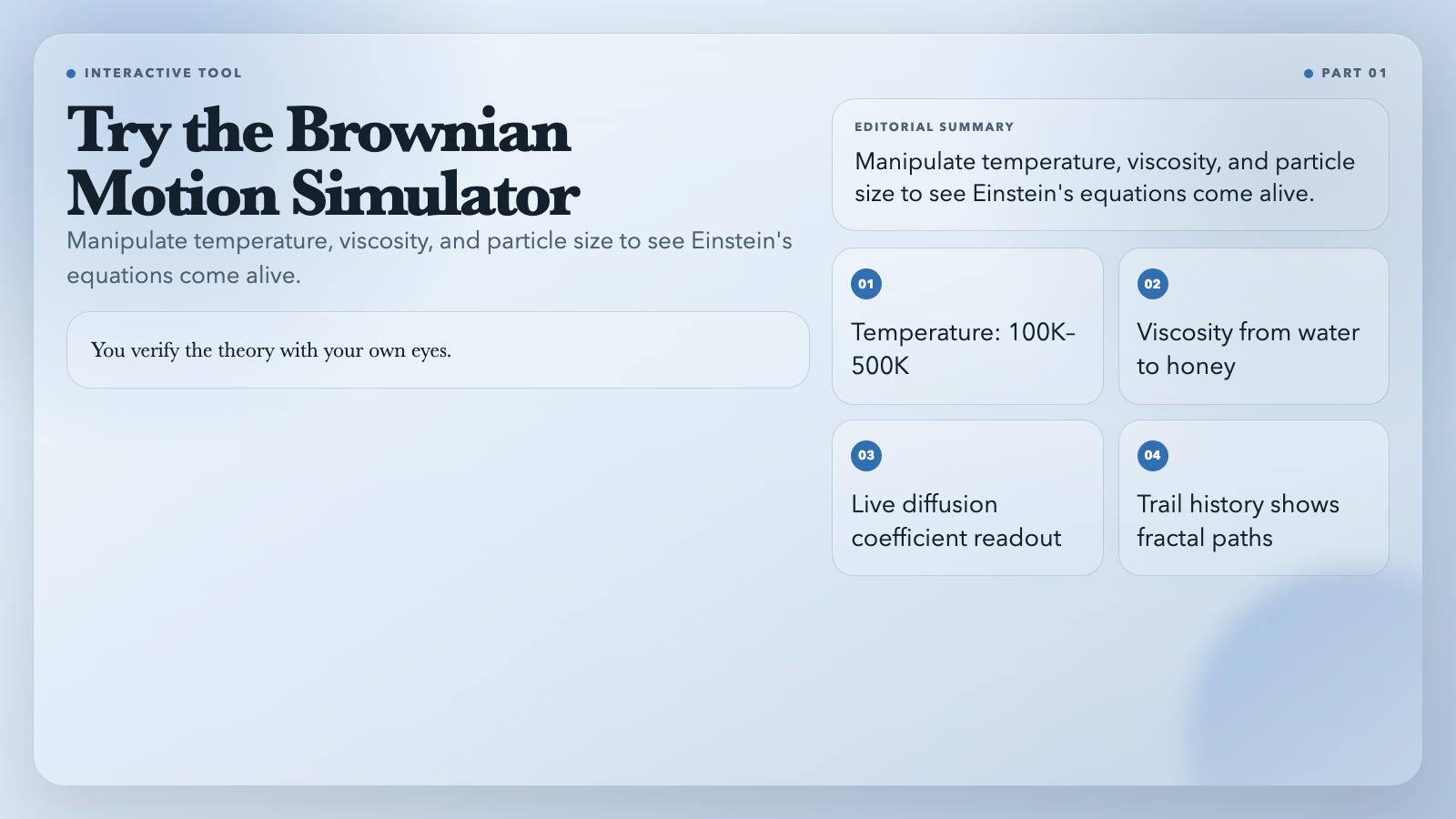
– Temperature (T): Slide from 100K to 500K. Particles transition from sluggish to frantic. The physics holds: higher T means more molecular impacts per second.
– Particle Radius (r): Larger particles accumulate more drag. The Stokes-Einstein relation shows this explicitly.
– Viscosity (η): Water has η ≈ 1.0 mPa·s. Honey has η ≈ 10,000 mPa·s. The same particle in honey barely moves.
– Trail Length: The fractal-like trajectory is a direct visualization of what Einstein described mathematically.
Live readouts show displacement, mean square displacement, and the diffusion coefficient in real time. You verify the theory with your own eyes.
A Beautiful Symmetry
What strikes me most about Stokes-Einstein is its symmetry. Einstein derived the diffusion coefficient from molecular theory. Stokes derived drag on a sphere from hydrodynamics. Both described the same interaction—and their formulas fit together perfectly, with no fudge factors.
This is what physics looks like when two completely different domains discover the same truth.
Where Brownian Motion Shows Up in the Real World

Finance: The Black-Scholes model—the foundation of modern options pricing—assumes stock prices follow geometric Brownian motion. One equation, two worlds.
Chemistry: Diffusion-controlled reactions depend on how fast molecules bump into each other, governed by D = kBT / 6π η r.
Biology: Nanoparticle drug delivery systems model particle transport through tissue as a Brownian process. The same physics that moves pollen moves medicine.
Electronics: Johnson-Nyquist noise in resistors—the thermal jitter of electrons—follows Brownian statistics. Your smartphone’s circuits run on Einstein’s pollen math.
The Polish Botanist, the Swiss Patent Clerk, and the Frenchman Who Won the Nobel
Einstein published his paper without knowing about Brown’s original observation. Jean Perrin read Einstein’s paper, designed experiments to test it, and spent years counting individual particles. In 1926, Perrin received the Nobel Prize in Physics for experimentally confirming atomic theory.
His Nobel lecture demonstrated what Einstein’s equations predicted: individual atoms were real, measurable, countable objects. The jittery pollen had finally given up its secret.
Why This Still Matters
The remarkable thing about Brownian motion isn’t just its universality. It’s that one physical phenomenon connects molecular biology, quantitative finance, semiconductor physics, and drug delivery—with the same mathematics. Einstein saw atoms through pollen. He didn’t know he was also laying the foundation for Black-Scholes.
Open the Brownian Motion Simulator. Crank the temperature to 500K. Watch the particles scatter like chaos. Then read the diffusion coefficient.
That number—derived from Boltzmann’s constant, temperature, viscosity, and radius—is the same equation that prices your options, delivers your medicines, and runs your smartphone’s noise floor. One phenomenon. One math. Everywhere at once.

Brown saw jittering pollen. Einstein saw atoms. What invisible architecture are you walking past right now?