# The 7 Health Numbers That Actually Matter — And How to Calculate Them Free
Three numbers your doctor has never mentioned: your basal metabolic rate, your heart rate reserve, and your body fat percentage. Your gym membership doesn’t include any of them. Your smart scale knows one and shows you another without context.
I spent three weeks inside the health calculator ecosystem testing every free tool I could find. Most were useless — they gave you a number with no explanation, no context, and no next step. But seven tools stood out. Together, they answer the questions that actually determine whether you’re healthy: Why won’t the scale move? Why are you always tired by 2pm? Why is your resting heart rate 80 when your friend’s is 52?
—
1. BMI Calculator — The Metric Doctors Use, but Nobody Explains
Body Mass Index divides your weight in kilograms by the square of your height in meters. Critics call it outdated — it doesn’t distinguish muscle from fat, and it classifies a lean athlete the same as a sedentary person at the same weight.
They’re right. But BMI matters because it’s the one number your doctor actually checks, and most tools stop there. They give you the score and nothing else.
The BMI Calculator goes beyond the raw score. Input your weight, height, age, and gender. It tells you which category you fall into — Underweight, Normal, Overweight, or Obese — and pairs it with a health risk assessment and a personalized ideal weight range for your height.
More importantly, it gives you three to five recommendations based on your category. If you’re in the “Overweight” range, you get specific guidance. If you’re in “Normal,” you get maintenance advice. That’s the difference between a number and something you can act on.
The tool accepts both metric and imperial units. No conversion required.
—
2. BMR Calculator — The Floor of Your Daily Burn
BMR (Basal Metabolic Rate) is the calories your body burns at complete rest — keeping your lungs breathing, heart beating, and brain functioning. It accounts for 60 to 75 percent of total daily energy expenditure for most people, regardless of how much they exercise.
Here’s why this number changes everything: two people eating the same 2,000 calories a day can have completely different body composition outcomes if their BMR differs. If one has a BMR of 1,700 and eats 2,000 calories, that’s a 300-calorie daily surplus. The other with a BMR of 1,500 is in a 500-calorie deficit. Same food, opposite results.
The BMR Calculator offers three formulas: Mifflin-St Jeor (most accurate for general populations), Harris-Benedict (revised 1984), and Katch-McArdle (requires body fat percentage). Running all three reveals a 100 to 200 calorie divergence — small per day, significant over a year.
For a 30-year-old, 175cm male at 75kg, Mifflin-St Jeor returns 1,722 calories per day at complete rest. That’s your metabolic floor. Sustained undereating below this level forces your body to choose between stored fat and lean tissue for fuel.
—
3. TDEE Calculator — The Number That Rewrites Your Diet
BMR is your floor. TDEE (Total Daily Energy Expenditure) is the ceiling of what your body actually burns in 24 hours — including walking, standing, digesting food, and structured exercise.
The TDEE Calculator takes your BMR and applies an activity multiplier: 1.2 for sedentary (desk job, minimal movement), 1.9 for very active (hard training twice daily, physical labor). The critical problem: most people overestimate their activity by a full tier.
Someone who exercises two to three days per week but sits at a desk the rest of the time is not “moderately active.” They’re sedentary to lightly active. Choosing the wrong multiplier throws your calorie target off by 300 to 500 calories per day.
For the 30-year-old male above with genuine moderate exercise three to four days per week, TDEE lands at approximately 2,670 calories per day. That’s nearly 1,000 calories above his BMR. This single number explains why “eating like my gym-going friend” produces completely different scale outcomes. TDEE — not willpower, not meal timing — determines whether you gain, lose, or maintain.
—
4. Calorie Burned Calculator — Making Movement Meaningable
TDEE accounts for baseline metabolism and planned exercise. But what about the two-hour hike on Saturday, the basketball game on Sunday, or the walk home from the office?
The Calorie Burned Calculator estimates expenditure across twelve activities — running, cycling, swimming, weightlifting, yoga, hiking, dancing — using MET values (Metabolic Equivalent of Task), which are research-backed energy estimates.
The useful feature: equivalence translation. Burn 350 calories in a 45-minute run, and the tool tells you that’s approximately 100 minutes of moderate walking or 50 minutes of cycling. Movement becomes a transferable currency. This is practical when you have 20 minutes but not 45.
For a 75kg person running at moderate intensity for 30 minutes: roughly 370 calories. The same person doing yoga for 30 minutes at moderate intensity: approximately 120 calories. Over a week of consistent training, the difference between these activities compounds significantly.
—
5. Body Fat Calculator (US Navy) — What the Scale Can’t Show
The scale reports 180 pounds. It doesn’t report that 180 pounds might be 10 percent body fat or 25 percent. Same weight. Radically different bodies.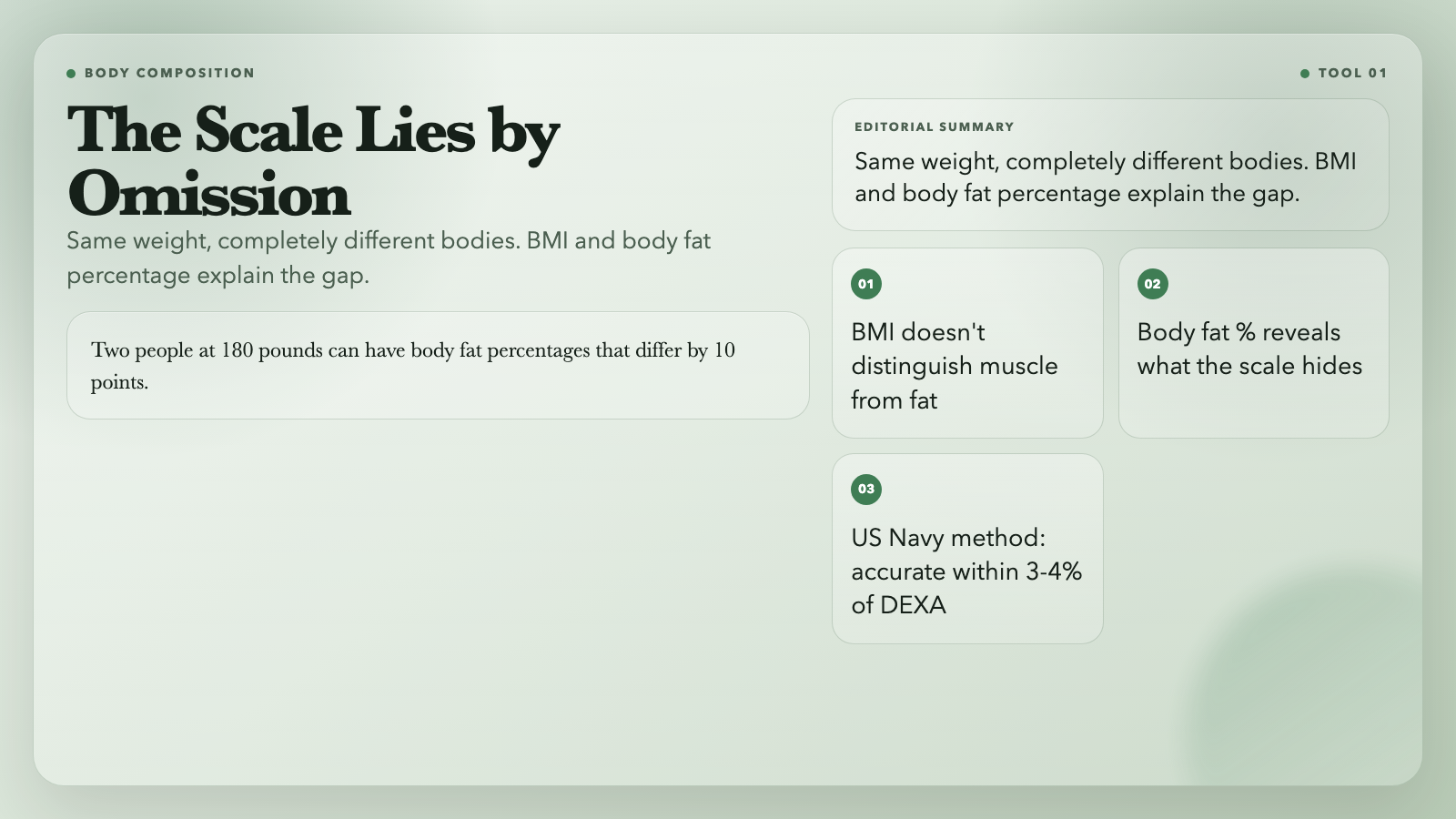
The Body Fat Calculator (US Navy) uses the circumference method — waist, neck, height, and hip (for women) — to estimate body fat percentage. The formula dates to US Navy research in the 1980s and remains in active military use because it’s fast, free, and accurate within 3 to 4 percentage points of a DEXA scan.
The category thresholds for men: Essential Fat (2-6%), Athletes (6-14%), Fitness (14-18%), Average (18-25%), Obese (25%+). For women: Essential Fat (10-14%), Athletes (14-21%), Fitness (21-25%), Average (25-32%), Obese (32%+).
Two people at the same weight and same BMI can have body fat percentages that differ by 10 percentage points. That gap explains differences in insulin sensitivity, hormone production, and cardiovascular risk that a bathroom scale completely obscures.
—
6. Target Heart Rate Calculator — Train With Precision
Most people exercise without knowing which heart rate zone they’re working in. They run for 30 minutes and guess. The result: easy days are too easy, hard days aren’t hard enough, and the expected fitness improvements never arrive.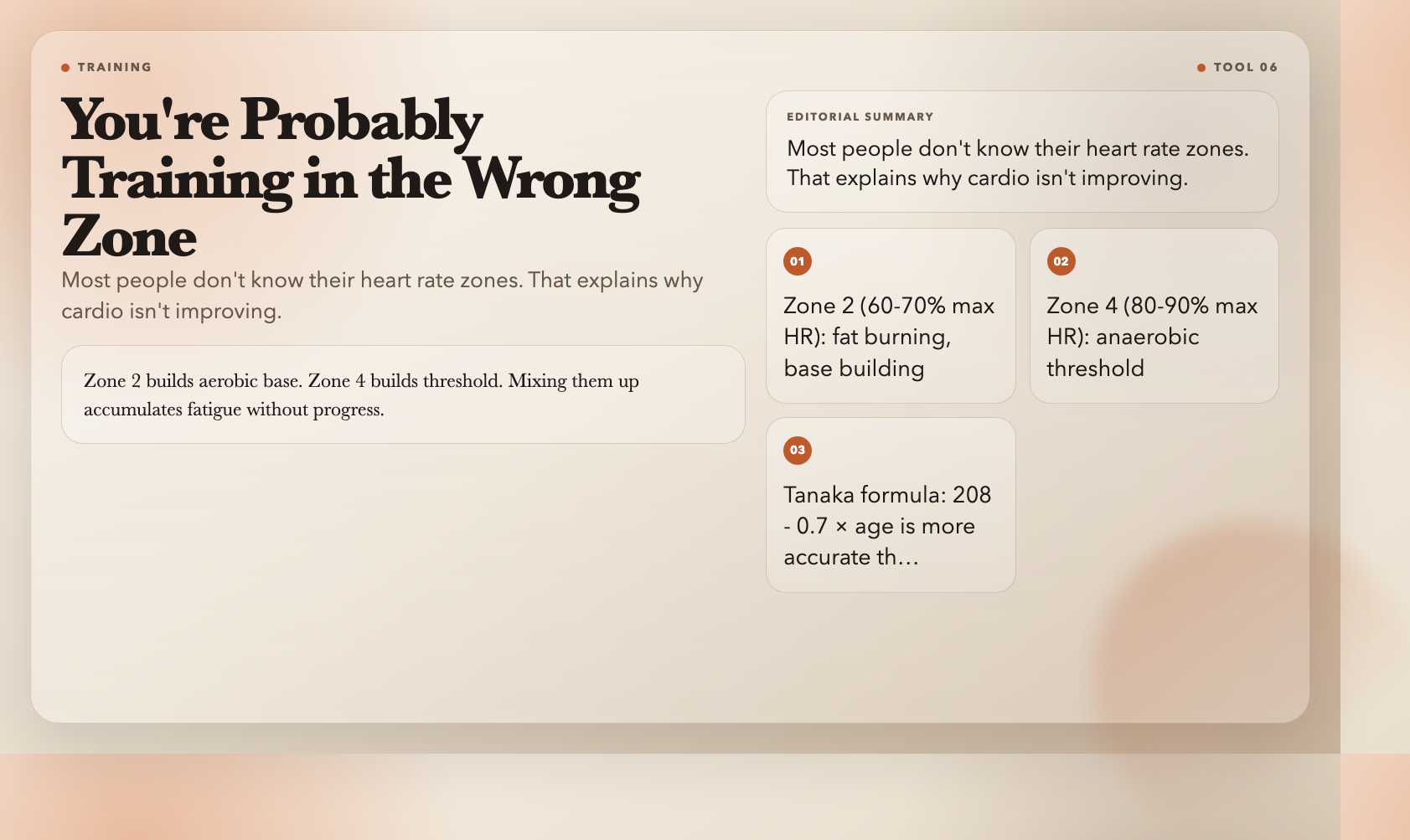
The Target Heart Rate Calculator defines five training zones based on your age and optionally your resting heart rate. Zone 1 (50-60% of max) is warm-up and recovery. Zone 2 (60-70%) builds aerobic base and burns fat. Zone 3 (70-80%) improves cardiovascular efficiency. Zone 4 (80-90%) develops anaerobic threshold. Zone 5 (90-100%) is maximum effort, sustainable only in short intervals.
For a 35-year-old, the Tanaka formula (208 – 0.7 × 35 = 184 bpm max) is more accurate than the classic 220 – age formula. Zone 2 lands at 110-129 bpm. Zone 4 at 147-166 bpm. Using the Karvonen method with your actual resting heart rate personalizes these ranges further — two 35-year-olds at different fitness levels get different Zone 2 targets.
Training in the wrong zone explains why your cardio isn’t improving despite consistent exercise. If you’ve been grinding in Zone 3 when you thought you were in Zone 2, you’ve been accumulating fatigue without the aerobic base building that Zone 2 provides.
—
7. Sleep Cycle Calculator — The Metric Nobody Tracks
Sleep is when your body repairs tissue, strengthens immunity, and consolidates learning. But waking up mid-cycle — even after a full eight hours — leaves you cognitively impaired for the first two hours of your day. The eight-hour number is meaningless if you’re waking in the middle of a sleep cycle.
The Sleep Cycle Calculator exploits one fact: sleep runs in 90-minute cycles. Wake at the end of a cycle, you feel rested. Wake mid-cycle, you feel groggy.
The tool works both directions. Input your intended bedtime and it calculates optimal wake-up times, accounting for 10 to 15 minutes to fall asleep. Or input a fixed wake-up time and it tells you when to go to bed for 4, 5, or 6 complete cycles.
Five cycles (7.5 hours) is the target for most adults. Six cycles (9 hours) benefits athletes and people in heavy training. Four cycles (6 hours) is the minimum and the tool labels it as such. If you need to wake at 6:45am, going to bed at 10:45pm (after a 15-minute fall-asleep buffer) gives you exactly 5 complete cycles. Your alarm going off mid-cycle is why you hit snooze three times.
—
The One Thing These Tools Don’t Do
All seven of these calculators share the same limitation: they give you data, not direction.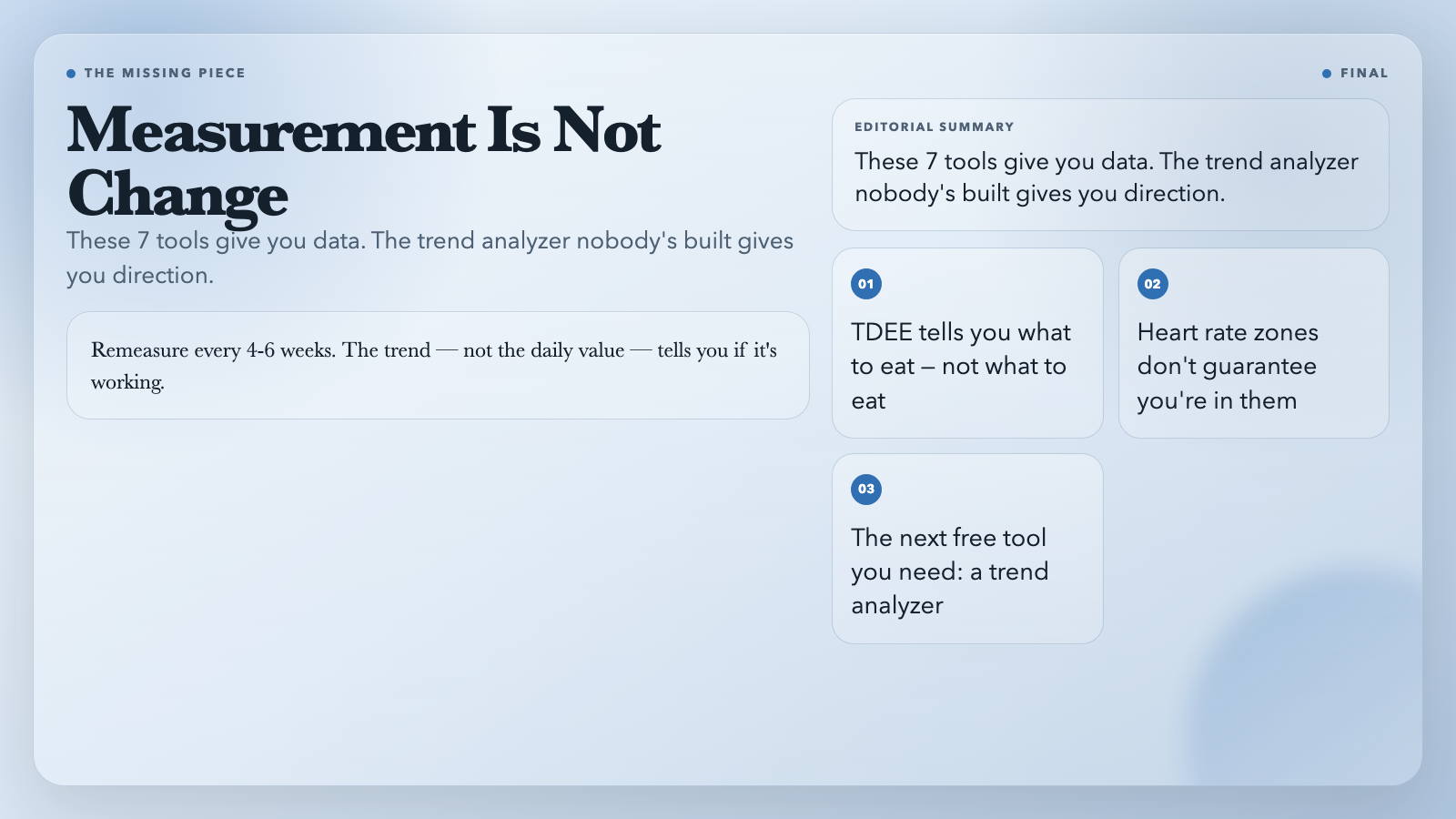
Knowing your TDEE doesn’t automatically change what you eat. Knowing your heart rate zones doesn’t guarantee you’re training in the right one. The gap between measurement and change is where most people’s health journeys stall.
The practical approach: use these seven numbers as baselines and remeasure every four to six weeks. BMI trending from 28 to 26 over three months tells you something. A single BMI of 28 tells you nothing.
The free tool nobody’s built yet: a trend analyzer that takes your before-and-after measurements and tells you whether your approach is actually working. Until that exists, start with these seven. Ten minutes total, zero cost, and the number you discover might finally explain what’s been happening with your body.