# The Hydrogen Atom Looks Nothing Like Your Textbook Pictures
Here’s a question that sounds simple but isn’t: Where is the electron in a hydrogen atom?
You probably learned that electrons orbit the nucleus like planets around the sun. Even the Bohr model—with its concentric circles—implies that. But that picture is wrong. A hydrogen atom doesn’t look like anything you can actually picture with your eyes. It’s stranger than that.
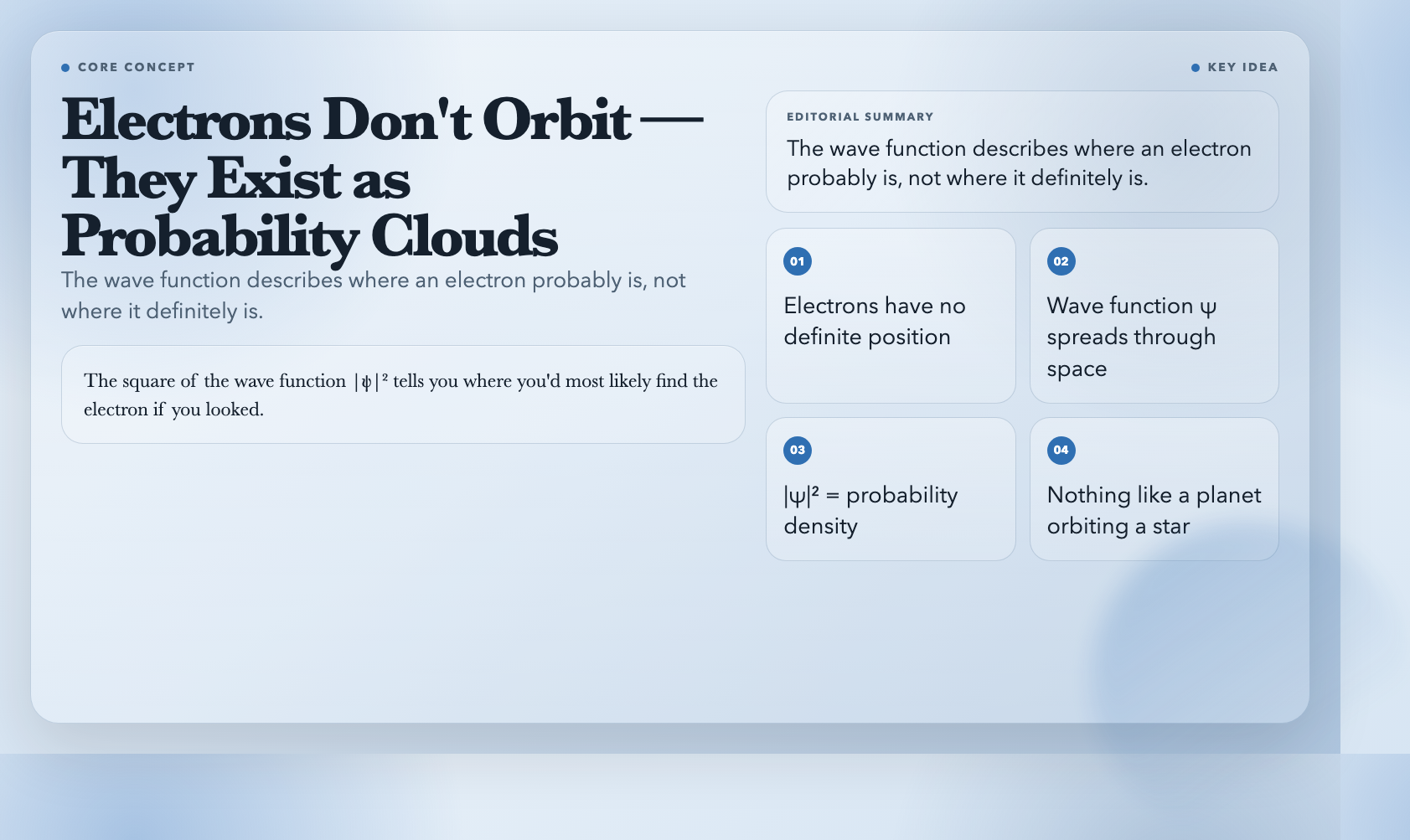
Electrons don’t orbit. They don’t have a definite position. They exist as a mathematical object called a wave function, spreading through space as a cloud of probability. The square of that wave function—|ψ|²—tells you where you’d most likely find the electron if you looked. Not where it *is*. Where you’d *probably* find it.
This isn’t philosophy. This is what a hydrogen atom actually looks like when you do the math right.
The Schrödinger Equation Changed Everything
In 1926, Erwin Schrödinger published an equation that described electrons not as tiny particles zipping around a nucleus, but as waves. His equation treated electrons as probability amplitudes—a kind of quantum fog that fills the space around an atom.
The equation in spherical coordinates breaks into two parts that do different jobs. R_nl(r) handles how the electron cloud extends outward from the nucleus. Y_lm(θ, φ) controls the shape and three-dimensional orientation of that cloud.
The full wave function—ψ(r, θ, φ) = R_nl(r) × Y_lm(θ, φ)—describes the electron completely. Squaring it gives the probability density: where you’d find the electron if you checked.
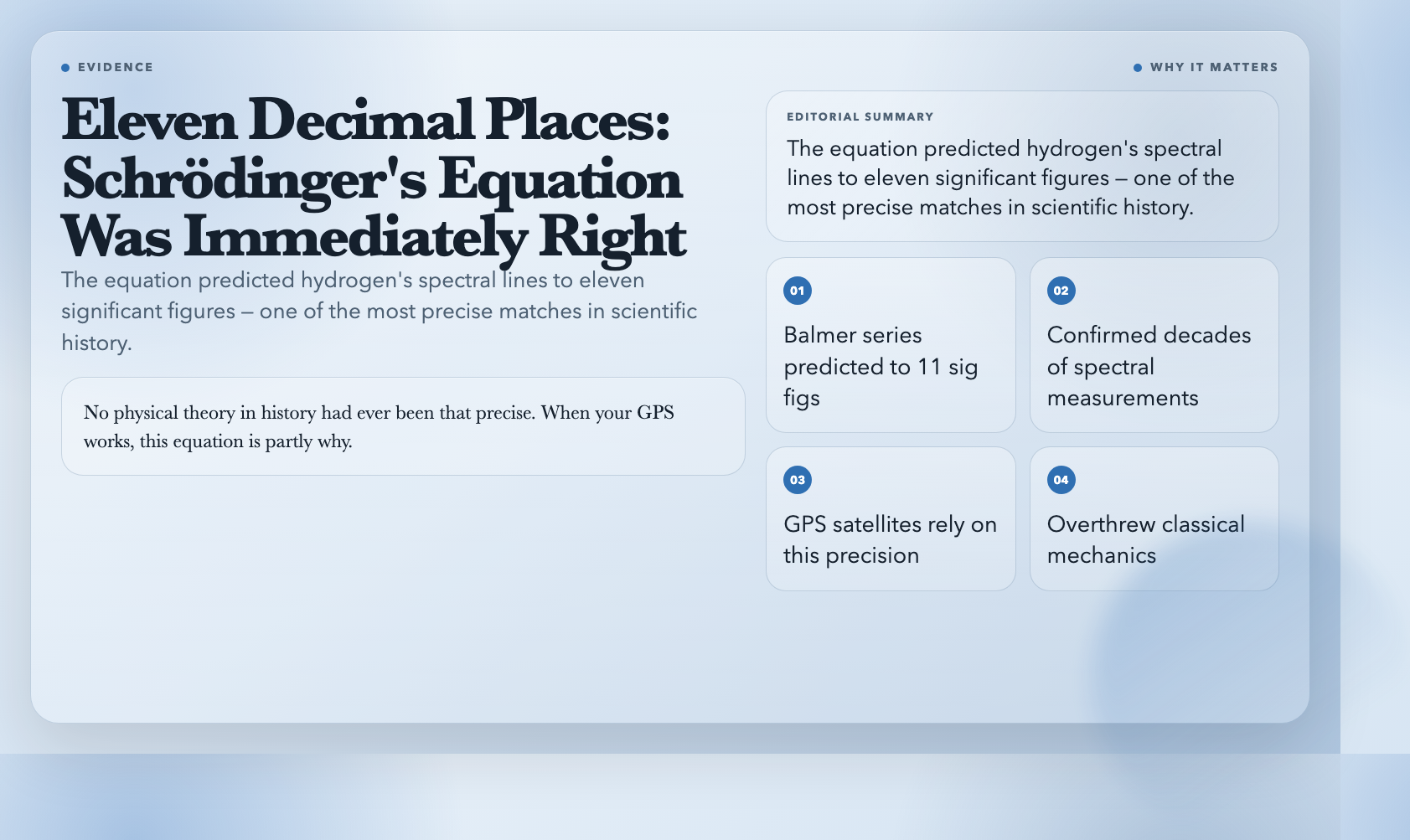
The predictions were immediately testable. The hydrogen spectral lines had been measured for decades. Schrödinger’s equation reproduced the Balmer series with an accuracy measured to eleven decimal places. No physical theory in history had ever been that precise. When your GPS works, this equation is partly why.
Quantum Numbers: The Addresses of Electrons
Every electron in a hydrogen atom is described by three quantum numbers. Think of them as an address system with three coordinates.
n — Principal quantum number (n = 1, 2, 3, …)
This sets the electron’s energy level. Larger n means higher energy and greater average distance from the nucleus. The Bohr radius a₀ ≈ 0.529 Å (about half an angstrom) is the natural unit here. For reference, a typical chemical bond spans about 1–2 angstroms. We’re working at scales smaller than what you’d find inside most molecules.
l — Azimuthal quantum number (l = 0, 1, 2, …, n−1)
This shapes the orbital. Each l value maps to a letter:
– l = 0: s orbitals — spherical, like a cloud centered on the nucleus
– l = 1: p orbitals — dumbbell-shaped, with two lobes flanking the nucleus
– l = 2: d orbitals — cloverleaf or donut-and-lobe shapes
– l = 3: f orbitals — complex multi-lobed structures
m — Magnetic quantum number (m = −l, …, 0, …, +l)
This determines spatial orientation. A p orbital (l=1) has three orientations: px, py, and pz, pointing along the x, y, and z axes. All three share the same energy—until you place the atom in a magnetic field, where they split slightly. This is the Zeeman effect, and astronomers use it to measure magnetic fields in distant stars.
What Nodal Surfaces Actually Mean
Here is something that sounds impossible: there are surfaces in space where the probability of finding an electron is exactly zero.
These are nodal surfaces. They come in two flavors.
Radial nodes are spherical shells where the wave function crosses through zero. The count is n − l − 1. A 2s orbital (n=2, l=0) has one radial node at r = 2a₀. A 3s orbital has two.
Angular nodes are planes or cones passing through the nucleus. The count is l. A p orbital has one nodal plane cutting through the center. A d orbital has two.
These nodes aren’t just mathematical curiosities. They determine how atoms fit together. An electron can’t exist at a node—the probability there is literally zero. This shapes the geometry of every molecule that exists. The specific angles in water (104.5°), the triple bond in nitrogen, the hexagonal shape of benzene—all trace back to where nodes force electrons not to be.
The Orbitals: What They Actually Look Like
Forget the flat Bohr circles. In three dimensions, orbitals have real shapes you can see and manipulate.
1s orbital (n=1, l=0, m=0)
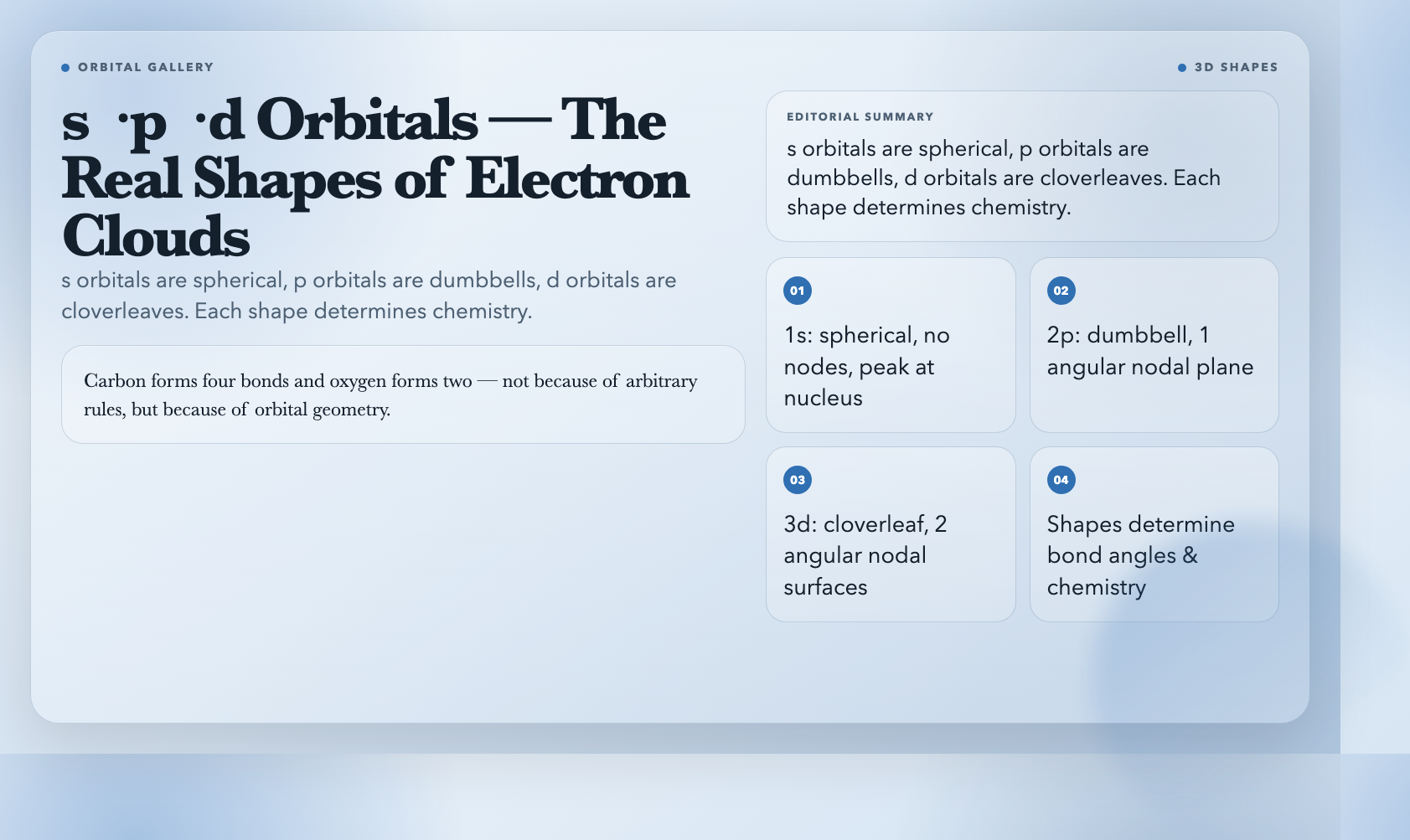
The simplest orbital. Spherical. No nodes. The probability density peaks *at the nucleus*—not in a ring around it, but right in the center. This is the ground state of hydrogen. Electrons spend some of their time literally inside the nucleus, which only makes sense once you stop thinking of them as little spheres following paths.
2s orbital (n=2, l=0, m=0)
Also spherical, but larger, with one radial node at r = 2a₀. The electron cloud has a shell-like structure: one probability region inside the node, another outside.
2p orbitals (n=2, l=1)
Dumbbell-shaped. Two lobes of electron density on opposite sides of the nucleus, with a nodal plane running through the center. Along x, y, or z depending on whether it’s px, py, or pz.
3d orbitals (n=3, l=2)
These look like four-leaf clovers—or a donut with two lobes attached. Two angular nodal surfaces give them their complex geometry.
Why This Matters Far Beyond Physics Class
The shapes of hydrogen orbitals aren’t an academic curiosity. They are the foundation of all chemistry.
Chemical bonding happens because orbitals on neighboring atoms overlap. s orbitals overlap head-on to form sigma bonds. p orbitals overlap sideways to form pi bonds. The shapes directly determine which bonds can form, how strong they are, and what angles they adopt. Carbon forms four bonds and oxygen forms two—not because of arbitrary rules, but because of orbital geometry. The shapes are the rules.
The periodic table is a consequence of how these orbitals fill up. Electrons occupy the lowest-energy orbitals first (the Aufbau principle), and the entire structure of the periodic table emerges from the quantum numbers and their allowed combinations. The periodicity that gives chemistry its structure is pure quantum mechanics.
Spectroscopy is built on electron transitions between these orbitals. When an electron drops from a higher orbital to a lower one, it emits a photon with energy equal to the difference. The hydrogen spectral lines were measured decades before Schrödinger—and his equation predicted them to eleven significant figures. The agreement was so exact it convinced physicists to abandon classical mechanics entirely.
Quantum computing relies on controlling quantum states. Google’s Sycamore processor achieved quantum supremacy by manipulating 53 qubits; each qubit is an object whose behavior the Schrödinger equation governs exactly. Trapped ion quantum computers, superconducting circuits, nitrogen-vacancy centers in diamond—all are hydrogen-like systems controlled by wave function mathematics.
Materials science traces back to overlapping atomic orbitals. Silicon’s semiconductor properties, the behavior of high-temperature superconductors, laser diodes, LEDs—all derive from the quantum mechanics of electron orbitals. The band theory of solids is atomic orbitals combined for millions of atoms in a crystal.
The Visualization That Makes It Real
Abstract math only gets you so far. The Hydrogen Atom Wave Function Visualization at ElysiaTools lets you explore these orbitals interactively.
Adjust the three quantum numbers with sliders and watch the electron cloud change shape in real time. Switch between electron cloud view (probability density), isosurface view (constant-probability boundary), and nodal surface view (where probability is zero). Rotate the 3D view freely from any angle.
Presets are available for common orbitals: 1s, 2s, 2p, 3s, 3p, 3d, and others. Each shows the orbital’s distinctive shape, node count, and symmetry properties.
The Strange Part Nobody Talks About
The wave function is the complete description of an electron. There is no deeper layer. The “particle” picture and the “wave” picture are both useful fictions for something that is neither.
An electron in a hydrogen atom doesn’t circle the nucleus. It doesn’t spin on an axis. It is a probability amplitude distributed through space—that resolves into something localized only when you measure it.
And yet this is what makes chemistry exact. The shapes of these probability clouds determine every reaction, every bond, every material in the universe. When you smell coffee, read this screen, or touch anything at all—you are experiencing the consequences of electron wave functions overlapping in mathematically precise ways.
The next time you see a diagram of atoms with dots orbiting a nucleus, remember: the real picture is stranger, more exact, and more beautiful.