5 Free Validation Tools That End the Tab-Switching Frustration
Every developer knows the drill. You need to check if a credit card number is valid. So you Google “Luhn algorithm,” copy-paste code, deal with edge cases, and — 20 minutes later — you’ve built something a free tool does in 2 seconds.
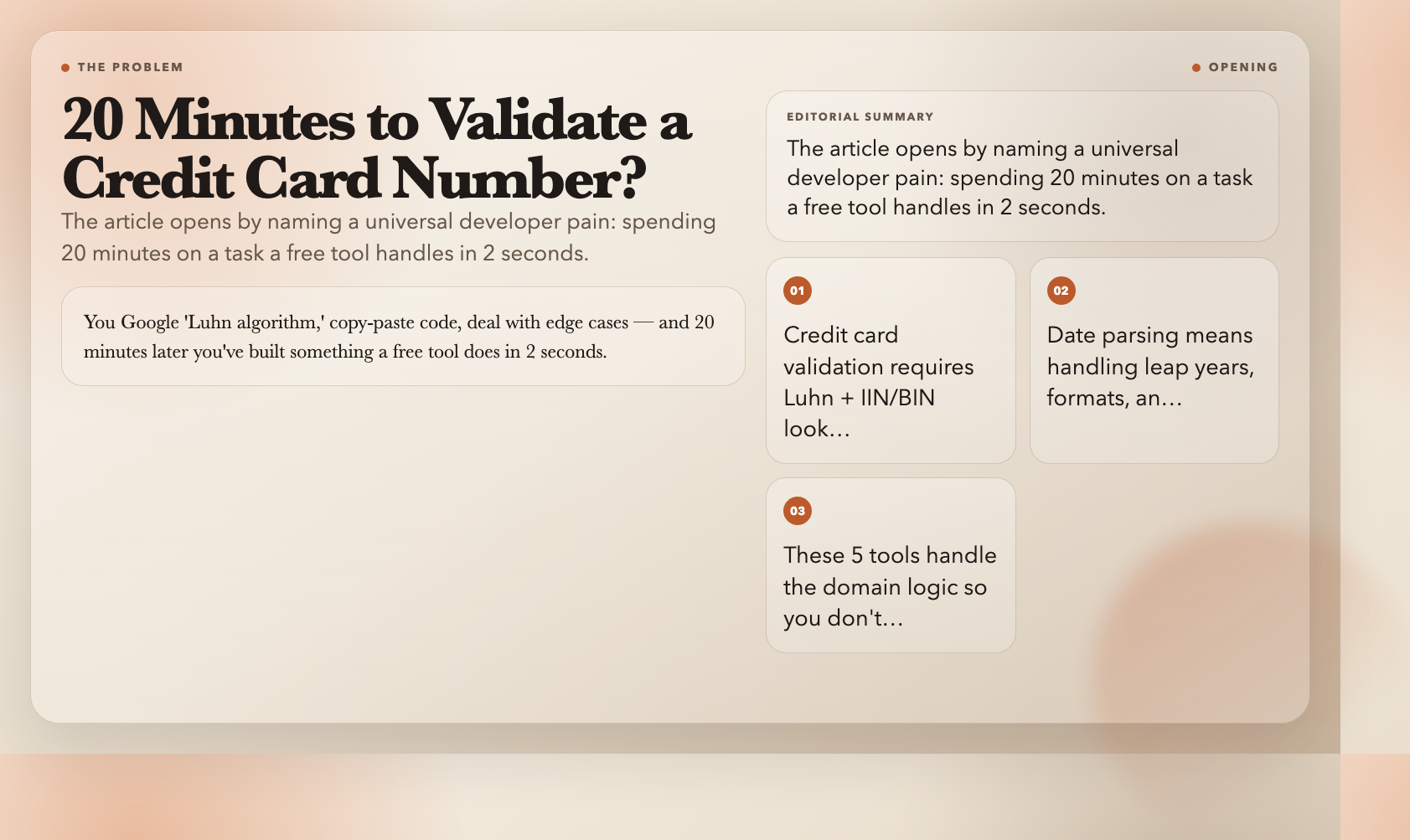
That’s the gap these 5 validation tools from ElysiaTools fill. They’re fast, free, require no signup, and they go way beyond a simple regex check.
Credit Card Validator
The classic “is this card number real?” question has a specific answer: the Luhn algorithm, combined with IIN/BIN range lookup.
This tool does both. Drop in a card number and it tells you:
– Whether the Luhn checksum passes
– Which card network it belongs to (Visa, MasterCard, Amex, Discover, JCB, UnionPay, Diners Club, Maestro)
– The industry category from the first digit (MII — banking, travel, petroleum, government)
– The full breakdown: IIN/BIN, account number, check digit
You don’t need to write a single line of code for any of it.
Use it when: Building a checkout flow, validating test data, or debugging payment integrations.
Date & Time Validator
Dates are notoriously messy. Is “2024-02-29” valid? Depends on the year. Is “01/05/2024” January 5th or May 1st? Is that Unix timestamp in seconds or milliseconds?
This validator handles the ambiguity. It auto-detects the format — ISO8601, RFC2822, Unix timestamp, plain date, or time — and then parses it fully. It shows you the day of week, week number, day of year, leap year status, Unix timestamp, and relative time (“3 months ago”).
Use it when: Parsing user-submitted dates from forms, converting between formats in a data pipeline, or debugging why your date library is giving you the wrong day.
IP Address Validator
Checking if an IP address is valid sounds trivial until you need to validate IPv6, handle CIDR notation, and distinguish between private, public, and multicast ranges.
This tool handles all of it. For IPv4 and CIDR blocks, it calculates the network address, subnet mask, broadcast address, and available host count. For IPv6, it shows the full expanded form, compressed form, prefix length, and scope (link-local, unique local, multicast, or global). It also classifies each address by type.
Use it when: Validating firewall rules, parsing server logs, configuring network ACLs, or building access control logic.
Color Code Validator
If you’ve ever spent 10 minutes trying to figure out why `hsl(360, 100%, 50%)` looks wrong — it’s because HSL hue wraps at 360, not 100 — you know color format validation is its own can of worms.
This validator recognizes 8 different formats: hex short (#FFF), hex long (#RRGGBB), hex with alpha (#RRGGBBAA), RGB, RGBA, HSL, HSLA, and named colors. For each valid input, it shows the full component breakdown and converts to other formats on the spot.
Use it when: Debugging CSS color values, validating design tokens, processing exported color palettes, or converting between formats for different rendering contexts.
Strong Password Validator
Most password “strength” checkers just count characters and call it done. This one scores on three dimensions: length, complexity, and character variety. It reports a 0–100 strength score, breaks down which requirements pass or fail, shows your character composition, flags common patterns (qwerty, password, 123456), and suggests improvements.
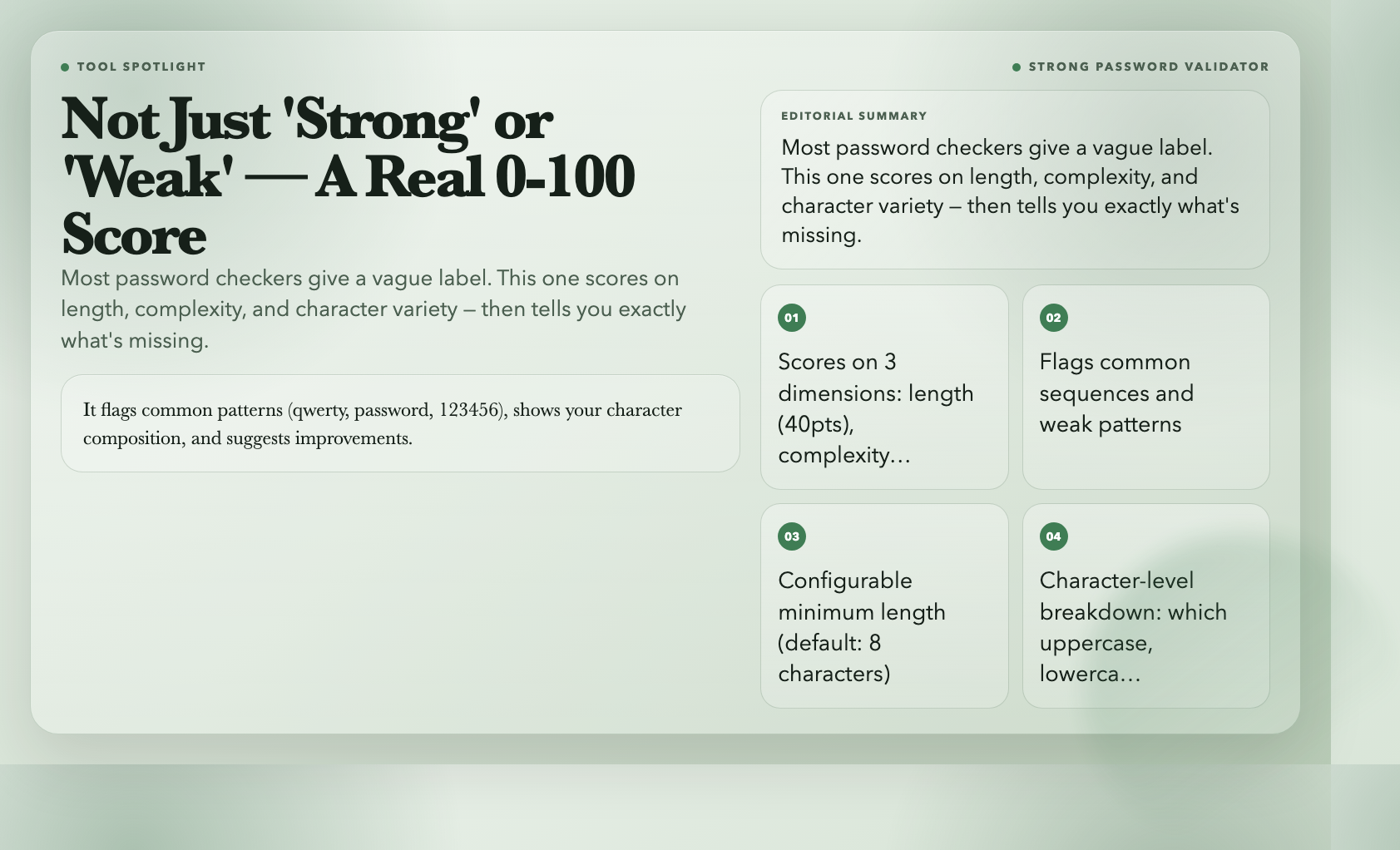
The default minimum length is 8 characters, but you can configure it.
Use it when: Validating password policy compliance, auditing existing user passwords, building registration flows, or testing password generators.
The Pattern
All 5 tools share a design philosophy: take something that requires domain knowledge (Luhn for cards, leap year rules for dates, CIDR math for networks), make it instant, and give you the full breakdown instead of just a yes/no.
No signup. No rate limits. No ads.
One thing worth noting: these tools run validation client-side in your browser. If you’re validating real user passwords or credit card data, that means nothing leaves your machine. For credit card numbers, you should still use proper payment processor libraries in production — but for quick checks and debugging, this works entirely offline.
What Validation Problem Are You Still Solving Manually?
Most teams accumulate a shortlist of “dumb checks” they do by hand or with half-finished scripts. These tools cover 5 of the most common ones. What’s the 6th one you’d want built?
Check out the full ElysiaTools library — there are over 1,600 free tools covering audio, data processing, PDF generation, developer utilities, and more.