7 Free Wellness Tools for Better Sleep and Less Stress (No App Required)
The wellness industry wants you to believe that fixing chronic stress requires expensive apps, elaborate morning routines, or expensive retreats. The research says something simpler: 90 seconds a day, consistently applied, reshapes your nervous system’s stress response more reliably than most interventions people pay for.
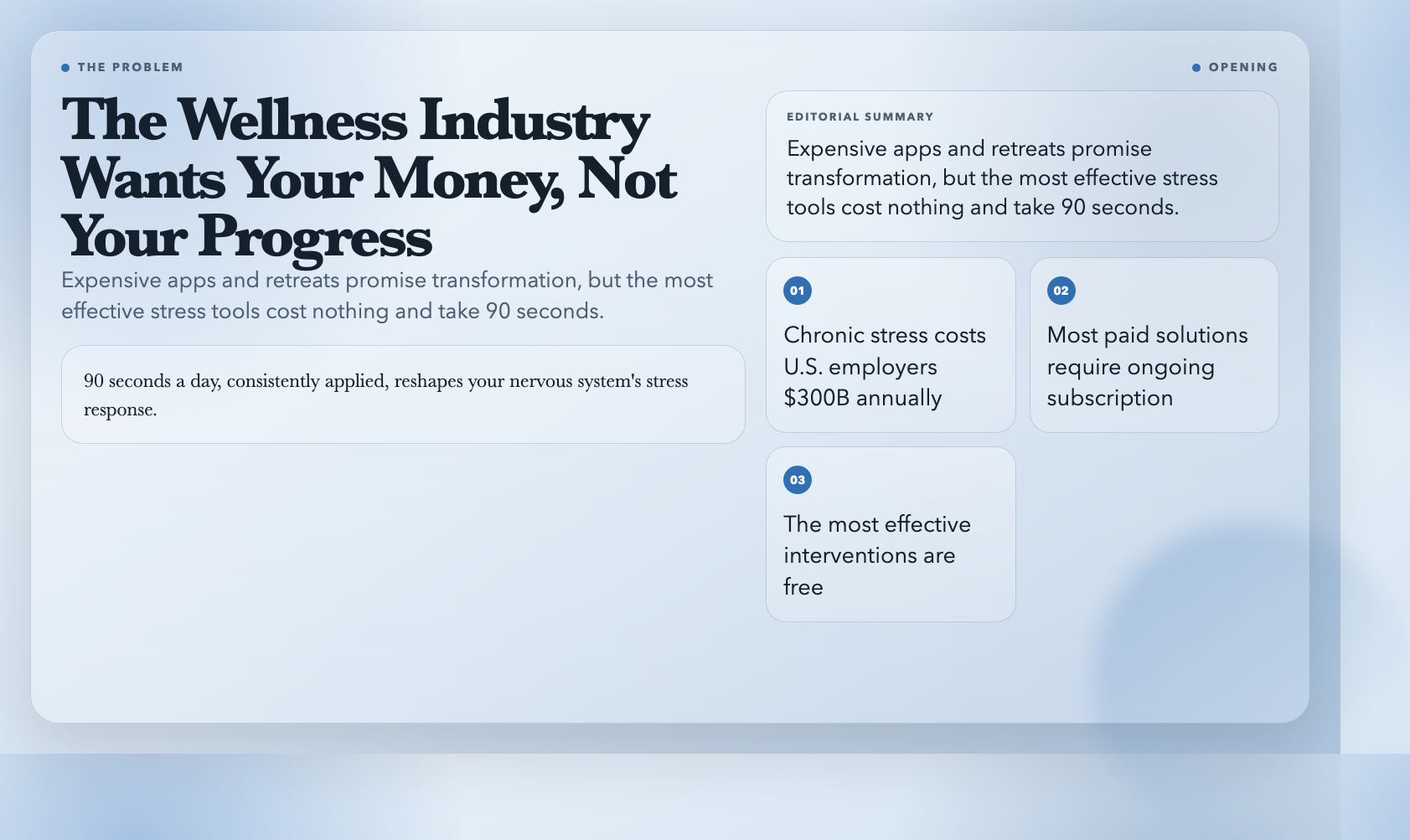
Seven free tools, built into ElysiaTools, cover the full recovery stack — from a breathing pattern for acute anxiety to a precision sleep calculator. No account, no subscription, nothing to install.
#
1. The 4-7-8 Breathing Exercise
Extended exhalation activates the parasympathetic nervous system — your body’s built-in off switch for fight-or-flight. Dr. Andrew Weil popularized this technique, but the underlying physiology is decades old and well-documented.
The practice is exact: inhale for 4 seconds, hold for 7, exhale for 8. Three to four cycles. Ninety seconds.
What happens biologically: prolonged exhalation increases vagal tone, suppresses cortisol, and slows your heart rate. Your body reads the signal as safety. After two weeks of daily use, most people fall asleep noticeably faster without using the technique as a crutch.
Use it when: Anxiety spikes before a difficult conversation, or you can’t power down after a long day.
Try the 4-7-8 Breathing Exercise tool →
#
2. Autogenic Training
Developed in the 1930s by psychiatrist Johannes Heinrich Schultz, Autogenic Training uses passive self-hypnosis to produce deep physiological relaxation. You focus on physical sensations — warmth in your hands, heaviness in your limbs — while maintaining a detached, non-striving attitude.
This isn’t visualization or positive thinking. It’s a standardized clinical protocol. In Germany, it’s covered by public health insurance for stress disorders. Research shows a 30–40% reduction in generalized anxiety after 8–12 weeks of daily practice.
After six weeks, most practitioners can reach a relaxation state within 90 seconds of starting. That alone changes what “too busy to relax” means.
Use it when: Anxiety has become a chronic pattern that breathing alone doesn’t break through.
Try the Autogenic Training tool →
#
3. Progressive Muscle Relaxation (PMR)
Edmund Jacobson developed PMR in the 1920s after noticing that anxious patients carried physical tension they weren’t consciously aware of. His solution: systematically tense and release muscle groups from feet to head, making you aware of the tension, then deliberately release it.
Physical tension and mental anxiety reinforce each other in a feedback loop. PMR breaks that loop. A 2004 meta-analysis in American Family Physician found it effective as a first-line treatment for chronic insomnia, reducing sleep onset latency by an average of 9 minutes.
The protocol: tense a muscle group for 5–10 seconds (firm, not straining), release completely, move upward. Fifteen to twenty minutes.
Use it when: Your body won’t power down at night, or you carry chronic tension in your shoulders, jaw, or lower back.
#
4. Guided Meditation Practice
Meditation isn’t one thing. The Guided Meditation Practice tool offers three evidence-based protocols, each targeting a different mechanism:
– Loving-Kindness (Metta): Compassion practice. A 2008 Journal of Experimental Social Psychology study found it reduced implicit racial bias by 23% after 8 weeks. It expands your circle of “people I care about” beyond yourself.
– Focused Attention: Breath-focused practice. Builds the attentional muscle — the ability to hold focus without being pulled away by wandering thoughts. The foundation most programs skip.
– Open Monitoring: Non-reactive awareness of whatever arises in consciousness. More advanced. Longitudinal studies link it to lasting reductions in amygdala reactivity — your brain’s fear center.
No experience needed. Choose your protocol, set your duration, and follow the guidance.
Try the Guided Meditation Practice tool →
#
5. Meditation Timer
The two decisions that kill a meditation practice: when to start, and when to stop. Both are small enough that most people never build the habit.
The Meditation Timer removes the guessing. Choose your duration, add optional background audio, and begin. No clock-watching, no early exits.
Use it when: You consistently cut sessions short, or you want ambient audio to support longer practice without checking the time.
#
6. Sleep Cycle Calculator
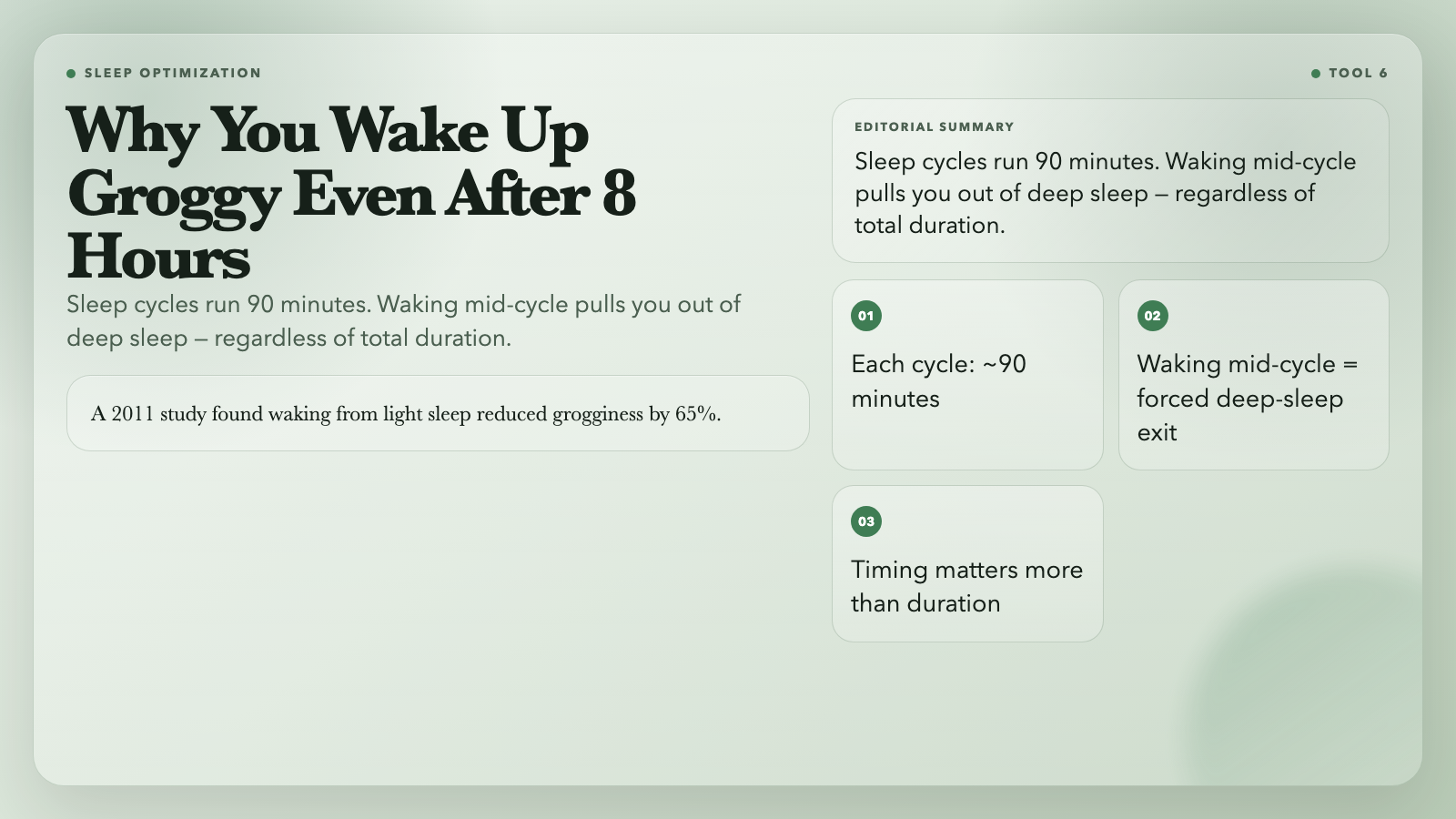
Each sleep cycle runs approximately 90 minutes. Waking mid-cycle — even after 8 hours of sleep — triggers grogginess because you’re pulled out of deep sleep. Waking at a cycle boundary feels natural regardless of total duration.
The Sleep Cycle Calculator works backward from your target wake time to show optimal bedtimes. Set a 6:30 AM wake time and it calculates 11:00 PM, 12:30 AM, and 2:00 AM as target sleep starts, based on 90-minute cycles.
A 2011 study found that waking from light sleep reduced self-reported grogginess by 65% compared to waking from deep sleep. Your morning quality depends on when you wake up, not just how long you sleep.
Use it when: You sleep 7–8 hours but wake up unrefreshed, or you want to optimize your schedule for morning alertness.
Try the Sleep Cycle Calculator →
#
7. Eye Care: The 20-20-20 Rule
Digital eye strain affects 65% of Americans, according to the Vision Council. The 20-20-20 rule offers a 20-second fix: every 20 minutes, look at something 20 feet away for 20 seconds. It resets your accommodation reflex and relaxes the ciliary muscle, which locks into sustained near-focus during screen time.
Use it when: You work at a screen for more than 2 hours a day. Set the tool’s reminder and it fires automatically.
Try the Eye Care 20-20-20 tool →
#
The Research Is Clear. Start Tonight.
Consistency outperforms intensity in almost every behavioral intervention study. One breathing cycle a day for 30 days reshapes your acute stress response more reliably than a one-week meditation retreat you attend once. That’s not optimism — that’s neuroplasticity.
The only thing between you and better sleep and less stress is the decision to do one thing, every day, for 30 days.
Start with the 4-7-8 breathing. It takes 90 seconds. You can do it tonight.