The Accidental Discovery That Proved Long-Term Weather Forecasting Is Impossible
In 1963, Edward Lorenz wanted to re-check a simulation. To save time, he started from the middle of a previous run — keying numbers in by hand instead of letting the computer work from the beginning. The computer stored six decimal places internally. The printout showed only three.
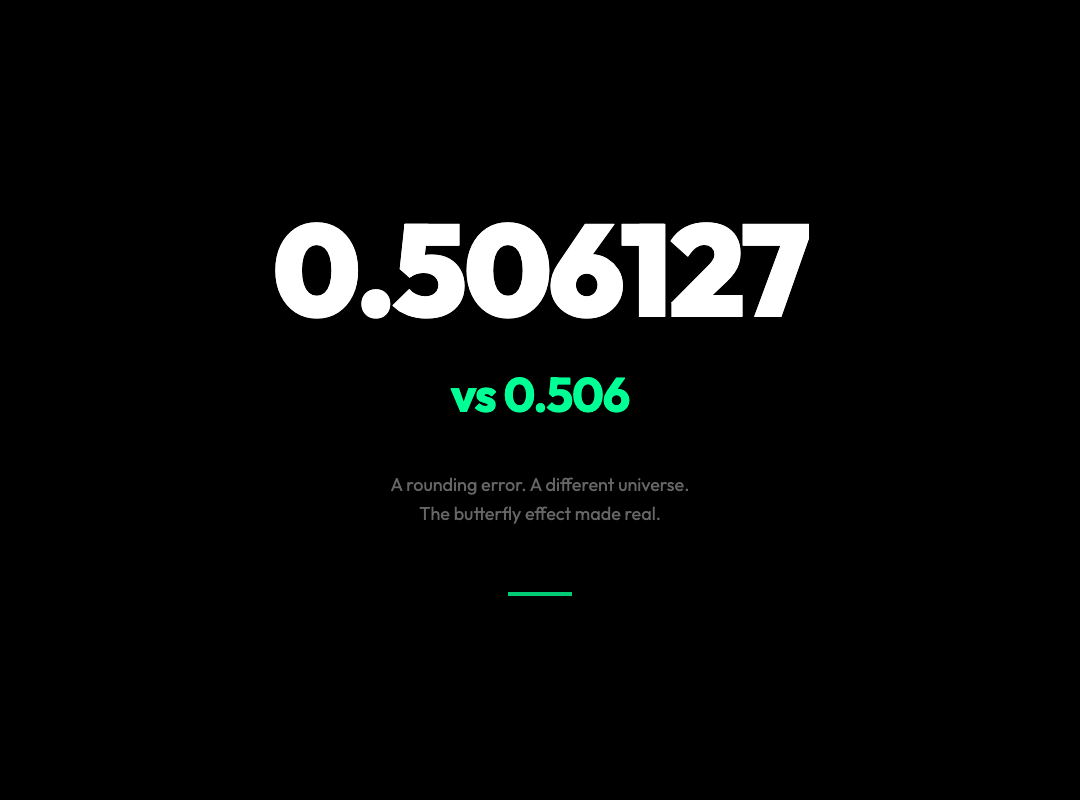
He typed in 0.506. The computer had been using 0.506127.
The difference was nothing. Point-zero-zero-one. A rounding error so small it barely registered.
Within a few model days, the two runs had diverged so completely that they looked like unrelated simulations. The same equations. The same starting conditions. One microscopic difference in the initial number.
That afternoon in a MIT computer lab broke the dominant assumption of classical physics. Lorenz had been trained to believe that determinism meant predictability. It didn’t.
This is the story of the Lorenz Attractor — the strange shape that made chaos theory impossible to ignore.
What Lorenz Found
Lorenz was modeling atmospheric convection — simplified rolls of rising warm air and sinking cool air. He stripped the physics down to three coupled differential equations:
dx/dt = σ(y – x)
dy/dt = x(ρ – z) – y
dz/dt = xy – βz
Three equations. Three variables. Almost insultingly simple for something that would upend an entire branch of science.
When you solve these equations numerically and plot the trajectory in 3D space, the orbit never crosses itself. It spirals around two interlocking wing-like structures, endlessly — but never periodically. It looks like the cross-section of a butterfly’s wings. Lorenz did not choose that shape. It emerged from the math.
Mathematicians call this a strange attractor. The trajectory is pulled toward this shape, but it never lands on a fixed point and never repeats exactly. The system is deterministic — the equations are fixed — but unpredictable. Tiny differences in starting conditions diverge exponentially fast.

The Math Nobody Believed
When Lorenz published his results in 1963 in a paper titled “Deterministic Nonperiodic Flow,” the response was mostly silence. The equations looked like a rounding artifact or a programming bug, not a fundamental discovery.
It took years for the scientific community to recognize what Lorenz had actually found: that some deterministic systems are fundamentally unpredictable over long time horizons — not because our computers are too slow, but because the mathematics itself contains an honest limit to prediction.
The mechanism is sensitive dependence on initial conditions. Two trajectories that start one ten-thousandth of a unit apart diverge at an exponential rate. In the Lorenz system, this rate is measured by the Lyapunov exponent — a parameter that quantifies how quickly information is lost as time goes forward.
Here is what that means practically: if your model of the atmosphere is off by one part in a thousand in the initial conditions — which is essentially unavoidable — your prediction becomes useless well before a week is out. This is not a limitation of measurement technology. It is a property of the mathematics itself.
The Butterfly Effect Nobody Asked For

The phrase “butterfly effect” was not Lorenz’s idea. It came later, popularized by journalist James Gleick in his 1987 book on chaos. Lorenz’s own formulation, in a 1972 talk at the American Association for the Advancement of Science, asked whether “a single flap of a seagull’s wings” could permanently alter the weather. Someone swapped the seagull for a butterfly, and the image stuck.
The core idea, though, is exactly what Lorenz found in 1963. A butterfly flaps its wings in Brazil. This changes the initial conditions ever so slightly. In a chaotic system, that infinitesimal change cascades upward through the system until the long-range prediction diverges completely from what would have happened without the flap.
The butterfly effect is often misused to suggest that small things matter in some vague, inspirational sense. The actual mathematical meaning is harsher: in a chaotic system, small perturbations do not just matter — they eventually dominate everything.
This has a counterintuitive implication. While the system is locally unpredictable, it is globally stable. The Lorenz trajectory never flies off to infinity. It stays inside a bounded region of space — the attractor — no matter where it starts. Chaos does not mean disorder. It means a specific kind of order that happens to be unpredictable.
What a Fractal Dimension Actually Means
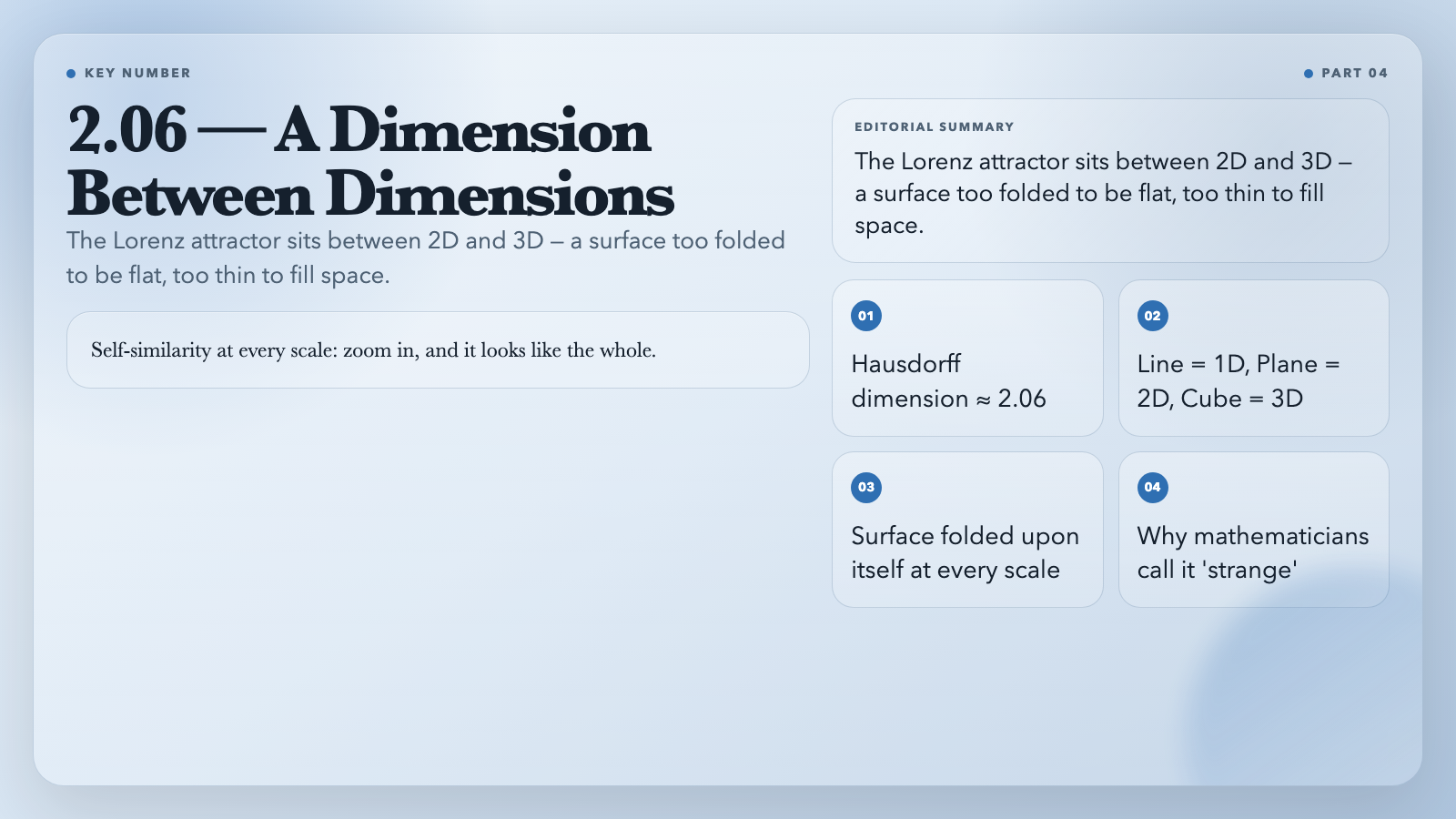
The Hausdorff dimension of the Lorenz attractor is approximately 2.06.
Sit with that number for a moment. A line has dimension 1. A flat plane has dimension 2. A solid cube has dimension 3. The Lorenz attractor sits between 2 and 3 — it is a surface that folds and folds upon itself until it has more structure than any flat sheet, but it does not fully fill the volume.
This is the fractal property: self-similarity at every scale. Zoom in on any small piece of the attractor, and it looks like a miniature copy of the whole. Zoom out, and the whole looks like a magnified piece. The same folding geometry repeats at every level of magnification.
Fractals show up everywhere in chaos — in coastlines, in heartbeats, in the electrical activity of the brain, in financial market volatility. The Lorenz attractor was one of the first places mathematicians saw fractal geometry emerge naturally from a dynamical system. Its dimension, hovering between integer values, is one of the reasons we call it “strange.”
Where This Shows Up Now
Meteorology: Lorenz’s work is the reason modern weather models run ensembles. Forecasters run many simulations starting from slightly different conditions and map the range of possible outcomes rather than predicting a single future. Every time you see a cone of probability on a weather map, you are looking at the practical consequence of chaos theory.
Chaos theory: The Lorenz system became the canonical example for understanding how order and chaos coexist. It spawned an entire field of nonlinear dynamics. Its equations are now in every introductory textbook for chaos theory.
Cryptography: The unpredictability of chaotic systems — combined with their bounded, structured geometry — makes them useful for generating pseudo-random sequences. Several encryption schemes exploit the fact that reverse-engineering a chaotic trajectory without knowing the exact initial conditions is computationally intractable.
Art and design: The Lorenz attractor shows up in generative art, music visualization, and sculpture. The shape is mesmerizing — organic in appearance but rigidly mathematical in origin. There is something compelling about an object that looks like it was drawn by nature but was computed from three lines of calculus.
The Deeper Point
Lorenz did not set out to prove that the world was unpredictable. He was trying to understand the weather. He stumbled onto the attractor because he refused to dismiss a result that did not match what he expected. Instead of calling it a bug, he followed it.
The shape he accidentally drew — the butterfly-wing attractor that sits on the boundary between dimensions, never repeating, always folding inward — is one of the most important pictures in modern science. It sits at the intersection of calculus, geometry, and physics, and it reminds us that deterministic rules can produce outcomes no amount of computation can reliably predict.
We live in a world that is increasingly sensitive to initial conditions. Financial markets, social networks, global supply chains — these are all, in the technical sense, chaotic systems. Small perturbations cascade. Long-range prediction is genuinely hard.
The flap of a butterfly’s wings always matters. The only question is whether you are watching the wings — or pretending they don’t exist until the tornado is already on the ground.
Explore the Lorenz Attractor interactively at ElysiaTools