8 Free Health Calculators That Reveal What Your Next Checkup Won’t
Your doctor says you’re fine. You go home and Google “how many calories do I actually need” — and get 14 contradictory answers.
The uncomfortable truth: the numbers that predict your health trajectory — BMI, body fat percentage, basal metabolic rate — have been calculated the same way for decades. The science isn’t controversial. Most people only encounter these numbers after something goes wrong.
Eight free browser-based tools close that gap. No appointment. No waiting room. Just your actual numbers, understood.
1. BMI Calculator — The Gatekeeper Metric Everyone Misuses
The Body Mass Index formula (weight in kg ÷ height in m²) was invented by Belgian mathematician Adolphe Quetelet in 1832. It’s been called “obsolete” by athletes, bodybuilders, and the British Medical Journal in equal measure. Critics argue it doesn’t distinguish between muscle and fat — and they’re right that it’s an imperfect proxy.
But here’s the practical reality: a 2017 meta-analysis of 30 studies and 4 million adults found that Grade 1 obesity (BMI 30–35) was associated with a 45% higher risk of cardiovascular death than normal BMI. A 2021 study in *JAMA Network Open* showed BMI correctly predicted cardiovascular risk in 74% of cases — better than waist circumference alone.
The ElysiaTools BMI Calculator doesn’t just return a number. It maps your result against WHO categories and gives you a category recommendation. This means you know not just *what* your BMI is, but *what it likely means* — and you can act before your next physical.
Use it when: You’re tracking weight changes and want a quick baseline. A BMI above 25 correlates with increased cardiovascular risk. Below 18.5, and nutritional deficiencies become a concern.
2. BMR Calculator — The Number That Explains Why Two People Eat the Same But Don’t Gain the Same
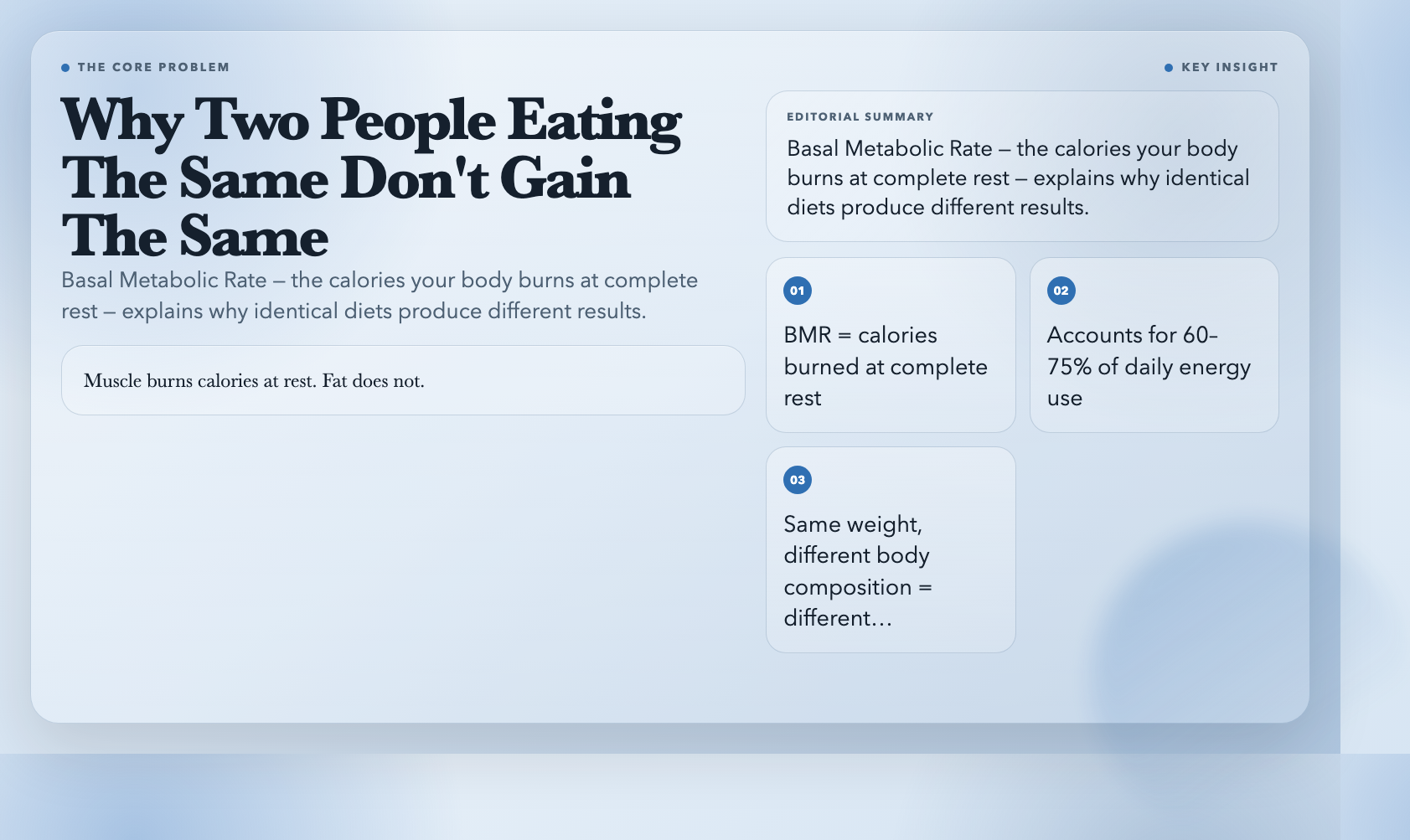
Your Basal Metabolic Rate is the calories your body burns at complete rest — the minimum energy your organs need just to keep you alive. It accounts for roughly 60–75% of your total daily energy expenditure.
The Mifflin-St Jeor equation, used by most modern BMR calculators (including ElysiaTools), was published in 1990 and found to be the most accurate of 11 tested formulas in a 2005 study published in the *American Journal of Clinical Nutrition*.
Two people can eat 2,000 calories a day. One gains weight. One doesn’t. BMR explains why — not as a personality quirk, but as biochemistry. A 180-pound man at 15% body fat might have a BMR of 1,750 calories. Swap that fat for muscle at the same weight, and the number climbs because muscle burns calories at rest while fat does not.
Once you know your BMR, you can layer in activity to get your true daily needs — and understand why your diet isn’t working. Stop guessing at portions. See the metabolic reality underneath.
Use it when: You’ve been eating “the same as always” but your weight is changing. Or when you’re planning a cut or bulk and want real numbers instead of wishful thinking.
3. Blood Type Calculator — The Genetic Question Your Family Tree Can’t Answer Alone
Most people learn their blood type only during a hospital visit. But blood type isn’t just for emergencies — it influences nutrient absorption, stress response, and which gut bacteria thrive in your system. Type O individuals, for instance, tend to have lower levels of certain clotting factors, which may explain why Type O is associated with a lower risk of coronary heart disease in some populations.
The ElysiaTools Blood Type Calculator works backwards from genetics: enter both parents’ blood types, and it returns the possible blood types for their children, including ABO and Rh factor combinations.
This isn’t just a genetics puzzle. It tells you whether your children could have a different type than either parent — which matters for pregnancy planning and neonatal care. If a mother is Rh-negative and her baby is Rh-positive, the mother may develop antibodies against the baby’s blood cells. Knowing in advance changes how doctors manage the pregnancy.
Use it when: Planning a family and wanting to understand the genetic possibilities. Or settling a family argument about whose type everyone “must have.”
4. Body Fat Calculator (US Navy) — The Number Your Scale Lies About
A scale tells you weight. It doesn’t tell you composition. This isn’t a philosophical point — it’s a practical one. Consider: a 5’10”, 200-pound man at 25% body fat has roughly 50 pounds of fat on his frame. Drop to 15% body fat at the same weight, and the scale barely moves. But his waist circumference shrinks, his energy improves, and his cardiovascular risk profile changes meaningfully.
The US Navy Body Fat Calculator uses circumference measurements — neck, waist, hip — along with height to estimate body fat percentage. It’s the same method the US military has used for decades because it’s reproducible and doesn’t require calipers or bioelectrical impedance equipment. The formula was developed by Hodgdon and Beckett in 1984 and validated against hydrostatic weighing (the gold standard) with correlation coefficients above 0.9.
This gives you a number that actually correlates with health outcomes. Not a goal weight — a body composition target.
Use it when: You want to track fat loss independent of scale weight. Men and women use different formulas because fat distribution patterns differ — the tool handles this automatically.
Body Fat Calculator (US Navy) →
5. Body Adiposity Index Calculator — When BMI Gets You Wrong
The Body Mass Index formula was designed for population-level studies. It wasn’t designed for the person who goes to the gym three times a week.
If you’re muscular or athletic, BMI consistently categorizes you as overweight or obese despite low body fat. This isn’t hypothetical — it happens to professional athletes routinely. LeBron James has a BMI of 27.5, which technically puts him in the “overweight” category.
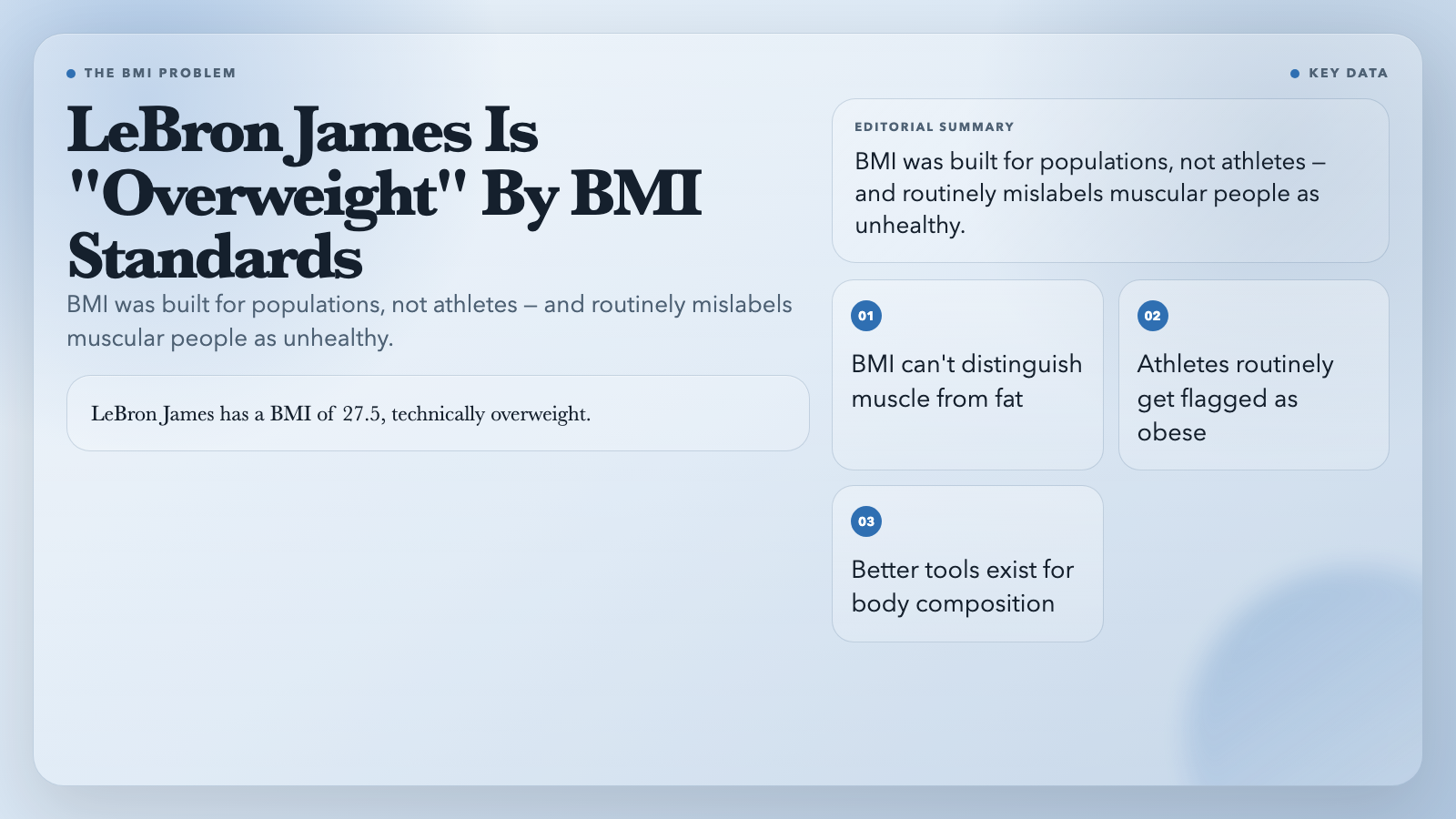
The Body Adiposity Index (BAI) takes a different approach. It estimates body fat percentage using hip circumference and height — no scale required. The formula was developed by Bergman et al. in 2011 specifically to account for the fact that hip-to-height ratio correlates differently with body fat than weight-to-height ratios. It often tells a different, more accurate story for people BMI mislabels.
Use it when: You’re muscular or athletic and want a body composition estimate that doesn’t treat your muscle as a problem.
Body Adiposity Index Calculator →
6. Calorie Burned Calculator — The Reality Check That Makes Dieting Honest
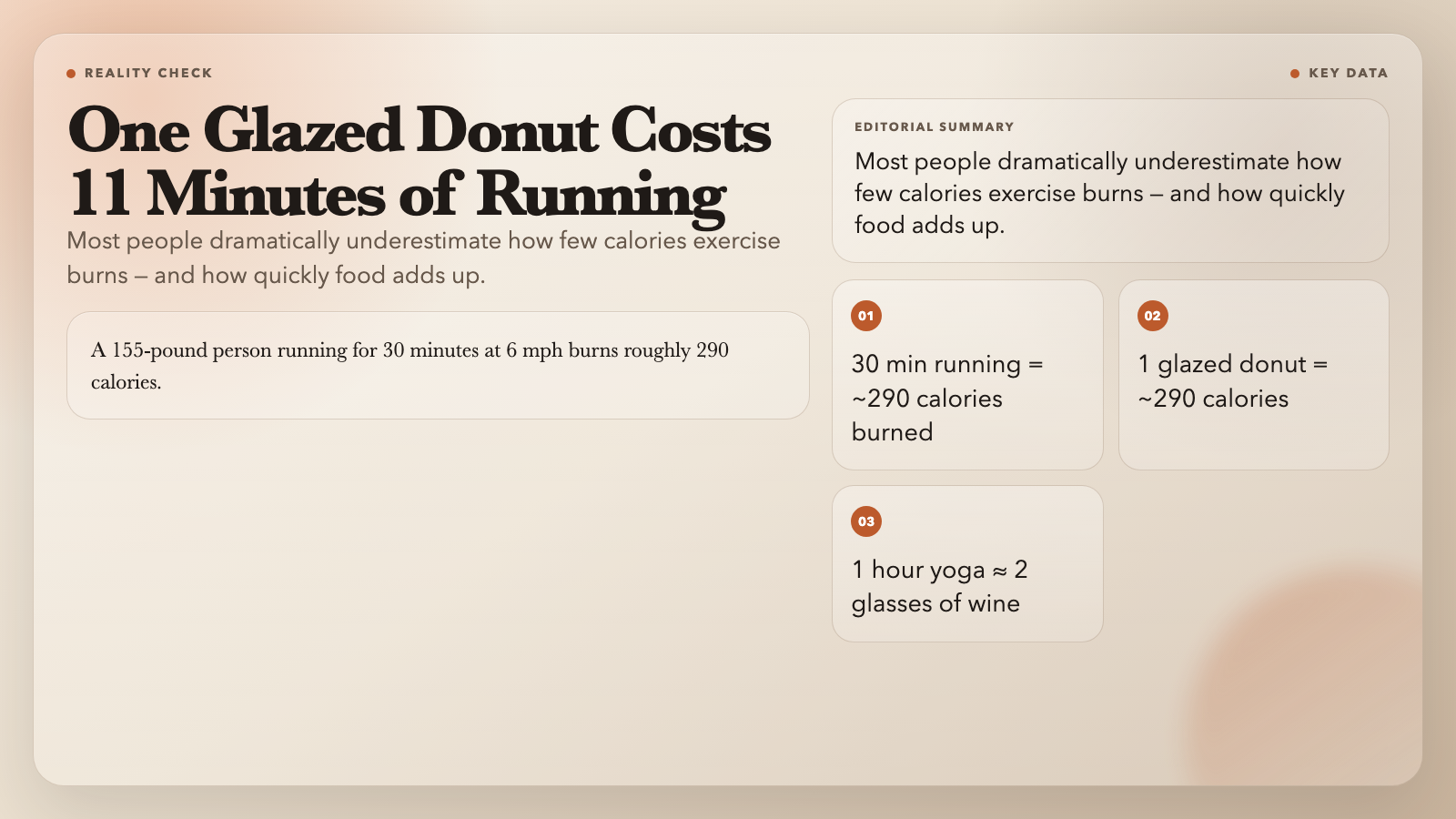
Most people dramatically underestimate how many calories they burn. A 155-pound person running for 30 minutes at 6 mph burns roughly 290 calories. That’s about 11 minutes of running to offset a single glazed donut. A typical hour of yoga? Around 180 calories — roughly the same as two glasses of wine.
The ElysiaTools Calorie Burned Calculator covers a wide range of activities — running, swimming, cycling, gardening, housework, even sleeping. Sleep burns roughly 400–500 calories per night for an average adult. Input your weight, activity, and duration, and it returns an estimated burn.
This means you can actually audit your day. Walked 40 minutes, cleaned the apartment for 30, chased a toddler for two hours — the calculator adds it up. Pair with a food diary, and the math of weight loss or gain suddenly makes sense.
Use it when: You’re trying to create a calorie deficit but don’t know what your “burn” actually is. Or when you want to know exactly how much running it would take to offset that dessert.
7. Daily Calorie Needs Calculator — The Tool That Ends the Guesswork
BMR tells you what you burn at rest. TDEE (Total Daily Energy Expenditure) tells you what you burn when you add movement, work, and life on top of that.
The ElysiaTools Daily Calorie Needs Calculator takes your BMR and multiplies it by an activity factor to give you your real daily requirement. Then it lets you set a goal — lose, maintain, or gain — and tells you exactly how many calories to target.
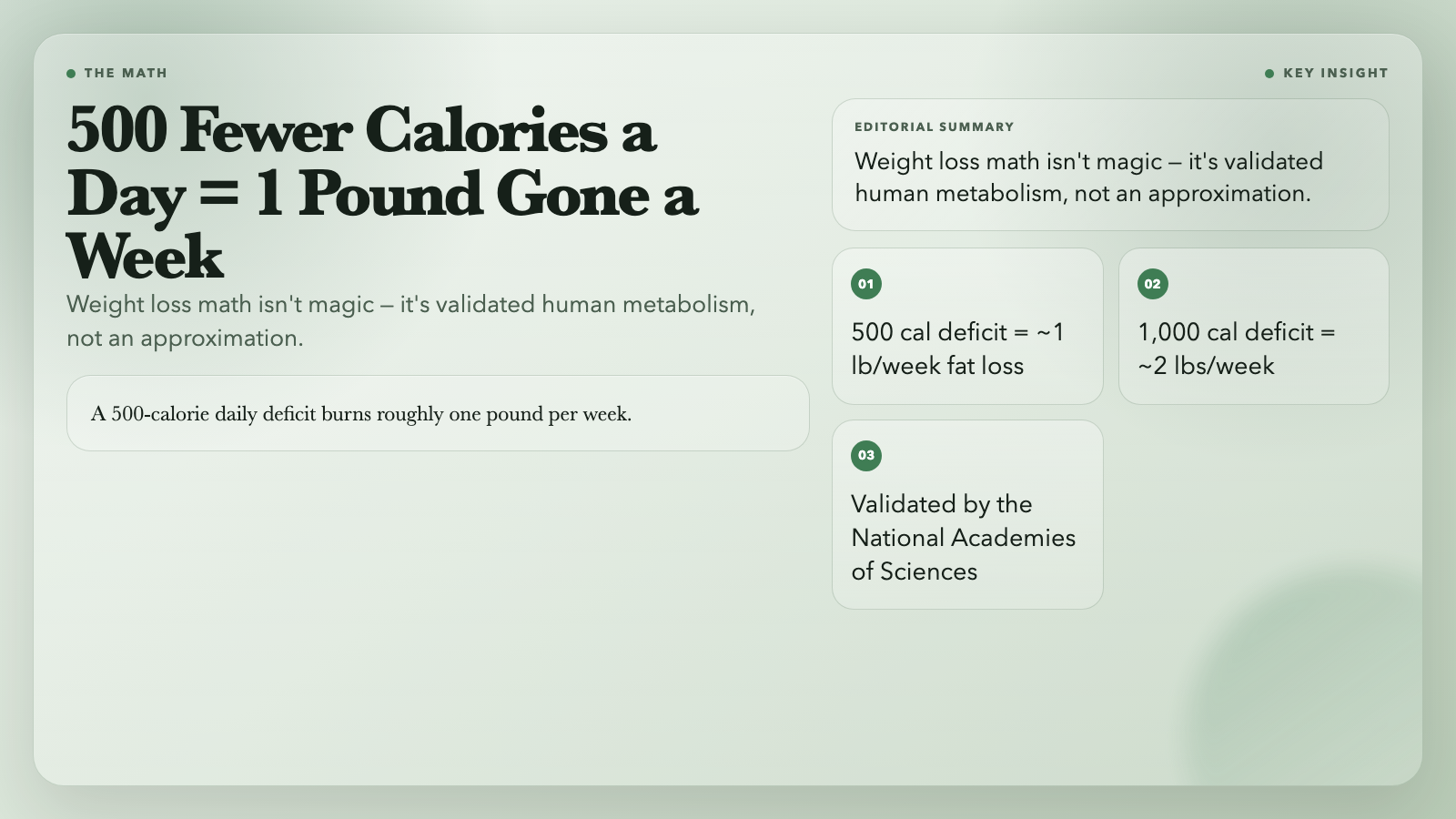
Here’s the math that makes it actionable: a 500-calorie daily deficit burns roughly one pound per week. A 1,000-calorie deficit burns two. These aren’t approximations — they’re the math of human metabolism, validated by the National Academies of Sciences. A 4-week experiment with real numbers tells you more than 4 months of intuitive eating.
Use it when: You’re ready to stop improvising and start running an experiment with your body. Input real numbers. Hit your target. Measure after 4 weeks. The data doesn’t lie.
Daily Calorie Needs Calculator →
8. Due Date Calculator — Because “9 Months” Is Vague in Exactly the Wrong Way
Pregnancy is tracked in weeks, not months. Every ultrasound, every screening, every prenatal test is scheduled relative to your due date. Getting it right matters — and the standard “9 months” framing is off by weeks in both directions.
The ElysiaTools Due Date Calculator gives you a precise estimated due date based on either your last menstrual period (LMP) or your conception date. It uses the standard 280-day (40-week) assumption used by obstetricians worldwide. The LMP method is the standard clinical approach because most women know their LMP date more reliably than their ovulation date.
Knowing your due date isn’t just exciting — it’s the reference point for every decision your OB will walk you through. Timing of first trimester screenings. Glucose tolerance testing at 24–28 weeks. Maternity leave planning. These are scheduled in weeks, not months.
Use it when: You’ve confirmed a pregnancy or are planning one. The first ultrasound will refine the estimate, but having a starting point helps you track milestones and prepare logistics.
The Pattern: These Numbers Run Whether You’re Watching or Not
Your BMI, BMR, body fat percentage, and daily calorie needs are variables in your body’s equation. The math runs whether you’re tracking it or not.
Most people only engage with these numbers after a doctor orders bloodwork, or after a scale crossing a threshold finally prompts action. By then, patterns that were visible months or years earlier have had time to compound.
These 8 calculators don’t replace medical care. But they give you the same numbers your physician uses — in a format you can access on your own timeline, as often as you want, for free.
The question isn’t whether your body is running the calculation. It’s whether you’re paying attention to the result. Check in quarterly. Your numbers will change, and that change is information.
*All tools are free, browser-based, and require no account.*