A stock moves 2% and your option gains 1.50.Anotherday,samemove,sameoption—itgains0.10. Same direction. Different result. If you’ve traded options long enough, this has happened to you. If you’re new, it will.
Most people blame the market. The real answer is five numbers that live inside every option contract: Delta, Gamma, Theta, Vega, and Rho — collectively called the Greeks. They don’t trade on exchanges. They don’t appear on your broker’s app. But they determine exactly how much money you make or lose on every trade.
Delta: Direction Is Everything
Delta measures how much an option’s price changes when the underlying stock moves $1.
A call option with a delta of 0.50 behaves like 50 shares of stock. If the stock rises 1,theoptiongainsabout0.50. A deep in-the-money call might have a delta of 0.90 — it moves almost lockstep with the stock. A far out-of-the-money call might be 0.05 — it barely notices.
Delta also has a second life: it’s the probability that an option expires in the money. A 0.50 delta call is roughly a 50% chance of finishing profitable. This dual meaning makes delta one of the most intuitive Greeks.
For direction trades — bets on which way a stock will move — delta is the primary tool. You want exposure without paying for a full position? A 0.40 delta call gives you 40% of the stock’s move at a fraction of the cost.
Gamma: When Direction Becomes a Moving Target
Delta sounds simple, but it changes. That’s what Gamma measures: the rate of change of delta itself.
Think of driving. Speed is delta — your position relative to time. Acceleration is gamma — how fast your speed itself is changing. A car going 60mph is one thing. A car going 60mph and accelerating hard is something else entirely.
Options near the strike price have the highest gamma. They’re the ones where delta is most unstable — a small stock move flips them from 0.49 to 0.51, completely changing your directional exposure. This is why short-dated options near expiration become volatile even if the stock barely moves: gamma is high, delta is swinging wildly.
Traders who sell options (collecting premium) love high gamma. Traders who buy options hate it — they’re paying for directional exposure that evaporates the moment they get it.
Theta: The Silent Drain
Every day you hold an option, it loses time value. Theta measures exactly how much.
Long options are a decaying asset. You’re not just betting on direction — you’re fighting a slow leak. A one-month option might lose 5% of its remaining value per week, even if the stock goes nowhere.
This is why cheap options are often cheap for a reason. A 0.50callona30 stock with six months to expiry might look like a bargain. But theta is quietly burning that $0.50 toward zero regardless of what the stock does. The stock needs to move and move fast enough to outrun decay.
A concrete example: an at-the-money one-month option might have a theta of –0.05perday.That′s0.05 lost every single day, compounding. Hold it for 10 days and you’ve lost 0.50ona3.00 option — 17% of its value gone to decay alone, before the stock moves at all. Time is always working against the option buyer.
Vega: Volatility Is the Real Engine
Most beginners focus on direction. Most experienced traders focus on volatility.
Vega measures how much an option’s price changes when implied volatility moves 1%. And this is often the dominant driver of option prices — bigger than the stock’s actual movement.
Here’s why. An option is worth something because it might move a lot before expiry. If a stock is calm and predictable, there’s not much value in the right to buy it at a fixed price. If the same stock is volatile — earnings coming, a lawsuit, a product launch — that right becomes expensive.
This is why options around earnings get so expensive. Implied volatility rises before the announcement because the market is pricing in a big move. After earnings, whether the stock goes up or down, the uncertainty is resolved and vega collapses. The option loses value even if you predicted the direction correctly. This is the “vol crush” that catches new traders every earnings season — they bought the call because they were right about direction, but the stock’s move wasn’t big enough to offset the vol collapse.
Understanding vega means understanding that options are, in part, volatility bets — not just direction bets.
Rho: The Interest Rate Greek
Rho is the least-discussed Greek, but it matters in a specific environment: rising interest rates. Higher rates make calls more expensive (the strike price paid in the future is worth less today) and puts cheaper (cash becomes more attractive relative to fixed assets). In 2022, as the Fed raised rates from near-zero to over 4%, options traders who ignored rho were systematically wrong on long-dated positions by a small but consistent margin. For short-dated options near zero, it’s nearly irrelevant. For five-year options, it can move the needle.
The Dashboard in Action
The five Greeks aren’t independent. They interact. A trade that’s good on delta can be terrible on theta. A position that profits from volatility crush is underwater if the stock moves fast your direction.
The best traders read all five simultaneously, like a pilot reading five instruments at once. They know that a long-dated, far-from-the-money call has high vega (great if vol spikes), high theta drag (bad if you’re wrong), and low delta (you need a big move).
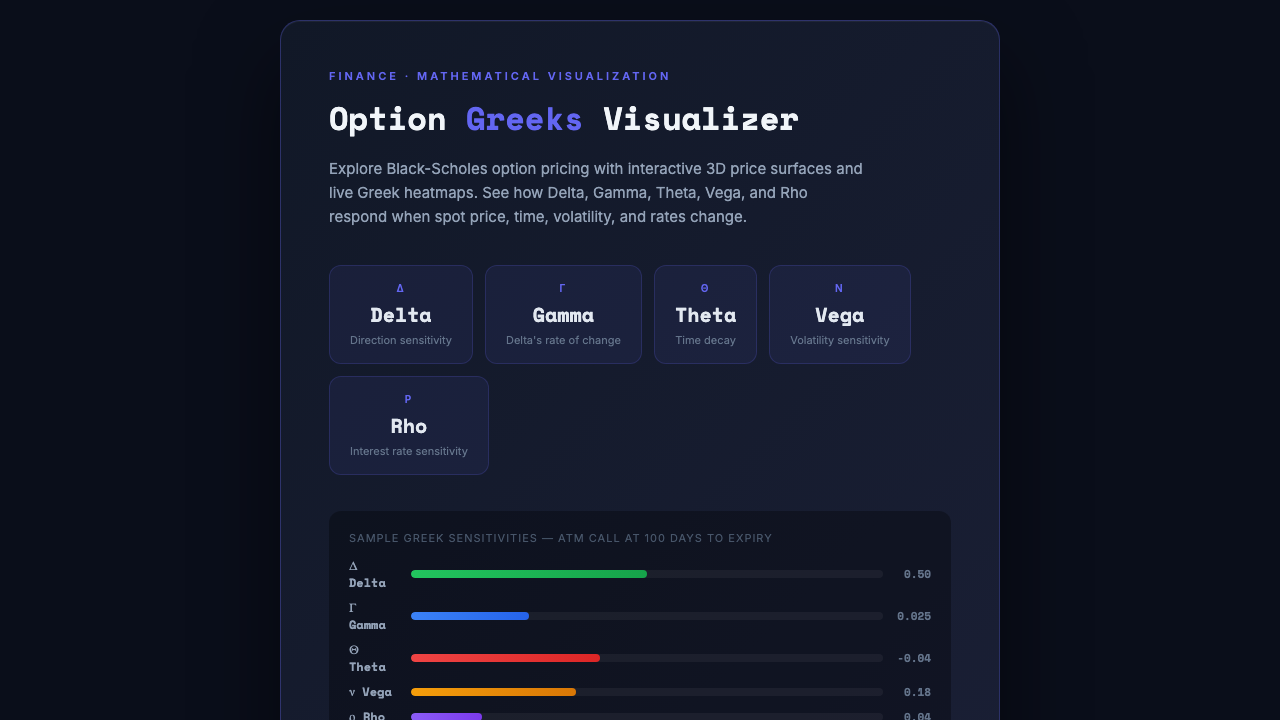
The Option Greeks Visualizer on ElysiaTools lets you play with all five simultaneously. Drag spot price, time, volatility, or interest rates and watch every Greek respond in real time. The 3D price surface shows you the shape of option value across the full parameter space — a view that makes abstract formulas tangible.
This is how intuition gets built. Read about gamma for an hour, or watch it spike when you slide an option to the money and understand it in thirty seconds.
Why This Matters Beyond Trading
Options aren’t just for traders. Anyone working with contracts, compensation packages, or structured deals implicitly deals with option-like payoffs. An employee with a two-year vesting schedule holds an option on their company’s value. A startup negotiating an acquisition structure is negotiating options.
Understanding the Greeks builds intuition for any asymmetric payoff — which is most interesting deals. The same math that governs an SPX option governs the strike price on a warrants clause in a term sheet.
The visualizer makes this accessible without requiring a quant background. Move sliders, watch numbers change, and develop a feel for why the curve looks the way it does.
This article was published as part of the ElysiaTools developer advocacy program. All tools mentioned are free to use at https://elysiatools.com.