Why 50,000 Fireflies Suddenly Blink Together
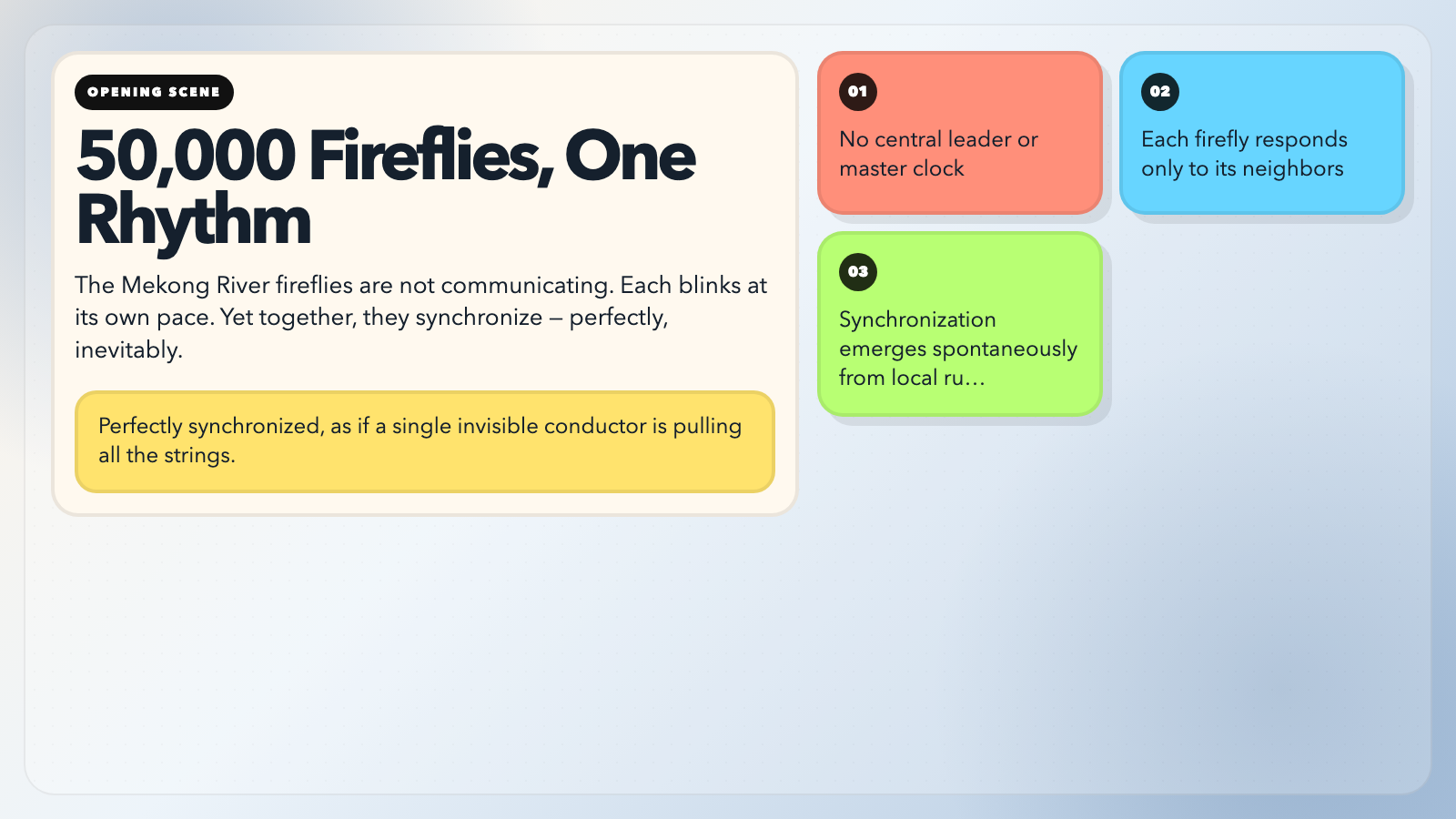
Every June evening along the Mekong River, tens of thousands of fireflies collect in the mangrove trees — and begin blinking in unison. Not mostly aligned. Not approximately synchronized. Perfectly synchronized, as if a single invisible conductor is pulling all the strings.
For centuries this was filed under “curious natural phenomena.” Then, in 1975, Japanese physicist Yoshiki Kuramoto proved it required almost nothing to happen.
The Counterintuitive Discovery
Here is what makes the Mekong fireflies so remarkable: the individual insects are not communicating with each other. Each has its own rhythm, its own internal clock, slightly faster or slower than its neighbors. Yet when you place enough of them together, collective synchronization emerges — spontaneously, reliably, inevitably.
This defies ordinary intuition. Mix a room of people walking at different paces and you expect chaos. But Kuramoto proved mathematically that for weakly coupled oscillators with diverse natural frequencies, the opposite can occur. Weak coupling does not cancel out. It recruits.
Each oscillator nudges its neighbors every moment. The slow ones get sped up. The fast ones get slowed down. Over time, this gentle mutual correction pulls the entire group into lockstep. The critical ingredient is not strong coupling or identical frequencies. It is just enough connection, maintained over time.
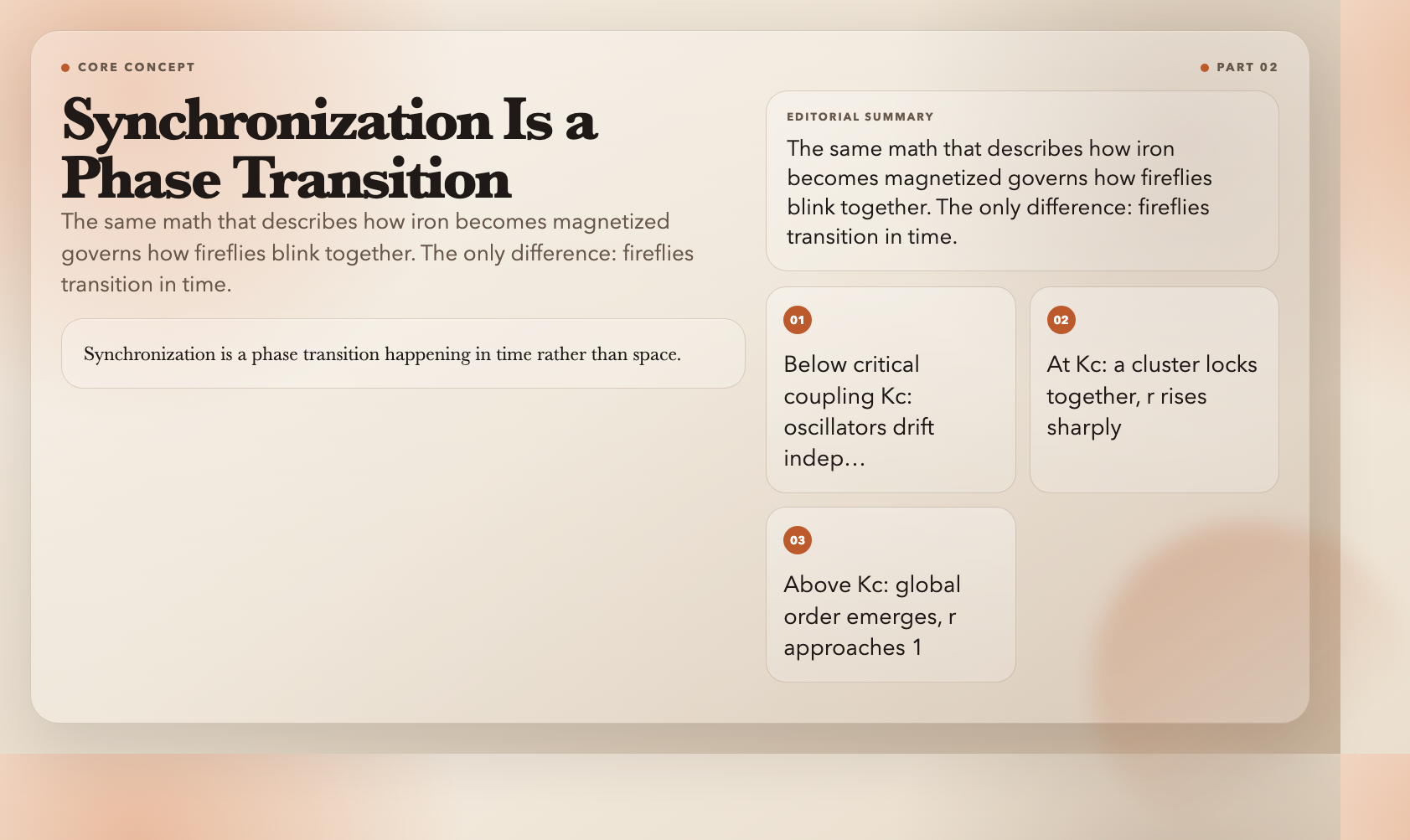
This is a phase transition — the same mathematical structure that governs how iron becomes magnetized, how water turns to steam, or why a magnet loses its magnetism above a critical temperature. Synchronization is a phase transition happening in time rather than space.
The Math That Reveals the Mechanism
Kuramoto distilled this into an equation that looks almost deceptively simple:
dθᵢ/dt = ωᵢ + (K/N) × Σⱼ sin(θⱼ − θᵢ)
Each term is doing real work:
- ωᵢ is oscillator i‘s natural frequency, drawn from a Gaussian distribution — meaning each oscillator has a slightly different preferred speed
- K is the coupling strength — how hard each oscillator pushes its neighbors toward alignment
- N is the total number of oscillators
- The sine term captures how phase differences drive mutual correction
Change K, the coupling strength, and the system undergoes a sharp phase transition. Below a critical value Kc ≈ 2Δ√(2/π), oscillators drift independently, each running to its own drummer. Above Kc, a cluster locks in. More oscillators get pulled in. The order parameter r — a number between 0 (full disorder) and 1 (full sync) — rises sharply. The mathematics of statistical mechanics, previously confined to matter and magnets, now describes clocks and fireflies.
You can watch this happen in real time at the Kuramoto Synchronization Model interactive visualization. Start with K=0 (pure disorder) and slowly increase coupling. At the critical point, you’ll see dots scattered randomly on a circle suddenly coalesce into a tight cluster. The math becomes visible.
Where This Shows Up Across the Real World
Fireflies are the photogenic case. But the same structure governs systems where synchronization has serious consequences:
Neurons in the brain. When you sustain attention on a difficult task, large cortical networks lock onto common firing frequencies — gamma oscillations around 40 Hz. These gamma waves, first measured rigorously by Singer and Gray in 1989, are now a central focus in neuroscience research on consciousness and binding. The leading theory holds that synchronization at specific frequencies is how the brain unites distributed processing into a coherent experience.
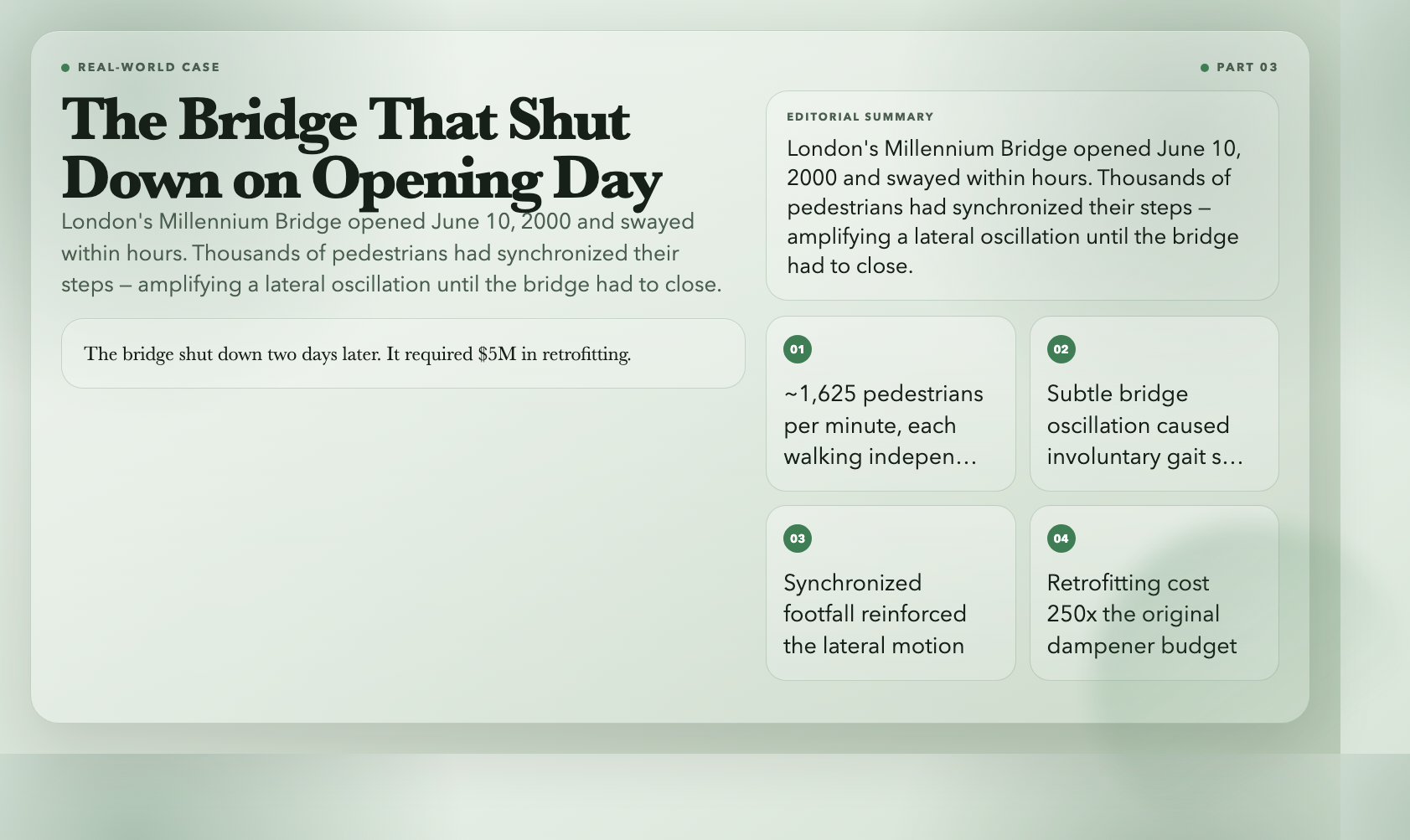
The Millennium Bridge in London. On opening day, June 10, 2000, London’s newest pedestrian bridge began swaying laterally under normal foot traffic. Researchers later determined that roughly 1,625 pedestrians per minute were walking at their own individual rhythms — until subtle lateral oscillations in the bridge caused them to involuntarily synchronize their steps, which amplified the motion, which reinforced the synchronization. The bridge shut down two days later. It required $5M in retrofitting with viscous dampers to reopen in 2002.
Superconducting Josephson junctions. When two Josephson junctions biased in parallel synchronize their quantum oscillations, they produce voltage references of extraordinary precision — accurate to within 1 part per billion. This Josephson voltage standard replaced the Weston normal cell as the international reference in 1990 and remains the basis for calibrating instruments worldwide.
The 2003 Northeast Blackout. On August 14, 2003, a cascading grid failure left 55 million people without power across the northeastern U.S. and Canada. Post-event analysis revealed that multiple generators had fallen into undesirable phase synchronization, triggering protective trips that propagated across 21 power plants and 265 power lines in under 9 minutes.
Audiences clapping after concerts. In a 2001 study published in Nature, physicists from the University of Rome measured audience applause and found it consistently self-organized into synchronized rhythmic clapping within 30 seconds — and could transition into synchronized periodic surges. The effect disappeared when people were isolated from each other’s sound.
Why This Matters Beyond the Curiosity
The Kuramoto model travels across disciplines without losing its explanatory power.
Biologists use it to understand how cardiac pacemaker cells synchronize their rhythms (your heart’s natural rhythm is a synchronization phenomenon, not a simple metronome). Neuroscientists use it to study how distributed brain regions coordinate during cognition. Engineers use it to design phased arrays of lasers and sensors. Climate scientists have found Kuramoto-like transitions in the El Niño-Southern Oscillation, where Pacific Ocean temperatures and atmospheric pressure shift between synchronized and unsynchronized states.
The model does something philosophically striking: it shows how global order can emerge from purely local rules without central control. No firefly is leading. No neuron is acting as conductor. No pedestrian is orchestrating the bridge. Synchronization arises because each element responds only to what it immediately senses — and the aggregate effect is coherent collective behavior.
This is why the model has outlasted its origins. It describes one of the most fundamental things that can happen in a complex system: order emerging from interaction, not from design.
Explore the Kuramoto Synchronization Model and watch the phase transition happen in real time. When you see the order parameter jump from chaos to chorus, you will understand why this model has outlasted its origins in statistical mechanics: it is a reminder that simple rules, applied at scale, can produce something that looks, from the outside, like a miracle.
So ask yourself: what in your world is being slowly pulled toward sync — and whether you are ready for what happens when it arrives.