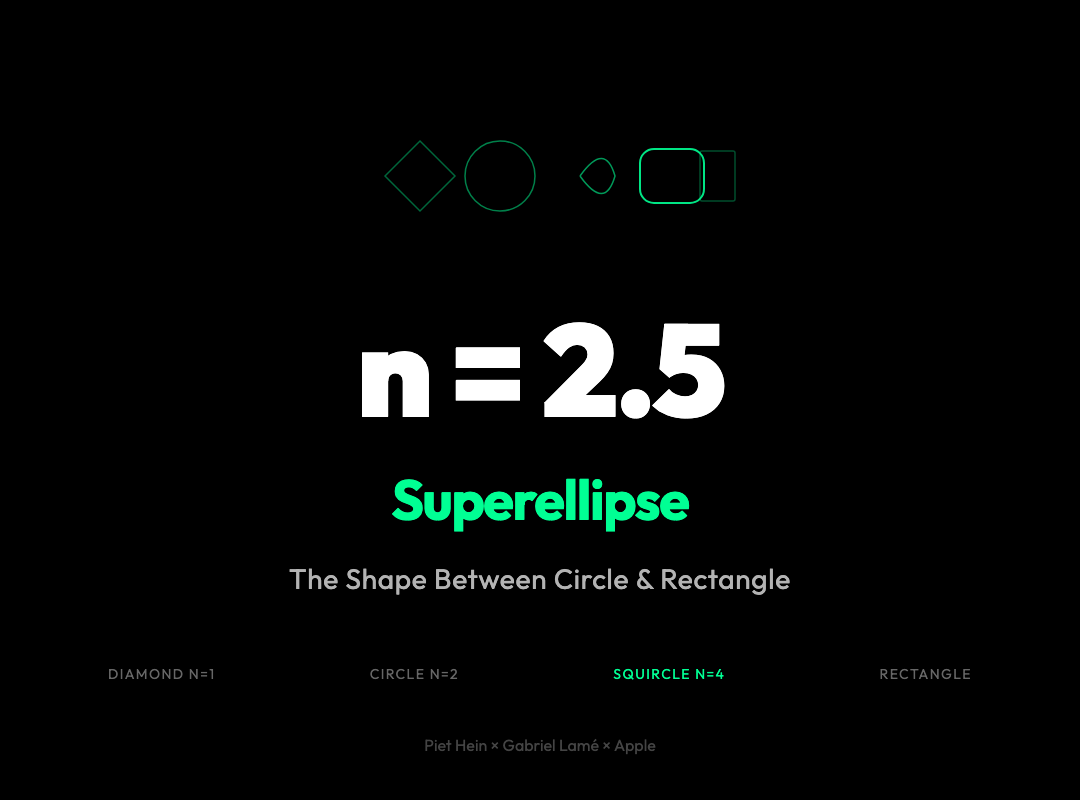
The Shape That’s Neither Circle Nor Rectangle — and That Made Both Obsolete
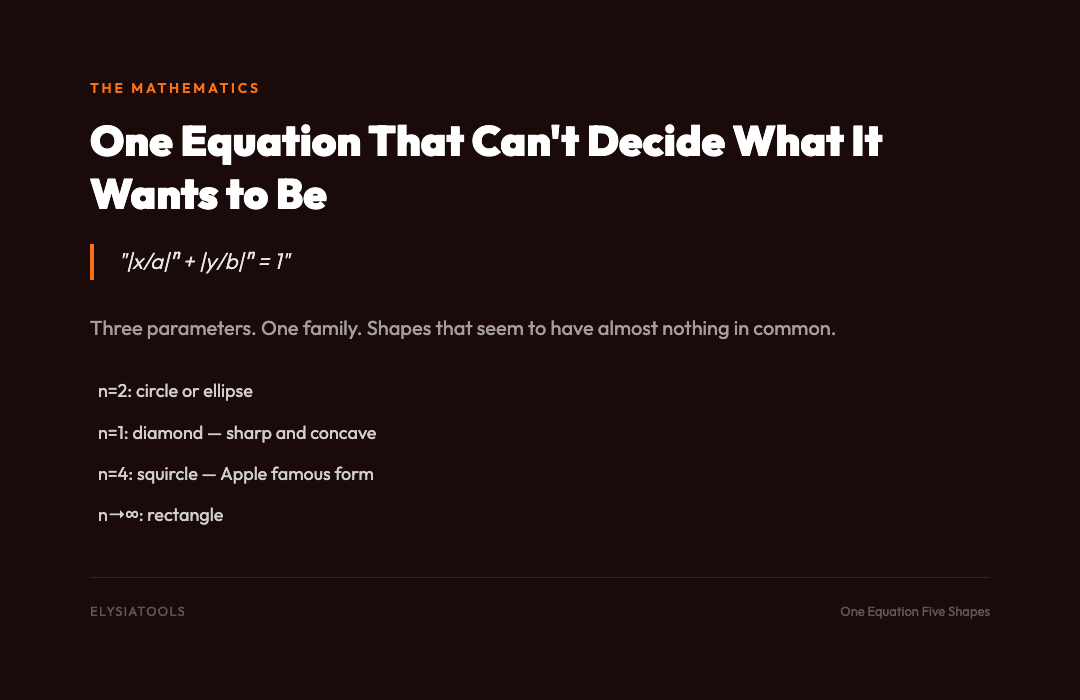
In 1959, a Danish mathematician named Piet Hein faced a problem that seemed impossibly mundane: the city of Stockholm needed a new traffic roundabout. The intersection at Sergels Torg was ugly, dangerous, and inefficient. The planners wanted a circle. Hein wanted something better.
What he proposed instead became one of the most elegant geometric forms in applied mathematics — a shape so smooth and satisfying that Apple later built its entire icon design language around it, and so versatile that it spans from urban plazas to the phone in your pocket. It is called the superellipse, or the Lamé curve.
The Equation That Changes Its Mind About What It Is
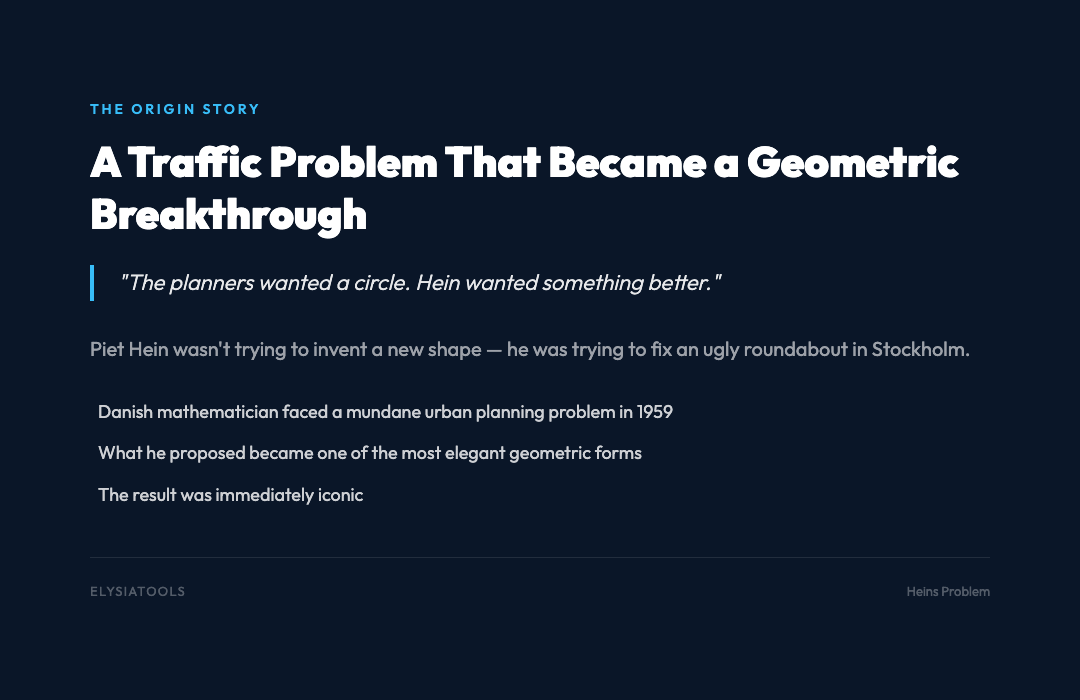
The superellipse is defined by a disarmingly simple equation:
|x/a|ⁿ + |y/b|ⁿ = 1Three parameters. That’s all it takes. And yet, depending on the value of n, this equation produces shapes that seem to have almost nothing in common with each other.
When n = 2, you get a circle — or an ellipse if a and b are unequal. Familiar. Comfortable.
Drop n to 1 and suddenly you have a diamond: four straight lines meeting at sharp corners, its concave sides pulling inward like a sail catching wind.
Push n below 1 and the shape becomes genuinely strange — star-shaped, with deeply indented sides. It looks like something a mathematician dreamed up to make designers uncomfortable.
But here is the twist: push n above 2 and watch the shape round itself out. As n grows, the corners soften. At n = 4, you get the form that made the superellipse famous: the squircle. It looks almost like a rectangle, but every corner is seamlessly, impossibly smooth. No straight line meets another at an angle. The transition is mathematically continuous.
This is not a circle. It is not a rectangle. It is a single continuous geometric family that stretches from sharp diamonds all the way to smooth rounded rectangles — and at every point along the way, it feels like a completely different shape.
Piet Hein’s Accident of Genius
Hein was not trying to invent a new geometric family. He was trying to solve a specific urban design problem: Sergels Torg needed to be visually unified, to feel cohesive without feeling boring. A regular circle would have been too static. A rectangle would have been too harsh.
He sketched. He calculated. And what he arrived at — partly by mathematical reasoning, partly by aesthetic intuition — was a superellipse with n = 2.5, stretched horizontally and vertically in a ratio of 6:5. The city planners accepted it. The result was immediately iconic.
Hein went on to apply the superellipse everywhere: tables with superelliptical tabletops, jewelry, furniture, even a now-famous bed design. He had stumbled onto something deeper than an aesthetic trend. The superellipse, it turned out, felt right to humans in a way that circles and rectangles — the shapes we had lived with for millennia — somehow did not.
Why Apple Bet Everything on the Squircle
In 2007, when Apple’s design team was creating the first iPhone interface, they faced a question of icon design. The traditional approach was to use rectangles with circular corners — a shape that was recognizable but slightly off. The transition from straight edge to curved corner was visible, almost abrupt.
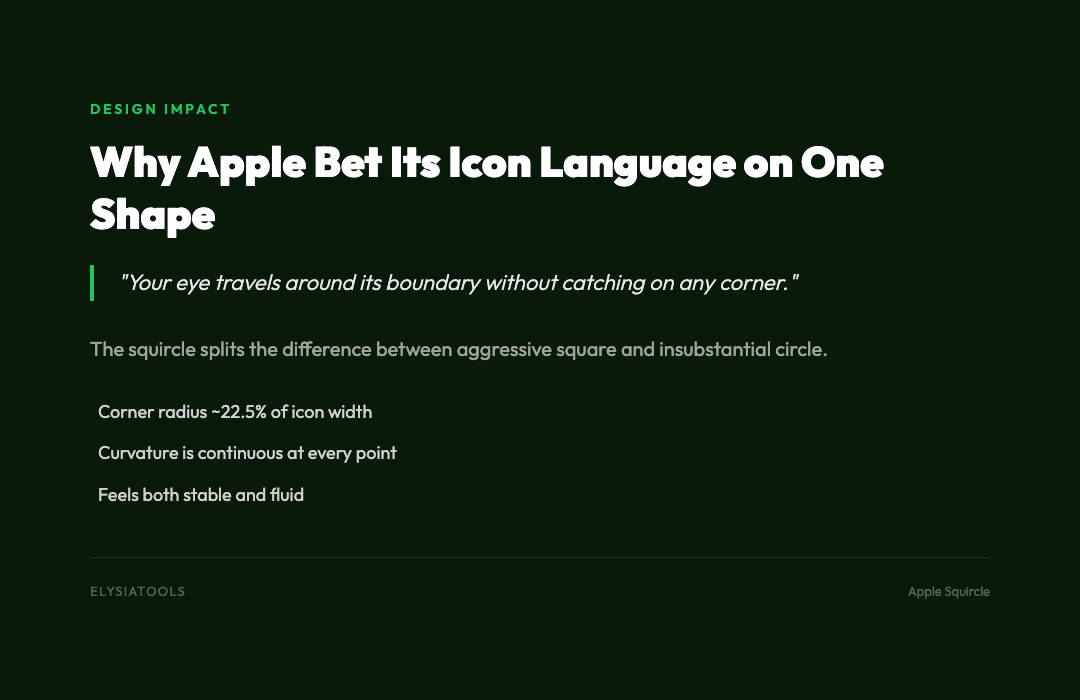
Jony Ive’s team proposed something different: the squircle, with a radius that was roughly 22.5% of the width of the icon. This was not quite a circle. It was not quite a square. But it was, somehow, exactly right.
The squircle’s advantage is perceptual. A sharp-cornered square feels aggressive. A perfect circle feels soft and insubstantial. The squircle splits the difference — it feels both stable and fluid. Your eye can travel around its boundary without catching on any corner, any angle, any discontinuity. The curvature is continuous.
This mathematical property — the continuous second derivative at every point on the curve — is what makes the squircle visually satisfying in a way that simpler shapes are not. It is the same reason the superellipse looks at home in a city plaza and on a smartphone screen. The shape breathes.
The Mathematics That Connects Them All
What makes the superellipse intellectually remarkable is that it is not just a design tool. It is a genuine mathematical generalization — one that contains the circle, the ellipse, the diamond, and the rectangle as special cases of a single unified equation.
This is rare in mathematics. Usually, the interesting forms are isolated peaks — the circle is beautiful, the rectangle is useful, the parabola is elegant, but they are unrelated families. The superellipse is different: it is a single continuous family where each member is related to every other by the smooth adjustment of a single parameter.
And it shows up in places you would not expect. The superellipse describes the cross-section of certain fiber optic cables. It appears in the modeling of stress distribution in materials. It shows up in font design, where the letterforms often borrow superelliptical curves for their rounded transitions.
The Danish poet and mathematician Martin Gardner put it best: Hein had found a shape that was “neither one thing nor another — and better than both.”
The Roundabout That Changed How We See Shape
Back in Stockholm, Sergels Torg still stands today, the superelliptical plaza at its center. If you visit, you will find that the shape somehow feels both organic and engineered — as if it grew out of the geology of the site rather than being imposed on it. That is the paradox of the superellipse: it is a mathematically precise construction, yet it reads as natural.
That gap — between mathematical precision and felt experience — is where the superellipse lives. It is a shape that earns its right to exist not through complexity but through continuity: one equation, one family, one smooth path from sharp to smooth, from aggressive to gentle, from square to round.
The next time you unlock your phone and see those softly rounded icons, or drive through a European roundabout that feels inexplicably more pleasant than it should, you are looking at the work of a Danish mathematician who was trying to solve a traffic problem and accidentally found one of the most beautiful shapes in geometry.
The circle gets all the fame. But the superellipse is the shape that actually does the work.