Why the Sandpile Is the Most Counterintuitive Model in Physics
Drop a grain of sand. Nothing happens. Another. Still nothing. Keep going. Then — one grain too many — and the whole pile collapses.
This is the Abelian Sandpile, a model so simple that a child can play with it, yet so profound that physicists have spent four decades extracting deep truths about how complexity erupts from simplicity. The model was invented by Per Bak, Chao Tang, and Kurt Wiesenfeld in 1987, and it changed how we think about nature’s tipping points — from earthquakes to power grid failures to the firing patterns of neurons in your brain right now.
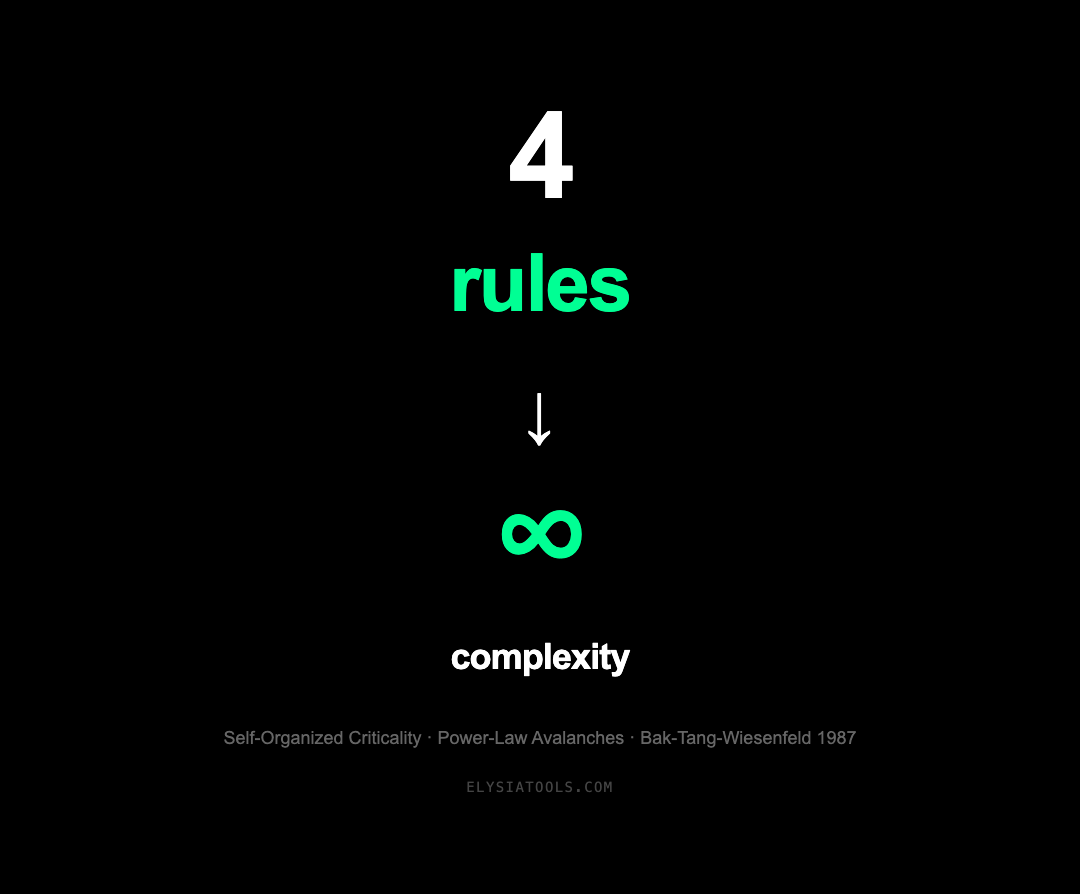
Four Rules, Infinite Complexity
The model lives on a grid. Here’s everything you need to know:
1. Drop: Add one grain of sand to any cell 2. Topple: If any cell has 4 or more grains, it becomes unstable and “topples” — giving 1 grain to each of its four neighbors 3. Cascade: Neighbors that receive extra grains may themselves exceed the threshold and topple, triggering a chain reaction 4. Boundary: Grains that fall off the edge of the grid disappear forever
That’s it. Four rules. No randomness in the physics. No fine-tuned parameters. No external hand.
Now run the simulation. Add grains at a constant rate. Watch what happens over thousands of drops.
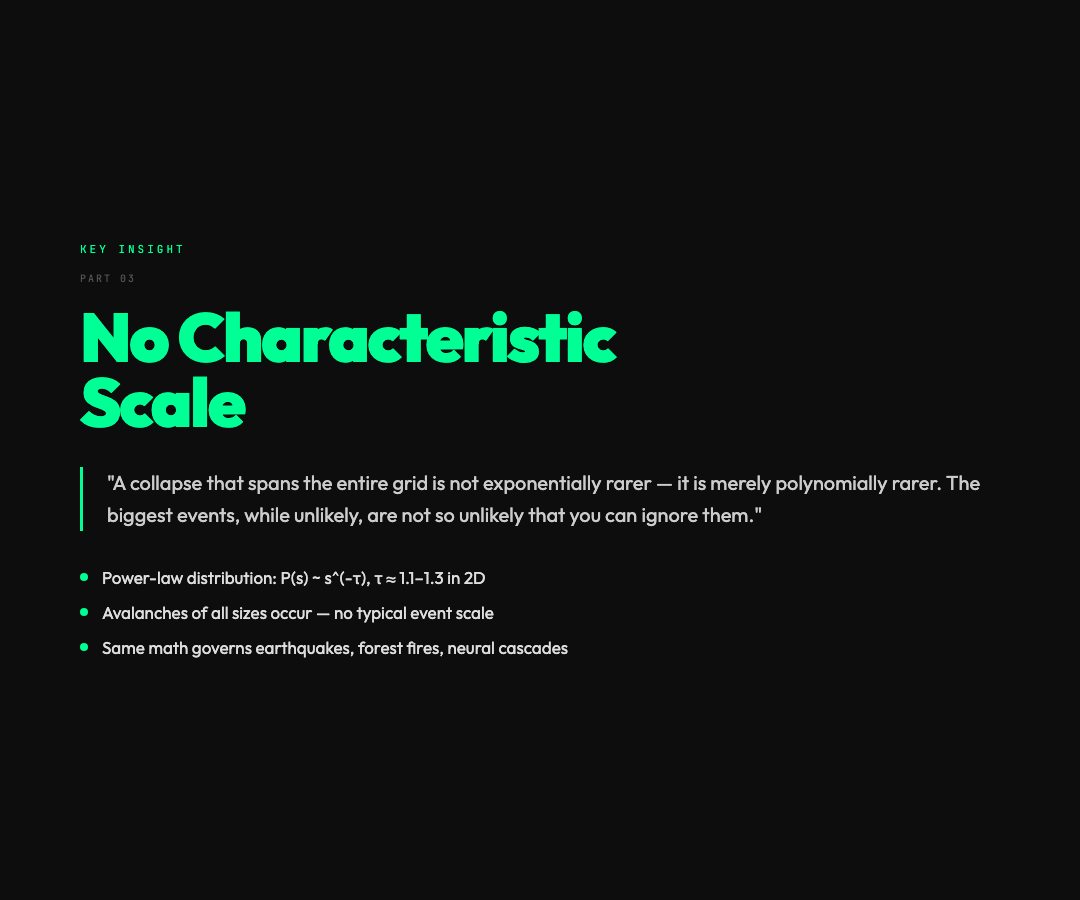
What emerges is extraordinary: the system settles into a critical state — balanced on the knife-edge between stability and collapse — entirely on its own. Avalanches of all sizes occur. Small ones, medium ones, and occasional system-wide cataclysms. The distribution of avalanche sizes follows a power law: P(s) ~ s^(-τ), where τ ≈ 1.1–1.3 in two dimensions.
A power law means there is no characteristic scale. You cannot look at the data and say “this is a normal-sized avalanche.” A collapse that spans the entire grid is not exponentially rarer — it is merely polynomially rarer. The biggest events, while unlikely, are not so unlikely that you can ignore them.
The Counterintuitive Part
Here is what makes the sandpile genuinely shocking.
Most physical systems require you to tune parameters to reach a critical point. Bring a magnet to exactly its Curie temperature and you see critical behavior. Lower the temperature below the critical point and the criticality vanishes. The system needs to be carefully balanced by an external hand.
The sandpile does something different. You add grains at a constant rate — that’s the only input — and the system self-organizes to criticality. You don’t tune anything. You don’t adjust parameters. You just keep dropping sand. The critical state is an attractor: if you perturb the system away from criticality, it naturally flows back.
This phenomenon — Self-Organized Criticality (SOC) — was the conceptual gift of the sandpile paper. Bak, Tang, and Wiesenfeld proposed that many complex phenomena in nature operate via SOC: they sit at the boundary between order and chaos not because someone placed them there, but because that boundary is the natural resting state of a driven, dissipative system.
Self-Organized Criticality in the Wild
Once you see SOC, you start finding it everywhere.
Earthquakes follow the Gutenberg-Richter law: the number of earthquakes with magnitude greater than m decreases as a power law. This is the same mathematical signature as sandpile avalanches. Tectonic stress accumulates slowly, then releases in collapses of all sizes — from micro-tremors to mega-quakes. The sandpile is a metaphor, but it captures the physics.
Forest fires spread in cascades: a tree catches fire, spreads to neighbors, which may spread further. The distribution of fire sizes follows a power law. Add firebreaks and you change the connectivity — you move the system away from criticality. Leave it alone and it self-organizes.
Solar flares release energy in bursts that follow a power-law distribution. The magnetic field in the solar corona organizes itself to a critical state, and then releases in avalanches ranging from tiny nanoflares to massive X-class events.
Your brain produces “neural avalanches” — cascades of neuronal firing — whose size and duration distributions follow power laws. This was discovered in slice preparations of rat cortex and confirmed in human MEG and fMRI studies. The brain, it appears, also operates near criticality.
The sandpile doesn’t prove that all these systems are sandpiles. But it provides a minimal, tractable model that captures the essential mathematics of how complexity emerges from local rules at the edge of chaos.
Why “Abelian”?
The model is called the Abelian Sandpile, and the name is not incidental. It refers to a property that sounds like a footnote but has real mathematical consequences.
In mathematics, an operation is “Abelian” (or commutative) if the order of operations doesn’t matter: a + b = b + a. Most arithmetic is Abelian. Most things in physics are not: if you push a swing at the wrong moment, you get a different result than if you push at the right moment, even if you push the same number of times.
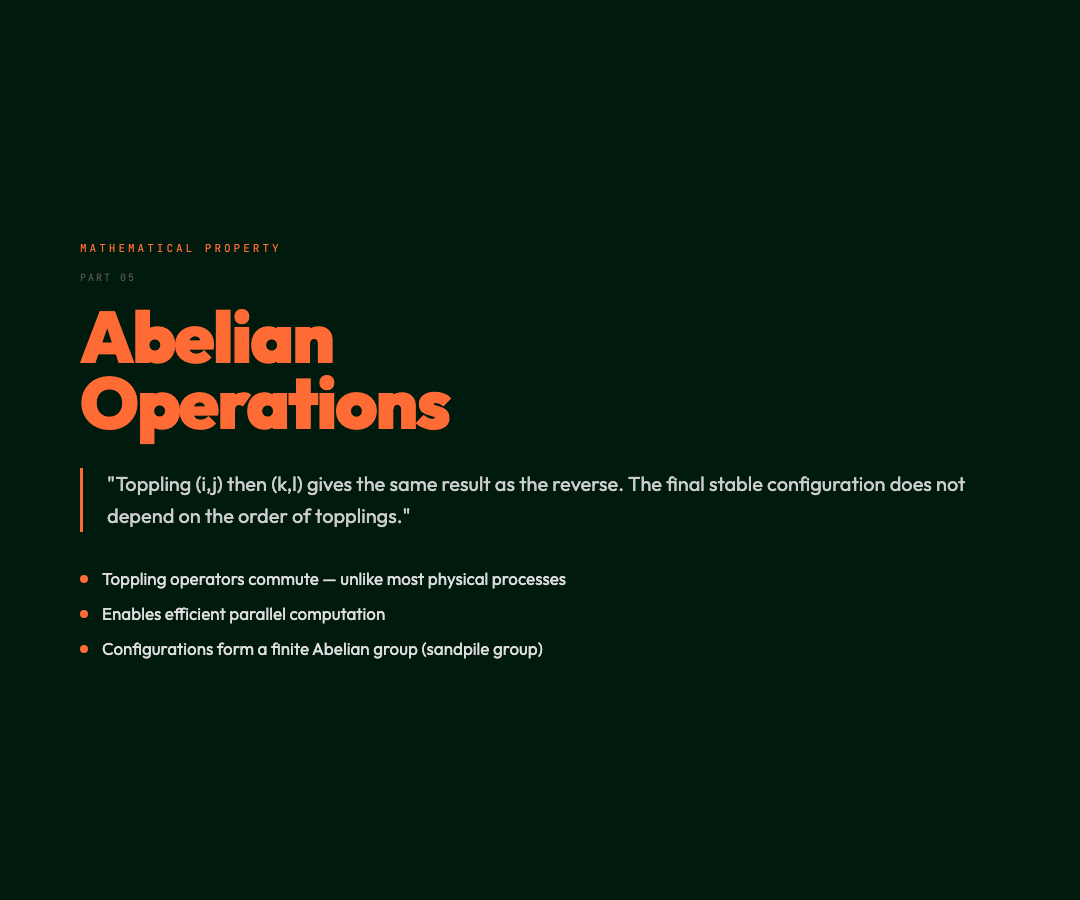
In the sandpile, the toppling operation is Abelian. If two cells are both unstable and you topple one and then the other, you get the same final configuration as if you did them in the reverse order. More surprisingly: if you add a grain of sand at some location and let the system relax to stability, and then add another grain somewhere completely different and let it relax — the order of those two additions doesn’t matter to the final stable state.
This commutativity is unusual in physics. It means the sandpile has a kind of algebraic structure that goes beyond just being a physics model. The set of stable configurations on a finite grid forms a finite Abelian group under a particular operation — the “sandpile group” or “chip-firing group.” The identity element of this group corresponds to a particular configuration that, when you add sand and let it relax, produces fractal patterns of haunting beauty.
These fractals — the identity configurations — are exact, not approximate. For grids of size 2^n – 1, the patterns show clean self-similarity across scales: nested rectangles and triangles that look hand-crafted but emerge from pure arithmetic. The connection between sandpile groups, tropical geometry, and algebraic graph theory is an active research frontier.
What the Interactive Tool Shows
The Abelian Sandpile visualization on ElysiaTools lets you explore the model directly.
You can drop sand in the center — producing the classic symmetric pile with radialavalanches — or drop it randomly across the grid, which produces a different critical state with more uniform activity. You can watch the height map (showing how many grains sit at each cell) or switch to a heatmap that highlights which cells are actively toppling.
The statistics panel is where the power law becomes visible. Over time, as you drop thousands of grains, the avalanche size distribution builds up on the log-log plot. If you see a straight line — that’s the power law. The slope of that line is the critical exponent τ, and it should come out around 1.0–1.3 for a 2D grid. This is the signature of criticality.
One counterintuitive observation: the maximum population never exceeds about 37% of the grid’s theoretical maximum. Even with unlimited sand, the system settles into a state where most cells sit at height 0, 1, or 2, with only scattered cells at height 3. The system self-regulates to maintain this sparse, critical state.
The Broader Lesson
The sandpile is a lesson in how simple local rules can produce global complexity without any master planner.
You don’t need a controller that monitors the whole system and decides when to trigger avalanches. The avalanches are the system. Every grain of sand that falls is both driving the system toward criticality and occasionally causing it to discharge through a cascade. The system maintains itself at the edge — always balanced, always ready to fail, always failing in ways that follow the same mathematical signature.
This is not just physics. Cascade failures in power grids — where one transformer overloads and trips, redirecting load to neighbors that then overload — follow sandpile-like dynamics. So does financial contagion, where one bank fails and triggers liquidations that push other banks underwater. So does the internet when BGP routing updates propagate in cascades across autonomous systems.
The sandpile doesn’t tell you exactly how these systems work. But it gives you a mathematical intuition for what to expect: power-law distributions of failure sizes, no characteristic scale, the impossibility of saying “this event is too big to happen.” It trains your intuition away from the comfortable assumption that big events are exponentially unlikely.
Four rules. A grid. And four decades of insight into how the world fails.