Why the Siren’s Pitch Changes Before It Reaches You
You hear it before you see it. A wail somewhere behind you, climbing in pitch as it closes in, then suddenly dropping the moment it passes. You knew an ambulance was coming before it appeared in your rearview mirror.
That shift in pitch — that strange rise-then-fall as a sound source moves past you — is one of the most useful phenomena in all of physics. It’s everywhere you hear it in every passing police car, every race car on a track, every bat navigating a dark cave. But the Doppler effect is far more than a curiosity of everyday life. It measures the universe.
The Core Idea: Waves in Motion
When a wave source moves toward you, it effectively squishes its own waves ahead of itself. Each new wave crest gets emitted from a position slightly closer to you than the last, so the crests arrive more frequently than they would if the source were standing still. The frequency you perceive goes up.
When the source moves away, the opposite happens. Each crest gets emitted from a position slightly farther away, so they reach you less frequently. The frequency goes down.
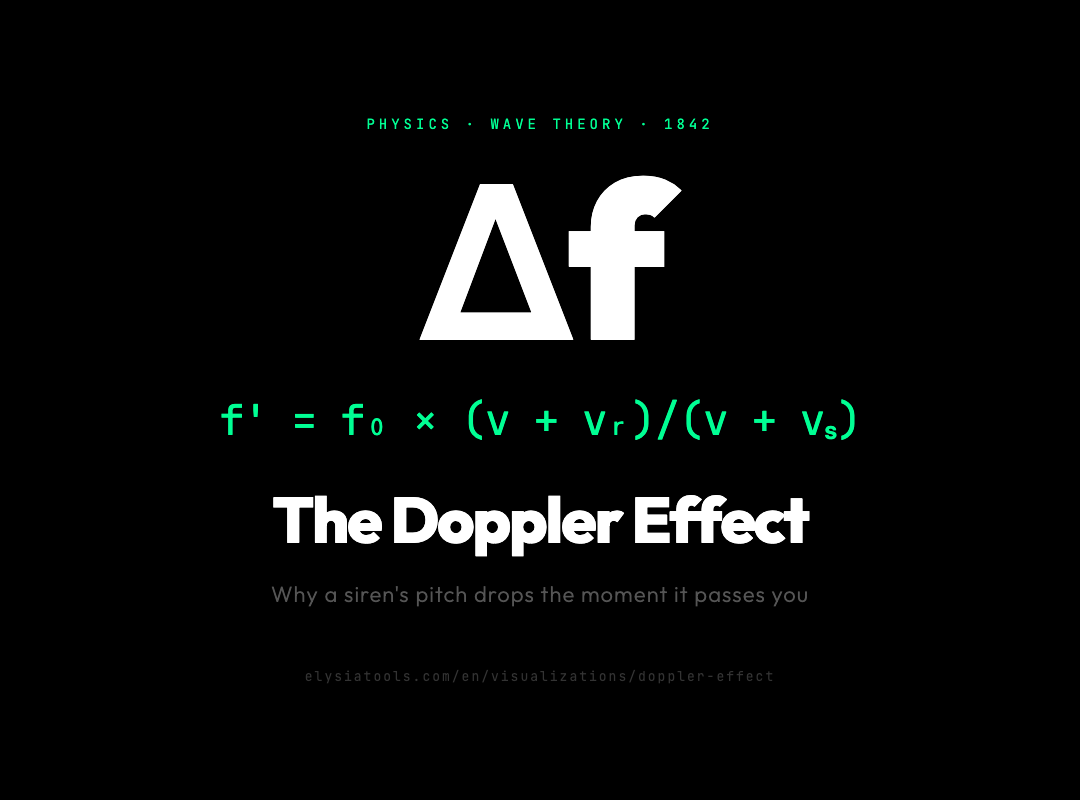
This is the Doppler effect. The source frequency f₀ stays the same. What changes is the observed frequency f’, depending on the relative motion between source and observer.
The formula is clean:
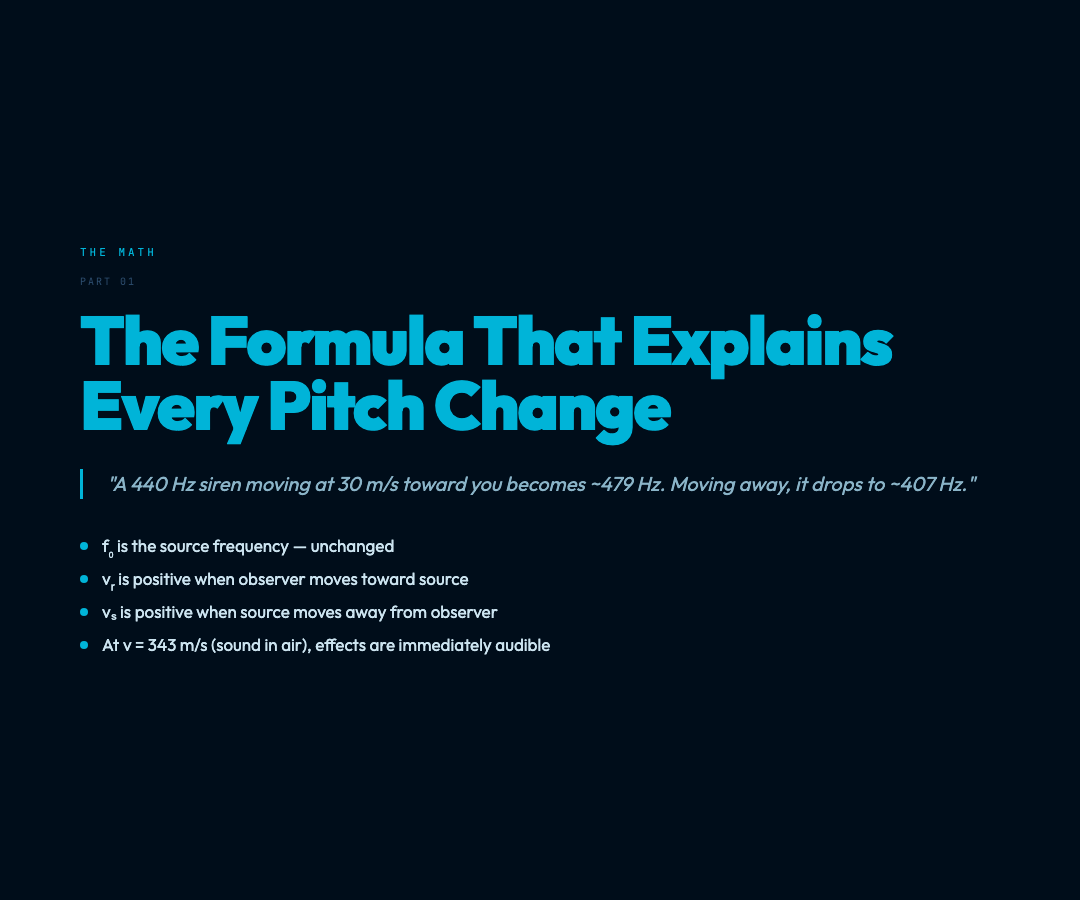
f’ = f₀ × (v + vᵣ) / (v + vₛ)
Where: – v = wave speed (e.g., ~343 m/s for sound in air) – vᵣ = observer velocity (+ if moving toward source) – vₛ = source velocity (+ if moving away from observer)
A stationary source (vₛ = 0) and stationary observer (vᵣ = 0) give f’ = f₀. No Doppler shift. Make the source move toward you at 30 m/s, and a 440 Hz siren becomes approximately 479 Hz — noticeably higher. Move it away at the same speed, and it drops to roughly 407 Hz.
Sound vs. Light: The Same Trick, Different Scales
The Doppler effect works for any wave — water waves, sound waves, light waves. But the consequences differ dramatically depending on the medium.
For sound, the medium is air, and the speed is fixed by the air itself (~343 m/s at room temperature). A source can’t exceed the wave speed without creating a sonic boom — when the source moves at or above the speed of sound, the wavefronts pile up into a single shock wave.
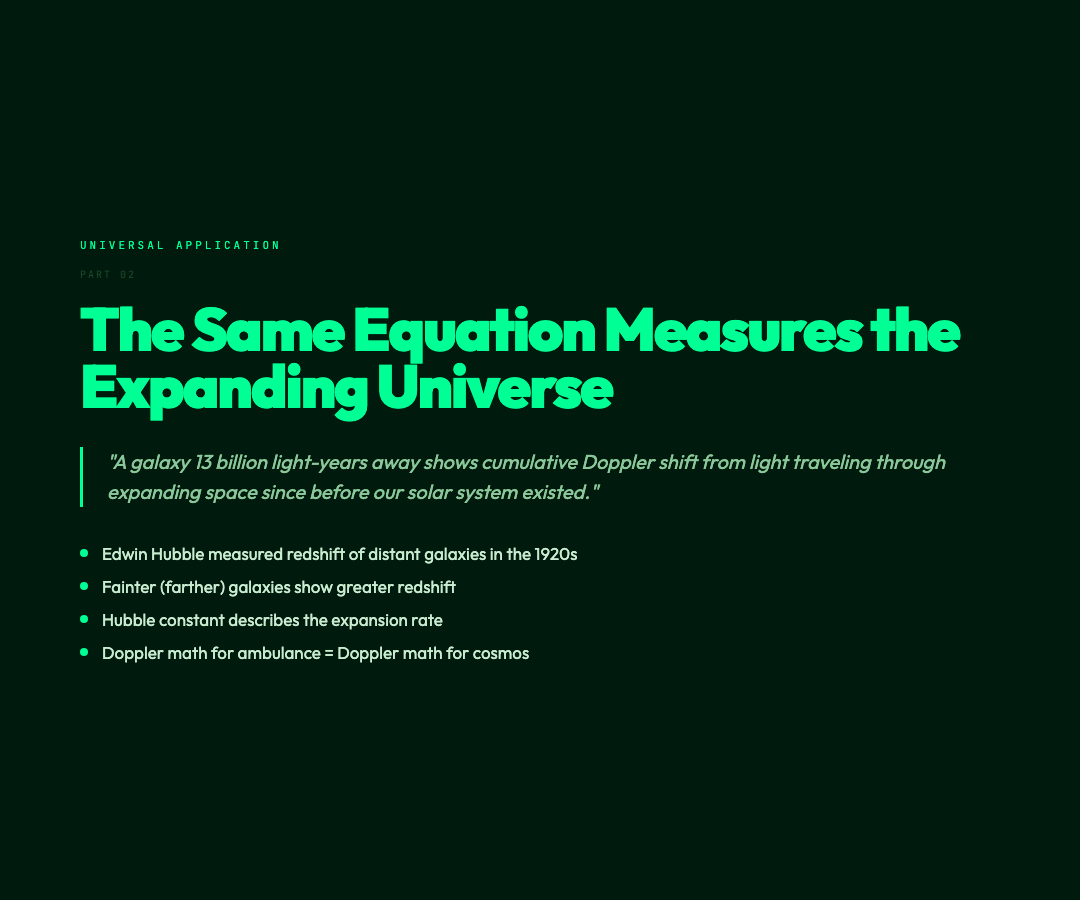
For light, there is no medium. Light always travels at c ≈ 299,792,458 m/s regardless of the source’s motion. But the Doppler effect still applies: objects moving away from us show their light shifted toward the red end of the spectrum (redshift), and objects moving toward us show it shifted toward the blue end (blueshift).
This is how we know the universe is expanding. In the 1920s, Edwin Hubble measured the redshift of distant galaxies and found something astonishing: the farther away a galaxy is, the greater its redshift. The universe isn’t just expanding — it’s expanding faster in every direction we look. Every galaxy except our nearest neighbors is running away from us.
Where You Already Use the Doppler Effect
The Doppler effect isn’t just a physics classroom demonstration. It’s embedded in technologies you use every day.
Weather radar — Doppler radar doesn’t just detect rain. It measures the frequency shift of radio waves bouncing off precipitation particles, revealing wind velocity inside storms. That’s how meteorologists can see rotation inside a tornado before it even forms.
Medical ultrasound — When a doctor measures blood flow through your arteries, they’re using the Doppler shift of ultrasonic waves reflected off red blood cells. Non-invasive, no radiation, real-time velocity data. It’s one of the cleanest applications of physics in medicine.
Police radar — The handheld device on the side of the road shoots a radio wave at your car. The reflected wave comes back at a shifted frequency proportional to your speed. The math is the same one Christian Doppler worked out on paper in 1842.
Astronomy — The redshift survey of galaxies gave us the Hubble constant — the rate at which the universe expands. More recently, the detection of gravitational waves relied on Doppler shifts in the light from orbiting neutron stars. When the stars spiraled into each other, their light Doppler-shifted in a predictable pattern that matched the theoretical gravitational wave signature.
The Bat’s Navigation System
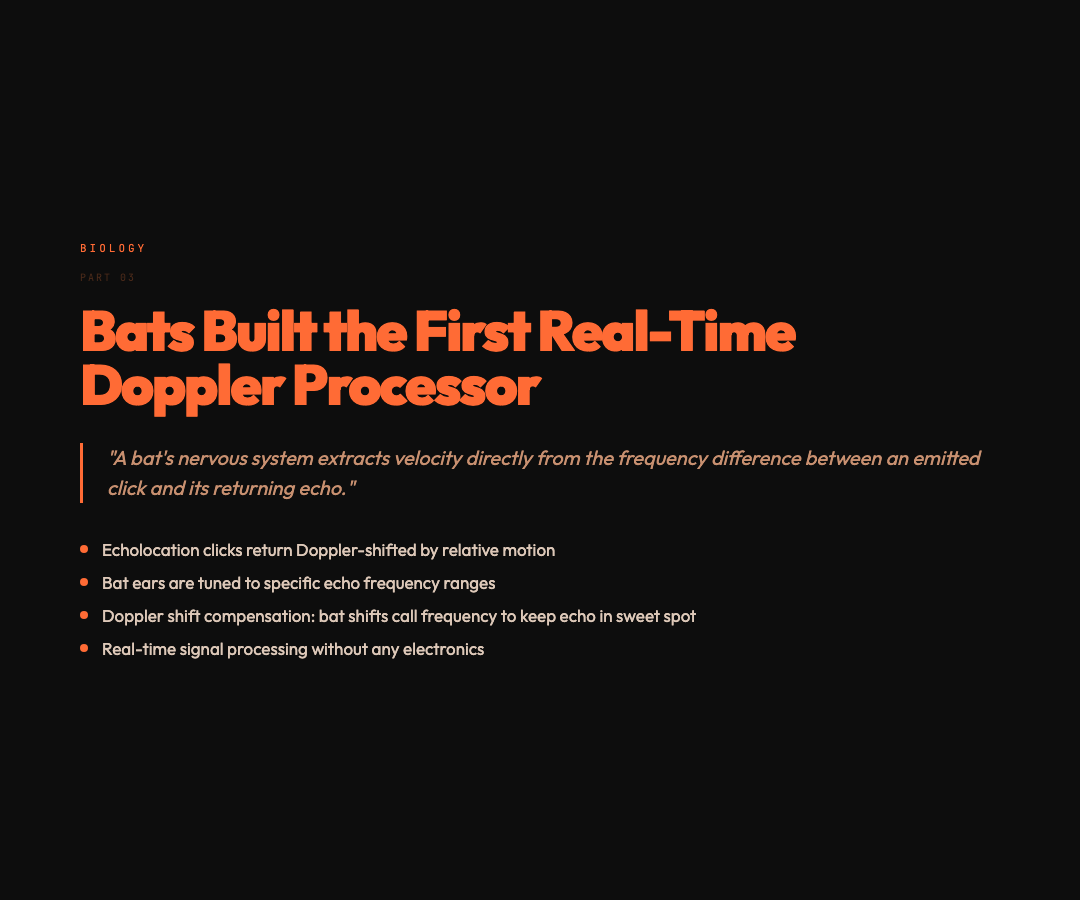
Bats navigate and hunt in complete darkness using echolocation. They emit ultrasonic clicks — very short, very loud bursts of sound — and listen for the echoes. But here’s the detail most articles skip: a bat doesn’t just measure distance. It uses the Doppler effect to measure relative velocity.
If a bat is flying toward an insect, the returning echo is Doppler-shifted to a higher frequency than the emitted click. The bat’s inner ear and nervous system are tuned to detect this shift instantly. It adjusts its flight path in real-time, using the frequency difference as a direct velocity readout.
Some bat species even shift the frequency of their calls to keep the returning echo in a frequency range their ears are most sensitive to — a behavior called Doppler shift compensation. They’re doing real-time signal processing that engineers spent decades learning to build.
See It Yourself
The Doppler Effect simulator on ElysiaTools lets you control source frequency, source velocity, observer velocity, and wave speed simultaneously, and watch the wavefronts compress and stretch in real time.
Change the source frequency and watch the waveform comparison panel update. Crank up the source velocity toward the wave speed and watch the wavefronts pile up ahead of the source. Toggle the Doppler color map on and off to see frequency differences mapped to color — blue ahead of the source, red behind.
The formula on screen updates live as you move the sliders. Once you see the numbers change in real time, the abstract description clicks into something intuitive: waves in motion, measured by what changes when things move.
The Universe as a Doppler Problem
Here’s the version that still catches me off guard: when astronomers measure the redshift of a galaxy 13 billion light-years away, they’re measuring the cumulative Doppler shift of light that’s been traveling through expanding space since before our solar system existed. Every galaxy in the observable universe is running away from us because space itself is expanding, and the Doppler math that describes a passing ambulance is the same math that describes the large-scale structure of reality.
The siren pitch drop is the same phenomenon as the universe’s expansion. Christian Doppler would have appreciated that.