Why Economic Ideas Spread Like Viruses
In 1974, economist Arthur Laffer sketched a curve on a napkin. On one axis: tax rates. On the other: government revenue. The curve was inverted-U shaped. Cut taxes, he argued, and government revenue might actually rise.
The idea was debated among economists for years — until Ronald Reagan made it the centerpiece of his economic policy. Within a single decade, a theory had mutated from a marginal academic proposition into the dominant framework of the world’s largest economy.
What happened?
Robert Shiller, who would later win the Nobel Prize, has a theory: economic ideas don’t spread the way we think. They spread like viruses.
Narrative as Epidemic
Mainstream economics treats markets as machines. Investors are rational actors, processing information efficiently, responding to fundamentals. Shiller thought this was dangerously incomplete. In 1981, in a paper that took years to get published, he argued that “animal spirits” — narratives, stories, the collective mood of investors — drove markets in ways that pure rational models couldn’t capture.
Four decades later, in his 2019 book Narrative Economics, he went further. Economic narratives aren’t just background noise. They are the disease.
His framework borrowed directly from epidemiology. Just as a virus needs susceptible hosts, a contagious idea needs minds ready to receive it. Just as an epidemic burns out when enough people recover, an economic narrative loses power when enough people stop believing it. The basic reproduction number — R₀ — that epidemiologists use to track diseases applies equally to the spread of financial narratives.
The Laffer Curve narrative had an R₀ well above 1 in the Reagan era. The “Greenspan Put” narrative — that the Federal Reserve would always bail out markets — had an R₀ above 1 through most of the 1990s and 2000s. The “housing prices only go up” narrative infected nearly every homeowner in America before 2008.
You can model this. And you can watch it happen in real time.
The SIR Model of Bullshit
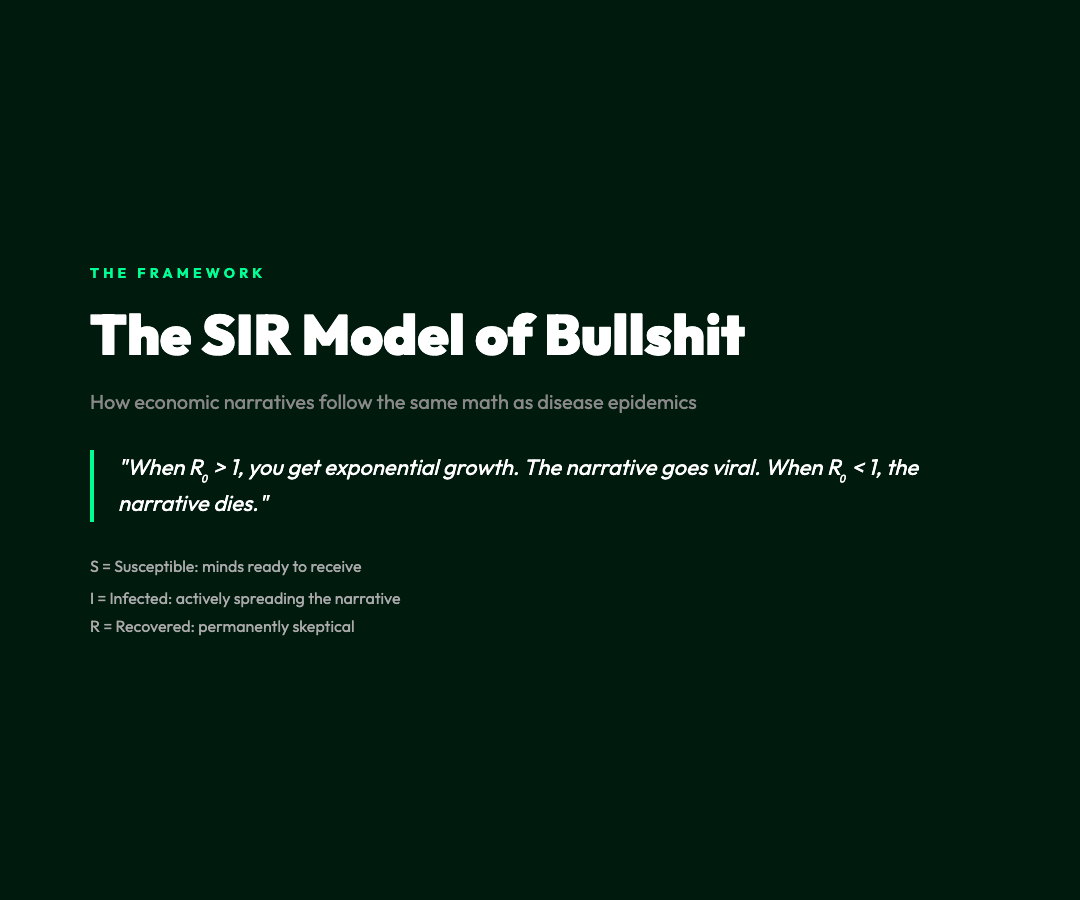
The classic epidemiological model is SIR: Susceptible, Infected, Recovered.
In narrative economics, this maps with eerie precision:
– Susceptible (S): People who haven’t yet adopted the narrative. They’rerational skeptics. For a new crypto narrative, this might be most of the population. – Infected (I): People actively spreading the narrative. They post about it, argue for it at dinner parties, tweet it into the void. For Bitcoin, this was the cypherpunks, then early adopters, then financial journalists, then your Uber driver. – Recovered (R): People who’ve moved on. They either lost interest, saw the narrative proven wrong, or became immune through exposure to counter-arguments. The dot-com believers who lost everything in 2000 mostly recovered — and became permanently skeptical of tech narratives.
The key parameter is the basic reproduction number, R₀ = c/r, where c is the contagion rate (how fast the narrative spreads) and r is the recovery rate (how fast people lose interest).
When R₀ > 1, you get exponential growth. The narrative goes viral. Everyone’s talking about it. The price of whatever it’s attached to is going up. The media covers it. More people hear about it. More people adopt it. Wash, rinse, repeat.
When R₀ < 1, the narrative dies. It never breaks through. The early adopters try to spread it, but most people don’t bite. The narrative fades to zero infected.
The critical threshold is R₀ = 1. At this point, the narrative neither grows nor shrinks. It persists at whatever level it’s currently at. This is where most enduring economic narratives live — the belief that inflation is bad, that diversification matters, that gold is a hedge. Not viral, but not dead. Just… persistent.
The Cases That Prove the Model
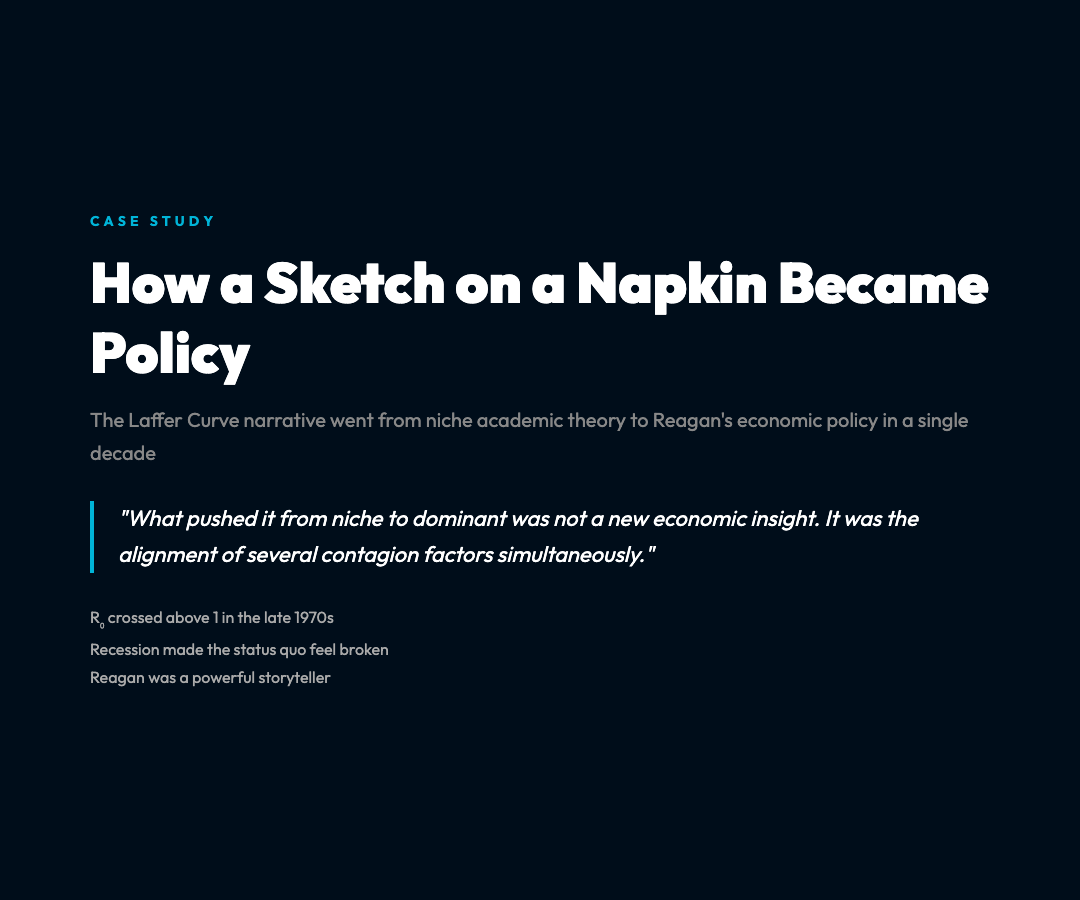
The Laffer Curve narrative is the cleanest case. In the late 1970s, the idea that high marginal tax rates were killing economic growth was a niche view. The economists who believed it were, by and large, in the “Infected” category. The “Susceptible” population was enormous: business leaders, politicians, conservative think tanks, and eventually the voting public.
What pushed it from niche to dominant was not a new economic insight. It was the alignment of several contagion factors simultaneously: a recession that made the status quo feel broken, a presidential candidate (Reagan) who was a powerful storyteller, and media infrastructure (newspapers, TV) that amplified the narrative into living rooms across America.
Bitcoin is a cleaner modern case. The “decentralized digital money” narrative started with a small group of cryptographers and cypherpunks. The contagion rate was initially low — most people hadn’t heard of it. Recovery was high — anyone who looked at the whitepaper and didn’t understand it simply dismissed it and moved on.
Then something changed. The price started going up. Social media amplified the narrative. Early adopters became evangelists. R₀ crossed above 1 sometime around 2013. What followed was a textbook epidemic curve: exponential growth, peak infection (everyone had heard of Bitcoin), followed by a partial die-off as early adopters took profits and skeptics became more vocal, followed by new waves as the narrative mutated (from “digital cash” to “store of value” to “inflation hedge”).
The pattern repeats. The Great Recession narrative — the comparison to 1929, the fear that the financial system might collapse — went viral in September and October 2008. The R₀ was enormous because the emotional resonance was so high. People who had never read an economics paper were suddenly talking about depression, contagion, systemic risk. The narrative infected policymakers, bank executives, and ordinary homeowners simultaneously.
Why This Matters for Investors
If narratives drive markets the way epidemics drive disease outbreaks, then the implications are uncomfortable.
First, you cannot fully “price in” a narrative the way you price in a quarterly earnings report. Narratives are inherently social phenomena. They depend on how many people believe them, how strongly they believe them, and how quickly belief spreads. This is not information that is easily captured in a discount rate.
Second, narratives have natural lifetimes. No narrative lasts forever. The epidemic eventually burns out — either because enough people recover (become skeptical) or because the disease mutates into something new. The investor who can identify when a narrative is in the exponential growth phase — when R₀ is well above 1 — has a window of opportunity. The investor who buys at the peak of narrative infection — when everyone already believes it — is buying at the worst possible time.
Third, and most unsettling: you can engineer the spread of a narrative. Politicians, central bankers, and financial institutions have always understood this intuitively. The Fed’s communication strategy is essentially a narrative engineering operation. When the Fed says “transitory inflation,” it is trying to shape the inflation narrative. When a company embarks on an earnings call, it is trying to shape the narrative about its stock.
This is not conspiracy theory. This is epidemiology.

See It Happen
The Narrative Economics visualization at ElysiaTools lets you explore this framework interactively. Adjust the contagion rate and recovery rate. Watch the SIR curves evolve in real time. Set different starting conditions — a narrative that starts hot and fades fast (high c, high r), a narrative that smolders for decades (low c, low r), a narrative that comes back in waves (the SIRS model variant).
The tool includes four historical case studies: the Laffer Curve, the Great Recession narrative, the Bitcoin “get rich quick” narrative, and others. Each case shows how the same SIR model captures the rise and fall of economic narratives that shaped real markets.
Understanding narrative economics won’t make you immune to narratives. Nobody is. But it might help you recognize when you’re standing in the middle of an epidemic — and give you a moment’s pause before you decide whether to become infected.
The Narrative Economics visualization is part of ElysiaTools’ economics collection. Free to use, no sign-up required.