Why Musicians Listen for Silence: The Science of Beat Frequency
Why Musicians Listen for Silence: The Science of Beat Frequency
The piano tuner adjusts one string by a fraction of a millimeter. She strikes the A above middle C on the perfectly tuned reference piano, then strikes the same note on the instrument before her. A faint pulsing sound emerges — a slow, rhythmic “wah-wah-wah” that gets faster, then slower, then faster again. She twists the tuning lever. The pulsing slows. She twists again. The pulsing stops entirely.
The note is now in tune.
What just happened? Two keys on two pianos struck at nearly the same frequency — 440 Hz versus 440.5 Hz — produced a third sound entirely: a beat frequency of 0.5 Hz. The human ear detected not just two pitches, but the difference between them. That difference is information. And that information is how every instrument in every orchestra gets tuned before a single观众 takes their seat.
What Is Beat Frequency, Exactly?
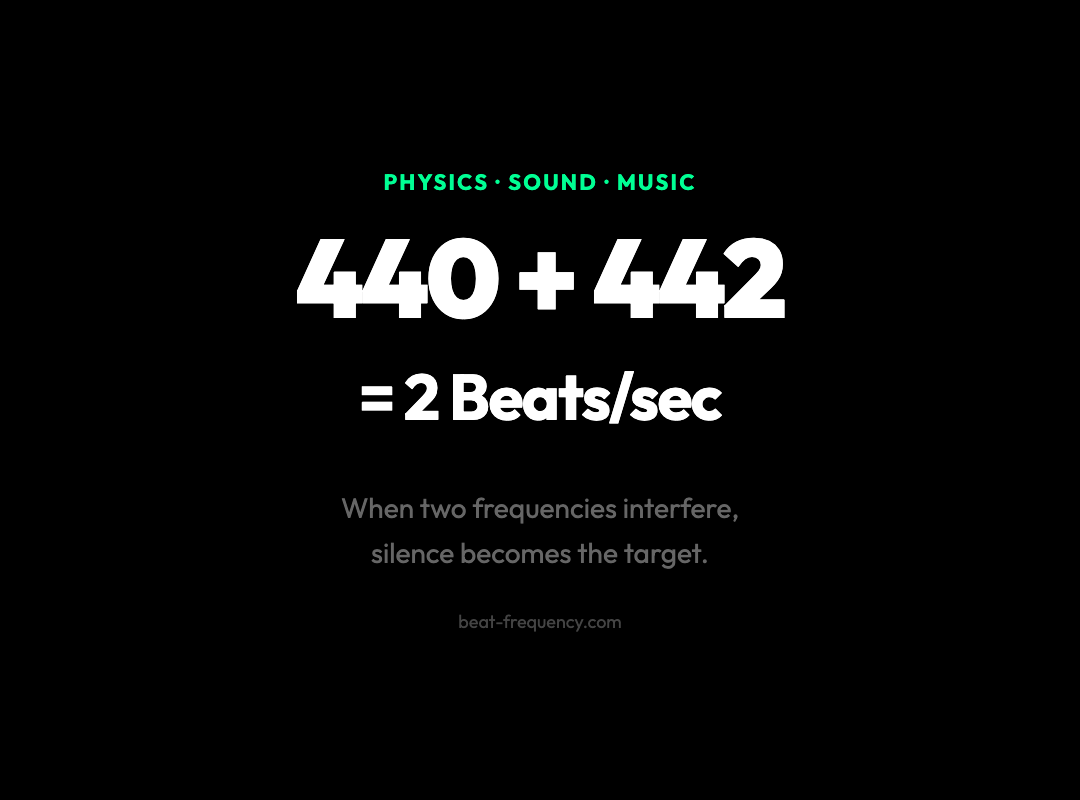
Beat frequency is what you hear when two sound waves of slightly different frequencies interfere with each other. When two tones play together — say, 440 Hz and 442 Hz — they periodically align in phase (reinforcing each other, producing a louder sound) and then fall out of phase (partially canceling each other, producing a quieter sound). This alternation happens at a rate equal to the absolute difference between the two frequencies.
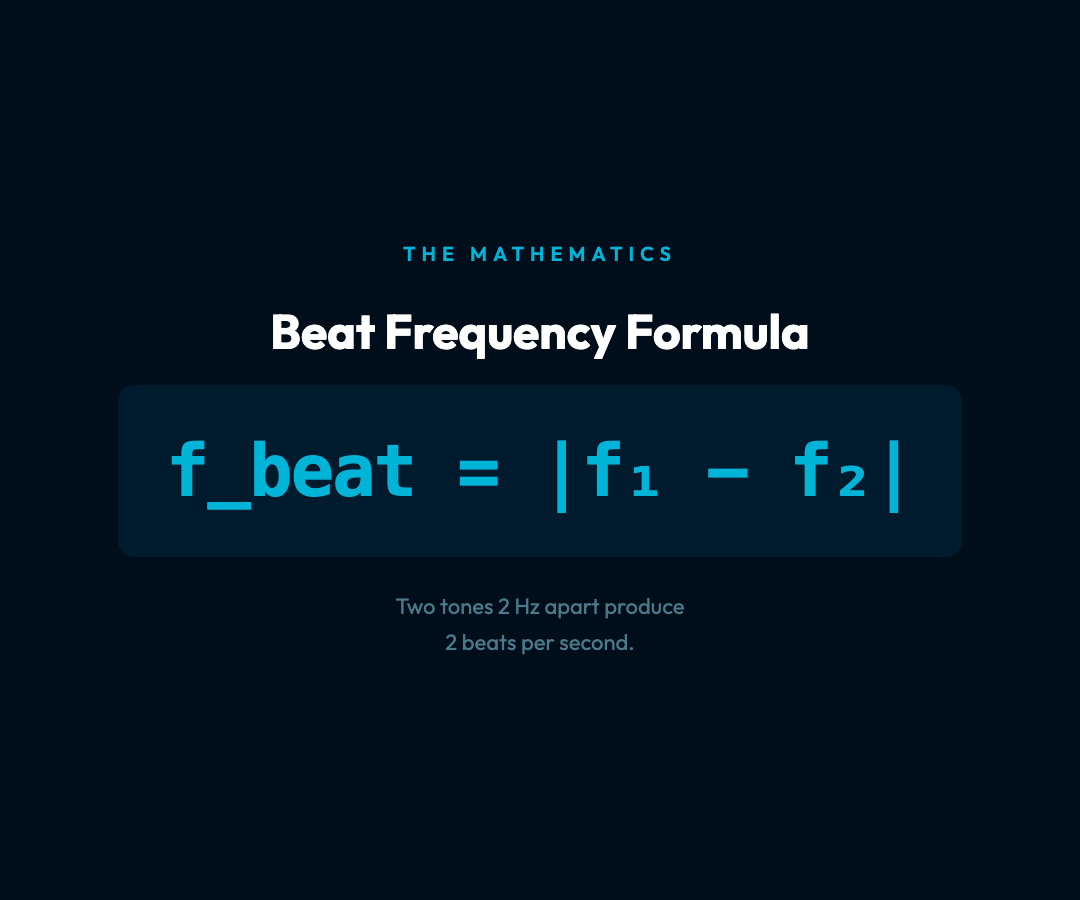
The beat frequency formula is straightforward:
f_beat = |f₁ – f₂|
Two tones 2 Hz apart produce 2 beats per second. Two tones 20 Hz apart produce 20 beats per second. When the frequencies match exactly, the beat frequency drops to zero — and that silence is precisely what musicians spend years training their ears to identify.
The Mathematics of Superposition
When two sine waves interfere, their amplitudes add. If wave 1 has amplitude A and wave 2 has the same amplitude A, and they are in phase, the combined amplitude is 2A — a louder sound. When they are exactly out of phase, the combined amplitude is zero — silence.
For two waves y₁ = sin(2πf₁t) and y₂ = sin(2πf₂t), their sum can be rewritten using the product-to-sum identity:
y₁ + y₂ = 2 sin(2π((f₁+f₂)/2)t) · cos(2π((f₁-f₂)/2)t)
This reveals what is really happening: the sum produces a wave at the average frequency (the pitch you hear), modulated by an envelope at the half-difference frequency (the beat). The envelope’s oscillation rate — the beat frequency — equals the difference between the two source frequencies.
Why This Matters More Than You Think
Beat frequency is not merely a curiosity of acoustics. It is fundamental to how we perceive sound, how instruments stay in tune, and how radar systems measure velocity.
Instrument tuning is the most audible application. A violinist adjusts finger pressure to shift string tension until beats disappear between two strings playing the same note. A vocalist matches pitch to a reference tone by listening for the same fading pulses. The goal in all cases is zero beats — perfect alignment of frequencies.
Piano tuning relies on this principle even more precisely. A piano has three strings for each mid-range note, and they must be tuned not just to match each other but to the correct stretch — slightly sharper in the treble, slightly flatter in the bass — to sound “right” to a trained ear. Professional tuners use a 440 Hz reference and listen for beats against each string, adjusting until the rate of beating falls below the threshold of perception.
Doppler radar uses the same principle in reverse. When radar waves bounce off a moving object, they return slightly shifted in frequency. The beat frequency between the transmitted and received signals encodes the object’s velocity directly. Police radars, weather satellites, and air traffic control systems all depend on this mathematics.
Music production and synthesis weaponize beat frequency deliberately. Slightly detuning two oscillators — say, one at 440 Hz and another at 441 Hz — creates a thick, chorused sound rich in harmonic texture. This detuning is why analog synthesizers have a characteristic warmth that digital emulations spend decades trying to replicate.
The Threshold Where Beats Become a New Sound
Here is where the phenomenon gets genuinely strange. The ear can perceive individual beats clearly up to about 15 Hz. Below that, you hear distinct pulses — the classic “wah-wah-wah” of two nearly-tuned instruments. Around 15 to 20 Hz, the pulses start to blur together. Above roughly 20 Hz, the individual beats become impossible to distinguish, and instead you perceive a new, lower pitch — a difference tone or subtractive tone — at the beat frequency itself.
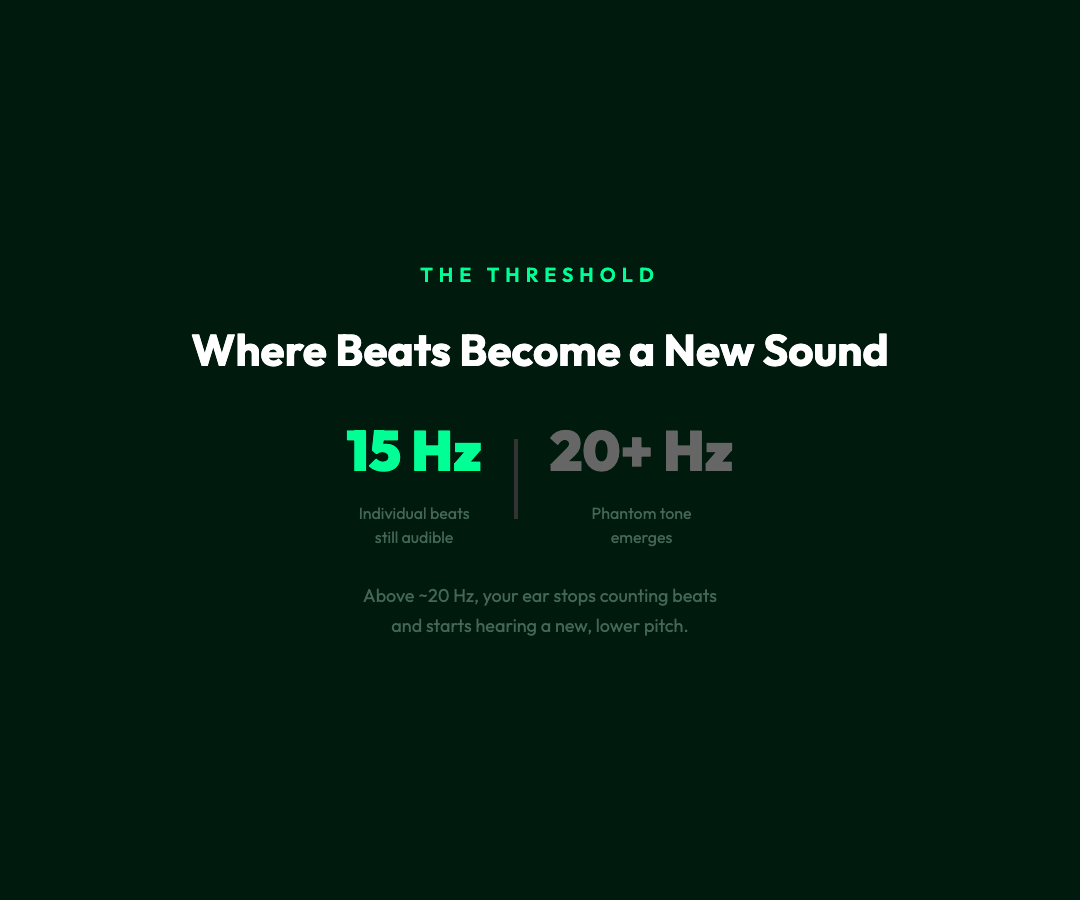
This means two tones of 440 Hz and 460 Hz do not just produce 20 visible beats per second. At higher beat rates, your auditory system generates a phantom third tone at 20 Hz — below the range of most speakers, but perceivable as a sensation of vibration rather than pitch. Thepsychoacoustic consequences of this are still being studied, but the practical implication is clear: the ear is not a Fourier analyzer. It does not simply report what is physically present; it constructs a hearing experience from a combination of physical stimulus and neural processing.
The Hidden Math in Every Piano
If you have ever wondered why a piano sounds “wrong” when you tune it perfectly to digital pitch — all keys exactly in mathematical ratio — the answer involves the stretch tuning that beat frequency relationships make audible.
A piano is tuned with a slight progressive sharpening as notes get higher, and progressive flattening as notes get lower, relative to equal temperament. This is not an error — it is a correction for the fact that strings of different thicknesses and tensions behave slightly non-linearly. Professional tuners use a technique called octave stretching: they tune an octave and then verify it by listening for beat frequencies between the upper note and the second harmonic (first overtone) of the lower note. When the beat rate of that interval matches the beat rate of the octave itself, the tuning is considered correct.
This is also why a perfectly tuned piano in one room can sound slightly out of tune when moved to another room with different temperature and humidity: the strings change tension fractionally, shifting all those carefully matched beat frequencies, and the ear notices.
The Beat Frequency Is Everywhere
Beat frequency is not limited to sound waves. Any oscillating system with a frequency difference produces beats: radio signals, light waves, electrical currents. In optics, two laser beams of slightly different frequency produce interference patterns whose spacing encodes the frequency difference — the same mathematics, a different domain.
In fact, the entire field of heterodyne detection — converting high-frequency signals to lower frequencies for processing — relies on creating beats between a received signal and a reference oscillator. Your FM radio receives stations at frequencies in the 88 to 108 MHz range, but your radio is not processing signals at those frequencies. It creates beats with a local oscillator and extracts the audio from the difference frequency, which falls in the audible range. All of this from the same principle that lets a piano tuner know when to stop turning a key.
The next time you hear that slow pulsing “wah” as two instruments drift slightly apart, you are listening to the most practical piece of mathematics in music — a formula that has been used to tune every orchestra, calibrate every radar, and build every radio that has ever brought you news or song.
The silence between the beats is the target. Every musician is, at some level, in the business of minimizing the difference.