Why the Arrhenius Equation Is the Most Important Formula You Learned in Chemistry Class (And Forgot)
The food in your freezer lasts months. Leave it on the counter and it spoils in days. Nobody needs to tell you this — you already know cold temperatures slow down decay. But behind that common observation sits a 135-year-old equation that predicts exactly how much slower reactions get when the temperature drops. Most students memorize k = Ae^(-Ea/RT) for the exam and never think about it again. That’s a shame, because the Arrhenius equation is one of the few formulas from undergraduate chemistry that working engineers actually use — in drug manufacturing, catalyst design, and materials science alike.
The Core Insight: Reactions Don’t Scale Linearly With Temperature
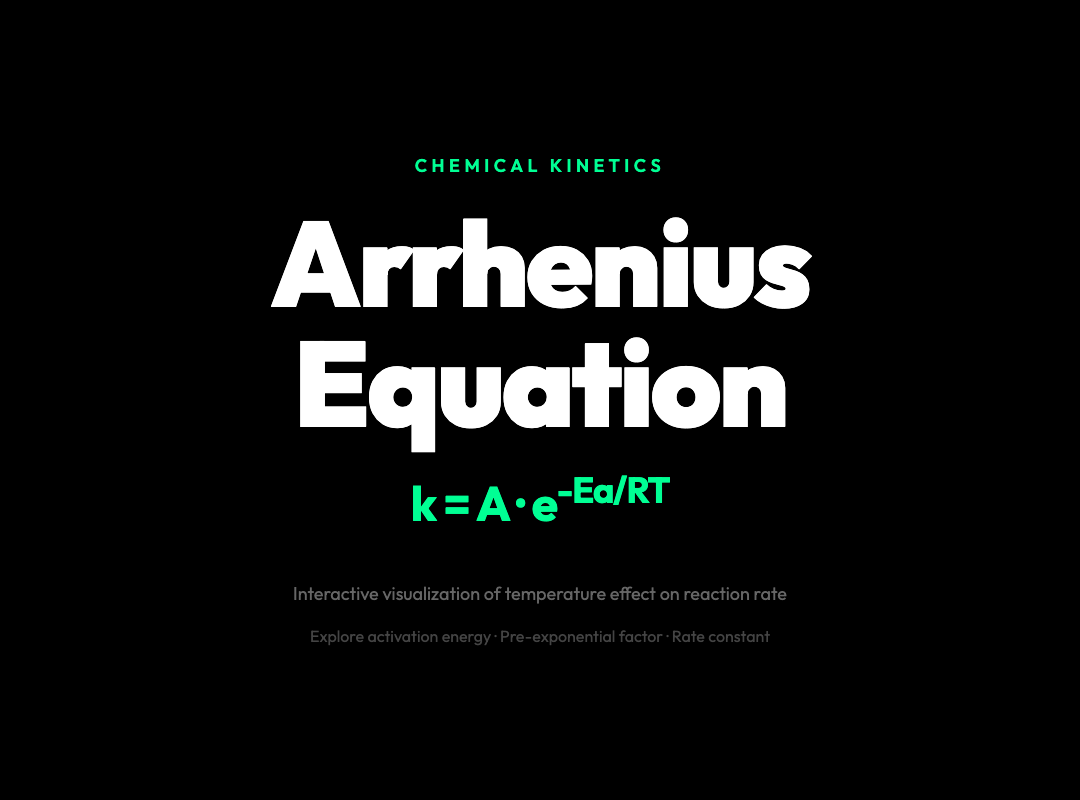
The Arrhenius equation, published by Swedish chemist Svante Arrhenius in 1889, describes how a reaction’s rate constant k depends on temperature T:
k = A · e^(-Ea/RT)
Three variables govern everything: – A — the pre-exponential factor, essentially the collision frequency between reactant molecules – Ea — the activation energy, the minimum energy a molecule needs before the reaction can proceed – R — the gas constant (8.314 J/mol·K) – T — absolute temperature in Kelvin
The exponential term e^(-Ea/RT) is the Boltzmann factor: it tells you what fraction of molecules at temperature T have enough energy to clear the activation barrier. Because this factor is exponential, small changes in temperature produce enormous changes in reaction rate. A reaction with an activation energy of 75 kJ/mol — typical for many organic reactions — doubles its rate for every roughly 10°C increase in temperature. That’s the “van ‘t Hoff rule” your chemistry teacher probably mentioned once and never explained.


Why Activation Energy Determines Everything
Activation energy is the central parameter in the equation, and it has an intuitive physical meaning. Imagine pushing a boulder over a hill to reach a valley on the other side. The height of the hill is Ea. If the hill is low, most boulders have enough thermal energy to roll over it spontaneously. If the hill is high, only the rare, unusually energetic boulders make it — until you add enough heat to get more of them over the top.
This sensitivity to Ea is why the Arrhenius plot (ln k versus 1/T) is such a powerful experimental tool. When you measure a reaction’s rate constant at several temperatures and plot the results, the slope of the resulting straight line directly gives you -Ea/R. You don’t need to know anything about the reaction mechanism to extract the activation energy from experimental data. This is how chemists determined activation energies for reactions long before computational chemistry existed.
Catalysts Work by Shrinking the Hill, Not Removing It
One of the most useful applications of the Arrhenius framework is understanding catalysis. A catalyst doesn’t change the thermodynamics of a reaction — the products have the same energy whether the reaction runs with or without the catalyst. What the catalyst changes is the path: a different mechanism with a lower activation energy.
In an Arrhenius plot, a catalyzed reaction and an uncatalyzed reaction of the same overall process will produce parallel lines — same slope (same -Ea/R for the new path), but different intercepts (different A values reflect the new mechanism’s collision geometry). Enzymes are biological catalysts that achieve extraordinary efficiency: they lower activation energies enough to accelerate reactions by factors of 10^6 to 10^12. This is why life runs at ambient temperatures instead of the hundreds of degrees that would be required for the same chemistry without enzymes.
The Arrhenius Equation in the Real World
The pharmaceutical industry lives and dies by the Arrhenius equation. Drug molecules degrade via chemical reactions, and the rate of degradation determines shelf life. Accelerated stability testing — storing drug candidates at elevated temperatures and measuring how quickly they break down — uses the Arrhenius equation to extrapolate shelf life at room temperature from high-temperature data. Without this shortcut, bringing a new drug to market would take decades longer.
In industrial chemistry, reactor design requires precise predictions of reaction rates at operating temperatures. The Arrhenius equation lets engineers simulate how a reactor will behave at scale before building it. In semiconductor manufacturing, the chemical vapor deposition processes that lay down thin films are governed by Arrhenius kinetics. Even the food industry uses it: the Q10 coefficient (the factor by which reaction rate changes for a 10°C temperature change) directly derives from the equation’s exponential form.
When the Arrhenius Equation Bre Down
The classical Arrhenius equation assumes A and Ea are constants — independent of temperature. This works well across moderate temperature ranges, but fails at extremes. At very high temperatures, the exponential term saturates and the assumption breaks down. For reactions with significant temperature-dependent entropy changes, the Eyring equation (derived from transition state theory) provides a more accurate alternative.
For enzyme-catalyzed reactions, classical Arrhenius behavior often breaks down entirely at both high and low temperatures, because the enzyme itself has a temperature optimum and can denature. These cases require more sophisticated models that account for the enzyme’s thermal stability, not just the chemical kinetics.
See It in Action
The Arrhenius equation rewards interactive exploration. Rather than staring at the formula, try manipulating the activation energy slider and watching how dramatically the rate constant curve changes shape. Compare the k-T relationship for reactions with different activation energies — a reaction with Ea = 50 kJ/mol looks almost flat as temperature rises, while one with Ea = 150 kJ/mol shoots upward almost vertically. The reaction energy diagram shows why: the height of the barrier determines how sharply the Boltzmann factor responds to temperature changes.
The Arrhenius plot transforms this exponential relationship into a straight line, which is where the equation’s real experimental power emerges. The slope directly encodes the activation energy; the intercept encodes the pre-exponential factor. Every piece of the equation has a measurable, physical meaning — no hidden parameters, no curve fitting that obscures what’s actually happening.
The Bottom Line
Svante Arrhenius published this equation the same year the Eiffel Tower was completed. More than a century later, it’s still the first place chemical engineers reach when they need to predict how temperature affects reaction rates. The Boltzmann factor that sits at the heart of it — e^(-Ea/RT) — appears everywhere from semiconductor physics to atmospheric chemistry to the kinetics of the protein folding that keeps your cells alive. It’s not just a chemistry formula. It’s one of the operating principles of the physical world.
Explore the interactive Arrhenius Equation visualization at ElysiaTools to see how activation energy, temperature, and reaction rate interact in real time.