The Day a Scientist Proved Earth Moves — By Watching Stars Do Something Strange
In 1725, British astronomer James Bradley sat down to settle a debate. The question: does Earth actually orbit the Sun, or is the whole Copernican story a elaborate fiction? The method: measure the apparent shift in star positions over six months — a technique called parallax. If Earth moves, nearby stars should wobble against the fixed backdrop of distant ones.
Bradley didn’t find parallax. He found something far stranger — and far more revealing.
Stars weren’t wobbling. They were drifting. Every star in the sky, regardless of distance, shifted by exactly the same 20 arcseconds (about 0.006 degrees) in a perfect annual ellipse. The same amount. At the same time. This wasn’t parallax at all. Something deeper was going on.
It took Bradley three years to figure it out. The answer would become one of the most elegant demonstrations of relativity ever discovered — and it works exactly like walking through rain.
The Rain Analogy That Explains Light Speed
Imagine you’re standing still in a rainstorm. The rain falls vertically, so you hold your umbrella straight up. Now start walking forward. The rain still falls vertically — but relative to you, it now appears to come in at an angle from ahead. You have to tilt your umbrella forward to stay dry. The faster you walk, the more you have to tilt it.
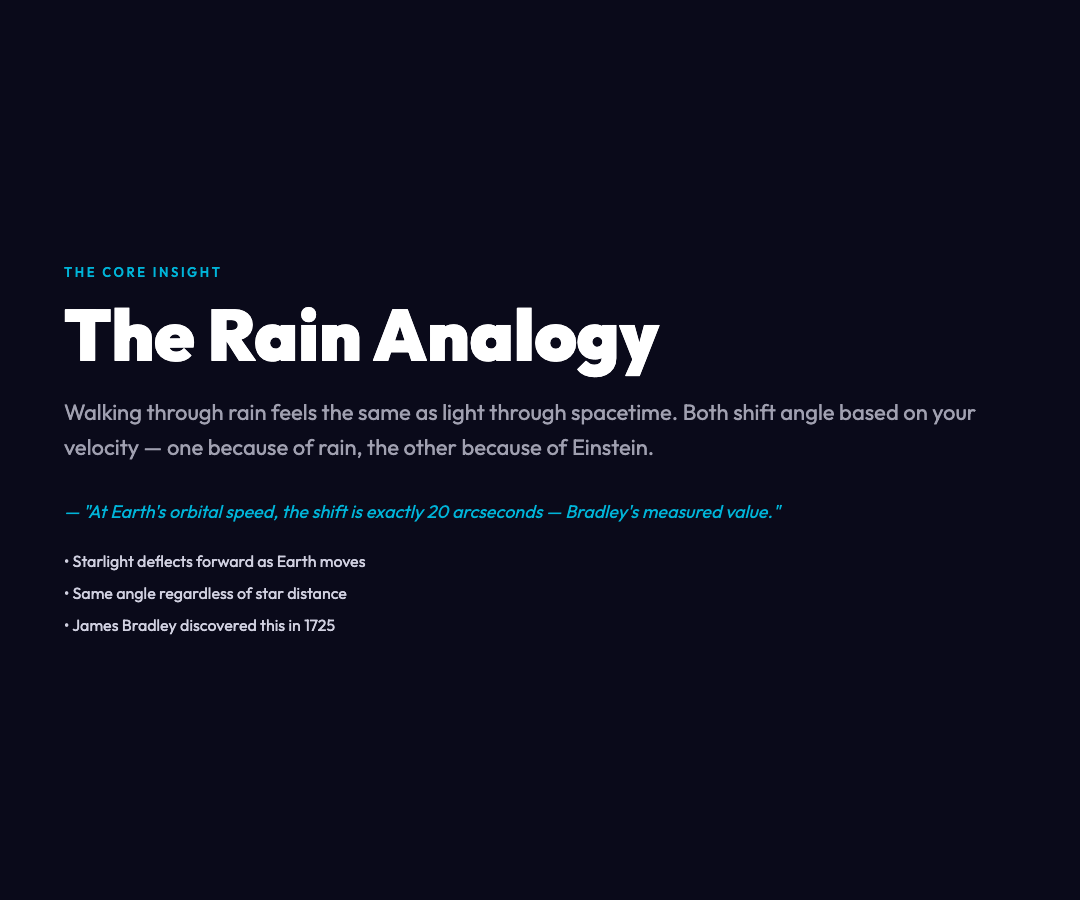
Now replace rain with starlight and walking with Earth orbiting the Sun at 30 kilometers per second. Stars appear to shift position not because they moved, but because the observer (us) is moving. Light from a star ahead arrives at an angle corresponding to our velocity. This is stellar aberration.
Bradley’s 20 arcsecond shift wasn’t a star’s actual movement — it was a geometric record of Earth’s speed through space, encoded in the apparent angle of incoming starlight.
The math is straightforward. At low speeds (v ≪ c), the aberration angle α follows:
α ≈ v/c × sin(θ)
where θ is the angle from the direction of motion. At Earth’s orbital speed, this gives Bradley’s 20 arcseconds — exactly what he measured.
Special Relativity Makes It Exact
Classical aberration was known. But Einstein’s 1905 paper on special relativity gave it precise form. The relativistic aberration formula is:
tan(θ’) = sin(θ) / [γ(cos(θ) – v/c)]
where γ = 1/√(1 – v²/c²) is the Lorentz factor. This reduces to the classical formula at low speeds, but diverges dramatically as v approaches c.
Here’s the key insight: as speed increases, light doesn’t just deflect slightly. The entire field of view warps. Stars that were behind you start appearing ahead. The sky itself compresses in the direction of motion.
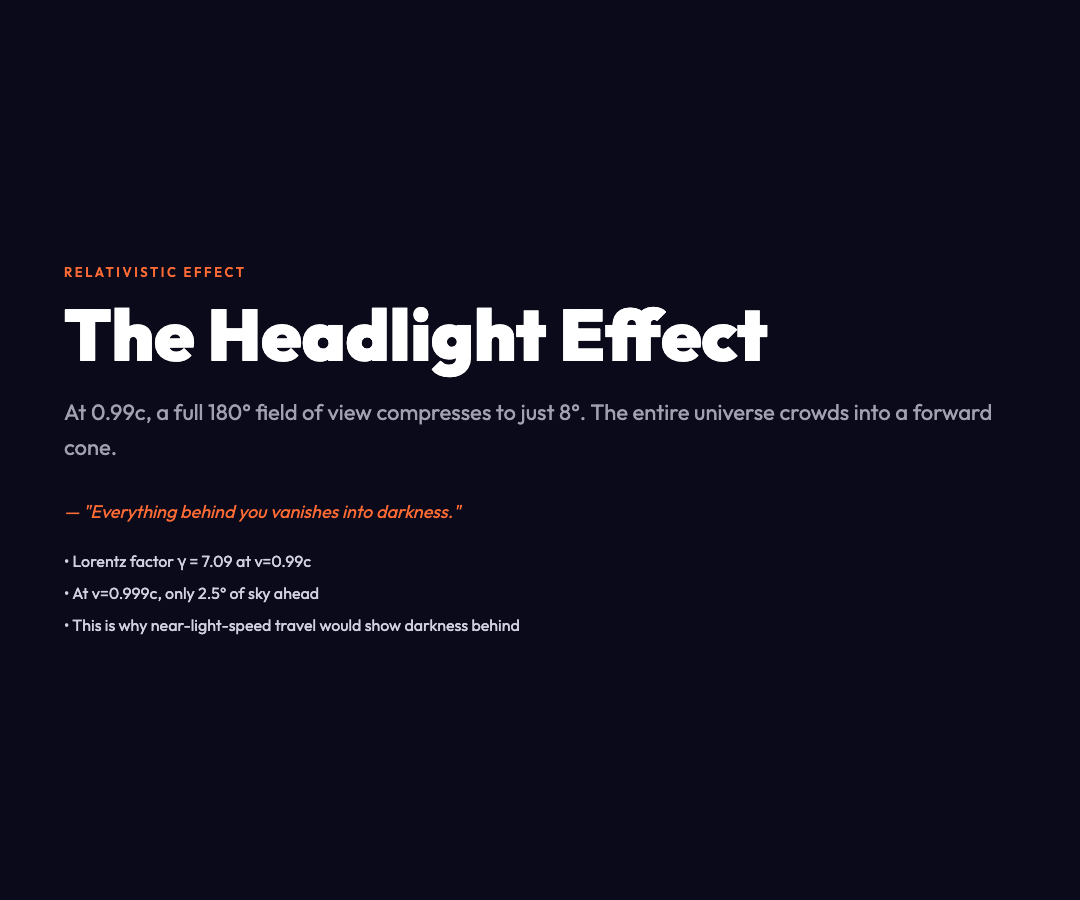
At v = 0.5c, a star that was at 90° (directly sideways) now appears at 69°. At v = 0.9c, it compresses to 37°. At v = 0.99c, it reaches just 8° from straight ahead. The universe begins to look like it’s all in front of you.
This is the relativistic headlight effect — the reason near-light-speed travel would make the entire cosmos appear concentrated in a shrinking cone ahead, with darkness behind.
The Headlight Effect at the Cosmic Scale
When an observer moves at relativistic speeds, photons from all directions get aberrated forward. In the extreme limit (v → c), nearly all visible starlight is compressed into a tiny forward cone. Everything behind you vanishes into darkness.
The Lorentz factor γ encodes how extreme this compression becomes:
| Velocity | γ (Lorentz Factor) | 180° compresses to… |
|---|---|---|
| 0.1c | 1.005 | 84° |
| 0.5c | 1.15 | 69° |
| 0.9c | 2.29 | 37° |
| 0.99c | 7.09 | 8° |
| 0.999c | 22.4 | 2.5° |
The universe doesn’t just look different at near-light speed — it looks smaller. Distant stars that were once visible in every direction crowd into an ever-narrowing forward window.
Three Real-World Applications You Use Every Day
1. GPS Satellite Navigation
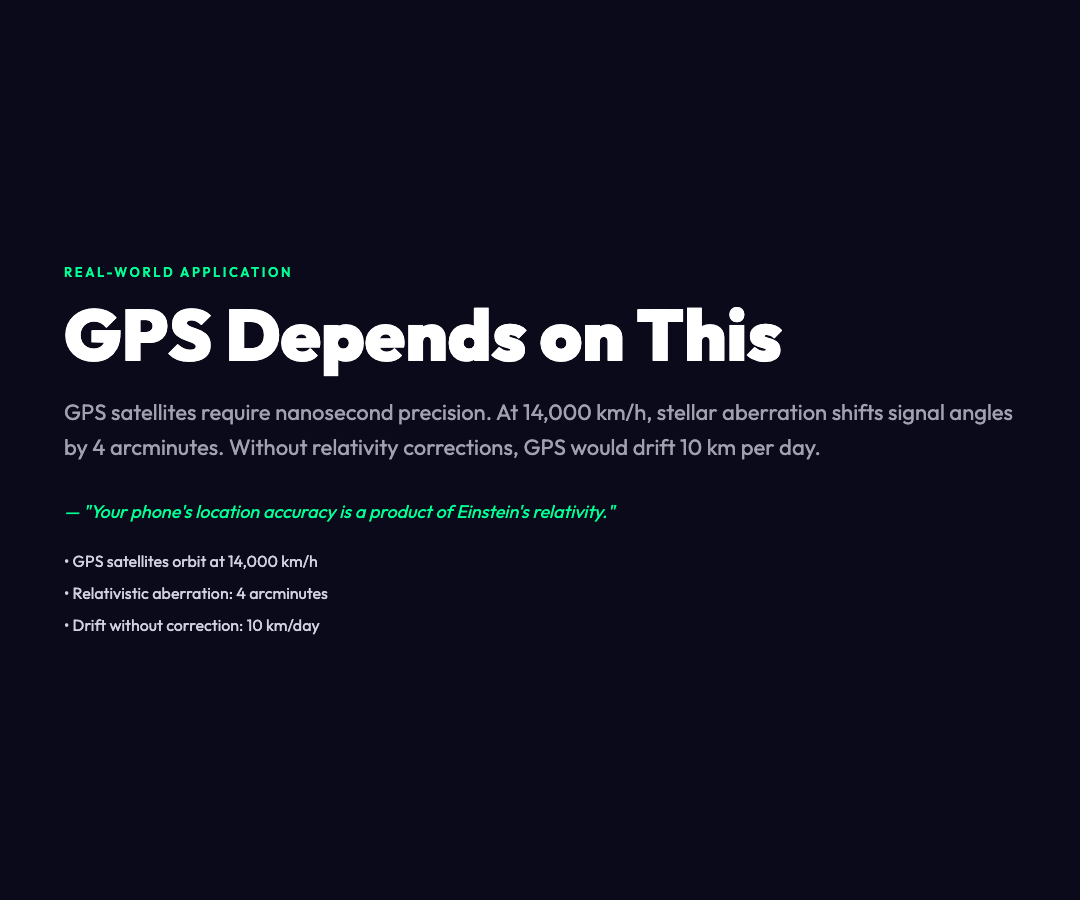
GPS satellites orbit at about 14,000 km/h — roughly 0.0004% of light speed. That seems negligible, but GPS requires timing precision to nanoseconds. At that velocity, stellar aberration shifts signal reception angles by about 4 arcminutes. Without relativistic corrections, GPS would drift by 10 kilometers per day. Your phone’s location accuracy is, literally, a product of Einstein’s relativity.
2. High-Precision Astronomy
Modern astrometry missions like Gaia map over a billion stars with microarcsecond precision. At this precision level, stellar aberration from Earth’s motion must be modeled continuously. The effect varies with satellite velocity, orbital eccentricity, and even atmospheric refraction. Getting star positions right means getting relativity right first.
3. Cosmic Ray Physics
Cosmic rays arrive at Earth from all directions. But Earth itself is moving around the Sun at 30 km/s, and the Solar System moves around the galaxy at 230 km/s. The observed direction of cosmic ray arrival is aberrated by this combined motion. Correcting for this reveals the true source distribution of cosmic rays across the sky.
Why This Visualization Matters
The Stellar Aberration visualization at ElysiaTools lets you see this effect directly. Switch between the rest frame and moving frame views. Adjust velocity from stationary to 0.99c. Watch the Lorentz factor climb and the aberration angle expand. Observe how the entire star field compresses forward as you approach light speed.
What Bradley spent three years puzzling through with paper and telescope, you can now see in real time — with interactive sliders.
The universe has a peculiar honesty about it. When you move, everything shifts. Light doesn’t care that you think you’re standing still. The angles change, the sky warps, and the cosmos itself keeps a precise geometric record of your motion.
Bradley set out to prove Earth orbits the Sun. He ended up proving something more profound: that motion through space changes the very geometry of what you see.
Try it: Stellar Aberration Visualization — adjust velocity from 0 to 0.99c and watch the headlight effect unfold in real time.
Tags: stellar-aberration, special-relativity, physics, james-bradley, GPS, astrometry, lorentz-factor, relativistic-effects, astronomy