
The Invisible Rainbow That Runs Everything: A Journey Through the Electromagnetic Spectrum
You are swimming in it right now. Reading these words, your eyes are detecting visible light — a thin ribbon of electromagnetic waves wedged between infrared heat and ultraviolet sunburn. But the spectrum stretches far beyond what any human has ever seen: from radio waves taller as mountains to gamma rays smaller than an atom’s nucleus.
The electromagnetic spectrum is the most consequential piece of physics you encounter every single day. Your phone, your microwave, your dentist’s X-ray machine, the sun warming your face — all different expressions of the same phenomenon. Yet most people have never seen it as a unified whole. This interactive visualization at ElysiaTools changes that.
The Ocean of Invisible Colors
Physicists describe electromagnetic waves with three properties that are locked together by one of the simplest equations in science:
c = λf   (speed of light = wavelength × frequency)
E = hf   (photon energy = Planck's constant × frequency)
The spectrum spans more than 15 orders of magnitude in wavelength — a range so vast that your brain literally cannot compress it into intuition. Radio waves can be hundreds of kilometers long. Gamma rays can be smaller than the nucleus of a carbon atom. They all travel at the same speed through vacuum: 299,792,458 meters per second.

What changes is what they do to matter.
Radio Waves: The Slow Giants
Radio waves occupy the longest wavelength end of the spectrum, ranging from 1 millimeter to over 100 kilometers. Their frequencies run from 3 kHz to 300 GHz.
The remarkable thing about radio waves is their politeness — they go around obstacles. Long-wave radio bends along the Earth’s surface (ground wave propagation). Short-wave radio bounces off the ionosphere and can circle the globe multiple times (sky wave propagation). This is how AM radio stations in the 1920s could be heard hundreds of kilometers from their transmitters.
Every time you connect to Wi-Fi, stream music via Bluetooth, or talk on a cell phone, you are manipulating radio waves. So is the radar gun a police officer points at your car. So are the satellite signals that tell your car’s GPS where it is on Earth.
The Cosmic Microwave Background — the oldest light in the universe, released 380,000 years after the Big Bang — sits in the microwave band. It fills the entire sky with a temperature of 2.725 Kelvin, a nearly perfect afterglow of creation.
Microwaves: Cooking the Universe
Microwaves (1 mm to 1 m wavelength, 300 MHz to 300 GHz) have a peculiar distinction: they are the band that humans use most deliberately to transfer energy into food.
Your microwave oven operates at exactly 2.45 GHz — a frequency chosen precisely because water molecules resonate at that frequency and convert the wave energy into thermal motion. This is not an accident. It is engineered thermodynamics.
But microwaves do far more than heat leftovers. The same frequency band carries satellite TV, satellite internet, and radar signals. Radio astronomers point microwave receivers at the sky and detect the faint hiss of the cosmic microwave background. Weather satellites measure atmospheric water vapor with microwaves. The next time you see a detailed weather map, thank a microwave sensor.
Infrared: The Heat Signature
Infrared (700 nm to 1 mm wavelength, 300 GHz to 430 THz) is what your skin detects as warmth from the sun, from a fire, or from another person. You cannot see infrared, but you feel it constantly.
About half of the sun’s energy output reaches Earth as visible light. Another half arrives as infrared. When you stand in sunlight and feel the warmth, most of that sensation is infrared radiation striking your skin.
Earth’s surface also radiates infrared into the atmosphere — and this is where things get politically charged. Greenhouse gases like CO₂ and methane absorb and re-emit infrared radiation, trapping heat that would otherwise escape into space. This natural effect keeps Earth’s average temperature about 33°C warmer than it would be otherwise. The problem is that human emissions have intensified it.
Your body’s thermal image, viewed through an infrared camera, is essentially a map of infrared emission. Night-vision goggles amplify infrared. Remote controls send signals in infrared. Fiber optic cables carry data using near-infrared light.
Visible Light: The Narrow Window
Then — in the middle of this enormous spectrum — there is a sliver less than a factor of 2 wide that the human eye can detect. Visible light runs from 400 nm (violet) to 700 nm (red), with frequencies from 430 THz to 750 THz.
Why these wavelengths specifically? Because water — which dominated early life in Earth’s oceans — absorbs light most strongly outside this range. Evolution selected for the narrow window where photons pass through water with least resistance. Life didn’t discover the electromagnetic spectrum; it found the only door that was open.
Different wavelengths in this narrow band correspond to different colors: red at 700 nm, orange, yellow, green around 555 nm (where the human eye is most sensitive), blue, violet at 400 nm. This is not an arbitrary classification — it is a direct map of photon energy. Red photons carry about 1.8 eV of energy. Violet photons carry about 3.1 eV, nearly double.
Ultraviolet: The Energizer
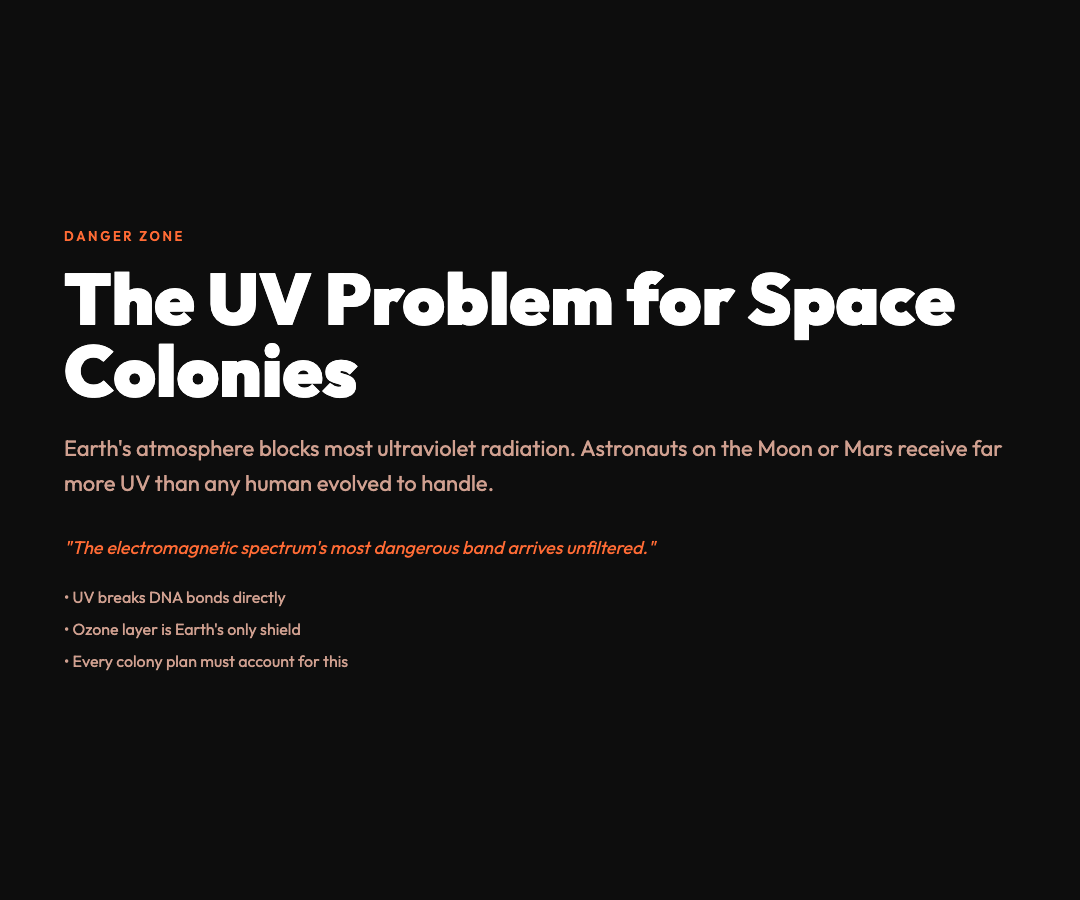
Ultraviolet (10 nm to 400 nm, 750 THz to 30 PHz) carries enough energy per photon to break chemical bonds — including the bonds in DNA. This is why UV causes sunburn and skin cancer.
The sun is extremely rich in ultraviolet, but Earth’s atmosphere blocks most of it. The ozone layer absorbs UV-C (the shortest, most dangerous wavelengths) and much of UV-B. Without this atmospheric shield, life on Earth’s surface would be sterilized.
This fact has a curious implication for space travel. Astronauts on the Moon or Mars receive far more UV radiation than any human evolved to handle. Every plan to colonize another world must account for the fact that the electromagnetic spectrum’s most dangerous band arrives unfiltered.
UV has productive uses too. UV-C light sterilizes medical equipment and water. UV exposure hardens and tans skin (a defense response). Forensic investigators use UV to reveal bodily fluids and counterfeit currency.
X-Rays: Into the Body
X-rays (0.01 nm to 10 nm, 30 PHz to 30 EHz) have enough energy to pass through soft tissue but are absorbed by bones and dense materials. This is the same property that makes them both medically useful and dangerous.
When Wilhelm Röntgen discovered X-rays in 1895 and took the first X-ray image of his wife’s hand, he had no idea he was looking at a tool that would become indispensable to modern medicine. Within months, X-ray imaging was being used in hospitals worldwide.
The CT scan — which stacks thousands of X-ray measurements into a three-dimensional image — can resolve structures smaller than a millimeter inside a living body. No surgery required.
Materials scientists use X-ray diffraction to determine crystal structures. Crystallographers fired X-rays at DNA and discovered its double-helix structure from the diffraction pattern. X-ray fluorescence reveals the elemental composition of ancient Roman coins without damaging them.
But the energy that lets X-rays see inside the body is the same energy that damages it. Each X-ray photon ionizes molecules as it passes through, breaking bonds and generating free radicals. Medical imaging uses the minimum dose necessary. Repeated exposure accumulates risk.
Gamma Rays: The Nuclear Fire
Gamma rays (below 0.01 nm wavelength, above 30 EHz) are produced by nuclear reactions: radioactive decay, nuclear explosions, the collision of matter and antimatter, the death of massive stars.
A single gamma-ray photon can carry energy equivalent to millions of visible-light photons. This energy destroys biological molecules on contact. Gamma radiation is what makes nuclear waste so dangerous to handle — and what makes it useful for killing cancer cells in radiation therapy.
Gamma-ray bursts are the most violent events in the observable universe. When a massive star collapses into a black hole, it can release more energy in seconds than the sun will emit over its entire 10-billion-year lifetime — and most of that energy is gamma rays. The burst outshines entire galaxies.

If you could see gamma rays, the night sky would look like a strobe light. NASA’s Fermi Gamma-ray Space Telescope detects these explosions several times per week from across the cosmos.
The Unified Spectrum
The remarkable thing about the electromagnetic spectrum is that it is genuinely one phenomenon. Radio waves and gamma rays are not different kinds of things — they are the same wave, differing only in wavelength and the energy each photon carries.
This unity has practical consequences. The principles governing a radio antenna are the same principles governing an X-ray diffraction pattern. The equations Maxwell wrote in 1865 describe all of it, from the radio waves that carry your voice to the gamma rays that emerged from the first nuclear reactions in the universe.
Try the interactive electromagnetic spectrum visualization at ElysiaTools. Slide through the bands, watch the wave animations adjust their frequency and wavelength, and see how photon energy changes across 15 orders of magnitude. It is one of the most complete spectrum tools available — free, browser-based, and surprisingly addictive to explore.
The next time you adjust your radio, microwave dinner, get an X-ray at the dentist, or feel sunlight on your skin — you will know that you are interacting with the same fundamental force, wearing seven different masks.