The Algorithm That Separates Ariana Grande from the Orchestra — Without Access to the Original Stems
Every karaoke night, you have a singer to thank: the neural networks that learned to hear music like a forensic scientist.
The Problem That Should Be Impossible
Imagine you’re handed a single audio file — a finished studio recording, everything already mixed down into two channels. Your task: pull out just the singer’s voice, nothing else. No multitrack sessions. No isolated stems. Just the final stereo mix.
This is called the cocktail party problem, and for decades it was considered unsolvable.

Human auditory processing is extraordinary. You can follow a single conversation in a noisy café without consciously trying. Your brain does something called auditory scene analysis — it groups frequencies, tracks harmonic relationships, and separates sources based on their spatial location, timbre, and pitch continuity. But we have no idea exactly how the brain does it. We can’t write down the algorithm.
And yet, starting around 2019, a series of AI models began solving this problem — not by mimicking the human brain, but by learning millions of examples until they internalized the statistical structure of what a vocal sounds like inside a mix. Not the physics of sound — the patterns.
The model doesn’t know what a voice is. It just knows that in this frequency range, when this harmonic series appears, the probability that it belongs to the lead vocal is very high.
The result: tools like Audio Dialog Isolation — powered by engines like Spleeter (from Deezer) and Demucs/MDX — that can take any MP3 and return two separate files: the vocals and the accompaniment.
What Actually Happens Inside the Black Box
The two dominant approaches are Spleeter and Demucs/MDX. They work differently under the hood, but they share the same high-level goal.
Spleeter uses a convolutional neural network (CNN) trained on spectrograms. It converts the audio into a time-frequency representation called a spectrogram — essentially a 2D heat map showing which frequencies are present at which moments. The CNN learns to classify regions of this spectrogram as “vocal” or “other.” At inference time, it generates two spectrograms — one for vocals, one for accompaniment — and converts them back to audio using a phase reconstruction algorithm.
Demucs (from Facebook AI, now Meta) takes a different approach. It’s based on a U-Net architecture — the same family of models used in image segmentation — operating directly on the waveform. It encodes the raw audio through successive downsampling layers, processes the compressed representation, then decodes back to the original length. Because it works on the raw waveform rather than spectrograms, it can capture certain fine-timing details that spectrogram-based methods lose.
Both approaches treat music source separation as a supervised learning problem: you train on mixes paired with their isolated stems. The quality of the model depends almost entirely on how good the training data is — and getting clean, professionally separated stems at scale is expensive and time-consuming.
The practical implication: these tools work better on commercially produced music (where the recording quality is consistent and the mix is clean) than on live recordings, lo-fi bedroom tracks, or heavily processed vocals (autotune, pitch correction, doubling).
Why This Matters Beyond Karaoke
Stripping vocals from music sounds like a party trick. But the real applications are far more serious.

Music education. A student learning guitar can isolate the bass line from a song and transcribe it note-for-note. A vocalist can remove their own voice from a recording to hear what the band sounds like without them — a surreal but useful exercise for self-critique.
Sound design and sampling. Producers have always needed isolated elements. Now you can sample a drum break directly from a finished track without recording it off vinyl.
Accessibility. Hearing-impaired listeners often struggle with vocals masked by instrumentation. Isolating the vocal track allows for more aggressive volume boosting without clipping the music.
Forensics and archival. Voice analysts sometimes need to isolate speech from background noise in recordings. The same neural networks that pull vocals from music can be retrained to isolate speech from ambient noise.
Podcast production. A podcast recorded in a room with bad acoustics can be partially remediated by treating the room reverb as “background” and the speech as “vocal.” Modern models are beginning to handle this case, though it’s harder than music separation because speech has less harmonic structure to exploit.
The Technical Limits Nobody Talks About
Here’s what the demos don’t show you.
Transients get mangled. The initial attack of a vocal — the sharp “p” or “t” consonant — has very different spectral characteristics from the sustained vowel sound that follows. Most models handle sustained vowels well but smear or attenuate transients. The result is a vocal that sounds slightly “breathy” or “soft” compared to the original.
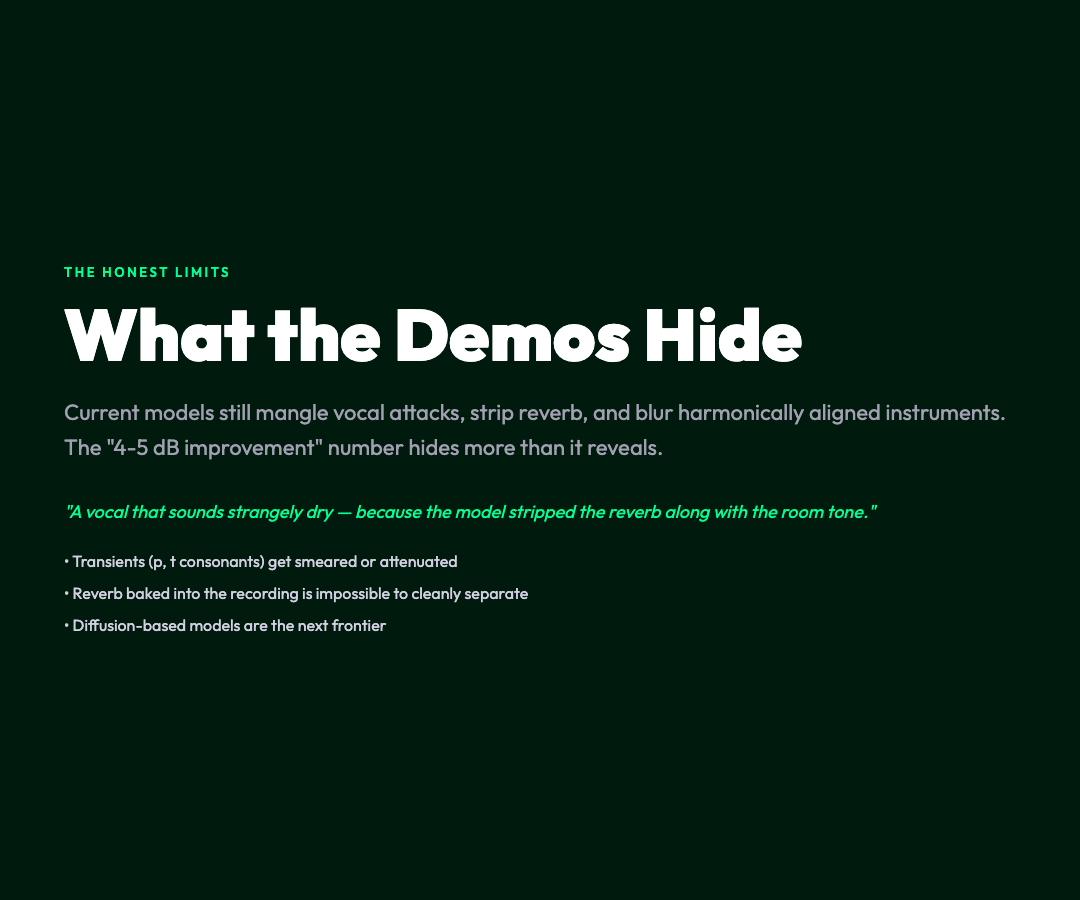
Reverb is ambiguous. A vocal recorded in a cathedral has the room sound baked into the same audio stream as the voice itself. Is the reverb part of the vocal or the accompaniment? Models make an arbitrary decision, and it often shows: isolated vocals from reverb-heavy recordings sound strangely “dry” because the model stripped the reverb along with the room tone.
Harmonic instruments are difficult. A violin playing the same note as the vocalist creates a perceptual grouping problem — the model can’t tell which frequency energy belongs to which source when they’re perfectly harmonically aligned. The result is that vocals often have faint harmonic bleed-through from strings, piano, or guitar.
Phase artifacts. Converting back from a spectrogram to audio requires estimating the phase (the timing information) of each frequency component. The phase estimation algorithm (traditionally the Griffin-Lim algorithm) is imperfect, and even state-of-the-art models produce subtle phase distortions that manifest as a faint “glassy” or “shimmering” quality in the isolated vocals.
How to Use Audio Dialog Isolation
The Audio Dialog Isolation tool at ElysiaTools handles all of this for you with two engine options:
Spleeter (2 stems) — Faster, slightly less accurate, works well for most pop and rock music. It’s based on a CNN trained on a large dataset of commercial music.
MDX/Demucs (2 stems) — Slower but more accurate, especially on complex arrangements. Uses the more modern U-Net waveform approach.
You can choose your output format (WAV, FLAC, MP3, M4A, OGG, or Opus) depending on what you need. WAV and FLAC are lossless; MP3 and OGG are compressed.
The output is delivered as a ZIP file containing both the isolated vocal stem and the isolated accompaniment stem.
The Uncomfortable Side: What This Enables
It’s worth being honest about what music source separation makes easier.
Music piracy has evolved. In the era before these tools, extracting isolated stems required insider access or expensive studio equipment. Now a motivated person with Python and a GPU can do it in minutes. Several services have attempted to commercialize this openly — some legally, some in legally ambiguous territory.
The music industry has largely responded not with legal action against the technology (which is neutral), but with contractual and watermarking approaches to discourage unauthorized stem extraction and distribution. It’s a rearguard action — the genie is out.
On the creative side, the democratization of stems has had a genuinely interesting effect: it has enabled new forms of musical collaboration and remixing that weren’t previously possible outside of professional studios. The technology itself is neutral. What matters is what people do with it.
The Road Ahead
The current state of the art (as of 2024-2025) achieves around 4-5 dB of signal-to-noise ratio improvement over the mixed source — meaning the isolated vocal is about 4-5 times “louder” relative to the accompaniment than in the original mix. That sounds impressive, but psychoacoustically, you can still clearly hear the accompaniment in most cases.
The next frontier is diffusion-based models — the same technology behind image generators like Stable Diffusion — applied to audio. These models generate audio by denoising random noise step by step, and they can be conditioned on specific sources. Early results suggest they produce cleaner separation with fewer phase artifacts than CNN or U-Net approaches, but they’re dramatically slower to run.
There’s also active research into single-channel speech enhancement — separating a single voice from non-musical noise (crowd noise, traffic, cafe chatter) — which is a harder problem because there’s no harmonic structure to exploit. The models that work for music separation don’t transfer well to this domain, and the field is still very much open.
For now, if you need to pull a vocal out of a song, the tools are good enough for most practical purposes. They’re not perfect — but they’re better than anything that existed five years ago, and they’ll be better still in five more years.