The Dead Star That Spins 716 Times a Second
In 1967, a graduate student named Jocelyn Bell Burnell was scanning radio telescope data when she noticed something peculiar: a signal that pulsed every 1.33 seconds with extraordinary regularity. Her first thought — before anyone else’s — was that it might be a signal from extraterrestrials. The data was labeled “LGM-1” (Little Green Men).
It wasn’t aliens. It was a pulsar: a neutron star, the remnant of a massive star that had exhausted its nuclear fuel and collapsed under its own gravity. The pulses were real, but they came from something far stranger than alien broadcasters. They came from a city-sized sphere of degenerate neutron matter spinning in space like a cosmic lighthouse.
That discovery won a Nobel Prize (for her supervisor, controversially — Bell Burnell was not included). And it opened a window into one of the most extreme states of matter in the universe.
What a Neutron Star Actually Is
When a massive star — somewhere between 8 and 30 solar masses — finishes burning its nuclear fuel, the outward pressure that had been holding it up suddenly disappears. The core collapses. In less than a second, a sphere roughly the size of Manhattan (about 10 kilometers across) forms, containing slightly more mass than our Sun.
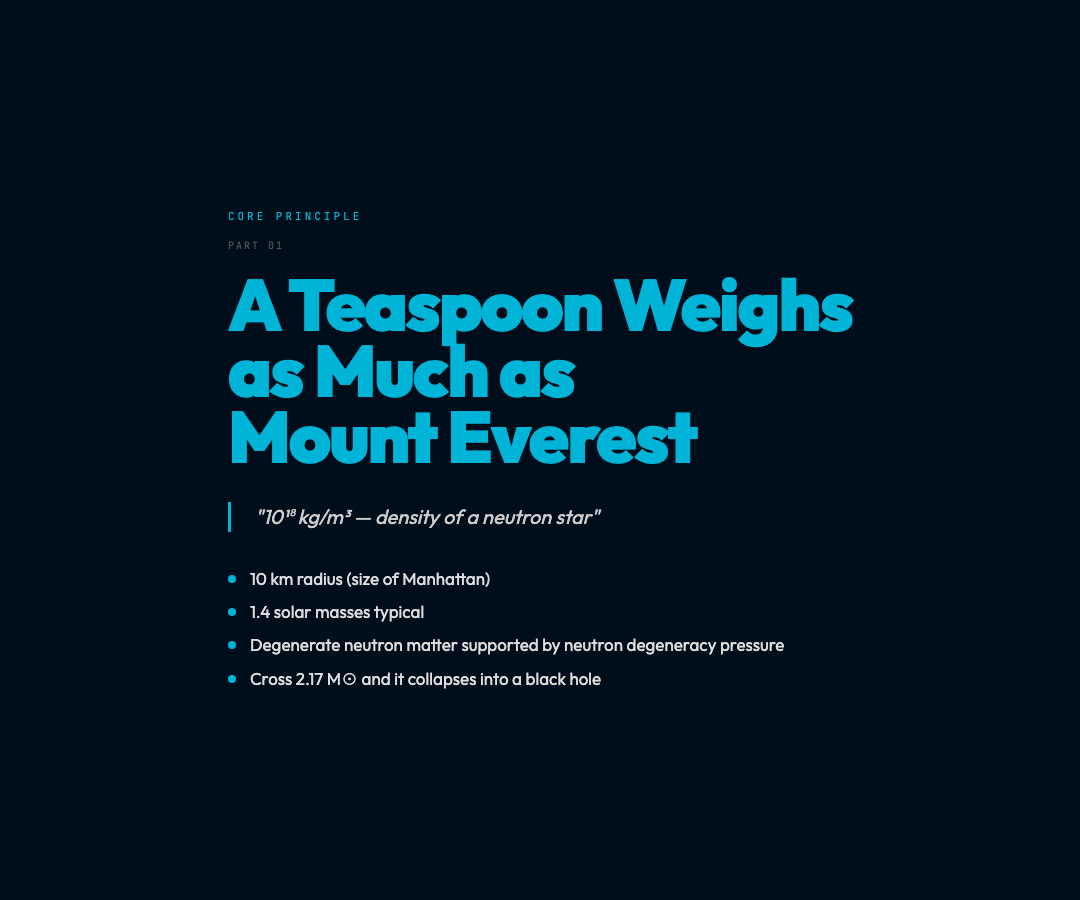
The density is staggering: 10¹⁸ kg/m³ — the same density as an atomic nucleus. A teaspoon of neutron star material would weigh about as much as Mount Everest. The gravity is so intense that atoms themselves are crushed. Electrons are forced into protons, forming neutrons. Hence the name.
This collapse does something remarkable: it conserves angular momentum. The slow-rotating core of a massive star collapses from millions of kilometers across to just 10 kilometers. Just like a spinning ice skater pulling in their arms, the rotation speeds up dramatically. What was a slow-spinning star becomes a rapidly rotating neutron star — some of them completing hundreds of revolutions per second.
The fastest known neutron star, PSR J1748-2446ad, spins at 716 times per second. At its equator, that means a point on the surface moves at about 15% the speed of light.
Pulsars: Cosmic Clocks in the Sky
The pulsar effect — that regular “lighthouse beam” — arises because neutron stars have enormously strong magnetic fields, typically around 10⁸ Tesla. (Earth’s magnetic field is about 0.00006 Tesla.) These fields are misaligned with the star’s rotation axis, so the magnetic poles sweep through space as the star spins.

When those beams happen to point toward Earth, we detect them as regular pulses of radio waves (or occasionally X-rays or gamma rays). The pulse period is astonishingly stable — more stable than atomic clocks over long intervals. Some pulsars rival the best atomic clocks in precision.
This stability makes them extraordinarily useful. The Hulse-Taylor binary pulsar (PSR B1913+16), discovered in 1974, provided the first indirect evidence for gravitational waves — energy leaving the system at exactly the rate predicted by Einstein’s general relativity. The orbital decay matched theory to within 0.2%. That discovery won Hulse and Taylor the 1993 Nobel Prize.
The TOV Limit: How Heavy Can It Get?
Neutron stars are defined by a mass-radius relationship governed by the Tolman-Oppenheimer-Volkoff (TOV) limit — the maximum mass a neutron star can support against gravitational collapse. That limit sits somewhere around 2.17 solar masses. Cross it, and the neutron star collapses into a black hole.
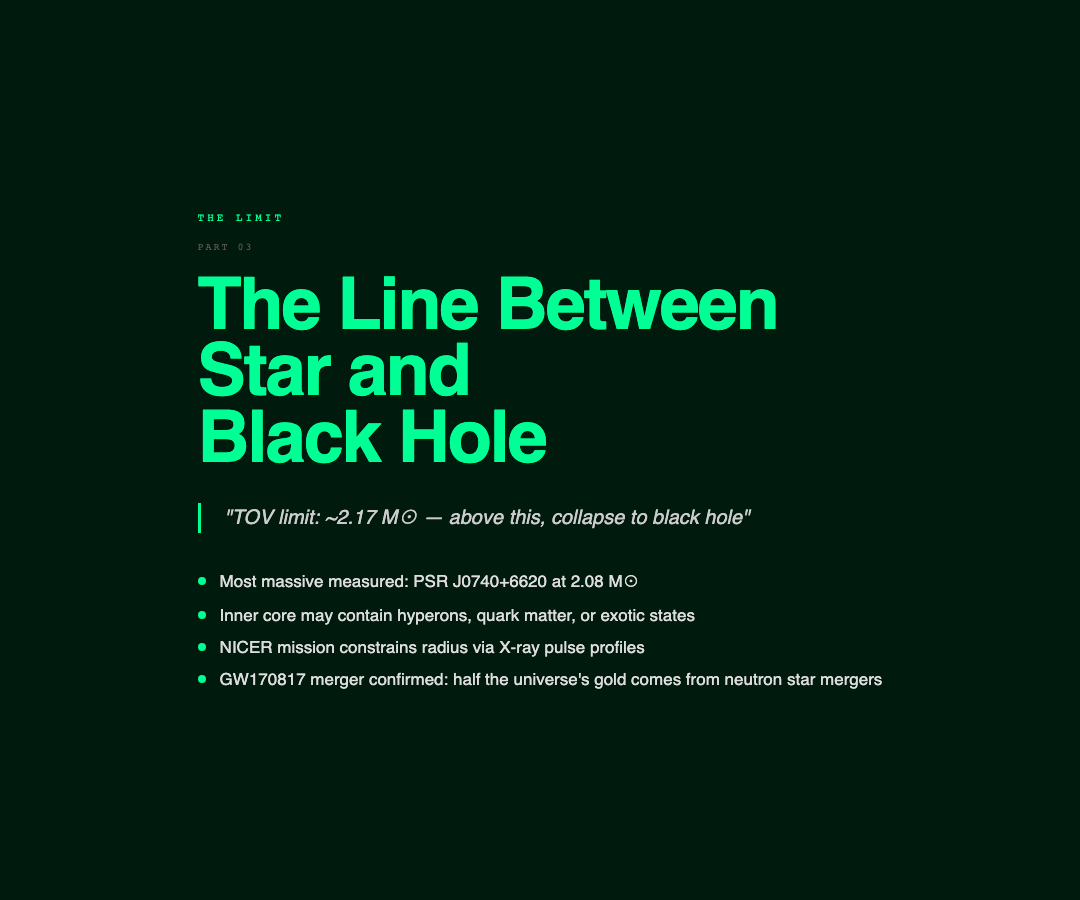
The most massive reliably measured neutron star is PSR J0740+6620, weighing in at 2.08 ± 0.07 solar masses with a radius of about 12 kilometers. Add just a fraction more mass, and the degeneracy pressure that had been holding it up finally loses to gravity.
This is where things get uncertain. The exact TOV limit depends on the equation of state — how pressure responds to density in the ultra-dense interior. And that’s where the interesting physics lives, because at these densities, we don’t fully understand what matter is doing.
What’s Inside: Four Layers of Weird
The inside of a neutron star is layered, and each layer is stranger than the last:
The Crust (~1 km thick): A solid lattice of iron-group atomic nuclei embedded in a sea of electrons. Density rises from about 10⁹ g/cm³ at the surface to 10¹⁴ g/cm³ at the crust-core boundary. Strange things happen here: atomic nuclei can become increasingly neutron-rich, and the crust may form exotic structures called “nuclear pasta” — shapes resembling lasagna, spaghetti, or waffles depending on density.
The Outer Core (~5 km): A superfluid mixture of neutrons with a small fraction of protons and electrons. Both the neutrons and the protons become superconducting. This is where most of the star’s mass lives.
The Inner Core (~3 km): This is where physics becomes genuinely uncertain. At densities above 2-3 times nuclear saturation density, the composition is unknown. Candidates include:
– Hyperons: particles containing strange quarks that become energetically favorable at high density – Quark matter: deconfined up and down quarks, possibly forming a color superconducting state – Exotic states: entirely new forms of matter that don’t exist anywhere else in the universe
The Atmosphere (a few centimeters): A thin plasma layer where the magnetic field shapes the emission. For magnetars, this is where the most energetic phenomena occur.
Magnetars: When the Field Goes Cosmic
Most neutron stars have magnetic fields around 10⁸ to 10⁹ Tesla. Then there are magnetars — a subset where the field reaches 10¹⁰ to 10¹¹ Tesla. This is roughly 100 trillion times Earth’s field. It’s the strongest magnetic field known to exist in the universe.
The energy stored in these fields is immense, and they power some of the most violent events in the cosmos:
– Giant flares: Sudden reconfiguration of the magnetic field releases up to 10⁴⁶ joules in a tenth of a second — more energy than the Sun emits in 100,000 years. The 2004 flare from SGR 1806-20 was detected across the solar system, brightening Earth’s upper atmosphere. – Starquakes: The rigid outer crust cracks under magnetic stress, releasing energy in bursts. – Soft gamma-ray repeaters (SGRs) and anomalous X-ray pulsars (AXPs): Classes of objects powered by magnetic field decay.
Neutron Star Mergers: Where Gold Is Born
The most dramatic neutron star event is a merger — two neutron stars spiraling into each other and colliding. These events are now among the most important in astrophysics.
GW170817 (August 17, 2017) was the first detected binary neutron star merger, observed by LIGO and Virgo. The event was also observed across the electromagnetic spectrum, confirming the kilonova hypothesis: the merger blasts out a cloud of neutron-rich debris where heavy elements — gold, platinum, uranium — are synthesized in seconds via the r-process (rapid neutron capture). Half of the elements heavier than iron in the universe were likely created this way.
The merger also confirmed that such events are the source of gravitational waves detectable on Earth, that short gamma-ray bursts are produced in these collisions, and that neutron star matter can produce the electromagnetic counterpart to gravitational wave events — a new era of multi-messenger astronomy.
Why We Can’t Quite Predict What They’d Look Like
Here’s the embarrassing truth: we can’t tell you exactly what the inside of a neutron star looks like, because the physics is too extreme to recreate and too uncertain to compute reliably from first principles.
The NICER mission (Neutron star Interior Composition Explorer) on the International Space Station is trying to change that. By precisely measuring the pulse profiles of X-ray emitting millisecond pulsars, NICER can infer their mass and radius simultaneously, which constrains the equation of state. Early results suggest radii around 11-12 km and are ruling out some of the softer equations of state.
Future gravitational wave detectors — the Einstein Telescope and Cosmic Explorer — will detect many more neutron star mergers with far greater precision, yielding independent constraints on the equation of state from the tidal deformability measured during the inspiral.
What the Visualization Shows You
The Neutron Stars Interactive Visualization lets you explore this extreme object directly:
– Mass and radius slider: See how different proposed equations of state map mass to radius. Try to find the edge of what’s allowed before collapse to a black hole. – Pulsar rotation speed: Watch how the rotation rate changes with mass and radius. Understand why some neutron stars spin at 700+ Hz. – Binary system: Watch how the orbital period changes as the stars spiral together — exactly as measured in the Hulse-Taylor system. – Magnetar field effects: See how extreme magnetic fields affect the emission and what happens during starquakes and giant flares. – TOV constraint: Plot your chosen mass-radius relationship and see how close it gets to the TOV limit.
No instrument can take you to a neutron star. But this visualization can take a neutron star to you — letting you manipulate mass, spin, and magnetic field and watch what happens when physics runs at its absolute limit.
The neutron star sits at the edge of what physics can describe: dense enough to pack a solar mass into a city, strong enough to beam lighthouse signals across the galaxy, and strange enough that we still don’t fully know what lives in its core.
It’s not Little Green Men. It’s something that makes the truth feel more interesting anyway.