Why a Swinging Ball Traces a Perfect Circle Without Ever Moving Toward the Center
Tie a string to a weight. Swing it in a circle so the string sweeps out a cone. The weight moves in a horizontal circle at constant speed, while the string itself rotates — the ball never moves closer to the center or further away. It simply circles, perfectly balanced, as if held by an invisible rail.
This is the conical pendulum, and it is one of the cleanest examples of circular motion in classical mechanics. Unlike a simple pendulum that swings back and forth, or a planet orbiting a star that speeds up and slows down, the conical pendulum traces a circle at constant speed with no changing distance. Understanding why requires following the forces — and the math is surprisingly elegant.
The Setup: What Makes a Conical Pendulum Different
A regular pendulum swings in a plane. A conical pendulum swings in a cone. The bob travels in a horizontal circle while the string sweeps out a conical surface. The angle between the string and the vertical is constant — this is the defining feature.
The key variables are the string length L, the angle θ the string makes with the vertical, and the angular velocity ω (how fast the bob circles). These three quantities are locked together by a simple relationship:
ω² = g / (L × cos θ)
Or equivalently, the period T of one full rotation:
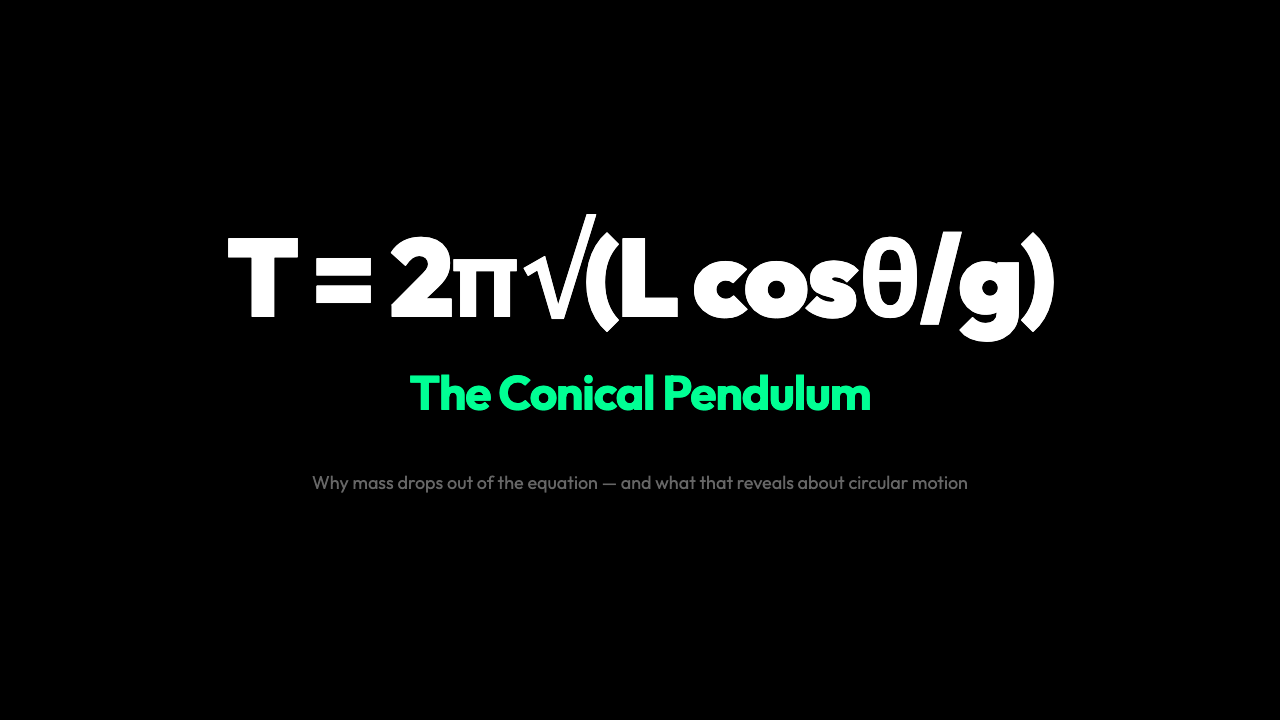
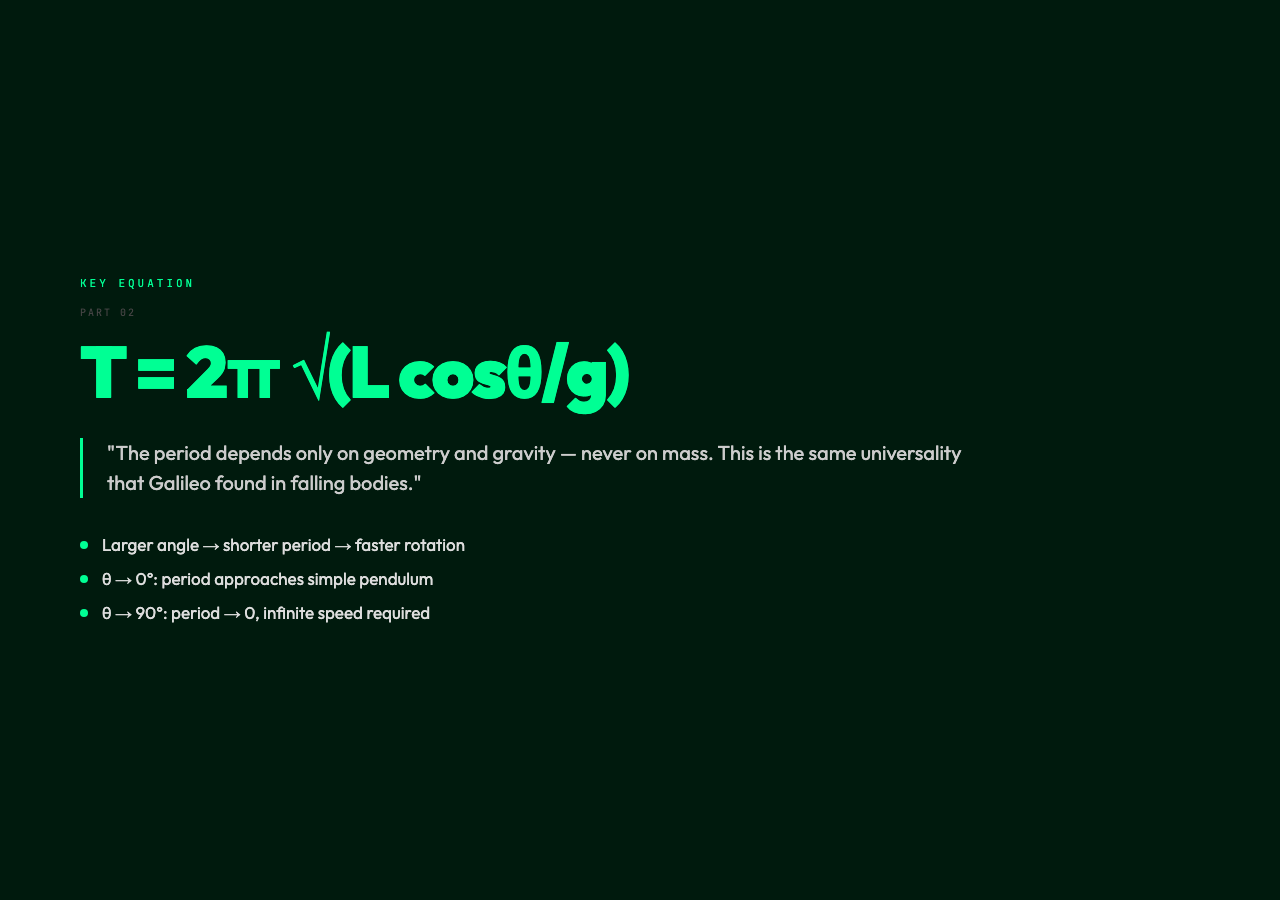
T = 2π × √(L × cos θ / g)
Notice what this equation says: the period depends only on the angle and the length. It does not depend on the mass of the bob. A 10-gram steel ball and a 10-kilogram wrecking ball attached to the same string, at the same angle, will complete their circles in exactly the same time. This is the same universality that Galileo discovered with falling objects — mass drops out of the equation entirely.
The Force Balance: Why Gravity and Tension Cooperate
Two forces act on the bob: gravity pulling straight down (mg), and the string tension (T) pulling along the string toward the pivot point. The string is not vertical — it tilts at angle θ, so the tension has both a vertical component and a horizontal component.

The vertical component of tension exactly balances gravity:
T × cos θ = mg
This keeps the bob from accelerating vertically. The horizontal component of tension provides the exact centripetal force needed to keep the bob moving in a circle:
T × sin θ = m × ω² × r
Where r is the radius of the circle traced by the bob. Since r = L × sin θ, these two equations together give the relationship between angular velocity and angle that defines the conical pendulum.
The Period Formula: A Surprising Result
Combining the force equations yields something elegant. The tension T cancels out, leaving:
ω² = g / (L × cos θ)
Or, expressed as the period of one revolution:
T = 2π × √(L × cos θ / g)
Compare this to a simple pendulum swinging back and forth with small amplitude:
T_simple = 2π × √(L / g)
The conical pendulum takes longer to complete one full circle than a simple pendulum takes for one back-and-forth swing — because cos θ is always less than 1, making L × cos θ smaller than L.
If the angle θ approaches 90° (string nearly horizontal), cos θ approaches zero and the period approaches zero — the bob must spin infinitely fast to maintain a nearly horizontal circle. If θ approaches 0° (string nearly vertical), cos θ approaches 1 and the period approaches that of a simple pendulum.
What the 3D Visualization Reveals
The ElysiaTools simulation shows the conical pendulum from multiple angles simultaneously. The 3D view makes the cone shape visible — you can see the string sweeping out a conical surface as the bob circles. The force diagram shows the tension vector, gravity, and the horizontal centripetal force decomposing in real time.
The motion chart plots the bob’s horizontal trajectory — it should trace a perfect circle if conditions are stable. In practice, any small perturbation causes the radius to slowly change, which is why real conical pendulums eventually spiral inward or outward unless carefully controlled.
This is also why a conical pendulum is used in some amusement park rides: the “conical pendulum” effect keeps riders pressed against the wall as the floor drops away. The faster the rotation, the larger the angle θ, the more horizontal the string becomes — and the greater the centripetal force pressing the rider against the wall.
The Centripetal Force: No Magic Required
The most common confusion about the conical pendulum is what provides the centripetal force pushing the bob toward the center of its circle. The answer: the horizontal component of the string tension is the centripetal force. Nothing pulls the bob toward the center — the string pushes it toward the center, at just the right rate to keep it moving in a circle rather than flying off tangentially.

If the string were cut, the bob would continue in a straight line tangent to the circle — not toward the center. This is Newton’s first law. The string’s tension redirects the bob’s natural straight-line motion into a circle, and the precise angle θ determines exactly how much redirection is needed.
Why This Matters
The conical pendulum is a gateway to understanding all circular motion — from electrons orbiting atomic nuclei to satellites in stable orbits. The same force-balance equations apply. The universality (mass independence) appears again and again in physics, and the conical pendulum makes it visible and tangible in a way that planetary orbits cannot.
The next time you see a ball on a string spinning in a cone, look for the forces, check the angle, and verify: the period depends only on the geometry, never on the mass.