Why Acid Rain Still Matters — Even as Coal Plants Disappear
In the summer of 1974, a researcher named Gene秧 noticed something strange in the lakes around Sudbury, Ontario. The water was clear. Fish were absent. The pH had dropped so low that the lakes had become chemically hostile to life — not from toxins or oxygen depletion, but from something far simpler: rain that had turned mild acid.
It was not a new phenomenon. But it was finally being measured with precision. And what the data showed challenged a comfortable assumption: that “clean” rain — rain with no visible pollution, no smog, no odor — was automatically safe.
It was not.
The Chemistry Hiding in Every Cloud
Acid rain begins with a sequence so ordinary it seems almost trivial. Power plants burn coal. Cars combust gasoline. Factories process sulfur-bearing ore. Each of these releases two invisible gases: sulfur dioxide (SO₂) and nitrogen oxides (NOₓ). They drift upward, mix with the atmosphere, and encounter water vapor.
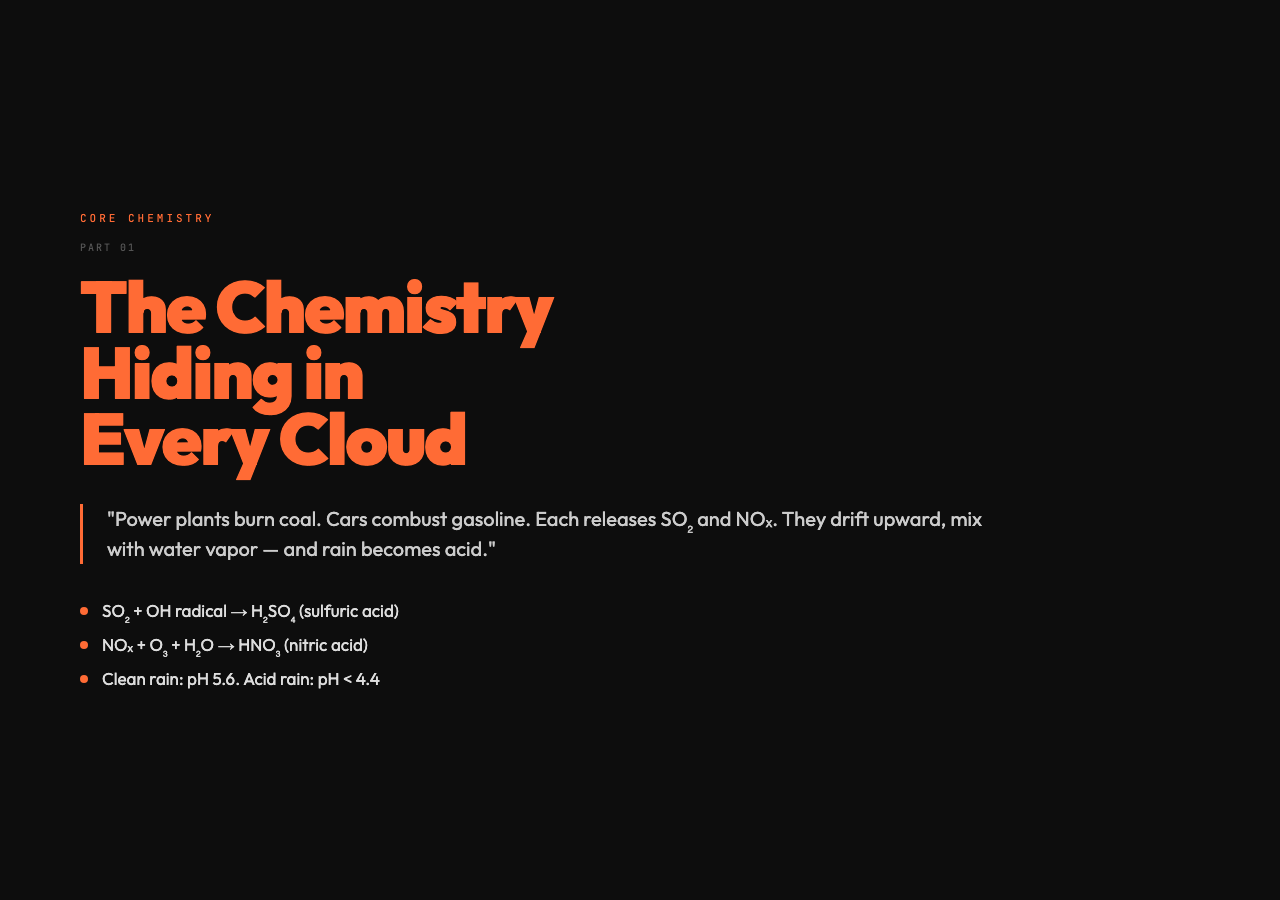
What happens next is Henry’s Law in action — these gases dissolve into cloud droplets, undergoing a series of oxidation reactions that produce sulfuric acid (H₂SO₄) and nitric acid (HNO₃). The rain that falls is no longer neutral. It carries actual acid, diluted but measurable, with a pH that can drop well below 4.4 — compared to clean rain’s natural pH of 5.6.
This is not a minor chemical footnote. A single large coal-fired power plant can emit tens of thousands of tons of SO₂ per year. Multiply that across thousands of plants, add vehicle emissions worldwide, and you have a planetary-scale titration experiment, slowly acidifying forests, lakes, and the limestone foundations of buildings and monuments.
What the Simulation Actually Models
The interactive simulation at Elysia Tools captures the full lifecycle of this process. It models three distinct phases that mirror real atmospheric science:
1. Emissions Injection. The user controls SO₂ and NOₓ emission rates, influenced by industrial activity levels and vehicle density. These gases are emitted into the atmospheric boundary layer, where wind speed and humidity determine how rapidly they disperse and oxidize.
2. Atmospheric Transport and Conversion. SO₂ does not immediately become sulfuric acid. It first oxidizes to SO₃, then reacts with water to form H₂SO₄. This conversion is influenced by hydroxyl radical (OH) concentration, ozone levels, and the presence of metal catalysts in particulate matter. The simulation approximates this with a wind-speed parameter — faster horizontal transport means wider dispersal but also more opportunity for oxidation pathways.
3. Deposition and Impact. Once acids form in cloud droplets, they fall as rain. The pH map in the simulation shows spatial variation in rain acidity across a region. Critically, the simulation tracks environmental impacts: lake pH, forest health, and building damage accumulate over time based on the acid load delivered.
The Lake Effect: When pH Drops Below the Survival Threshold
Fish have evolved in water with a relatively stable pH range — typically 6.5 to 8.0. Below pH 6.0, many species begin to disappear. Below pH 5.0, most aquatic life cannot survive at all.
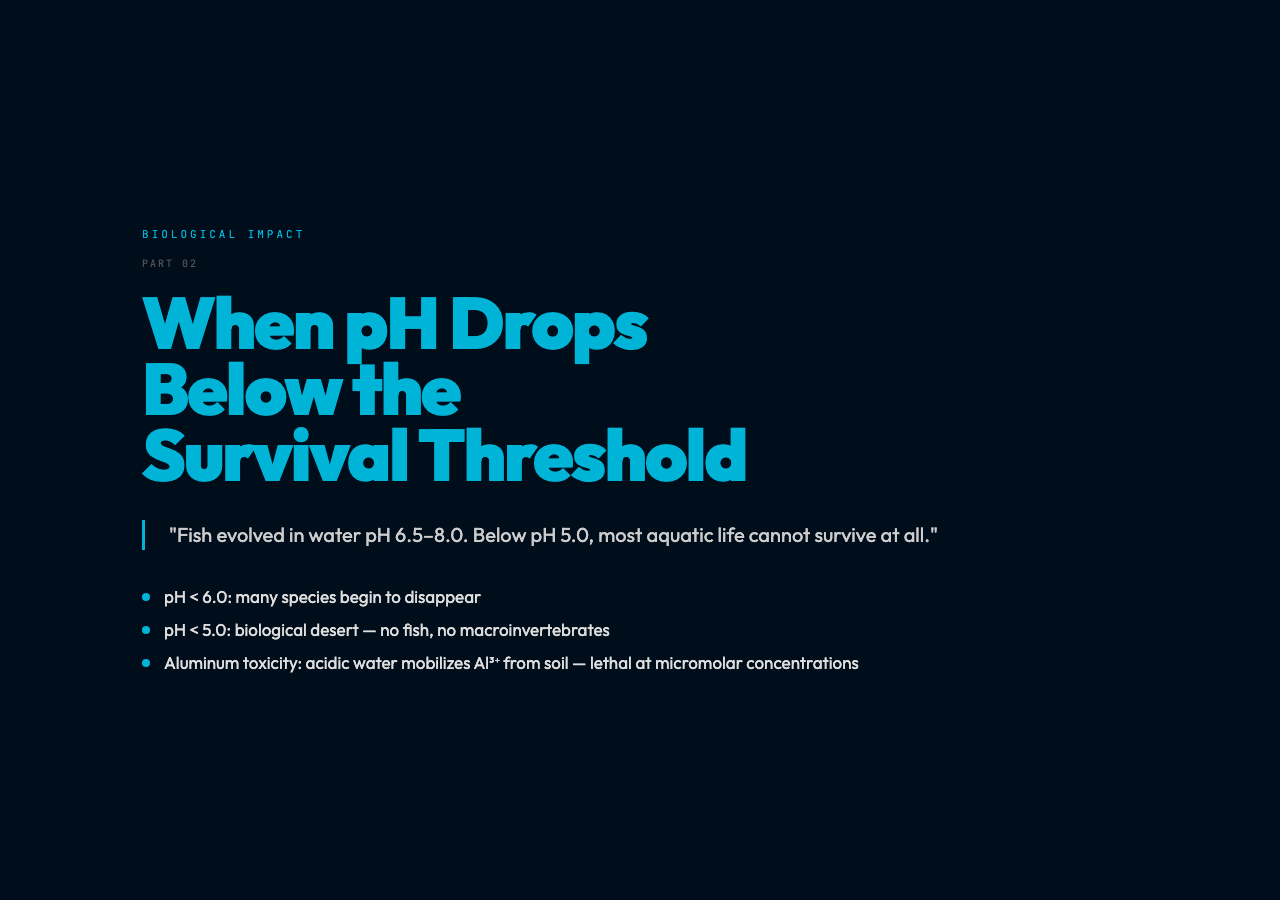
The mechanism is both direct and indirect. Directly, high acidity damages fish gills and ion regulation. Indirectly, it mobilizes aluminum ions (Al³⁺) from surrounding soil — aluminum is normally bound in mineral form, but acidic water dissolves it, and Al³⁺ is highly toxic to fish at micromolar concentrations.
This is what happened in Scandinavia and eastern North America during the 1960s and 1970s. Entire lakes became biological deserts. In Norway, forests on acidic soils began thinning because cation nutrients — calcium, magnesium, potassium — were leached from the soil and could not be replenished.
The Human Infrastructure Cost
Forests and lakes are biological systems that can, under the right conditions, recover. Concrete and limestone are not so forgiving.
Acid rain accelerates the corrosion of limestone, marble, and concrete through a process called carbonic acid weathering. The calcium carbonate in limestone reacts with acidic rainwater, forming calcium sulfate (gypsum), which is water-soluble and simply washes away. This is why the Parthenon in Athens, the Colosseum in Rome, and thousands of historic buildings in industrial regions show accelerated erosion patterns.
The Taj Mahal, built with Makrana marble, has required protective conservation efforts specifically because of acid rain induced by Agra’s vehicle and industrial emissions.
What Mitigation Actually Changes
The simulation includes four distinct mitigation controls, each targeting a different point in the emission-to-deposition chain:
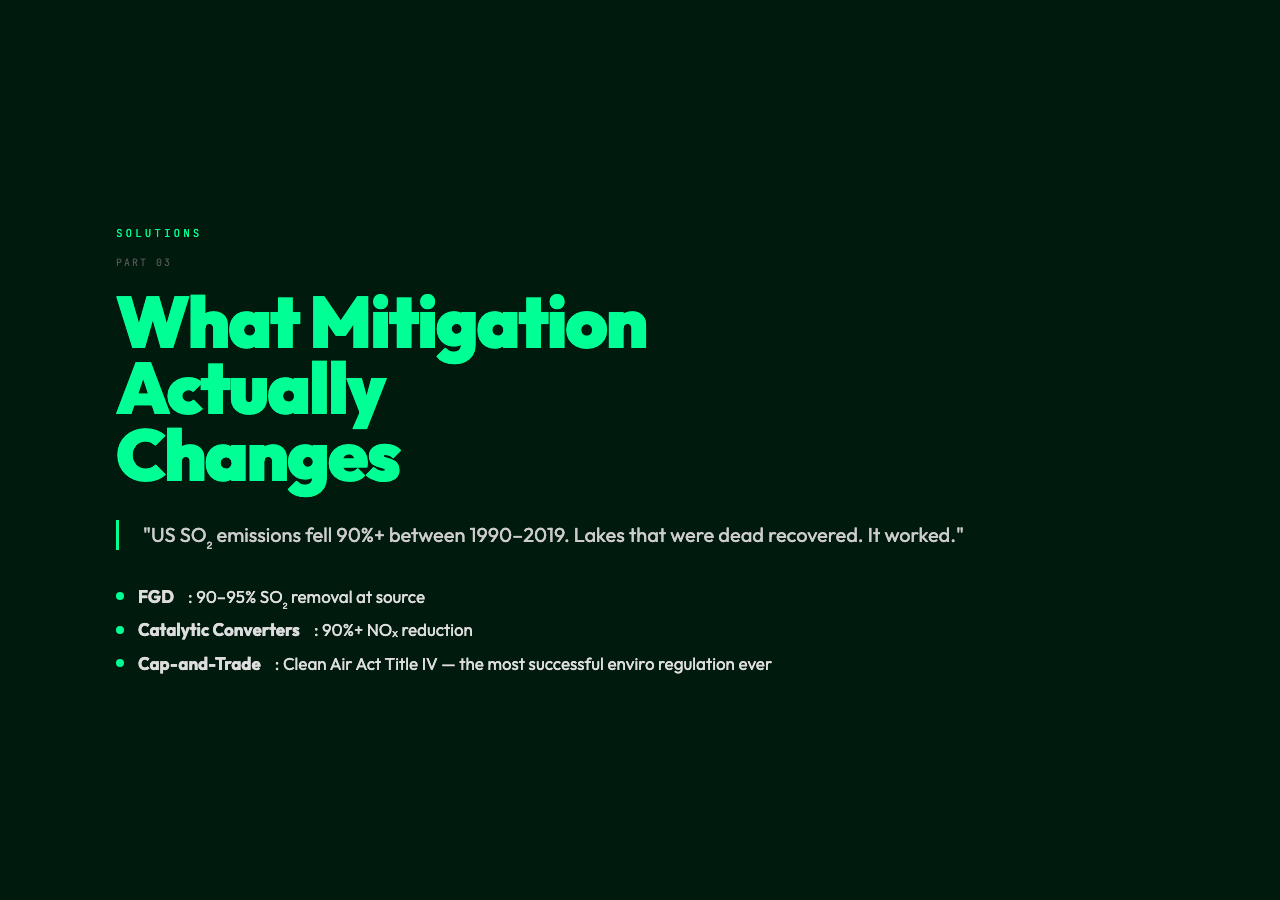
Flue Gas Desulfurization (FGD) removes SO₂ from power plant exhaust before it enters the atmosphere. This is the most direct intervention — it catches the pollutant at the source. Modern FGD systems can achieve 90-95% SO₂ removal efficiency.
Catalytic Converters in vehicles reduce NOₓ emissions by 90% or more through the three-way catalytic reaction, converting NOₓ to nitrogen and oxygen. This is why vehicle emissions standards have been one of the most effective levers for reducing acid rain globally.
Clean Energy Transition — replacing coal with wind, solar, or nuclear — eliminates both SO₂ and NOₓ at the source. The simulation models this as a reduction in industrial emissions intensity.
Emission Standards set legal caps on discharge quantities. The US Clean Air Act Amendments of 1990, specifically Title IV (the Acid Rain Program), established a cap-and-trade system for SO₂ that is widely considered one of the most successful environmental regulations ever implemented. SO₂ emissions from US power plants fell by more than 90% between 1990 and 2019, and acid rain problems in the northeastern United States measurably improved.
Why This Simulation Is Still Relevant
You might ask: is acid rain still a problem? The answer is nuanced.
In North America and Europe, aggressive regulation has dramatically reduced SO₂ and NOₓ emissions. Lakes that were dead in the 1970s have recovered. Forest health has improved in many regions.
But globally, the picture is more complex. Coal consumption is rising in parts of Asia. Many developing economies still rely on low-sulfur coal or have limited pollution controls. Shipping emissions — particularly from heavy fuel oil burned by container ships — remain largely unregulated for NOₓ and SO₂ in international waters.
The simulation’s pH map, showing the spatial footprint of deposition, is a useful reminder that acid rain is not a local problem. Emissions from the Ruhr Valley affect Scandinavian forests. Sulfur dioxide from Chinese coal plants has been linked to acid rain in Japan and South Korea. The atmosphere does not respect borders.
What You Can Do With This Simulation
The best use of the simulation is not passive observation but parameter exploration. Try these scenarios:
– Maximum emissions, no controls: Run the simulation with 100% industrial activity, 100% vehicle density, and all mitigation options disabled. Watch the pH map. See how quickly lake pH drops and forest health declines. Note the time scale — these impacts are not instantaneous, which is part of why they were initially so hard to detect.
– Desulfurization only: Enable FGD but leave other controls off. Observe that SO₂-related acidity drops significantly, but NOₓ-driven impacts persist. This is the situation in regions that have regulated power plant emissions but not vehicle or industrial NOₓ.
– Full mitigation: Enable all controls. The pH map stabilizes. Lake pH recovers. Forest health climbs. The simulation gives you a visual confirmation of what policy data has shown: targeted interventions work.
The chemistry of acid rain is not complicated. Sulfur and nitrogen oxidize, dissolve in water, fall as rain. But the environmental consequences — biological, structural, geopolitical — are significant enough that they reshaped environmental policy in the 1980s and 1990s, producing one of the few unambiguous regulatory success stories in global environmental management.
The lakes in Sudbury are healing. That is worth understanding.