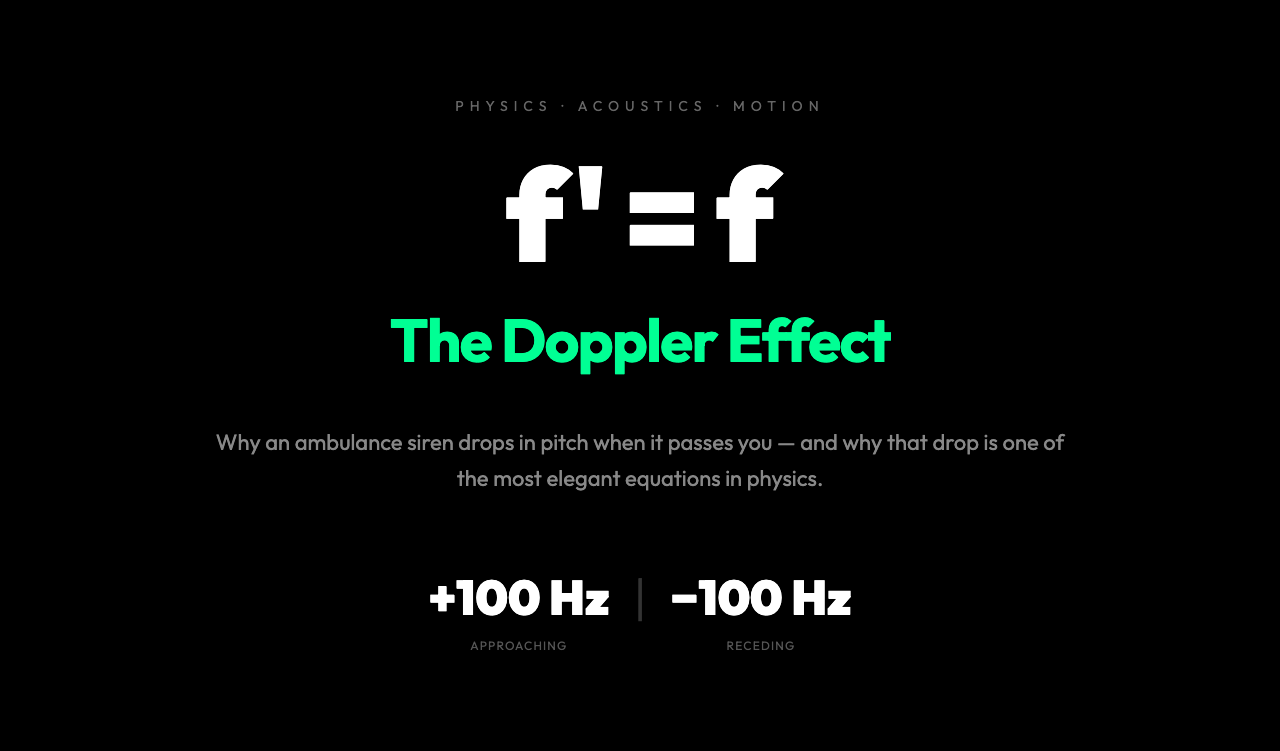
Why an Ambulance Siren Sounds Different When It Passes You
You’ve heard it a thousand times. An ambulance races toward you, its siren screaming at full pitch. Then it blares past, and something strange happens — the pitch drops, suddenly and noticeably, even though the siren hasn’t changed at all.
This isn’t an acoustic illusion. It’s one of the most elegant phenomena in physics, and it shows up everywhere: in astronomy measuring galaxy velocities, in weather radar tracking storms, and in your daily commute every time an emergency vehicle blows past.
The Core Mechanism
The Doppler effect describes how the frequency of a wave changes for an observer when the source is moving relative to that observer.
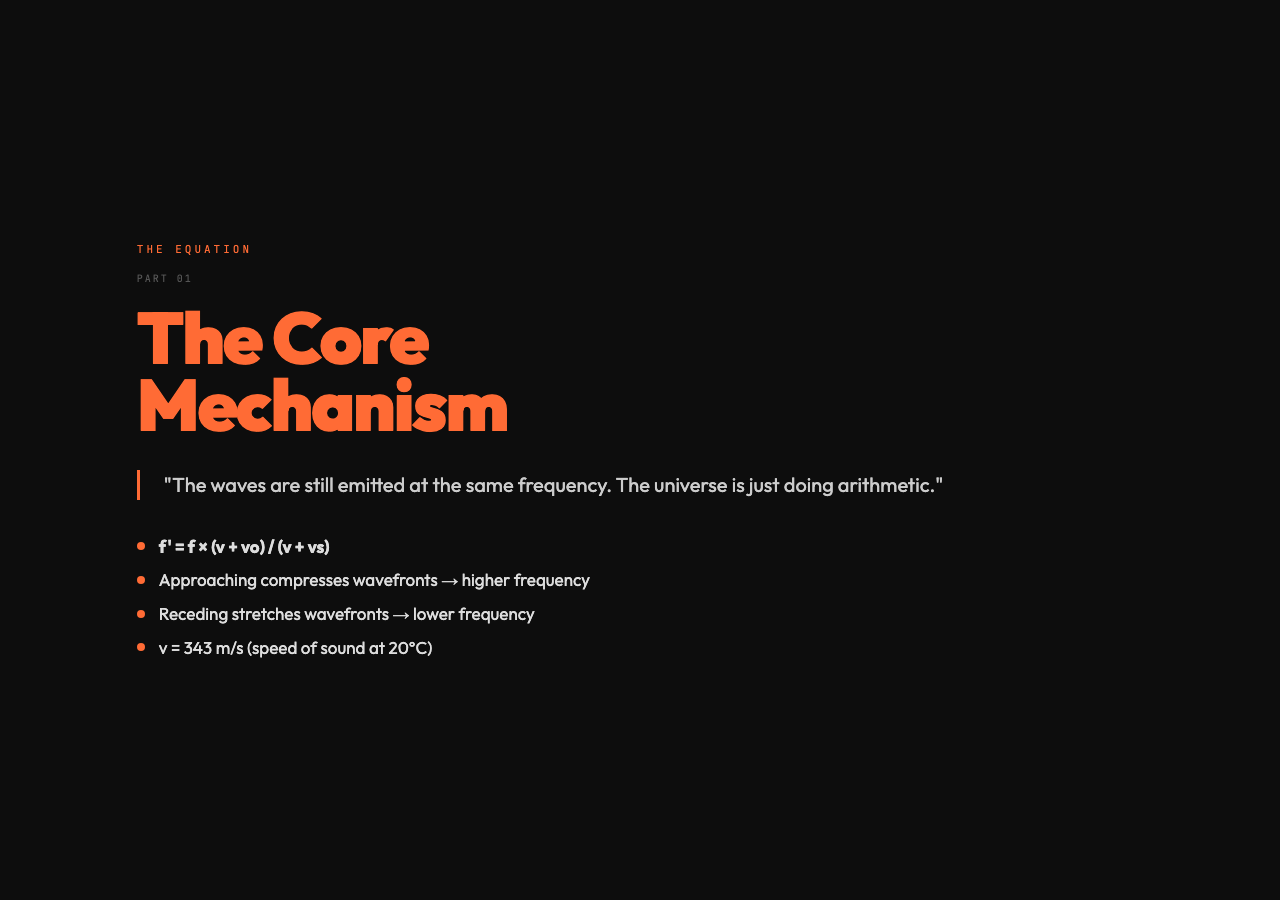
When the ambulance drives toward you, each successive sound wave is emitted from a position closer to you than the last. The distance between waves shrinks, so they arrive more frequently — a higher frequency, which your ear perceives as a higher pitch. As the ambulance passes and moves away, each wave is emitted from farther away, distances stretch, waves arrive less frequently, and the pitch drops.
The formula captures this cleanly:
f’ = f × (v + vo) / (v + vs)
Where: – f’ is the observed frequency – f is the source frequency – v is the speed of sound in air (~343 m/s at room temperature) – vo is the observer velocity (positive if moving toward source) – vs is the source velocity (positive if moving away from observer)
For a stationary observer and an approaching ambulance siren at 60 km/h playing a 600 Hz tone, the observed frequency approaching is about 652 Hz. Once it passes and recedes at the same speed, the observed frequency drops to about 554 Hz. Your ear hears that 100 Hz swing as a distinctly different pitch.
Why the Siren Feels So Dramatic
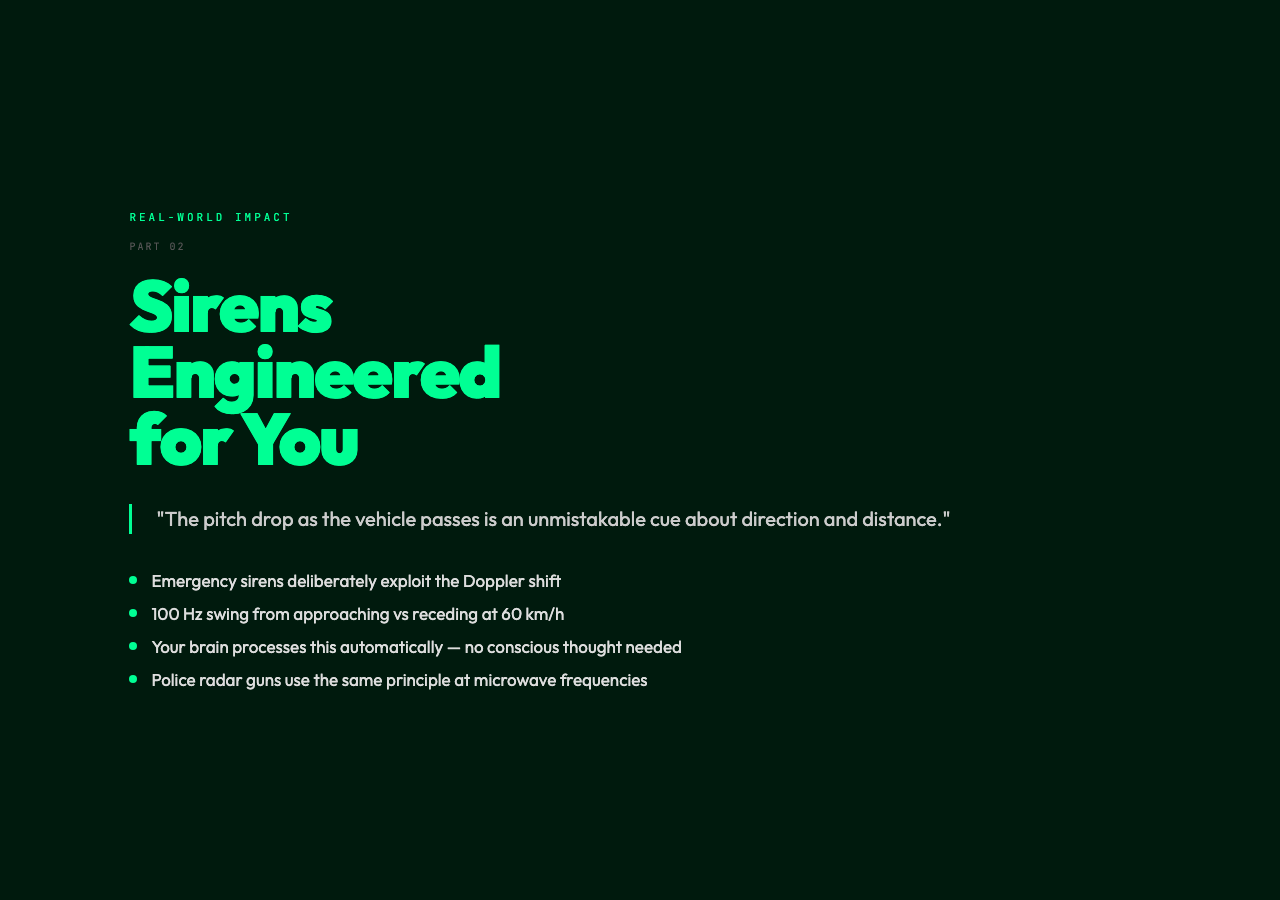
Emergency vehicle sirens are engineered to exploit the Doppler effect deliberately. They’re designed to cut through traffic noise — and the pitch drop as the vehicle passes creates an unmistakable cue about direction and distance.
A police siren at 500 Hz approaching at 80 km/h sounds roughly 100 Hz higher than it actually is. That extra tension in the sound signals toward you, getting closer. The sudden drop when it passes tells you away from you, now receding. Your brain processes this automatically, without conscious thought — which is exactly what makes it so effective for cutting through the noise of a busy road.
The siren doesn’t need to change its actual frequency to communicate this. The geometry of motion does all the work.
The Moving Observer Case
The Doppler effect doesn’t care whether it’s the source or the observer that’s moving. If you’re in a car traveling at 120 km/h toward a police siren playing 600 Hz, the same frequency shift occurs — your motion toward the source compresses the incoming waves.
This matters for a practical reason: two cars approaching each other at highway speeds both contribute to the Doppler shift, making the relative velocity larger than either alone. A 600 Hz siren on a stationary police car sounds different when you’re approaching at 100 km/h than when you’re approaching a moving patrol car at the same relative speed.
The Traffic Application
Beyond emergency vehicles, the Doppler principle underlies how police radar guns measure your speed. A radar gun emits a microwave beam at a specific frequency toward your car. Your car reflects the beam back, but because your car is moving toward the radar receiver, the reflected wave has a higher frequency than what was sent. The difference between sent and received frequency directly encodes your velocity — a clean mathematical relationship that radar guns convert to the number displayed on your dashboard.
The same principle, scaled to light waves, lets astronomers measure how fast galaxies are moving away from us — the famous “redshift” discovery that helped establish the expanding universe.
Temperature’s Quiet Role
One factor that surprises most people: the speed of sound changes with temperature. At 0°C, sound travels at about 331 m/s. At 20°C, it’s closer to 343 m/s. At 35°C (a hot summer day), it reaches 352 m/s.
This matters for the Doppler calculation because a 10 m/s change in the speed of sound shifts the observed frequency by roughly 3% — enough to affect precision radar measurements. Weather radar systems account for temperature gradients in the atmosphere when converting Doppler shifts to wind velocity measurements.
What the Visualization Shows
The interactive simulation lets you place an observer and a moving siren source, then watch the wavefronts compress on the approach and stretch on the recession. You can vary the source velocity and observe how faster motion produces a larger frequency swing. The pitch change you hear is not a trick — it’s a direct consequence of geometry.
The next time you hear an ambulance siren pitch drop after it passes, you’ll know exactly what’s happening: the waves are still being emitted at the same frequency. The universe is just doing arithmetic.
Key takeaway: The Doppler effect is geometry made audible. No physical change in the source — just the relationship between motion and wave propagation. Emergency engineers weaponize this physics. Astronomers use it to map the cosmos. And every time you hear a siren drop, you’re eavesdropping on one of the cleanest equations in physics.