Why Two Hanging Weights Taught Us That Simple Systems Can Be Impossible to Predict
Tie two pendulums together. Hang them from the same point. Pull one arm to the side and let go.
What happens next looks random. The arms swing, twist, flip — sometimes slow, sometimes violent, never repeating. Watch for ten seconds and you genuinely cannot guess where they’ll be at second eleven.
This is the double pendulum: two weighted rods hinged together, hanging from a fixed point. It is one of the simplest mechanical systems you can build. And it is one of the most fundamentally unpredictable things in classical physics.
The Setup: What a Double Pendulum Actually Is
A standard pendulum — a weight on a rod swinging back and forth — is textbook simplicity. It has one moving part. Its motion is regular and perfectly predictable: the same period, every single swing.
A double pendulum adds a second link. One rod swings from a fixed pivot. A second rod swings from the end of the first. That second joint can rotate a full 360 degrees. The system now has two angles changing simultaneously, each influenced by the other.
You can describe it with just four numbers: the angle of the first arm, the angle of the second arm, and their rates of change. Four numbers. That is all.
And yet, those four numbers never repeat. The system never returns to the same state twice.
Sensitivity to Initial Conditions: The Butterfly Effect Has Numbers
Here is the core of chaos: tiny differences in the starting conditions produce entirely different futures.
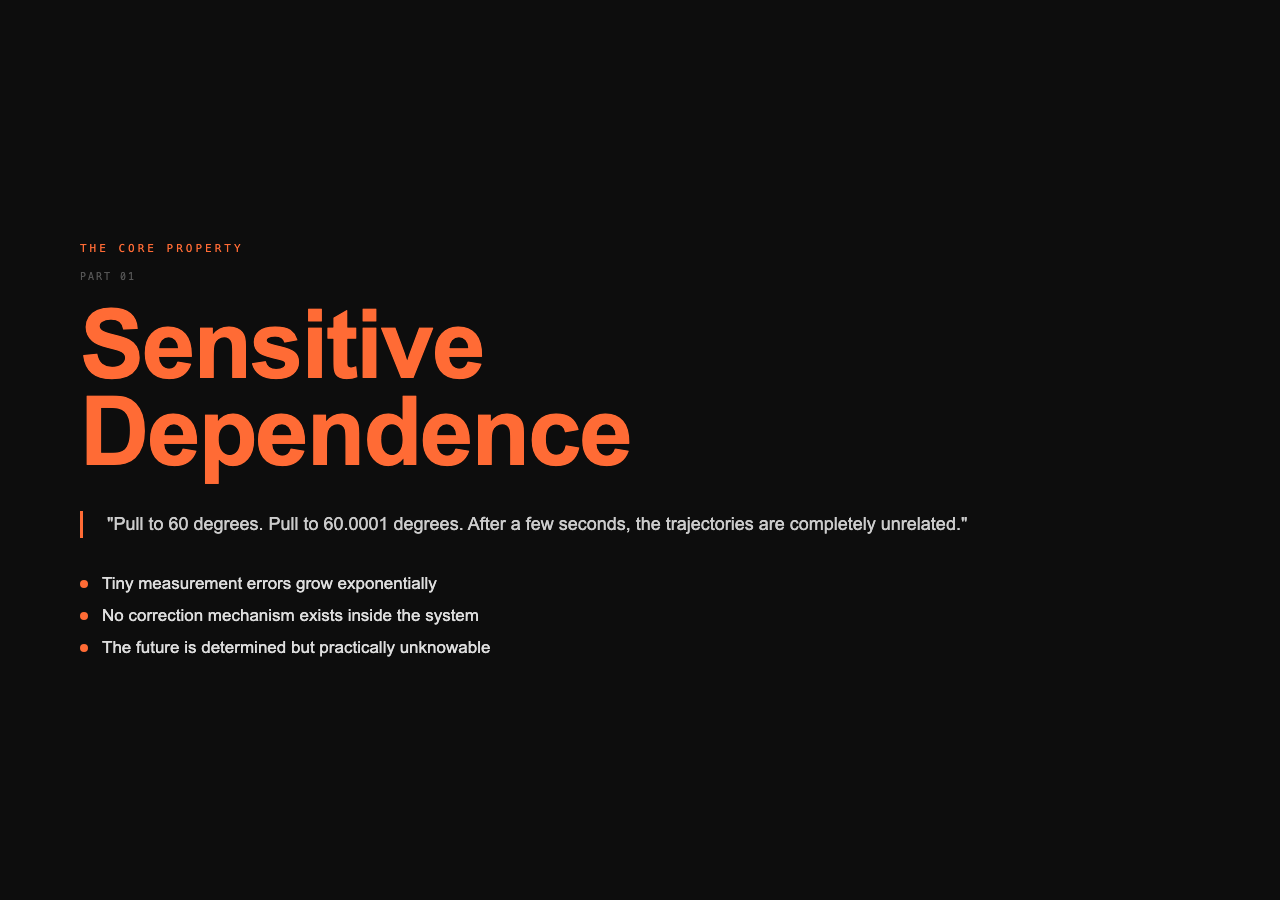
Pull the first arm to exactly 60 degrees and release. Now pull it to 60.0001 degrees — one ten-thousandth of a degree difference. For most systems, this is meaningless noise. For a double pendulum, it is everything.
After a few seconds, the two trajectories look unrelated. After ten seconds, they are completely divergent. There is no correction mechanism, no restoring force that pulls things back toward a median path. Small errors grow exponentially.
This is not stochastic randomness. There is no dice being rolled inside the mechanism. The equations governing the double pendulum are completely deterministic — given the exact starting conditions, the entire future is determined in principle. The problem is that you can never know the starting conditions precisely enough to use that determinism.
Every real measurement has limits. No instrument can tell you the angle to an infinite number of decimal places. And for a chaotic system, those decimal places are not cosmetic — they are the entire game.
Phase Space: Seeing the Shape of Unpredictability
Physicists studying chaos often switch from talking about positions and velocities to talking about “phase space” — an abstract landscape where every possible state of the system occupies a point.
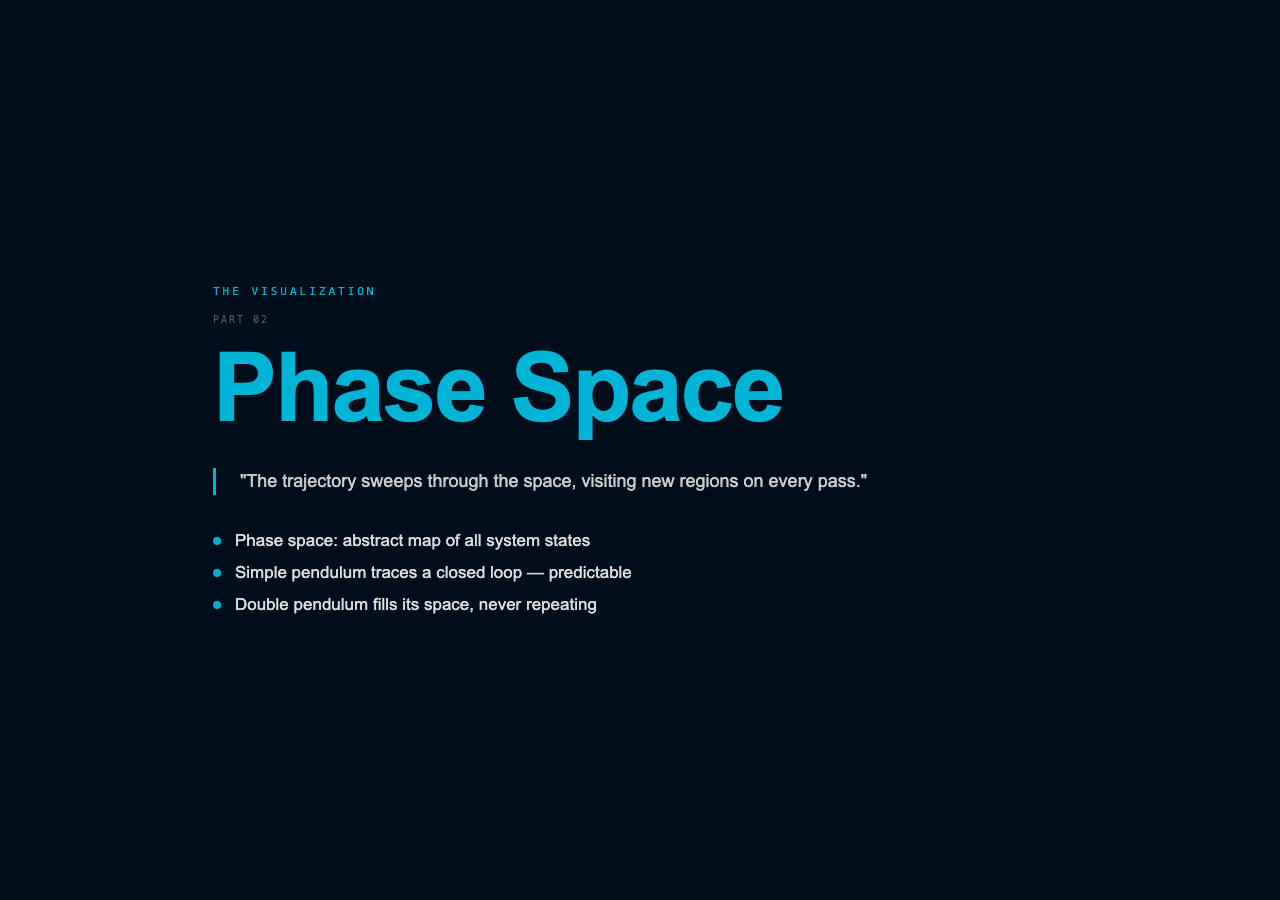
For a simple pendulum, phase space is a closed loop. The system traces the same oval path over and over, returning to where it started on each cycle. Predictable. Peaceful.
For a double pendulum, phase space is something else entirely. The trajectory sweeps through the space, visiting new regions on every pass. It fills the space, traces near itself, drifts away, loops back through similar shapes but at different times. The path looks like it is trying to visit everywhere but settling nowhere.
This is a hallmark of chaotic dynamics: trajectories in phase space are confined to a finite region (energy is conserved, so the system cannot fly off to infinity) but are also “mixing” — any two nearby points in phase space get pushed apart as time evolves, their trajectories diverging without bound.
Why This Matters Beyond the Pendulum
The double pendulum is a model. Not an analogy — a direct mathematical model of the same structure that appears in climate dynamics, fluid turbulence, predator-prey population cycles, and the orbits of moons around planets.
The same property that makes the double pendulum unpredictable — sensitive dependence on initial conditions — is what makes long-range weather forecasting fundamentally impossible. It is why climate models give useful trends but not specific day-to-day weather a century from now. It is why Jupiter’s Great Red Spot, a stable storm larger than Earth, can persist for centuries while the surrounding atmosphere churns chaotically.
None of these systems are random in the same sense that radioactive decay is random. They follow precise equations. The chaos lives in the gap between deterministic rules and finite-precision knowledge.
What Determinism Actually Means in a Chaotic World
Here is the philosophical punch line: the double pendulum does not disprove determinism. The equations still work. Given perfect knowledge of the initial state, you could in principle predict the behavior exactly — if perfect knowledge were possible, and if you had infinite computational power to run the simulation forward.
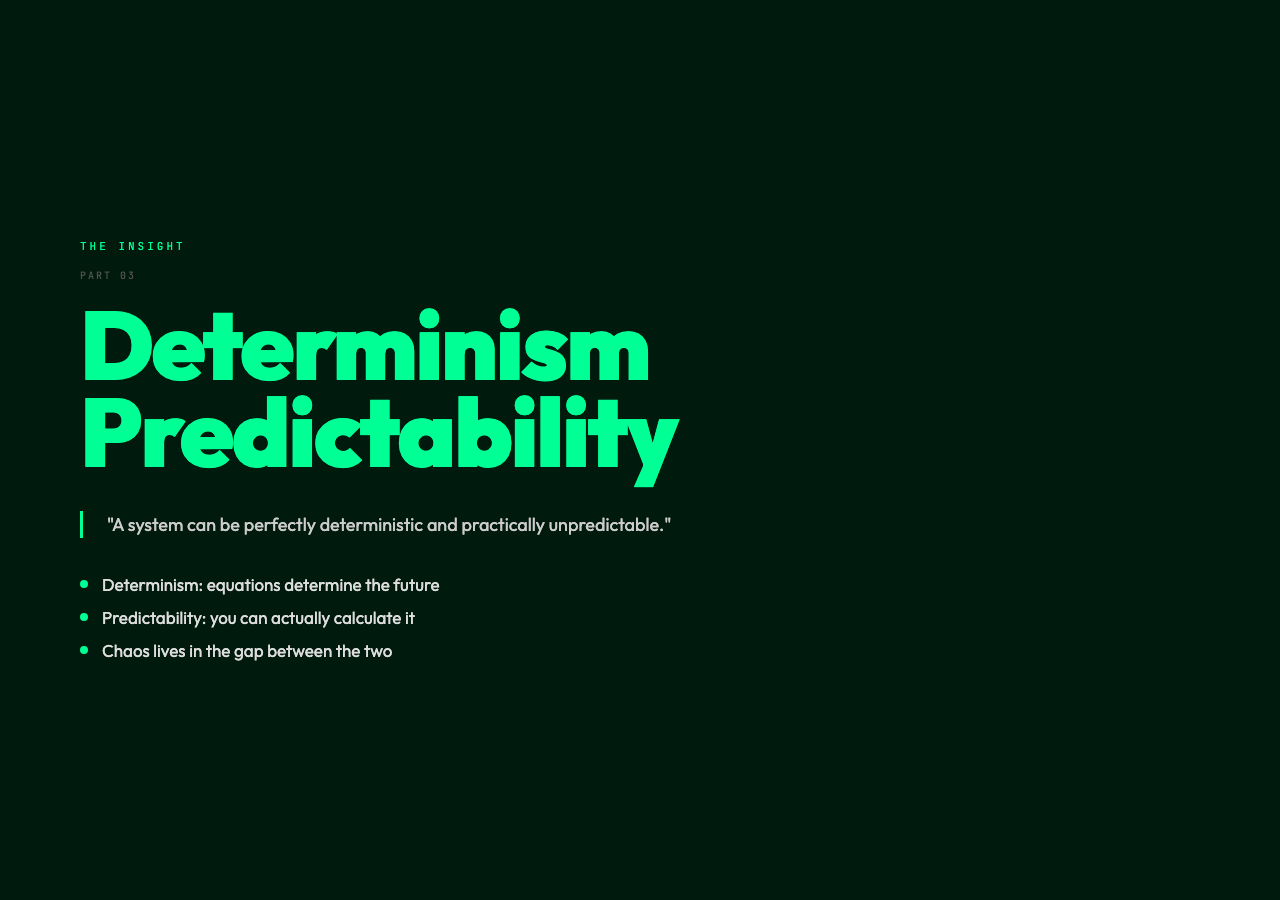
The practical lesson is different: determinism and predictability are not the same thing.
A system can be perfectly deterministic and practically unpredictable. The future is determined by the past, but you cannot use the past to calculate the future because your measurements are never precise enough and errors amplify faster than you can correct them.
The double pendulum does not break physics. It reveals that most of what we mean by “determinism” — that like causes produce like effects, that small changes produce small changes — is only true for a restricted class of systems. Outside that class, the word breaks down.
Building Intuition With the Simulation
The interactive simulation makes this visceral rather than abstract. You can set the initial angles, adjust masses and lengths, and watch the trajectory draw itself in real time. Try to predict where it will be in five seconds. You will fail, and the failure will feel wrong — because you can see the physics working, you know it is deterministic, and yet prediction is genuinely impossible.
Then change one angle by a fraction of a degree and run again. What seemed like the same motion immediately becomes something else. You have just performed the same experiment that chaos theorists did in the 1960s and 1970s, when they realized that the simple mechanical systems they had been teaching in physics classes contained behavior that no one had catalogued before.
The double pendulum is not a complex system. It is a simple system that exhibits complex behavior. That distinction — between complexity of parts and complexity of behavior — is one of the foundational insights of chaos theory.
And it all fits in four numbers.