Why the Wave That Swallows Everything Emerges Whole
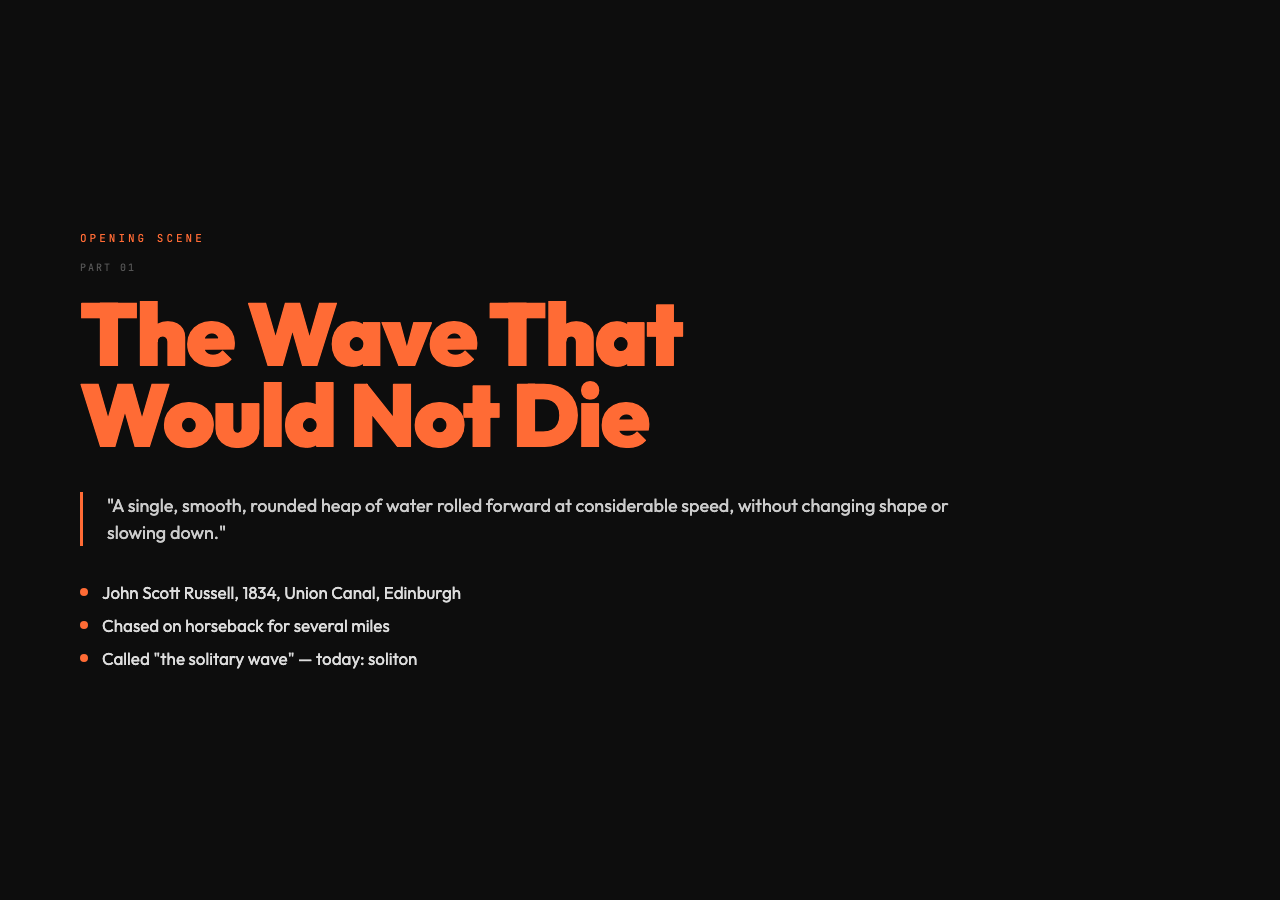
In 1834, a young engineer named John Scott Russell was riding alongside the Union Canal near Edinburgh when he saw something that defied every wave he’d ever known.
A boat suddenly stopped. The water it had been pushing forward piled up at the bow — then released. A single, smooth, rounded heap of water rolled forward at considerable speed, without changing shape or slowing down. Russell chased it on horseback for miles before losing it.
He called it “the solitary wave.” Today, we call it a soliton.
The Problem With Ordinary Waves
Most waves are fragile. Throw a stone into a pond and you get ripples — they spread out, grow weaker, and disappear. This is dispersion: different wavelengths travel at different speeds, so the wave packet dissolves over time.
Now take a water wave in shallow water. Taller parts travel faster than shorter parts. This nonlinearity makes waves want to steepen and eventually break — like ocean waves curling into surf.
These two effects work against each other. Dispersion spreads waves out. Nonlinearity clumps them together. In most systems, one wins and the wave dissipates.
But in a narrow range of conditions, they cancel perfectly. The wave neither spreads nor breaks. It just… travels. Forever.
That’s a soliton.
The Equation That Describes It
The Korteweg-de Vries equation — KdV for short — was written down in 1895 by Dutch mathematicians Diederik Korteweg and Gustav de Vries. It looks like this:
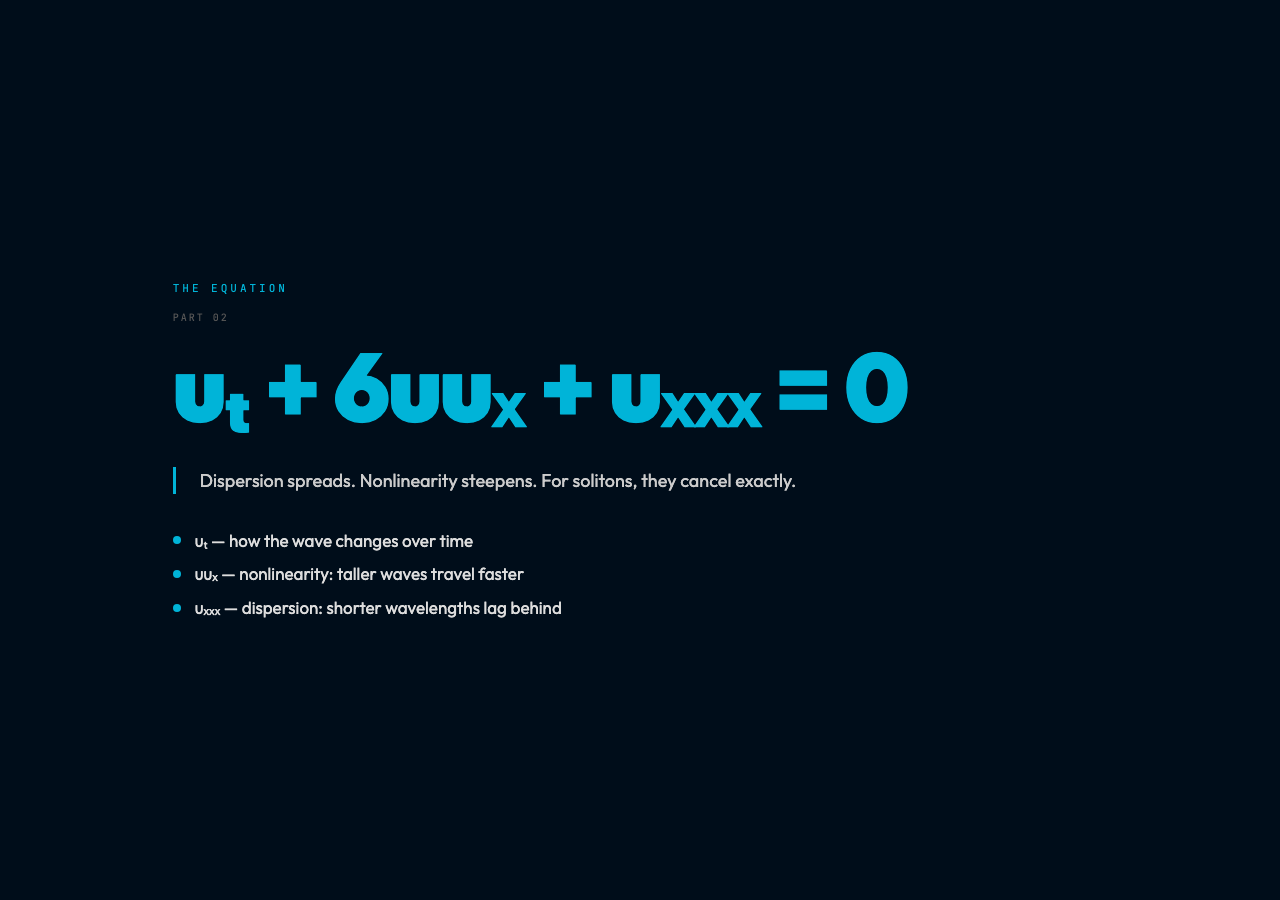
uₜ + 6NN · uuₓ + Duₓₓₓ = 0
Don’t let the notation scare you. Here’s what each piece does:
- uₜ — how the wave changes over time
- 6NN · uuₓ — the nonlinear term (taller = faster = steepening)
- Duₓₓₓ — the dispersive term (spreading out)
The magic is in the balance. For a single soliton, the solution takes the form:
u(x,t) = (c/2N) sech²(√(c/D)/2 · (x – ct – x₀))
This describes a bump of height proportional to its speed, with a width inversely proportional to the square root of that speed. A taller soliton moves faster and is narrower. A shorter one moves slower and is wider.
The Most Beautiful Property: Elastic Collisions
Watch two solitons collide and you see something remarkable.
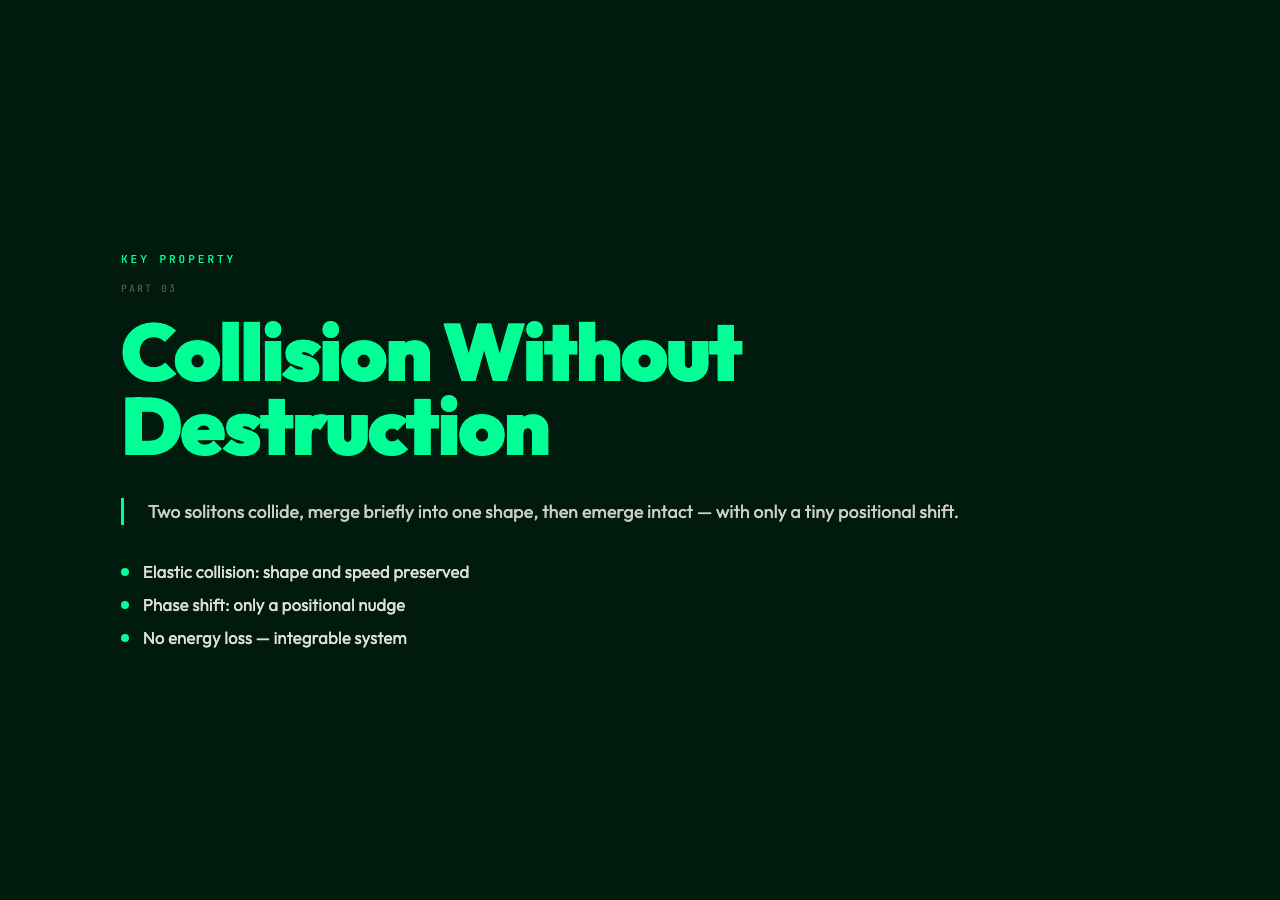
The taller, faster one catches up to the shorter one. They interact — merging into a single larger-looking shape. Then they emerge. Both intact. Both still moving at their original speeds.
No energy is lost. No shape is distorted. They acquired only a tiny phase shift — a slight nudge forward or backward in position.
This is why physicists call solitons “particle-like.” They behave like objects that cannot be destroyed, only displaced.
The phase shift formula for two colliding solitons involves the logarithm of the ratio of their amplitudes — a quiet reminder that the mathematics of waves and the mathematics of particles share deep roots.
Three Modes to Explore
The KdV Soliton simulator lets you switch between three visualization modes:
Single Soliton — Watch one soliton travel at constant speed. Adjust the amplitude (A) and observe how height controls velocity: taller solitons move faster and are narrower. This is not an approximation — it is an exact property of the KdV equation.
Two-Soliton Collision — One fast soliton catches a slow one. Watch the interaction. Notice how the wave peaks merge and separate. This is the “soliton exchange” — a fundamental phenomenon in fiber optics, where data pulses travel as optical solitons over thousands of kilometers.
Dispersive Wave — Turn off the nonlinearity (set N=0) and watch an initial pulse dissolve into many smaller ripples. This is what ordinary dispersion does: no balance, no survival. You see why the soliton is special — without the nonlinear term, the wave has no mechanism to hold itself together.
Where Solitons Actually Appear
This is not a mathematical curiosity. Solitons show up across physics:
- Fiber optics: Optical soliton pulses carry data across transoceanic cables without reshaping
- Plasma physics: Ion-acoustic solitons occur naturally in hot ionized gases
- Bose-Einstein condensates: Matter-wave solitons form in ultracold atomic clouds
- Shallow water: The original Scott Russell wave — tsunami in deep ocean approximate soliton behavior
- Molecular biology: Energy transport along protein chains may use soliton-like mechanisms
The KdV equation even shows up in the mathematics of traffic flow — where the same balance between bunching (nonlinearity) and spreading (dispersion) explains why stop-and-go traffic waves form and persist.
Why It Matters
Russell spent years trying to convince the scientific establishment that his solitary wave was fundamental — not a freak occurrence but a predictable consequence of physics. He was right.
What he couldn’t have known is that solitons represent a general principle: when nonlinear steepening and dispersive spreading balance exactly, stable structures emerge from chaos.
The same idea — stable patterns maintained by opposing forces — appears in economics, biology, and social systems. The soliton is not just a wave. It is a template for understanding how complexity sustains itself.
That is why, nearly two centuries after Russell chased a wave on horseback, we are still watching solitons collide in simulators and fiber optic cables around the world.
Some waves dissolve. Others just keep their shape and carry on.