Why Rainbows Always Arch the Same Way: The Geometry of Light in a Water Droplet
There is a moment — usually after rain, when the sky is still half-dark — when a arc of color appears at the edge of the clouds. You have seen it thousands of times. But if you have ever stopped to ask why it is always there, and why it is always the same arc, the answer leads deep into the physics of light, water, and the geometry of the cosmos.
A rainbow is not a object in the sky. It is a relationship — between the sun behind you, the water droplets in front of you, and the precise angle at which light enters and leaves each droplet. Understanding that angle is understanding why rainbows are universal, why they never give you the colors in a different order, and why no two people ever see quite the same one.
Light Bends When It Changes Speed
When light travels from one medium to another — from air into water, for instance — it does not simply continue in a straight line. It bends. This is refraction, and it happens because light slows down in water. The ratio of these speeds is the refractive index: for water, it is about 1.33. For air, it is 1.00.
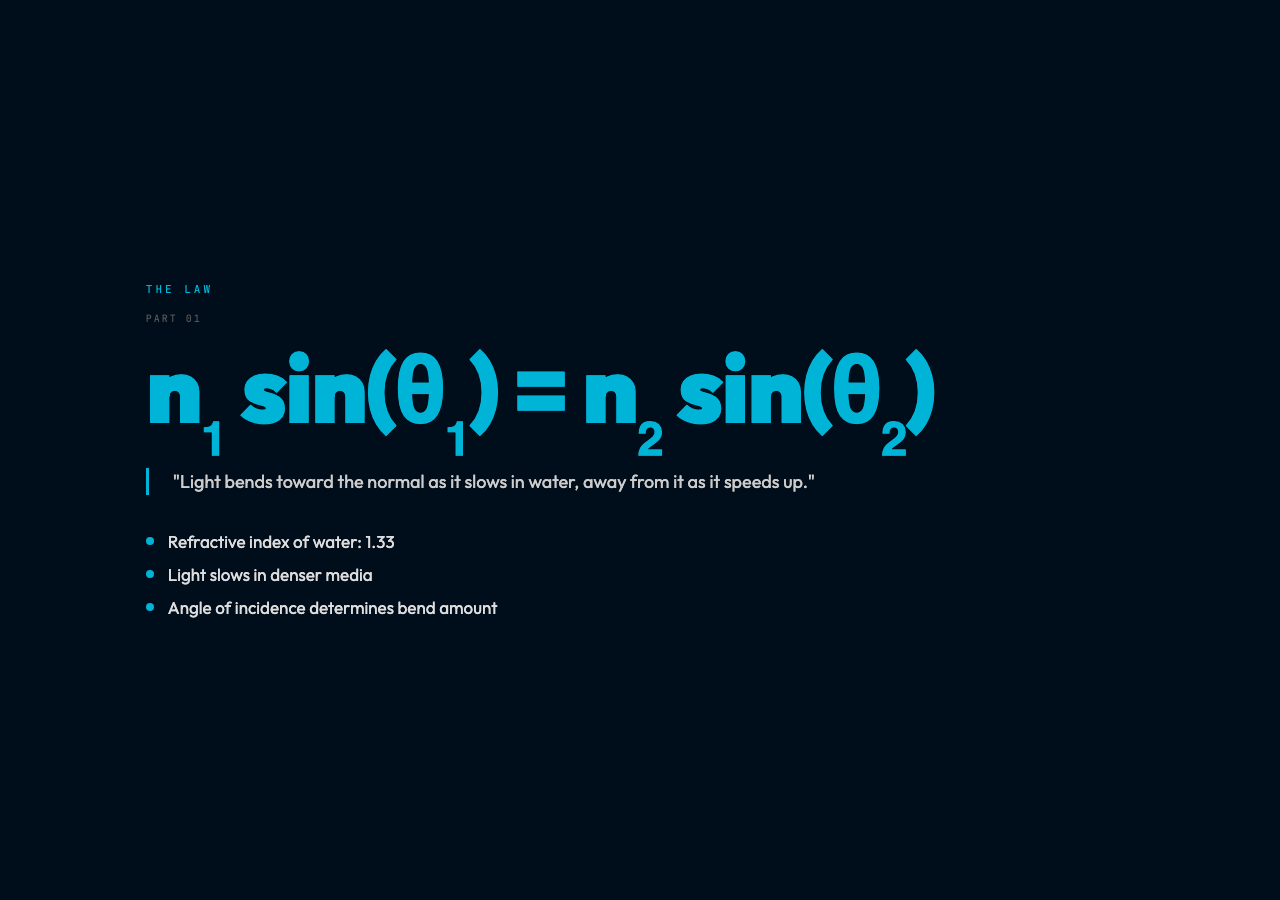
The amount of bending depends on the angle at which the light arrives. A beam hitting the water surface head-on bends more than one arriving at a shallow angle. This is described quantitatively by Snell’s Law:
n₁ sin(θ₁) = n₂ sin(θ₂)
Where n₁ and n₂ are the refractive indices of the two media, and θ₁ and θ₂ are the angles of the light relative to the normal — the imaginary line perpendicular to the surface at the point of entry.
In a raindrop, this bending happens twice. Light enters the front of the droplet, bends toward the normal as it slows. It travels across the droplet, reflects off the back surface (like a mirror), and then exits through the front again — bending away from the normal this time as it speeds back up into the air.
The Critical Angle: 42 Degrees
The geometry of this two-bend-plus-reflection path produces something remarkable. For water (refractive index 1.33), the angle at which light exits relative to the incoming sunlight direction peaks at approximately 42 degrees. Light at this angle is concentrated — more light exits at 42° than at any other angle. This is the rainbow’s peak intensity.
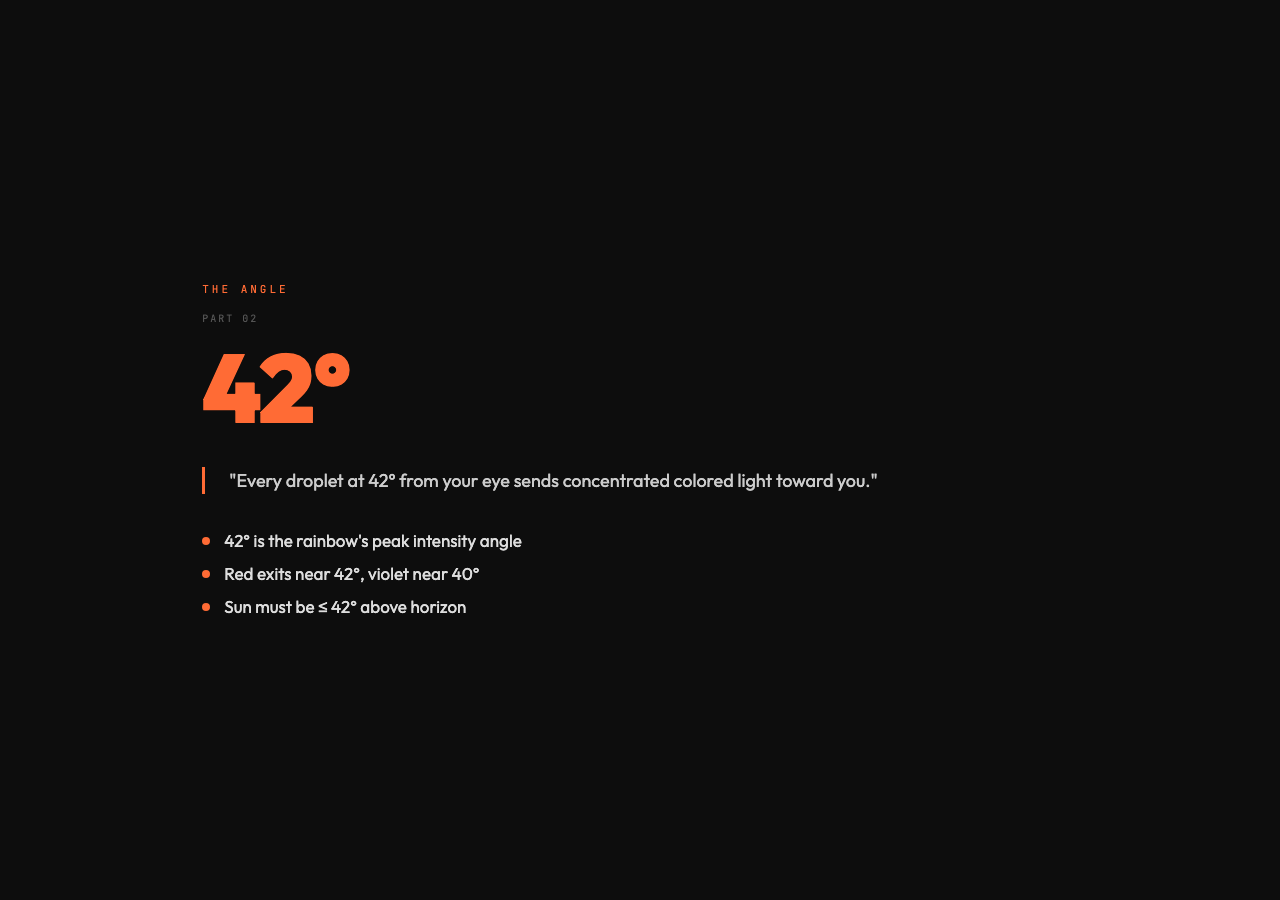
This is why rainbows are circular arcs. Every droplet that lies at 42° from your eye — relative to the sun’s rays — sends concentrated colored light toward you. The set of all points at a fixed angle from a given direction forms a cone. Your eye sits at the tip of that cone. The rainbow is the circle where the cone intersects the curtain of falling droplets.
The sun must be behind you, no higher than 42° above the horizon. When the sun is higher than that, the cone’s apex points below the horizon and no rainbow appears.
Why Colors Separate
White light is not a single color. It is a mixture of all visible wavelengths — from about 400 nanometers (violet) to 700 nanometers (red). Each wavelength travels at a slightly different speed in a given medium, so each bends by a slightly different amount.

Water is dispersive: its refractive index is not constant but depends on wavelength. Shorter wavelengths (blue and violet) slow down more than longer wavelengths (red) when entering water. This means violet light bends more than red light on the way into the droplet.
The result is that each color emerges from the droplet at a slightly different angle. Red light exits around 42°, violet around 40°. This 2-degree spread between red and violet is enough to separate the spectrum into distinct colored bands — red on the outside of the arc, violet on the inside.
This dispersion is also why the sky inside a primary rainbow is brighter than the sky outside it: light from all colors inside the rainbow angle is scattered back toward the observer, while outside the angle, most of the light simply passes through without returning.
The Secondary Rainbow: A Second Reflection
Sometimes a second, fainter rainbow appears outside the first. This secondary rainbow is wider — its red edge sits at about 50° and violet at about 53°.
The difference comes from an extra reflection inside the droplet. Primary rainbows involve one internal reflection. Secondaries involve two. Each additional reflection inverts the color order (red is now on the inside) and reduces intensity (each reflection loses some light).
The angle geometry also flips: the two-reflection path concentrates light at a different peak angle, producing the wider, fainter arc.
The Spherical Droplet Assumption
For the rainbow angle calculation, droplets are treated as spherical. This is a good approximation for raindrops in the atmosphere, which are kept nearly spherical by surface tension. In a laboratory setting, a cylindrical water jet can produce similar effects — a circular cross-section acts like a spherical lens.
In reality, larger raindrops are slightly flattened by air resistance, which subtly affects the rainbow’s geometry. The idealized spherical model is what gives the rainbow its mathematically clean arc. Real rainbows are slightly imperfect — and slightly more beautiful for it.
The Physics You Can See
What makes the rainbow simulation particularly valuable as a learning tool is that it separates the variables that are normally confounded in the sky. You can hold the sun angle constant and watch how changing the refractive index (substituting water for glass, say) shifts the rainbow’s position. You can turn off the white light and isolate individual wavelengths, watching precisely how each color’s path through the droplet differs.
The core insight — that a rainbow is an angle, not an object — becomes visceral when you can manipulate that angle in real time. The colors do not sit inside the droplet like paint. They are sorted by the geometry of their exit.
That is the quiet miracle of a rainbow: the spectrum is not in the water. It is in the geometry. The water is just the instrument that makes the geometry visible.
This article was written with the help of an interactive physics visualization of rainbow formation. The simulation lets you adjust the incident angle, refractive index, and droplet radius to see how each parameter shifts the rainbow’s geometry in real time.