Why Clocks Hanging on the Same Wall Started Beating in Sync: The 350-Year Mystery Huygens Couldn’t Explain
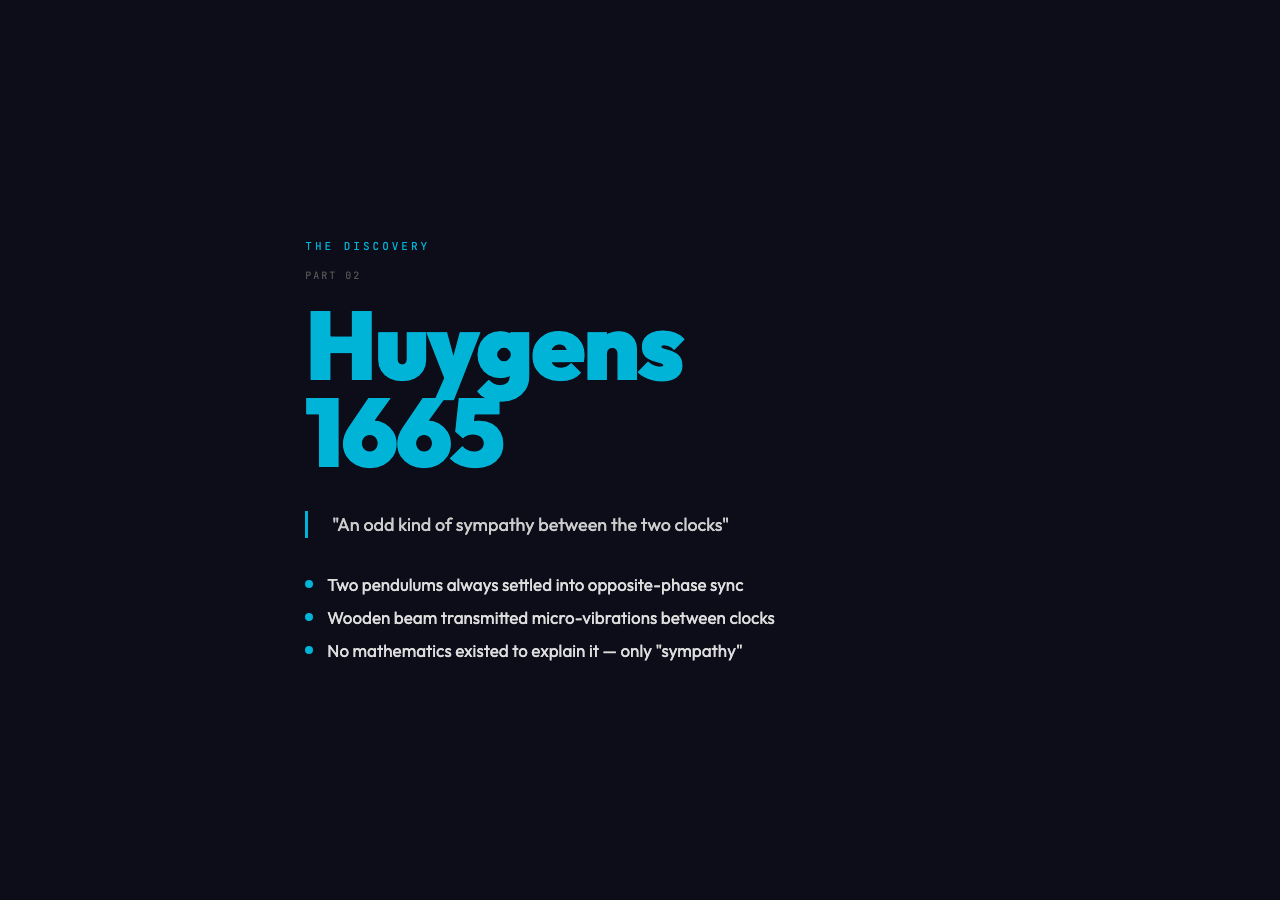
In 1665, Christiaan Huygens — bedridden with a cold and staring at a pair of pendulum clocks mounted on the same wooden beam — noticed something strange. No matter how the pendulums started, they always ended up swinging in perfect unison, but in opposite directions. When he nudged one, they slowly drifted back into this synchronized anti-phase. He called it “an odd kind of sympathy.”
Three and a half centuries later, physicists call it coupled oscillator synchronization — and it shows up everywhere. Fireflies on a summer evening blink in unison. Thousands of pacemaker cells in your heart coordinate their rhythm. Even audiences at a concert gradually clap in sync. The same mathematical framework that Huygens accidentally observed explains all of them.
This visualization lets you watch it happen in real time.
The Setup: Two Pendulums and a Weak Coupling
Huygens’ discovery had a mundane cause: the wooden beam connecting his clocks was just rigid enough to transmit tiny forces between them. Each pendulum’s swing created micro-vibrations in the beam, and those vibrations fed back into the other clock. Over minutes to hours, this weak coupling pushed both pendulums into a stable synchronized state.
The visualization models this with a Kuramoto-style coupling: each pendulum has a natural frequency (set by its length), and the coupling strength determines how strongly each pendulum influences the others.
You control: – Number of pendulums — from 2 to 10 – Coupling strength — how aggressively they synchronize – Frequency spread — how different their natural periods are – Damping — how quickly oscillations die out
What You’re Watching: Phase and Synchronization
The main canvas shows the pendulums swinging in real time. But the real insight is in the analysis panels:
Phase heatmap shows each pendulum’s instantaneous phase angle over time. When all rows show the same color gradient moving together, the system is synchronized. Before synchronization, you see chaotic stripes as different pendulums fight for their own rhythm.
Frequency spectrum reveals the dominant oscillation frequencies. In a synchronized state, all pendulums lock to a common frequency — even pendulums that started with different natural frequencies.
Why Synchronization Is Harder Than It Sounds
You might expect that coupling two oscillators would trivially force them into sync. But it’s not that simple. Two pendulums with very different natural frequencies will resist synchronization — the stronger coupling might drag the slower one along, or the faster one might get dragged, but they might also settle into a more complex pattern.
The critical parameter is the ratio of coupling strength to frequency mismatch. Strong coupling plus similar frequencies produces reliable synchronization. Weak coupling or large frequency differences can produce partial synchrony, where some oscillators sync while others continue drifting, or even chaotic behavior where synchronization never quite settles.
The Kuramoto Model: Synchronization in Abstract
Physicists abstract this phenomenon into the Kuramoto model, which strips synchronization to its mathematical essence:

> dθᵢ/dt = ωᵢ + (K/N) × Σ sin(θⱼ – θᵢ)
Where θᵢ is the phase of oscillator i, ωᵢ is its natural frequency, K is the coupling strength, and N is the number of oscillators. Each oscillator is pulled toward the average phase of all others, with the pull strength proportional to the sine of their phase difference.
The sine function is crucial: when one oscillator leads another, sin(θⱼ – θᵢ) is positive and pulls the lagging one forward. When it lags, the sine is negative and slows it down. The result is a gentle correction that, over time, brings everyone into a common rhythm.
Applications: Beyond Pendulums
The same mathematics governs systems far removed from 17th-century clockmaking:
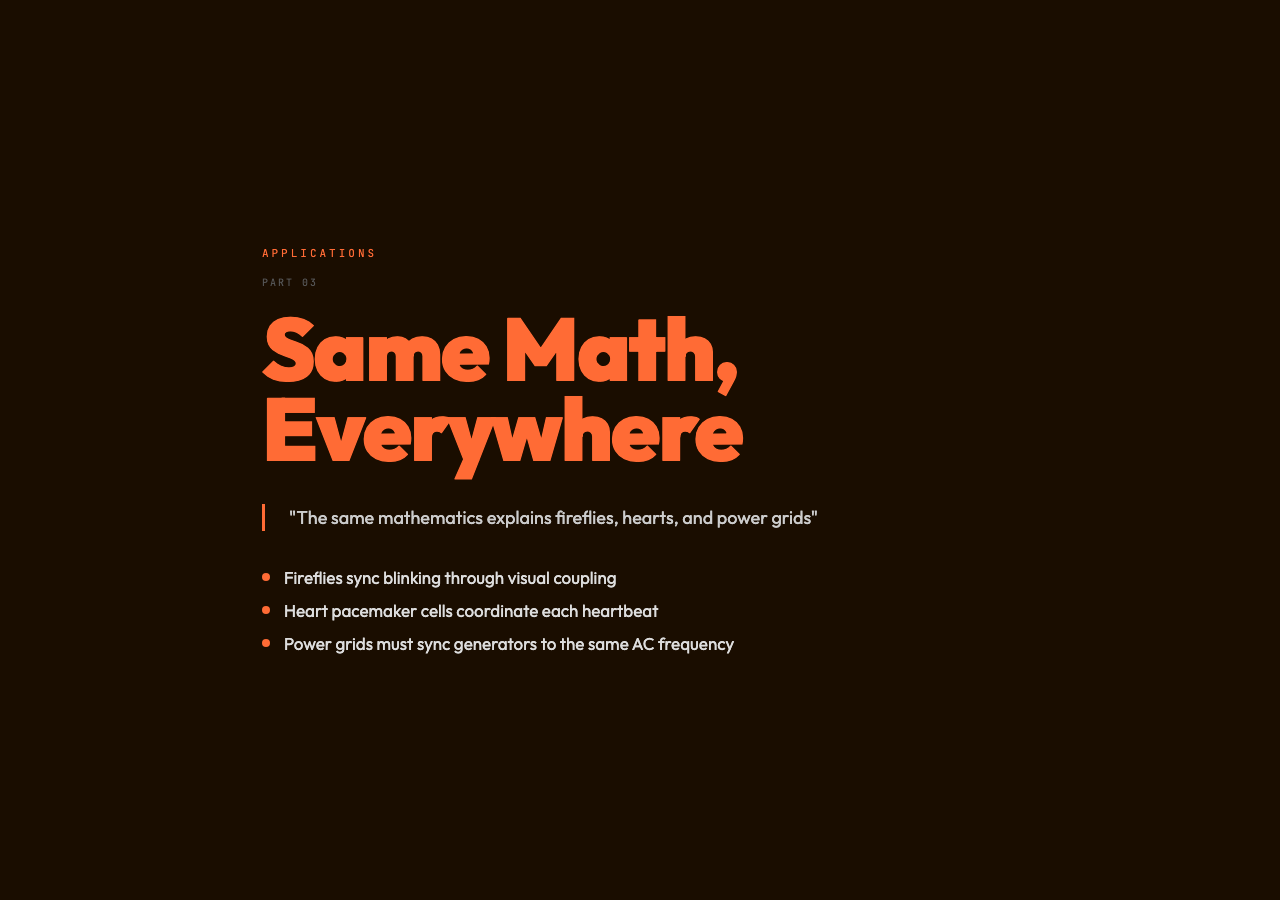
Biology — Thousands of cells in the sinoatrial node of your heart fire in sync to create each heartbeat. Neurons in the brain coordinate their activity during attention and sleep cycles. Fireflies synchronize their blinking through visual coupling — each firefly adjusts its flash timing based on when it sees neighbors flash.
Engineering — Power grids must synchronize generators to the same AC frequency. Wireless networks use synchronization protocols so that transmitters can share the same communication channel without interference.
Social systems — Audience applause naturally evolves toward sync or toward random disorganized clapping depending on the venue’s acoustics and the audience’s mood. Traffic flow exhibits synchronization when cars bunch up at a stoplight and then accelerate together.
The Deeper Surprise: Synchronization Can Be Stable or Fragile
The visualization reveals something counterintuitive: synchronized states aren’t always permanent. Change the coupling strength or frequency spread mid-simulation and you can watch the system fall out of sync. Increase coupling again and it slowly re-synchronizes, but sometimes into a different pattern.
The most dramatic case is oscillator death — when strong coupling actually stops the oscillators entirely. This sounds like the opposite of synchronization, but it emerges naturally from the same equations. In certain parameter regimes, the coupling drains energy from each oscillator until all motion ceases. It was observed in real electrochemical oscillator experiments in the 1970s and took physicists by surprise.
Huygens Was Right to Be Astonished
Huygens had no mathematical framework for understanding what he saw. He couldn’t write down a system of differential equations describing two weakly coupled pendulums, let alone solve them. He attributed the synchronization to “sympathy” — a word that sounds mystical but was actually a reasonable empirical description of an unexplained phenomenon.
It took 300 years for the Kuramoto model to crystallize the essential ingredients: slightly different natural frequencies, weak coupling, and enough time for the system to settle. What looked like mystical sympathy turned out to be a universal feature of dynamical systems with the right structure.
The next time you notice fireflies blinking in unison on a summer night, or feel your heartbeat steady itself when you lie down — you’re watching Huygens’ sympathy at work, running on the same mathematics that governs pendulums on a wooden beam.