Why Opposite Charges Attract and Like Charges Repel: The Force Behind Nearly Everything
In 1785, Charles-Augustin de Coulomb published a law that would become one of the most important discoveries in physics. Using a torsion balance — a delicate instrument that measured the twist of a wire — he showed that the force between two charged objects depends on two things and two things only: how much charge each object carries, and how far apart they are.
That discovery, now known as Coulomb’s Law, wasn’t just a neat party trick. It was the mathematical description of the interaction that holds atoms together, drives chemical reactions, and makes life itself possible.
The Law Itself
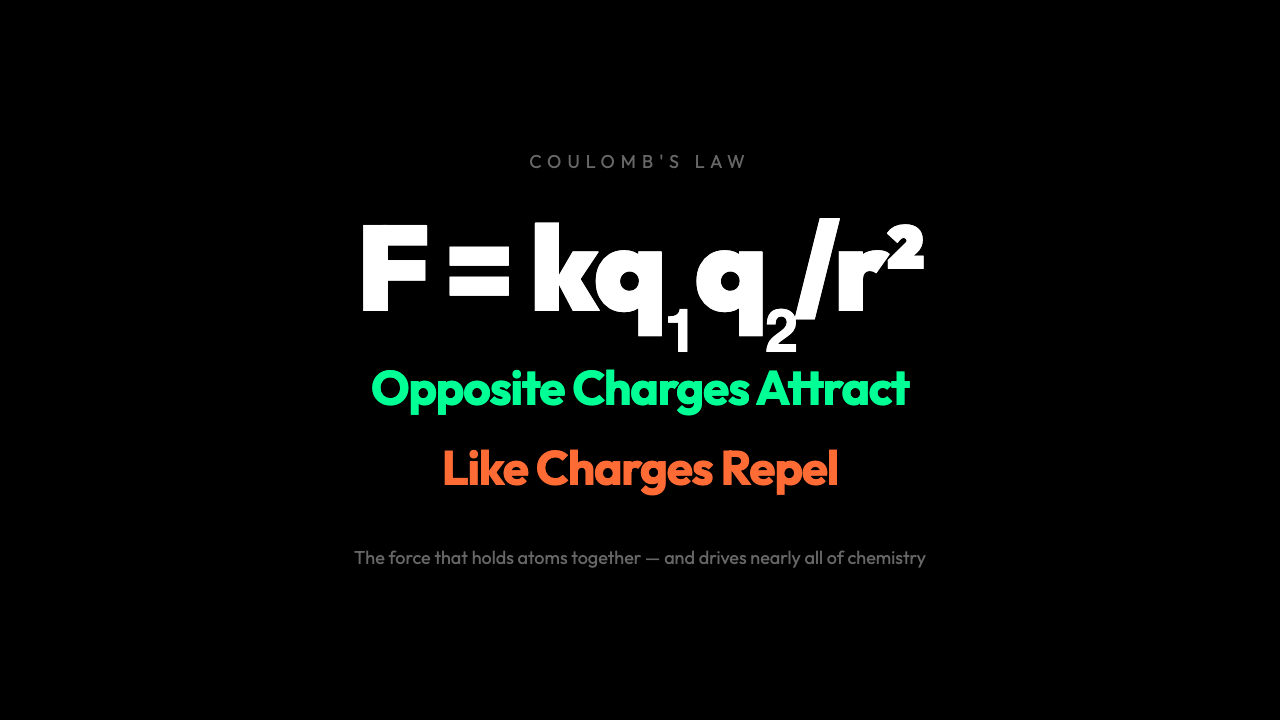
Coulomb’s Law states that the magnitude of the electrostatic force between two point charges is directly proportional to the product of the charges and inversely proportional to the square of the distance between them:

F = kₑ × |q₁ × q₂| / r²
Where: – F is the force in newtons – kₑ is Coulomb’s constant (8.99 × 10⁹ N·m²/C²) – q₁ and q₂ are the charges in coulombs – r is the distance between the charges in meters
The inverse square relationship is worth pausing on. Double the distance between two charges and the force doesn’t just halve — it drops to one quarter. Triple the distance and it’s one ninth. This isn’t a quirk of the math; it reflects something deep about how forces spread through space in three dimensions.
What the Sign Actually Means
The formula as written gives you the magnitude of the force — always positive. But the sign of the product q₁ × q₂ tells you everything about direction:

– q₁ × q₂ > 0: Like charges (both positive or both negative) → repulsion. The force pushes the objects apart. – q₁ × q₂ < 0: Opposite charges (one positive, one negative) → attraction. The force pulls the objects together.
This is the feature that makes chemistry interesting. If every charge attracted every other charge indiscriminately, matter would just collapse into a single dense lump. The competition between attraction and repulsion — between electrons and nuclei within each atom, between atoms as they approach each other — creates the rich structure of the material world.

Why It Matters: Beyond the Textbook
Coulomb’s Law isn’t just an equation you memorize for an exam. It’s the organizing principle for understanding:
Molecular bonding. The ionic bond is essentially Coulomb’s Law in action: one atom transfers an electron to another, the opposite charges attract, and a crystal lattice forms. table salt (NaCl) is held together by nothing more than the electrostatic attraction between Na⁺ and Cl⁻ ions arranged in a repeating pattern.
Electrostatic discharge. Lightning is a dramatic demonstration of Coulomb’s Law at scale. When charge separation in clouds becomes large enough, the electric field can ionize air molecules, creating a conductive path. The result is a rapid discharge that equalizes charge differences — a miniature version of what happens when you shuffle across a carpet and touch a doorknob.
DNA’s double helix. The negatively charged phosphate groups along DNA’s backbone repel each other constantly. Yet the molecule coils into a stable double helix. The explanation involves countervailing forces — water molecules, metal ions, and the stacking interactions between base pairs — but the starting point is always Coulomb’s Law.
Capacitors. Every electronic device contains capacitors, which store energy by separating charge. A capacitor’s ability to store charge (its capacitance) depends directly on the geometry and the materials between the plates — materials that modify the effective force between charges according to Coulomb’s Law modified by the dielectric constant.
The Similarity That Bothered Coulomb (and Einstein)
Coulomb noticed something uncomfortable: his law looked suspiciously like Newton’s law of universal gravitation. Both involve an inverse square relationship. Both are fundamental forces that act at a distance.
This similarity bothered physicists for over a century. When James Clerk Maxwell unified electricity and magnetism in the 1860s, the electrostatic force and the magnetic force were revealed as two aspects of a single electromagnetic interaction. When quantum electrodynamics (QED) arrived in the 1940s, it explained the electromagnetic force as the exchange of virtual photons between charged particles.
Gravity, by contrast, remains stubbornly separate. General relativity describes it as the curvature of spacetime, not an exchange of particles. The mathematical forms are similar, but the underlying physics seems utterly different. Reconciling these two views — finding a quantum theory of gravity — is one of the great unsolved problems in physics.
Visualization: Watching the Force
An interactive charge interaction visualization makes this concrete. Place two charges on a canvas and watch the force vectors appear: arrows pointing toward each other for opposite charges (attraction) and arrows pointing away from each other for like charges (repulsion).
The visualization lets you vary the sign and magnitude of each charge. What you’ll notice immediately: the force grows dramatically as you bring charges closer together. At short distances, even modest charges produce substantial forces. This is why atomic-scale physics is so violent — charges are tiny, but they’re packed into spaces measured in angstroms (10⁻¹⁰ meters), and at those distances, Coulomb’s Law produces forces that would be cartoonishly large if applied to everyday objects.
The Takeaway
Coulomb’s Law is simple to state but vast in implication. Two charges, a distance, a constant. From this sparse ingredients, you get:
– The structure of every atom – The behavior of every molecule – The operation of every circuit – The lightning in every storm
Not bad for a law published in 1785, verified with a torsion balance and a lot of careful reading of a twisted wire.