Why Doubling Your Distance Quarters the Force: The Inverse Square Law Hiding in Every Charged Particle
Touch a balloon to your hair and it sticks. Plug in a phone charger and the cable goes live. Separate clothes in the dryer and they crackle. All of it — every electrostatic phenomenon — comes down to one equation, one relentless mathematical truth, and two tiny charged particles doing exactly what physics demands.
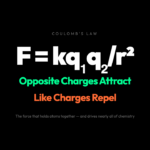
Coulomb’s Law describes the force between two charges:
F = k · q₁ · q₂ / r²
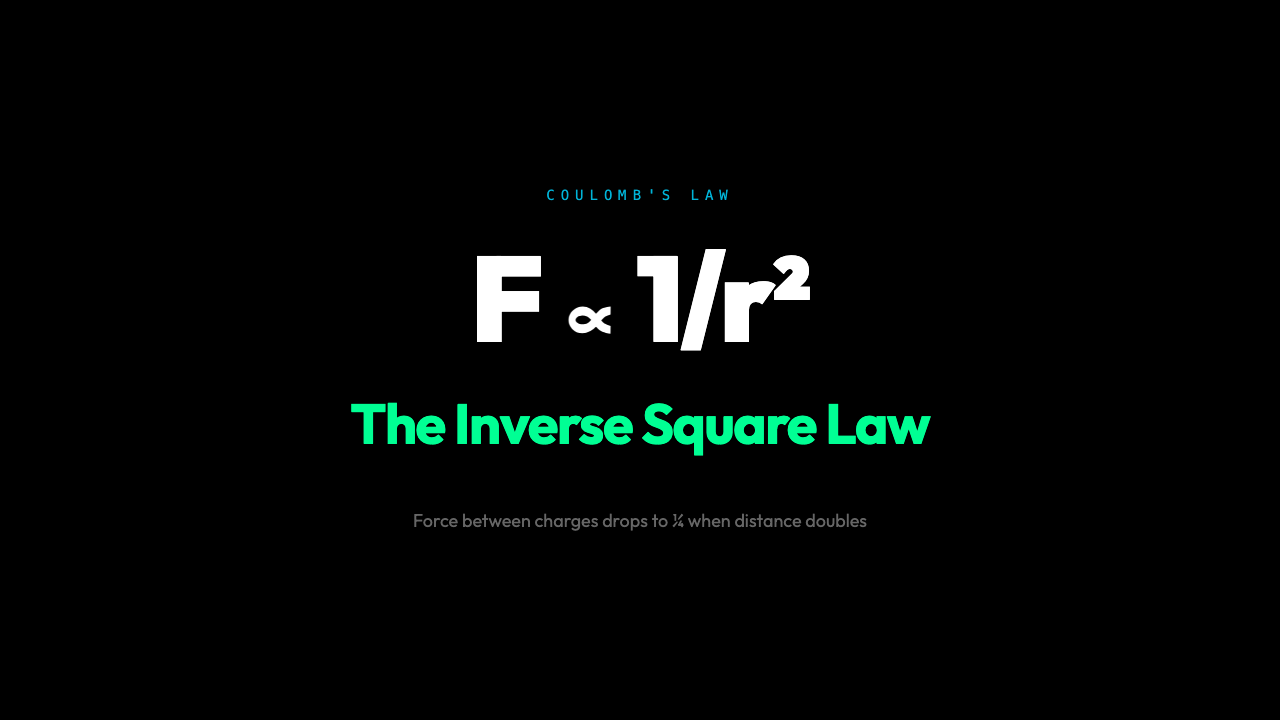
Move twice as far away and the force drops to one-quarter. Move three times farther and it becomes one-ninth. The denominator grows with the square of the distance — hence “inverse square law.” This same mathematics governs gravity, light, sound, and radiation. But Coulomb’s law makes it visible and interactive, on demand, with just two charges and a slider.
The Physics Behind the Equation
The force depends on three things:

1. The magnitude of each charge (q₁ and q₂). Measured in Coulombs. A static shock from a doorknob involves roughly 0.001 C — tiny by everyday standards, but enormous by the standards of single electrons (1.6 × 10⁻¹⁹ C each). The more charge, the stronger the push or pull.
2. The Coulomb constant (k = 8.99 × 10⁹ N·m²/C²). This fundamental constant sets the scale. In a vacuum, it determines exactly how many Newtons of force arise from given charges at given distances. Think of it as the stiffness of the electromagnetic field.
3. The distance between them (r), squared. This is the inverse square part. Doubling r makes the denominator 4× larger, so F becomes ¼. Triple r and F becomes 1/9. The force never drops to zero — only approaches it as r grows very large.
Attraction vs Repulsion: Same Equation, Opposite Directions
The equation doesn’t distinguish between attraction and repulsion. That comes from the sign of the charges.
– Same sign (both positive or both negative): the product q₁ · q₂ is positive → force is positive → particles repel – Opposite signs (one positive, one negative): the product is negative → force is negative → particles attract
The magnitude formula uses absolute values — F = k|q₁·q₂|/r² — but the direction depends on whether the product is positive or negative. The visualization makes this explicit: red arrows show repulsion, green arrows show attraction.
What the Interactive Graph Reveals
The visualization plots F vs r for the current charge values. A few things stand out:
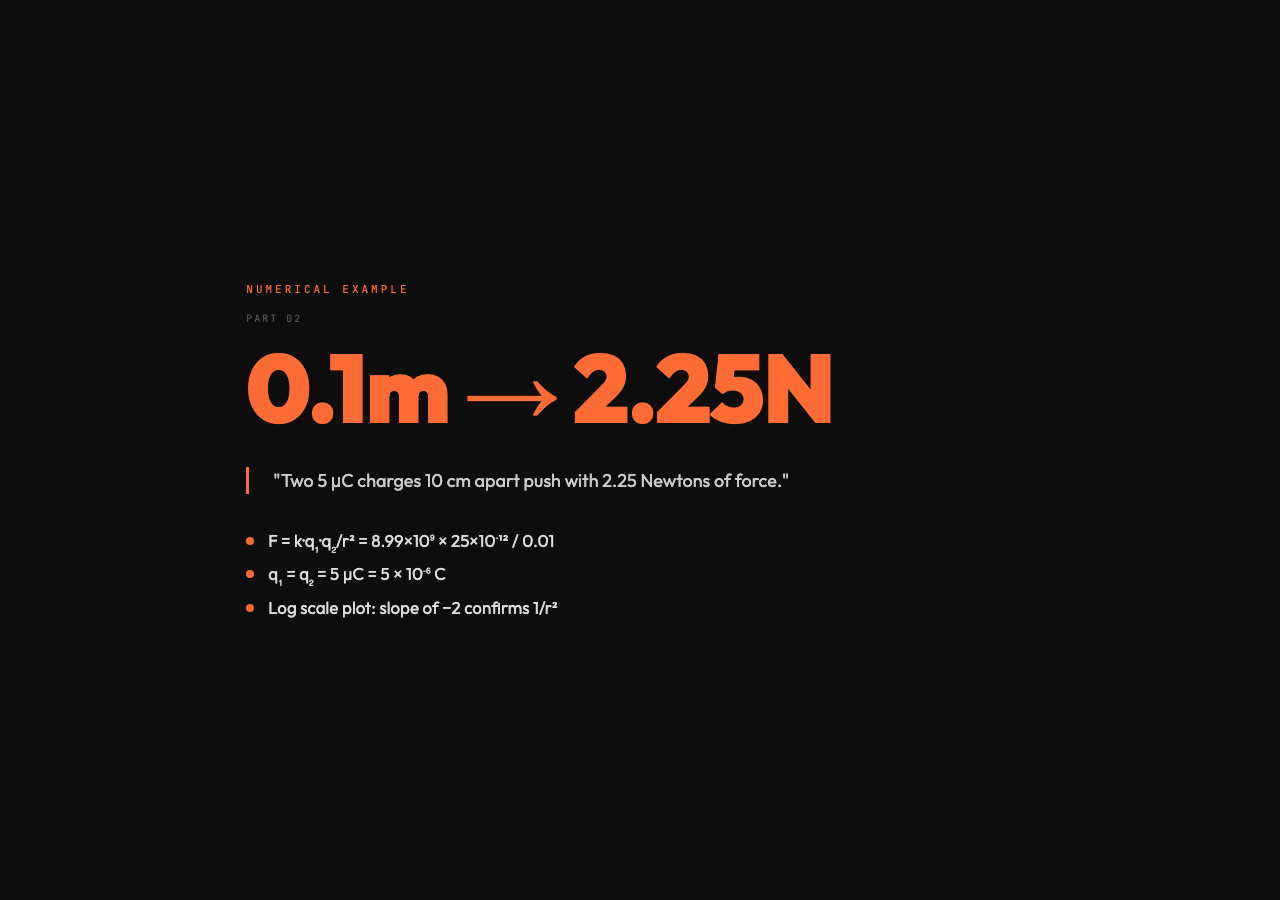
At close range, the force skyrockets. For q₁ = q₂ = 5 μC at r = 0.1 m, the force is:
F = (8.99 × 10⁹) × (5 × 10⁻⁶) × (5 × 10⁻⁶) / (0.1)² ≈ 2.25 N
That’s enough to feel — and to make small particles jump. As r increases, the curve bends sharply downward.
Switch to logarithmic scale on the graph and the inverse square relationship becomes a clean straight line with slope −2. This is the fingerprint of the 1/r² law: every decade of additional distance reduces the force by exactly two decades.
Why This Matters Beyond the Textbook
Coulomb’s law is why:
- Static electricity builds up. Charges on an insulator can’t easily redistribute. The forces between them grow until discharge — a spark — equalizes everything.
- Lightning happens. A cloud accumulates charge until the electric field between cloud and ground is strong enough to overcome air’s resistance. Then: bolt.
- Capacitors store energy. Two conducting plates held close together at different potentials store charge via the very same electrostatic forces. Squeeze them closer and you store more energy per volt.
- Atomic bonds form. The electrostatic attraction between electrons and nuclei is the glue of chemistry. The same 1/r² force, quantum-mechanically dressed, determines which molecules are stable and which fall apart.
The Deeper Pattern
Coulomb’s law is one of three great inverse-square laws in physics — alongside Newton’s gravity (F = Gm₁m₂/r²) and the propagation of light and radiation. All three share the same mathematical DNA: dilute whatever is emanating from a point source by spreading it uniformly over the surface of a sphere, and the intensity drops as 1/r².

The sphere’s surface area grows as 4πr², so the flux through it shrinks at exactly that rate.
This geometric fact about spheres is the reason charged particles in empty space interact so weakly over large distances — and why getting them close together can shatter the status quo. The inverse square law is simultaneously the reason the universe isn’t a single tangled knot of electromagnetic force and the reason it isn’t empty either.
Move twice as far. Feel one-quarter the pull. The math is patient — and the visualization makes it impossible to ignore.