Why Your Money Grows Faster Than You Think: The Exponential Physics of Compound Interest
$10,000. 8% per year. 30 years.
You do the math in your head: $10,000 × 0.08 × 30 = $24,000. So $34,000 total. That’s what simple interest gives you — your principal earns a fixed slice each year, nothing more.
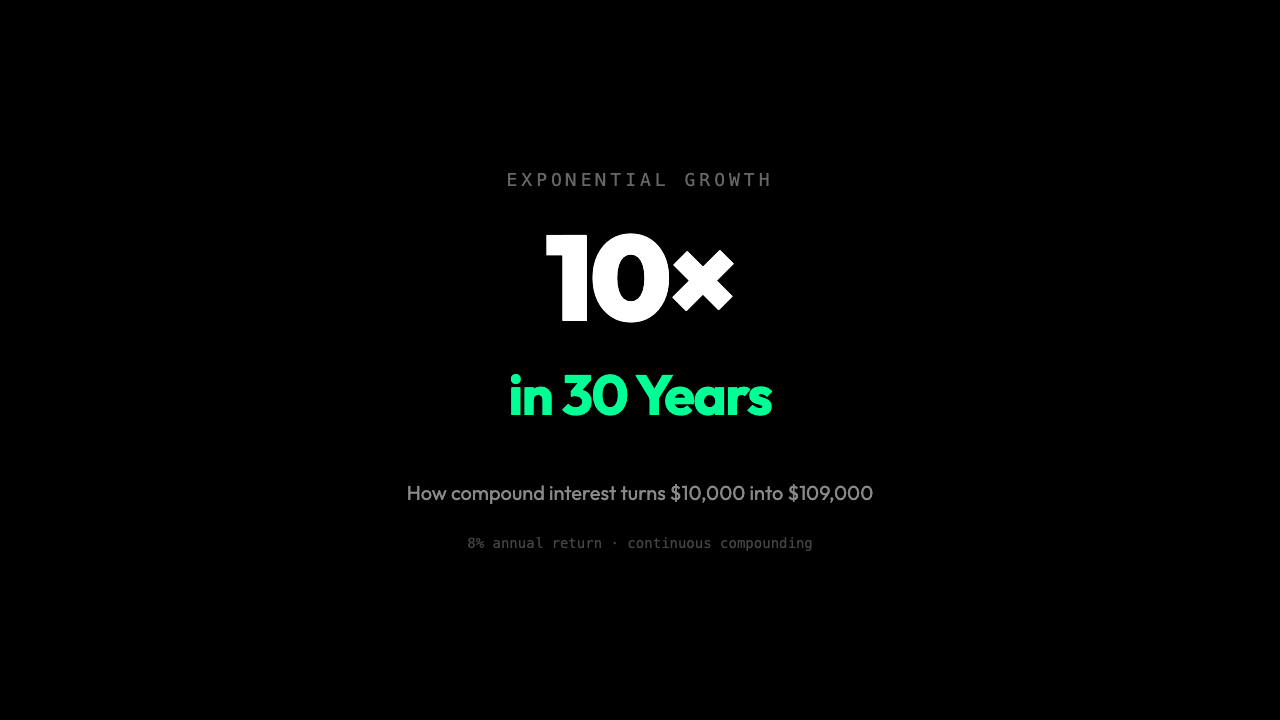
But compound interest doesn’t work that way. In year one your money earns $800. In year two it earns $800 on the original $10,000 plus $64 on the $800 you already earned. By year 30, your $10,000 has become roughly $109,000 — not $34,000. The gap between compound and simple isn’t small. It’s not even in the same category.
This is the physics of exponential growth in financial form. And once you see the math behind it, a lot of other phenomena start making sense too: population growth, radioactive decay, the spread of viruses. The same equation appears everywhere nature allows something to compound on itself.
The Core Formula: Where e Lives in Finance
Simple interest is linear. Compound interest is exponential. The formula that separates them is:

A = P(1 + r/n)^(nt)
Where: – P is your starting principal ($10,000) – r is the annual interest rate (0.08 for 8%) – n is how many times per year interest is compounded – t is the number of years
As n grows without bound — compounding every month, every day, every second — the expression (1 + r/n)^(n) approaches e^r, where e ≈ 2.71828. This is “continuous compounding,” the theoretical maximum your money can earn:
A = Pe^(rt)
With $10,000 at 8% for 30 years, continuously compounded: $10,000 × e^(0.08 × 30) = $10,000 × e^2.4 ≈ $109,196
The frequency of compounding barely matters once you’re doing it monthly or daily. The real leverage is time. Shift from 30 years to 40 years and your $10,000 becomes $294,000 — nearly tripling from the 30-year result. The later years aren’t just more of the same. They are categorically different.
The Growth Gap: Why Early Money Is Expensive Money
Here’s the number that most people find striking: at 8% annual return, your money roughly doubles every 9 years (this is the Rule of 72 — divide 72 by your interest rate to get doubling time).

That means: – Year 0–9: $10,000 → $20,000 (first doubling) – Year 9–18: $20,000 → $40,000 (second doubling) – Year 18–27: $40,000 → $80,000 (third doubling) – Year 27–36: $80,000 → $160,000 (fourth doubling)
Notice what happened: each successive doubling produces a larger absolute gain than the last, even though the rate is the same. This is the non-intuitive heart of exponential growth. The curve isn’t just steep — it changes character over time.
In the compound interest visualization, you can watch this happen. Three lines are drawn: the compound curve (exponential), the simple interest line (linear), and the gap between them. Early on, the gap is barely visible. By year 20, it’s substantial. By year 30, it’s the dominant feature.
This gap — the difference between what compound growth delivers and what simple growth would deliver — is the cost of not compounding. It’s also the reward for starting early.
The Monthly Contribution Multiplier
The physics gets even more interesting when you add regular contributions. Suppose you invest $10,000 upfront and add $500 per month at 8% annual return.

The total principal over 30 years is: $10,000 + ($500 × 12 × 30) = $190,000. But the compound total is roughly $815,000 at 30 years. Your money contributed $190,000. The exponential curve contributed $625,000.
The monthly contribution is a forcing term — it injects new principal that then begins its own exponential journey. The earlier those contributions start, the more doublings they get to participate in. A contribution made in year 5 has 25 years to compound. A contribution made in year 25 has only 5 years.
This is why financial advisors talk about “time in the market” with such urgency. The exponential function doesn’t wait for you to catch up. Every year of delay is not just a year of forgone gains — it’s a lost doubling, which means the gap compounds too.
The Rule of 72: A Useful Heuristic
If you want to estimate doubling time without a calculator, use the Rule of 72:
Doubling time ≈ 72 / interest rate
At 6%: ~12 years At 8%: ~9 years At 10%: ~7.2 years At 12%: ~6 years
This works because log(2) ≈ 0.693, and 72/100 ≈ 0.693. The approximation is remarkably close for rates between 4% and 20%.
The Rule of 72 is also the same logic behind pandemic spread models and nuclear chain reactions — anything that grows exponentially follows the same doubling arithmetic. Understanding compound interest is, in a precise sense, understanding exponential growth in its most familiar form.
What the Interactive Graph Reveals
The visualization lets you sweep across parameters: change the interest rate from 4% to 12%, switch between monthly and continuous compounding, dial the monthly contribution up or down, stretch the time horizon from 10 to 50 years.
Three curves always emerge: 1. Compound — your actual wealth trajectory (exponential) 2. Simple — what you’d have if interest were calculated only on the original principal (linear) 3. Linear (contributions only) — what you’d have with no interest at all, just principal plus contributions
The gap between curves (1) and (2) is pure compound effect. The gap between (1) and (3) is compound plus contribution leverage.
What you’ll notice: at low interest rates (4%) and short time horizons (10 years), the three lines are close. At higher rates and longer horizons, they diverge dramatically. The same physics — the same math — explains why $10,000 at 4% for 20 years yields $21,911 while at 8% for 20 years it yields $46,610. The rate change of 4 percentage points more than doubles the outcome.
Why This Matters Beyond Finance
Exponential growth shows up everywhere in physics and systems thinking:
– Radioactive decay: atoms decay according to N(t) = N₀e^(-λt), the same mathematical form as continuous compounding in reverse – Damped oscillations: the envelope of a damped harmonic oscillator decays exponentially, and the “half-life” of oscillations is computed the same way as bond duration – Population dynamics: unrestricted growth follows P(t) = P₀e^(rt), identical in form to continuous compound interest – Diffusion: the spread of particles from high concentration to low follows an exponential spatial profile
The compound interest formula is, structurally, the same equation that governs heat diffusion, capacitor discharge, and the absorption of light through a medium. Finance just found a positive version of it first.
Understanding exponential growth in the context of money — where you can see it, interact with it, and feel its effects — is one of the best entry points into a pattern that governs much of the natural world.
The Takeaway
Compound interest is not a banking product. It’s a physical law. The same mathematics that makes your savings accelerate over decades makes a nuclear chain reaction possible, makes populations explode, and makes a cup of coffee cool down exponentially toward room temperature.
The key variables are always the same: the rate (r), the time (t), and whether you’re adding new principal or just letting existing principal ride. Change any one and the outcome changes non-linearly. This is why starting early — even if you start small — is so powerful. Time is not just money. In an exponential system, time is the multiplier.