Why Heat Spreads Like Water: The Mathematics Behind Every Temperature Difference
Start with a cold spoon in hot tea. Watch the metal turn warm. That simple observation hides one of the most elegant equations in physics — a partial differential equation so fundamental it shows up in climate models, microchip design, and the spreading of forest fires.
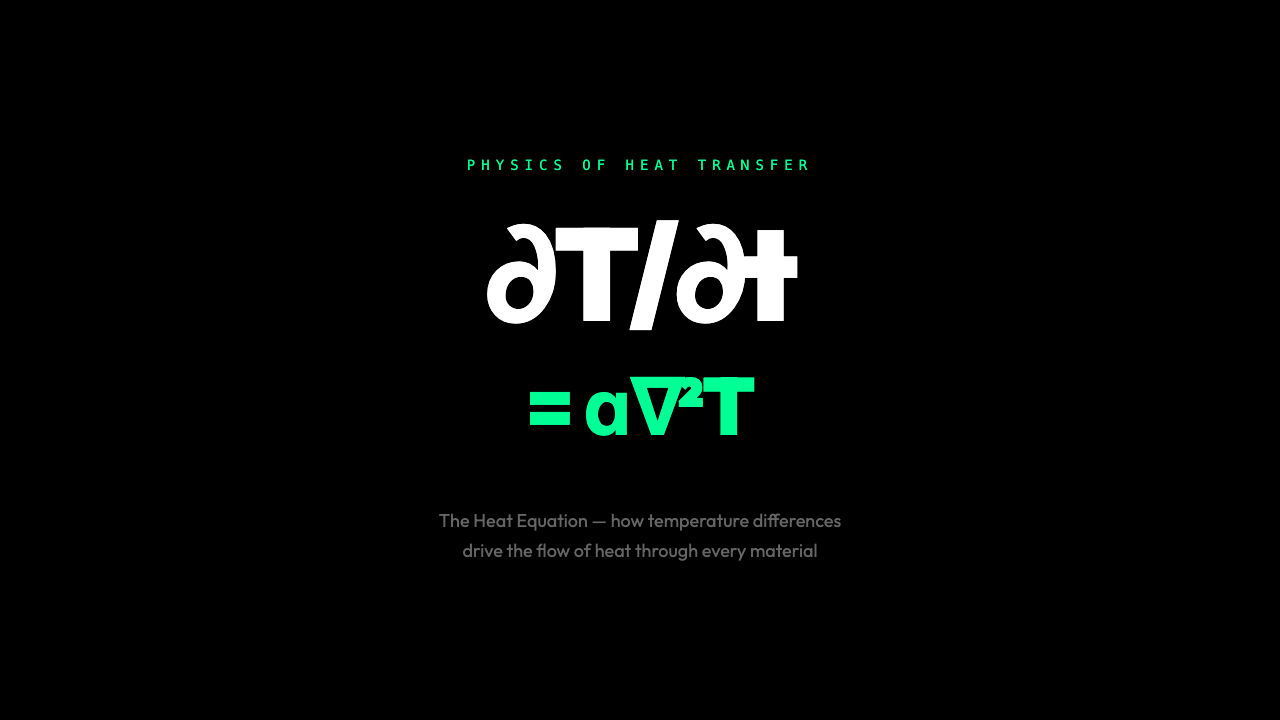
The heat equation describes how temperature evolves in space over time. It looks like this:
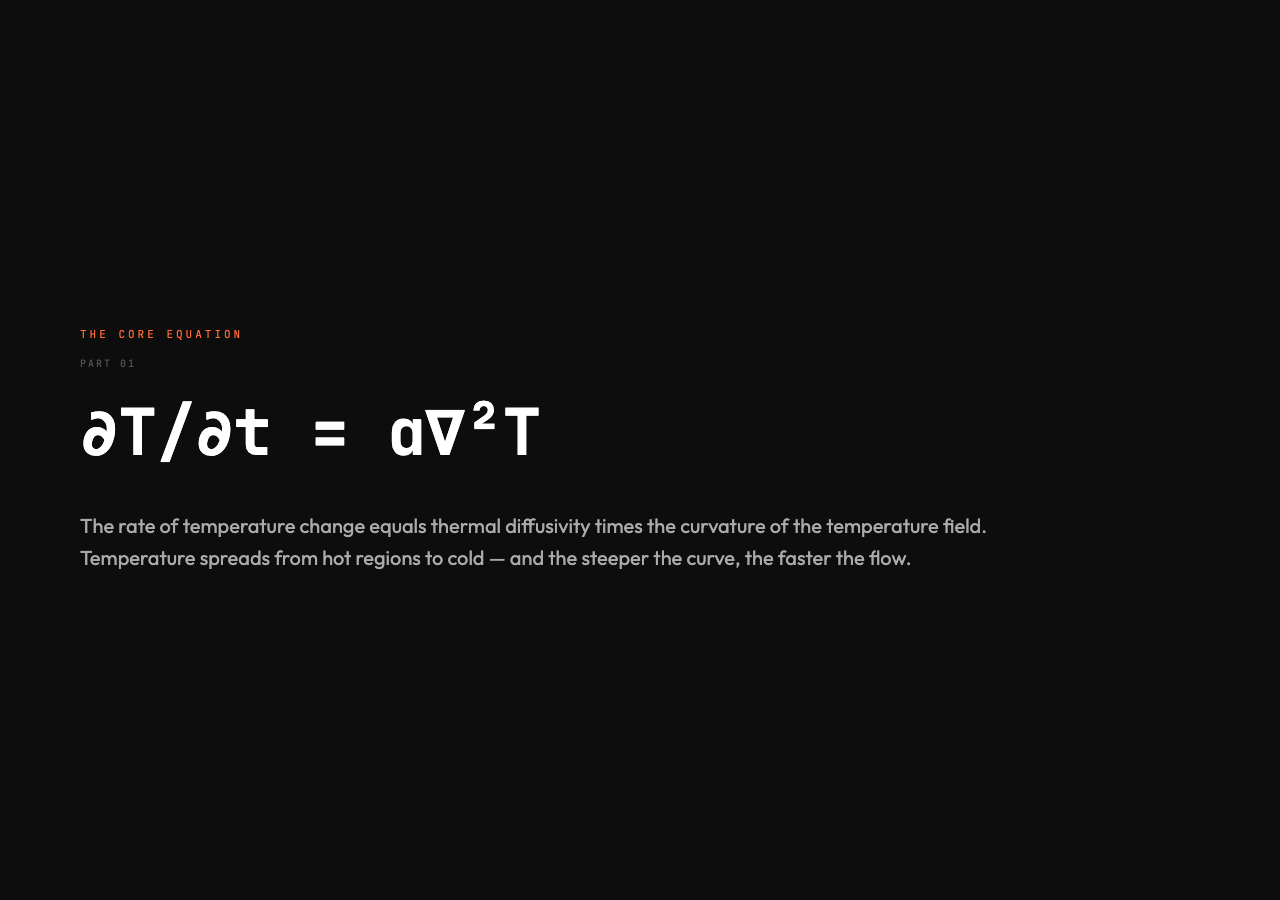
∂T/∂t = α · ∇²T
Read it as: the rate of temperature change at a point equals the thermal diffusivity multiplied by the curvature of the temperature field. Temperature spreads from hot regions to cold regions, and it spreads faster or slower depending on the material.
Why “Curvature” Matters
Most people expect heat to flow from hot to cold — that’s obvious. But the equation says something more specific: heat flows proportional to the curvature of the temperature distribution.
Imagine a bar with one end at 100°C and the other at 0°C. The temperature profile isn’t a straight line — it’s curved, especially near the hot end where heat enters rapidly. That curvature drives the heat flow. The steeper the curve, the faster the heat moves.
This is why a metal spoon warms up quickly near the hot end first — the large local curvature there drives intense heat influx. As the bar approaches equilibrium, the curvature flattens, heat flow slows, and eventually stops.
Thermal Diffusivity: The Material Fingerprint
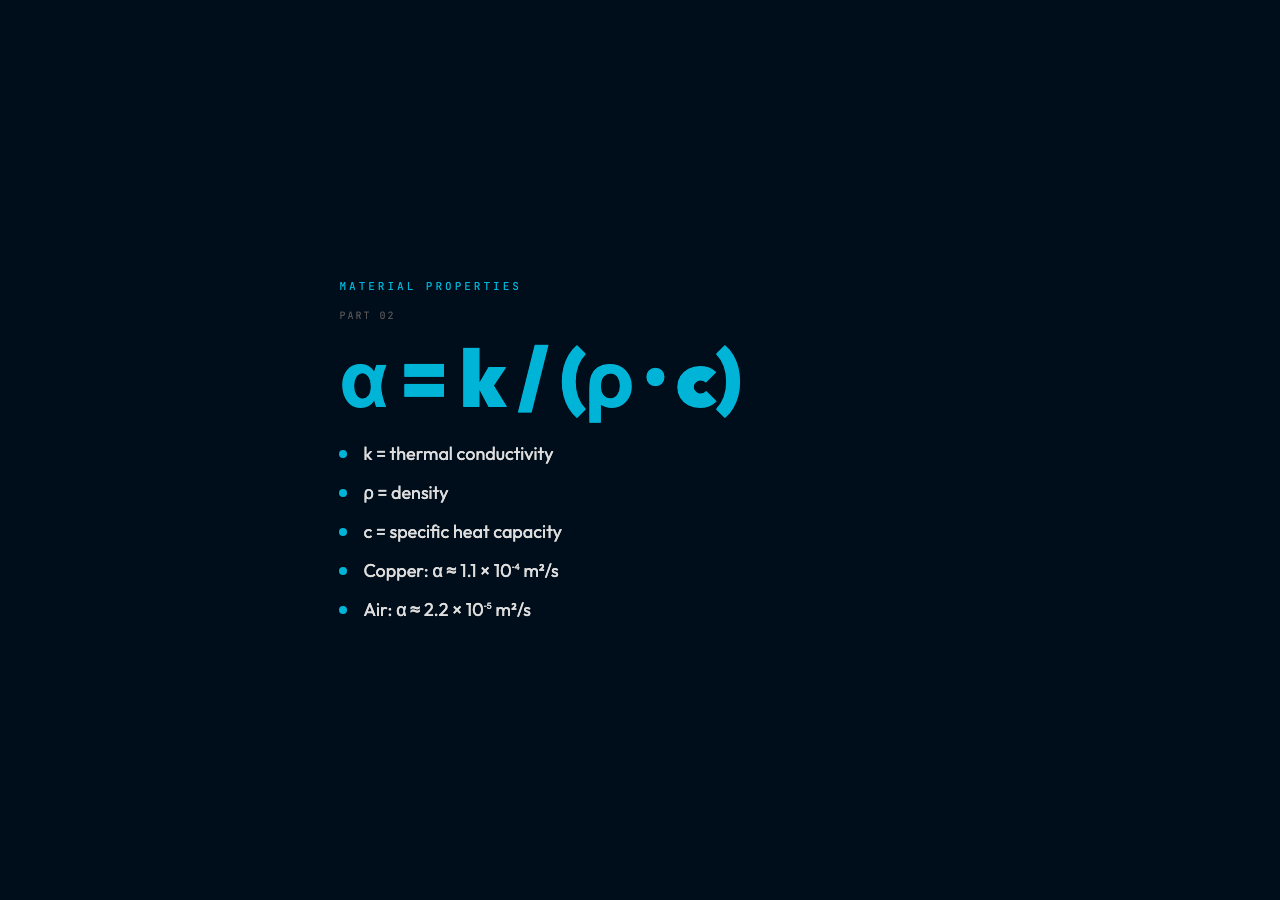
The α in the equation is thermal diffusivity — a single number that captures how fast heat spreads through a given material. It combines three material properties:
α = k / (ρ · c)
– k = thermal conductivity (how well the material conducts heat) – ρ = density (mass per unit volume) – c = specific heat capacity (how much energy it takes to raise temperature)
Copper has α ≈ 1.1 × 10⁻⁴ m²/s. Air has α ≈ 2.2 × 10⁻⁵ m²/s — about 50 times slower. This means a temperature disturbance spreads through copper roughly 50 times faster than through air. That’s why copper cookware heats more evenly than stainless steel, and why a metal bench feels colder than a wooden one at the same temperature — your hand loses heat rapidly to the metal’s high diffusivity.
The Equation in Two Dimensions
The heat equation in one dimension is manageable. In two dimensions, it becomes:
∂T/∂t = α(∂²T/∂x² + ∂²T/∂y²)
The term in parentheses is the two-dimensional Laplacian (∇²T) — it measures how the temperature deviates from the local average. If a point is hotter than its surroundings, the Laplacian is positive and the point cools down. If it’s cooler, the Laplacian is negative and it heats up.
This local-average behavior produces the spreading pattern you see when you drop food coloring into water — the color spreads from the drop in all directions, diffusing toward regions of lower concentration. Heat behaves identically, except the “color” is temperature.
Where the Heat Equation Shows Up
The heat equation isn’t just about tea spoons. It’s the backbone of:

– Microelectronics cooling: Chip designers solve the heat equation numerically to predict temperature hotspots before a chip is fabricated. No thermal simulation means a processor that throttles or fails in your hand.
– Climate modeling: The atmosphere and oceans are modeled as heat diffusion systems, with additional terms for convection and radiation. Climate sensitivity — how much warming results from doubling CO₂ — depends heavily on how fast the ocean can diffuse heat downward.
– Forest fire spread: Fire models use a modified heat equation where the “temperature” is ignition probability and the “diffusivity” varies with fuel moisture and wind. The 2019–2020 Australian bushfire season spread partly because dry, wind-driven conditions effectively increased the thermal diffusivity of the landscape.
Why Numerical Solutions Are Hard
The heat equation has closed-form solutions only for simple geometries — a rod with insulated ends, a sphere cooling in air, a semi-infinite solid. Real engineering problems involve irregular shapes, varying material properties, and boundary conditions that change over time.
Engineers use Finite Element Analysis (FEM) to solve it numerically: they divide the geometry into a mesh of small elements, approximate the derivatives at each node, and solve a large linear system at each time step. For a modern microchip with millions of elements and nanosecond timescales, the computation is substantial.
This is why machine learning models are now being trained to approximate heat equation solutions — once trained on enough simulations, a neural network can predict temperature fields in microseconds, enabling thermal management that runs in real time on the chip itself.
The Fundamental Insight
The heat equation encodes a single physical truth: temperature differences drive temperature flow, and the flow is proportional to how curved those differences are.
Everything else — the specific material properties, the geometry, the boundary conditions — is just details that determine the value of α and the shape of ∇²T.
The next time you wrap your hands around a warm mug, you’re watching that equation unfold in real time. The metal spoon is a one-dimensional heat diffusion problem, and the tea is solving it faster than your hand can conduct it away.