Why Energy Never Disappears: The First Law of Thermodynamics
Walk into any physics classroom and the first thing you’ll hear is “energy is conserved.” But what does that actually mean in a system you can touch — a gas squeezed inside a metal cylinder, for instance?
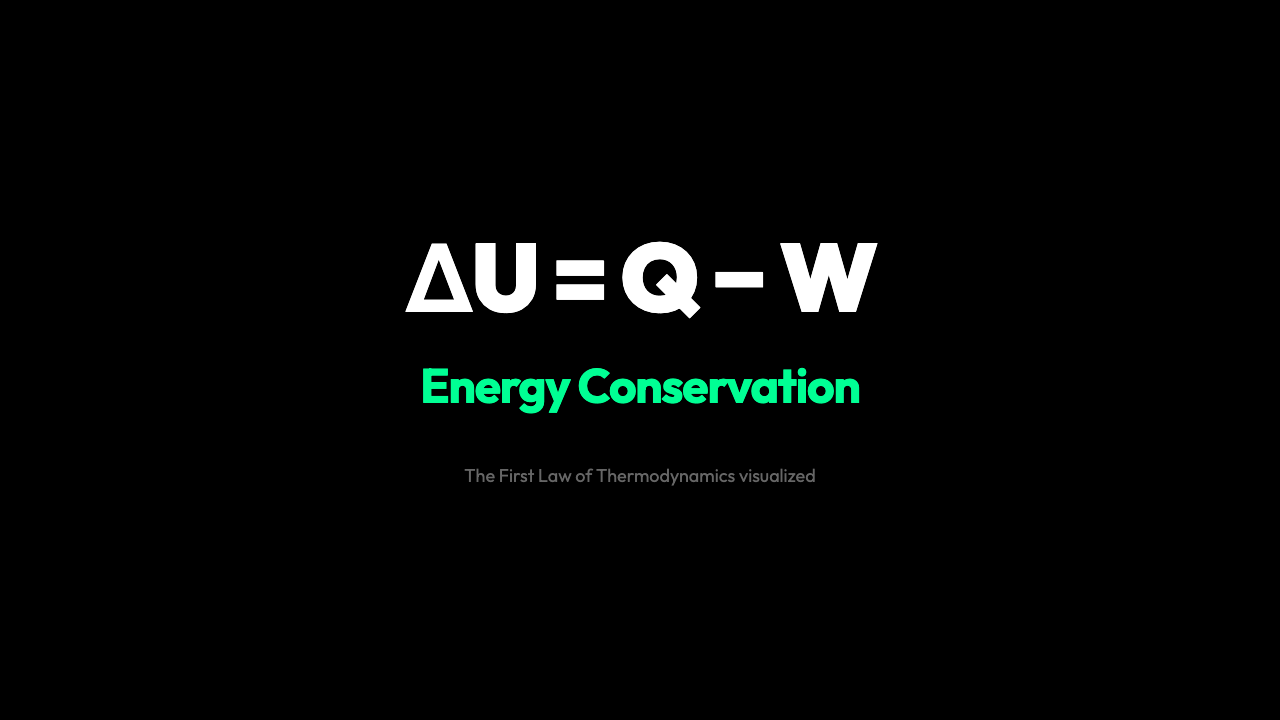
The First Law of Thermodynamics answers exactly that. It says the change in a system’s internal energy equals the heat you add minus the work it does on its surroundings. Written as a formula:
ΔU = Q − W
Three processes show this law in action. In an isochoric process, volume stays fixed, so the piston doesn’t move and no work is done — all the heat you add goes straight into changing the gas’s temperature. In an isobaric process, pressure stays constant while the piston moves, so the gas both heats up and pushes outward. In an adiabatic process, no heat flows in or out at all — the gas heats up purely because you’re compressing it.
You can interact with all three at once in the visualization below.
The Three Processes Side by Side
Isochoric Heating: When Work Is Zero
The simplest case: you clamp the cylinder so the volume can’t change, then add heat. The temperature rises. The formula simplifies to ΔU = Q. Since W = 0 (the piston isn’t moving), every joule of heat energy shows up as a rise in internal energy.
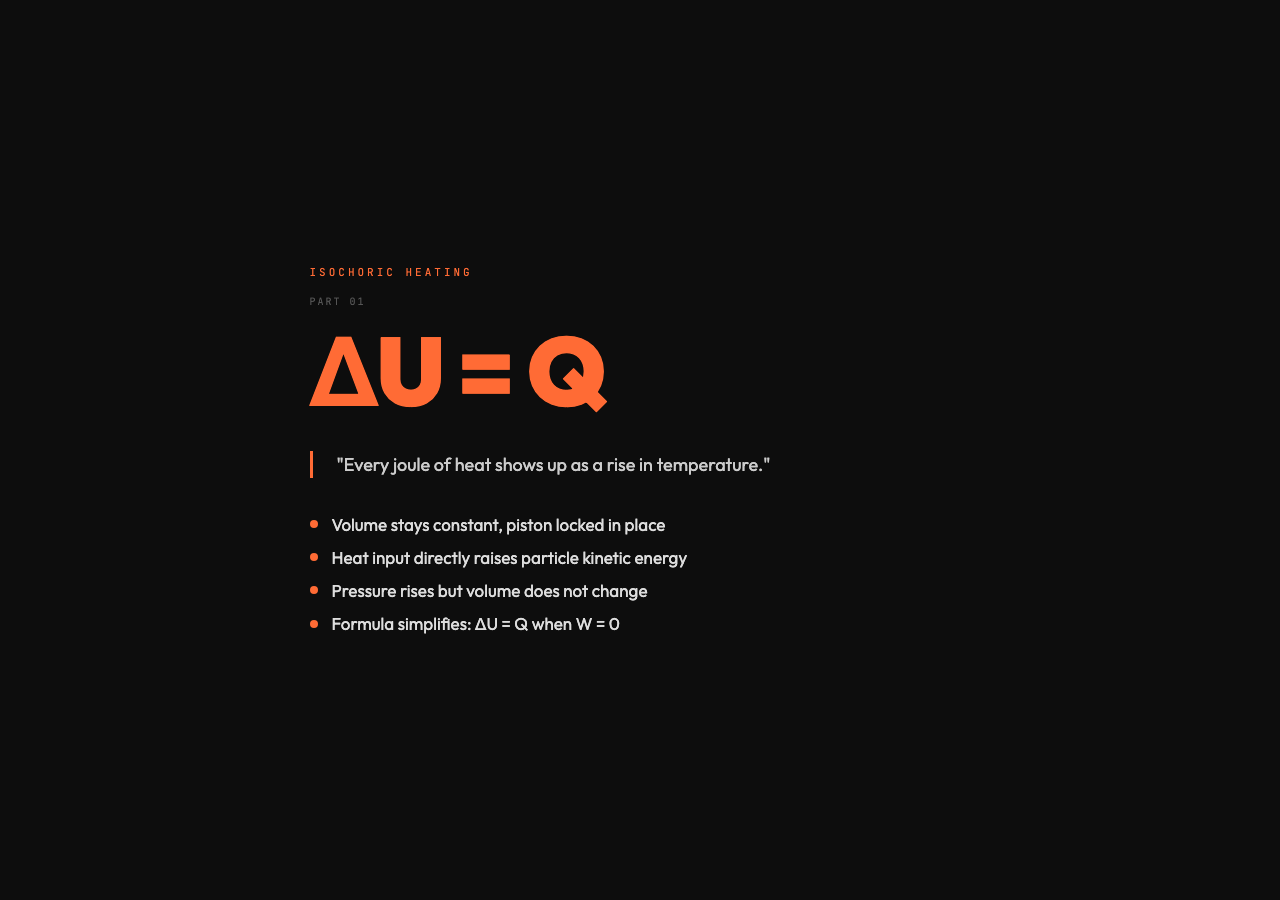
In the simulation, the isochoric process shows a gas with fixed volume — the piston stays at the same height. As heat flows in, the colored particles inside speed up and the temperature bar climbs. The pressure increases because the confined particles collide with the walls more often.
Isobaric Expansion: Heat Plus Work
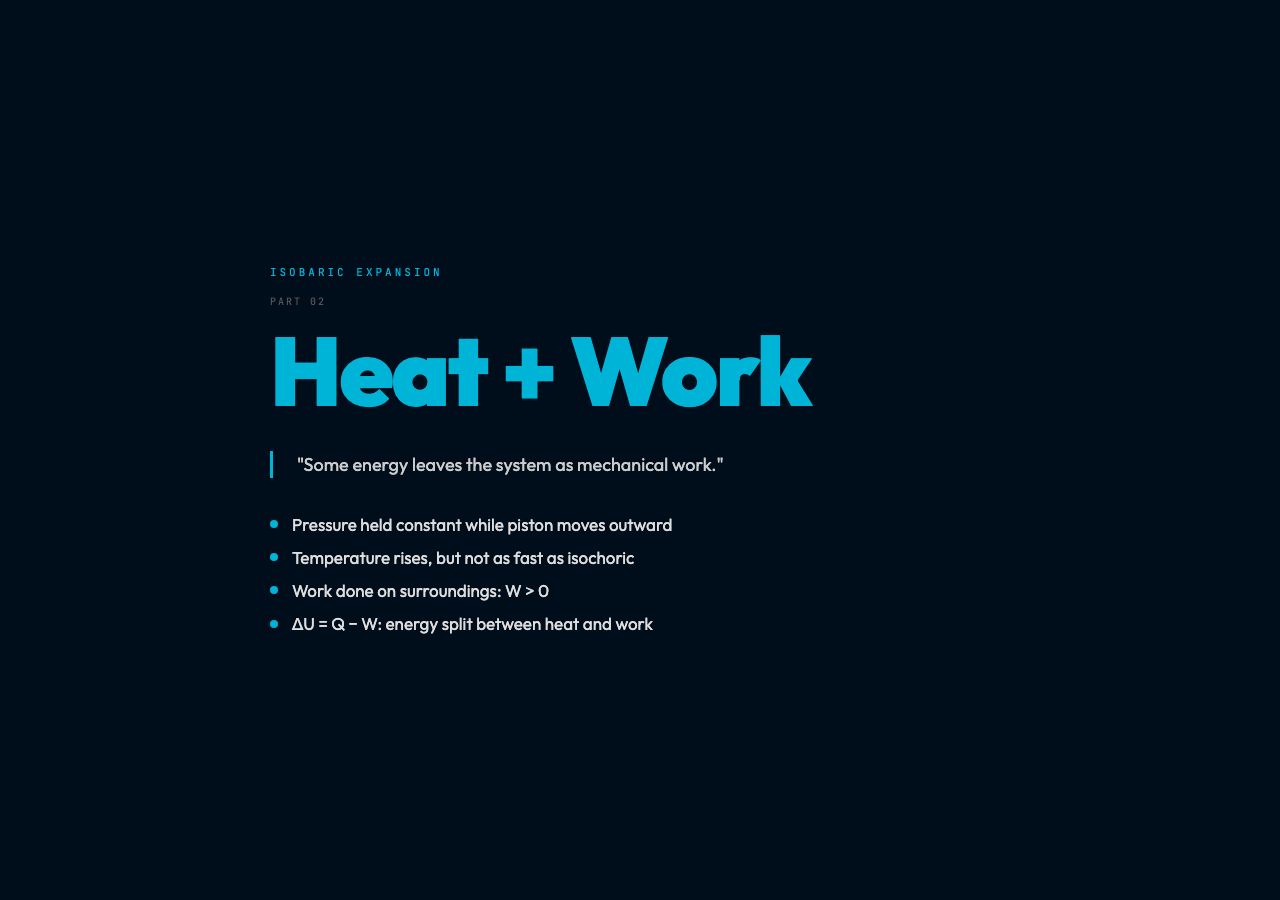
Now let the piston move, but keep the pressure constant. As you add heat, the gas expands and does work on the piston. The internal energy still rises, but not by the full amount of Q — some energy leaves the system as mechanical work.
In the isobaric process, you can watch the piston rise as the temperature climbs. The volume increases while the pressure indicator stays flat. The heat input is larger than the resulting temperature change because some energy is diverted to lifting the piston.
Adiabatic Compression: No Heat Allowed
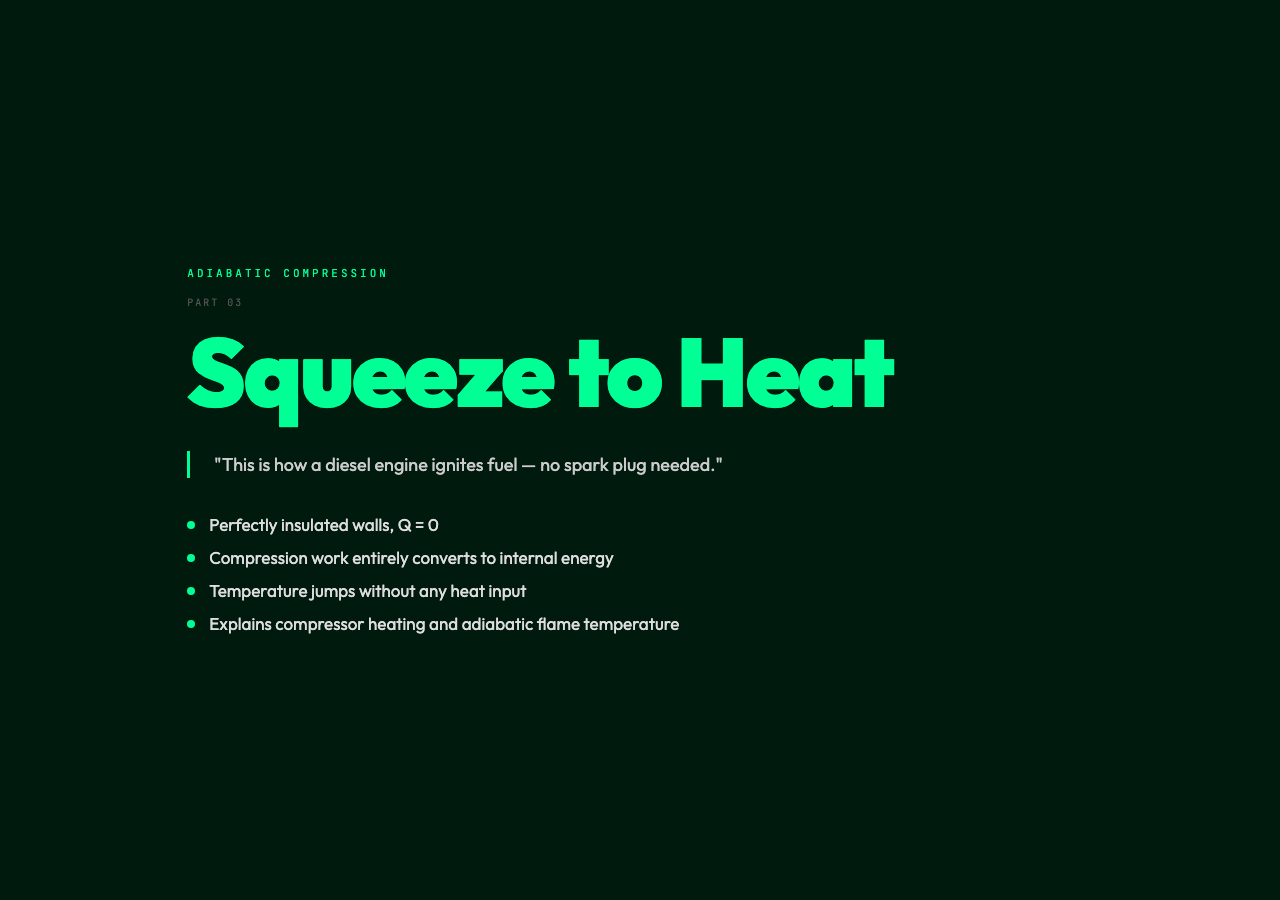
The most dramatic case: you insulate the cylinder perfectly and then compress the gas rapidly. No heat enters or leaves, so Q = 0. The formula becomes ΔU = −W. You do work on the system (negative W), and that work entirely becomes a rise in internal energy — and thus a rise in temperature.
In the adiabatic run, watch the temperature jump even though you never added any heat. Squeeze the gas hard enough and it becomes hot enough to ignite a diesel engine’s fuel air mixture. This is why diesel engines need no spark plugs.
Why This Matters Beyond the Classroom
The First Law is the reason your refrigerator hums, your car engine runs, and a balloon deflates in cold air. In every case, energy enters a system as heat or leaves as work, and the internal energy adjusts accordingly.
The three idealized processes — isochoric, isobaric, adiabatic — don’t describe every real system, but they are the clean cases every physics student learns first because they isolate one variable at a time. Real processes are usually some messy combination of all three.
What the Interactive Tool Shows
The visualization lets you run all three processes simultaneously and watch the gas particles inside each cylinder. You can see how particle velocity (temperature), pressure, and volume respond to each type of energy exchange.
Set the heat input (Q) and work output (W) yourself and watch the first law hold every time. ΔU will equal Q minus W, no matter what numbers you pick.
The tool is at Elysia Tools — First Law of Thermodynamics.