Why Crystal Structures Determine Everything About the Materials You Use
Every metal you touch, every semiconductor chip inside your phone, every solar panel harvesting sunlight — they all owe their properties to one thing: how their atoms are arranged. That arrangement has a name in physics: the crystal structure.
Most people never think about it. But engineers think about it constantly. The strength of steel versus aluminum isn’t accidental — it’s a consequence of whether the iron atoms pack in a body-centered cubic structure or something else. The speed of a computer chip doesn’t just depend on the transistors — it depends on the crystal lattice that electrons travel through.
This article explains what crystal structures are, how they differ, and why those differences ripple through every material decision humans have ever made.
The ThreeArchitectures That Define Engineering
When atoms arrange themselves into solids, they don’t do it randomly. Under ordinary conditions, they settle into repeating geometric patterns — lattices — that minimize energy. Three of these patterns dominate engineering:

Simple Cubic (SC) — atoms at the corners of a cube. This structure is rare in nature because it’s not densely packed. Polonium is one of the few elements that uses it. Engineers rarely encounter SC directly.
Body-Centered Cubic (BCC) — atoms at the corners plus one atom in the center of the cube. Iron uses this structure at room temperature. So do chromium, tungsten, and many transition metals. BCC metals are typically harder and have higher melting points than FCC metals at comparable atomic weights.
Face-Centered Cubic (FCC) — atoms at the corners plus one atom in the center of each face. Copper, aluminum, gold, and silver all use FCC. This structure packs atoms more densely, which makes FCC metals more ductile — easier to shape and draw into wires.
Understanding which structure a metal uses tells you immediately whether it can be rolled into thin foil, drawn into wire, or forged into complex shapes.
Miller Indices: How Scientists Describe Crystal Planes
Describing a crystal structure requires a way to talk about planes within the lattice. This is where Miller indices come in.

Given a crystal plane that cuts the three crystallographic axes (a, b, c) at integer multiples of the lattice constant, the Miller indices (hkl) are calculated as the reciprocals of those intercepts, multiplied to clear fractions. A plane cutting axes at 1a, 1b, and 1c has indices (111). A plane cutting at 1a, ∞b, ∞c (parallel to the b and c axes) has indices (100).
The interactive visualization lets you select different (hkl) planes and watch the diffraction pattern change. This isn’t theoretical — it’s how X-ray crystallography works. When X-rays scatter off crystal planes, the pattern they produce encodes the lattice structure. That pattern is what enabled the discovery of DNA’s double helix and the design of every silicon wafer in every chip ever made.
Real-World Consequences
Consider aluminum and iron. Both are abundant metals. Their properties are completely different:
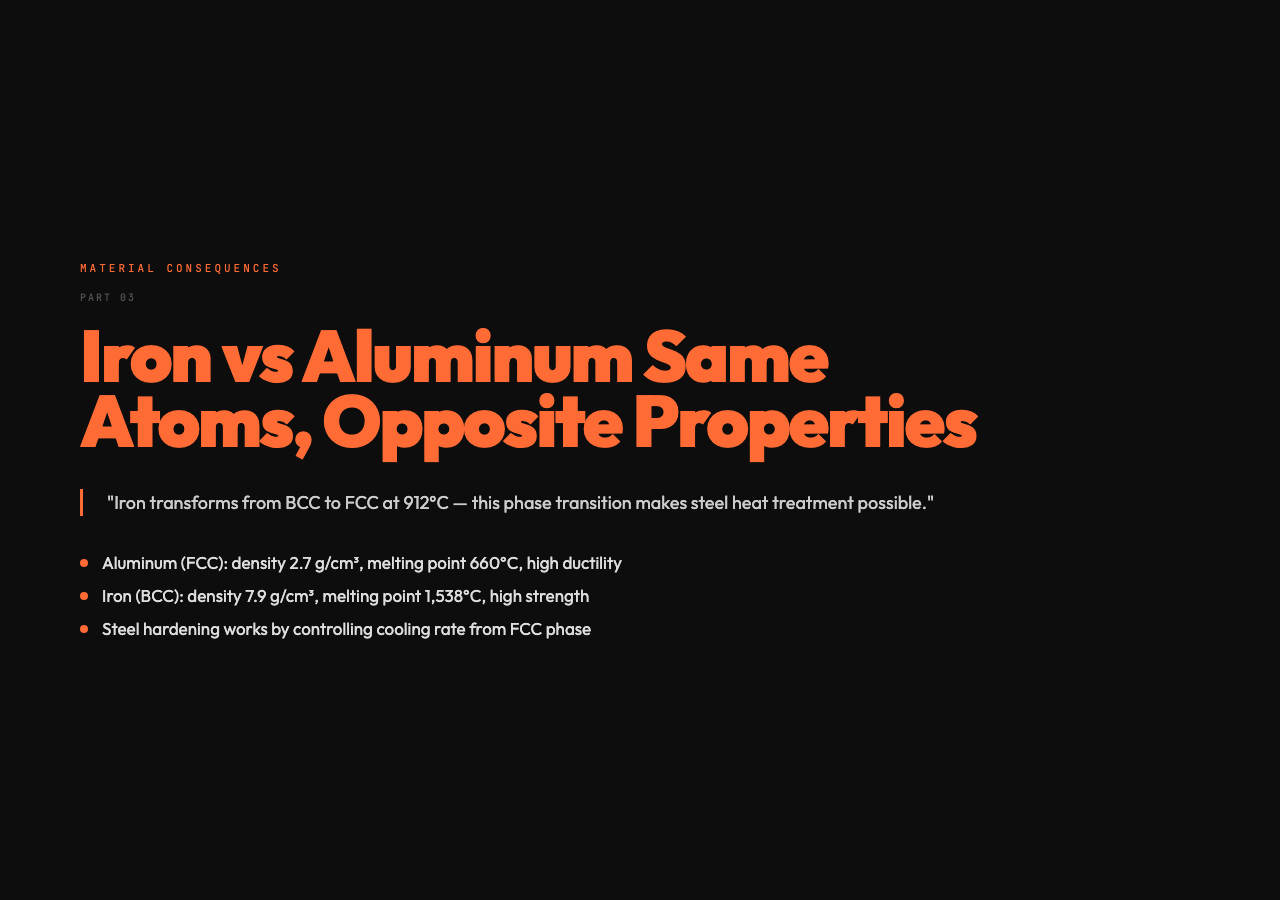
| Property | Aluminum (FCC) | Iron (BCC) |
|---|---|---|
| Density | 2.7 g/cm³ | 7.9 g/cm³ |
| Ductility | High | Moderate |
| Melting Point | 660°C | 1,538°C |
| Electrical Conductivity | High | Moderate |
These differences aren’t accidents. They’re direct consequences of crystal structure. FCC aluminum’s dense packing makes it lightweight and easy to work with. BCC iron’s open structure and strong directional bonds give it strength at high temperatures — which is why steel (iron with carbon) is the material of choice for buildings, bridges, and automobiles.
What the Interactive Visualization Reveals
The crystal structures visualization shows all three lattice types simultaneously. You can rotate them, toggle unit cells, and see Miller index planes in action.
The most striking observation: the same atoms can form radically different structures depending on temperature and pressure. Iron is BCC below 912°C, FCC between 912°C and 1,394°C, then BCC again until it melts. This phase transition is what makes steel heat treatment possible — you can harden iron by controlling how fast it cools from the FCC phase, trapping atoms in a configuration they wouldn’t hold at equilibrium.
Understanding crystal structures is the difference between treating materials as black boxes and understanding why they behave the way they do. It’s one of those pieces of physics that, once you see it, makes everything else make more sense.