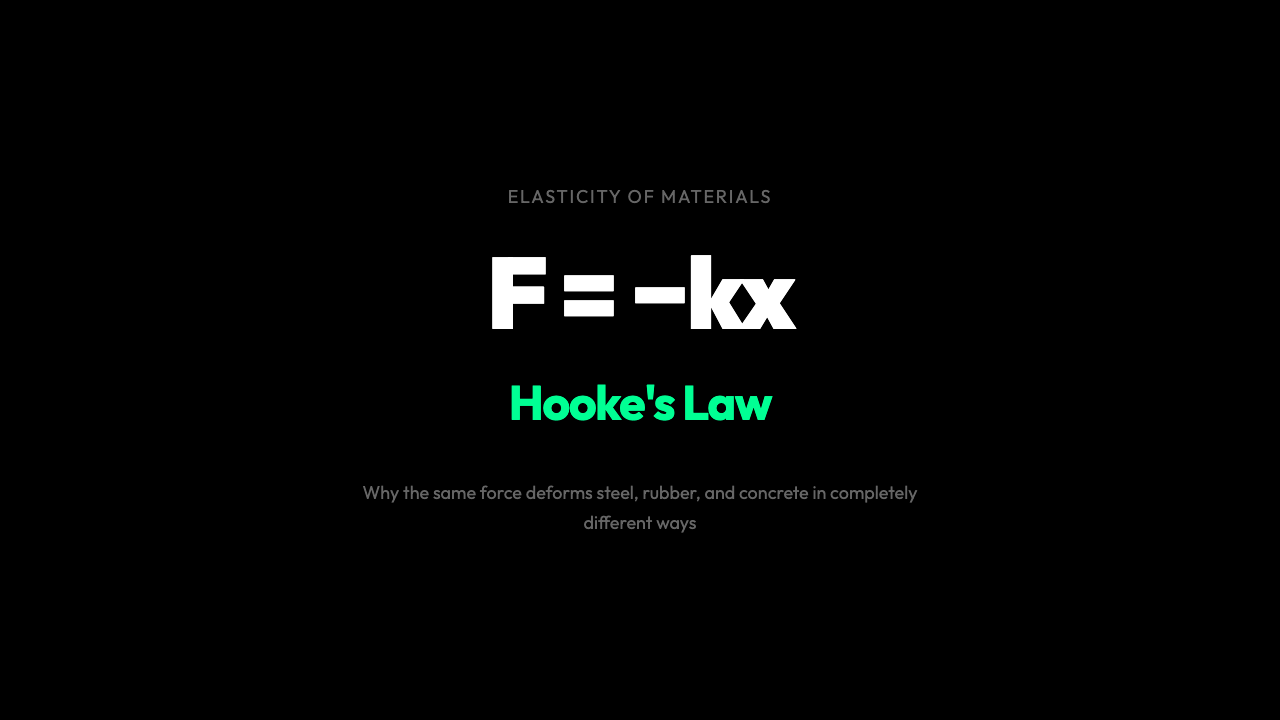
Why the Same Force Deforms Steel, Rubber, and Concrete in Completely Different Ways
Push on a steel beam, a rubber band, and a concrete block with the same force. The steel barely budges. The rubber stretches like taffy. The concrete cracks. Same force, entirely different behavior — and that difference is governed by one of the most practical equations in physics: Hooke’s Law.
This isn’t just a classroom curiosity. Understanding elasticity explains why buildings don’t collapse under wind load, why bridges flex during earthquakes, and why a rubber ball bounces while a ceramic mug shatters. It’s the physics that engineers use to choose materials, predict failure, and design things that last.
What Elasticity Actually Measures
Elasticity is a material’s ability to resist deformation under load and return to its original shape when the load is removed. A perfectly elastic material springs back exactly — no permanent damage, no residual strain. A perfectly plastic material deforms permanently, like playdough.

Real materials fall somewhere in between, and where they fall determines almost everything about how we use them.
The core relationship is Hooke’s Law:
F = −kx
F is the applied force, k is the spring constant (stiffness), and x is the displacement. The negative sign means the force opposes the displacement — the material pushes back. A steel beam has a huge k value, so even a large force produces a tiny x. A rubber band has a small k, so the same force produces a large stretch.
But stiffness alone doesn’t tell the whole story. To really compare materials, physicists use stress (force per unit area) and strain (relative deformation):
– Stress σ = F/A — how much force is distributed across the cross-section – Strain ε = ΔL/L₀ — how much the length changes relative to the original
The ratio of stress to strain is the Young’s modulus (E):
E = σ/ε
Young’s modulus is the material’s intrinsic stiffness — independent of its shape or size. This is what lets engineers compare materials fairly:
| Material | Young’s Modulus (GPa) | Behavior Type |
|---|---|---|
| Steel | 200 | Ductile |
| Rubber | 0.05 | Elastic |
| Concrete | 30 | Brittle |
Steel is 4,000 times stiffer than rubber. Concrete is 6.7 times stiffer than rubber but 6.7 times less stiff than steel.
The Stress-Strain Curve: Reading a Material’s Biography
If you stretch a material while measuring both stress and strain, you get a stress-strain curve. That curve tells you everything about how the material will behave in service.

For ductile materials like steel, the curve has distinct regions:
- 1. Linear elastic region — stress and strain are proportional (Hooke’s Law holds). Remove the load, and the material returns to exactly its original shape.
- 2. Yield point — beyond this, the material begins to deform plastically. Permanent deformation occurs even if you remove the load.
- 3. Strain hardening — the material resists further deformation, getting stronger as it’s stretched.
- 4. Necking — the cross-section locally narrows. This is a failure warning sign.
- 5. Fracture — the material breaks.
For brittle materials like concrete, the curve is different. There is almost no plastic region — the material deforms linearly up to the point of sudden fracture. No warning, no necking, just catastrophic failure.
For rubber (an elastic material), the curve is highly non-linear. Rubber starts stiff, then gets easier to stretch, then hardens again near its elastic limit. This “J-curve” behavior is why rubber bands feel easy to stretch at first, then suddenly resist strongly.
Three Materials, Three Failure Modes
The interactive simulation lets you apply force and watch how steel, rubber, and concrete respond in real time.
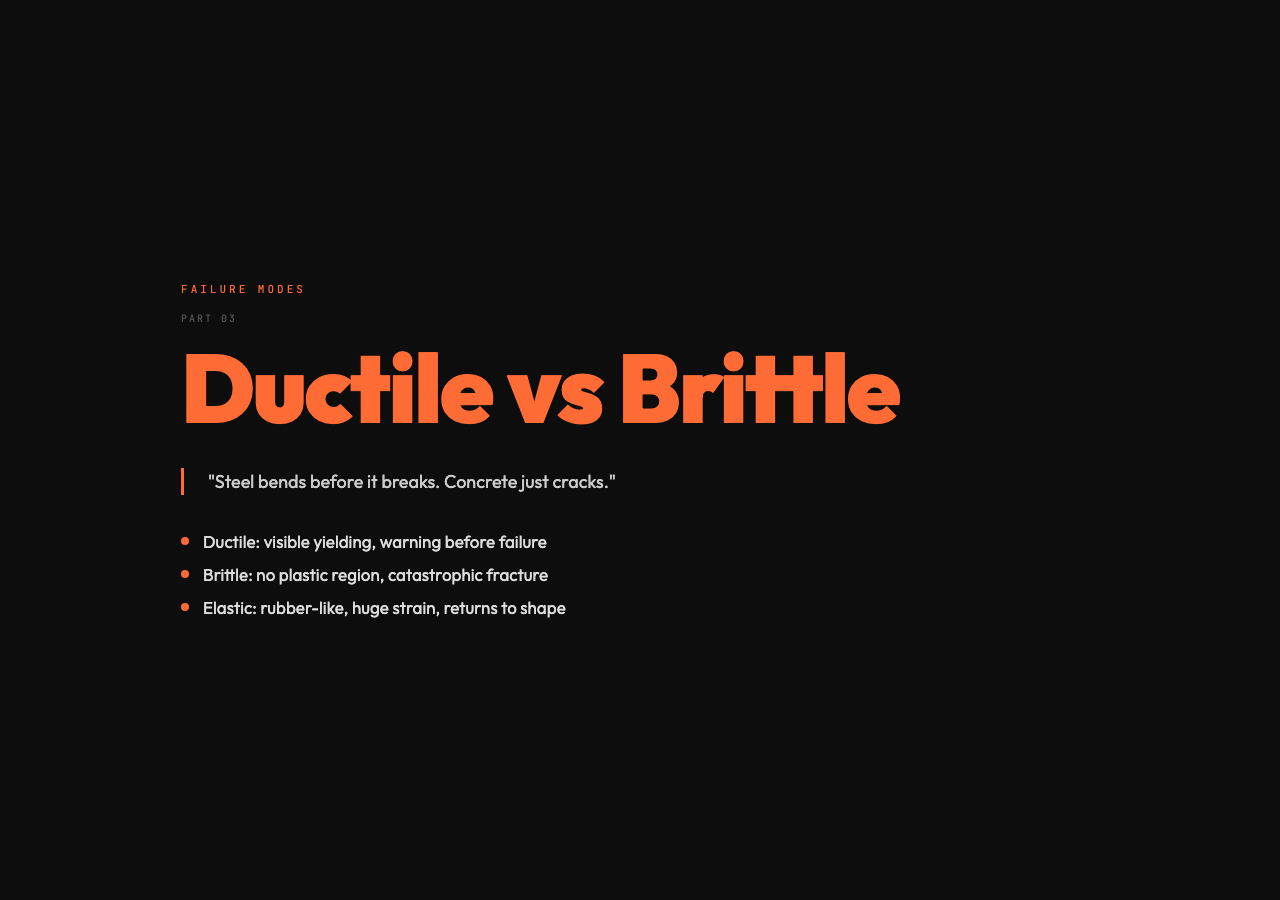
Steel deforms elastically under small loads. As you increase load, it yields, then strain-hardens. You can overload steel significantly before it fails — it gives you warning through visible bending and necking. This is why steel is the material of choice for structures that need to be resilient.
Rubber stretches dramatically and returns. But push it past its elastic limit and it permanently deforms — or tears. The key parameter is the elastic limit, typically much lower than steel’s on an absolute force scale, but remarkable given rubber’s enormous strains (it can stretch to several times its original length).
Concrete is strong in compression but weak in tension. That’s why concrete is always reinforced with steel rebar — the steel handles the tensile forces that would crack plain concrete. A concrete beam under bending will crack on the tension side while the compression side holds.
Why This Matters in Engineering
Every structure is an elasticity problem. When you design a building:
- Columns must support compressive loads without buckling
- Beams must resist bending without yielding
- Connections must allow controlled movement to release stress
The 2008 I-35W Mississippi River bridge collapse was partially attributed to a design that didn’t adequately account for stress concentrations at gusset plates — points where the geometry caused local stress to spike far above the nominal stress. Elasticity theory told engineers exactly where the problem was, but the analysis wasn’t done rigorously enough.
Modern finite element analysis (FEA) tools solve elasticity equations numerically for complex geometries, letting engineers predict exactly how much a bridge deck will sag under peak traffic load, or how much a airplane wing will flex in turbulence.
Hooke’s Law Is Everywhere
Beyond structural engineering, Hooke’s Law governs:
- Medical devices — arterial stiffness is measured via the relationship between pressure and vessel diameter change
- Orthopedic implants — bone screws must provide enough stiffness to stabilize fractures without stress-shielding (where overly stiff plates cause bone resorption)
- Sports equipment — the “feel” of a tennis racket or golf club is largely determined by how much the material deflects under impact
The spring constant k isn’t just for springs. Every material has an effective spring constant for every mode of deformation — axial stretching, shear, bending, torsion. Understanding elasticity means understanding how anything that has shape responds to force.
The next time you stretch a rubber band, bend a paperclip, or watch a bridge flex in the wind — you’re watching Hooke’s Law in action, the same relationship that engineers have used to build the modern world.