Why Your Coffee Always Ends Up Room Temperature: The Exponential Law Behind Every Cooling Process
Drop a hot mug onto a table and watch it lose heat. Not linearly — not at a steady number of degrees per minute — but faster when it’s hot, slower as it approaches room temperature. Every degree closer to ambient, the cooling slows. After ten minutes it’s barely changing. After twenty it’s practically the same as the air around it. This isn’t a quirk of coffee or cups. It’s a law of nature that every material obeys.
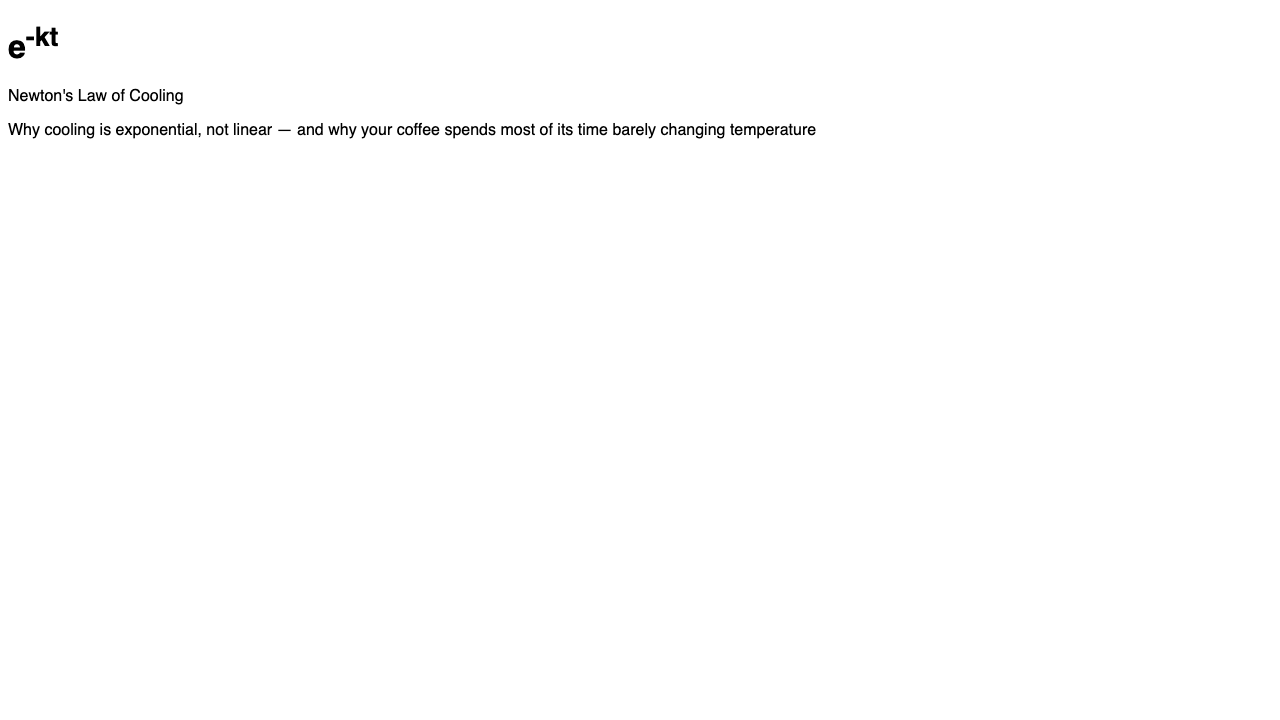
Newton’s Law of Cooling states that the rate of heat loss is proportional to the temperature difference between an object and its surroundings. Mathematically: T(t) = T_env + (T₀ – T_env) × e^(-kt). But the equation is less important than what it implies: cooling is exponential, not linear. And that single fact explains why your coffee spends most of its time barely changing temperature.
The Core Insight: Cooling is Exponential, Not Linear
If cooling were linear, your coffee would lose the same number of degrees every minute. From 85°C to 75°C in the first minute, 75°C to 65°C in the second, 65°C to 55°C in the third. That would mean it reaches room temperature (say, 22°C) in about an hour.
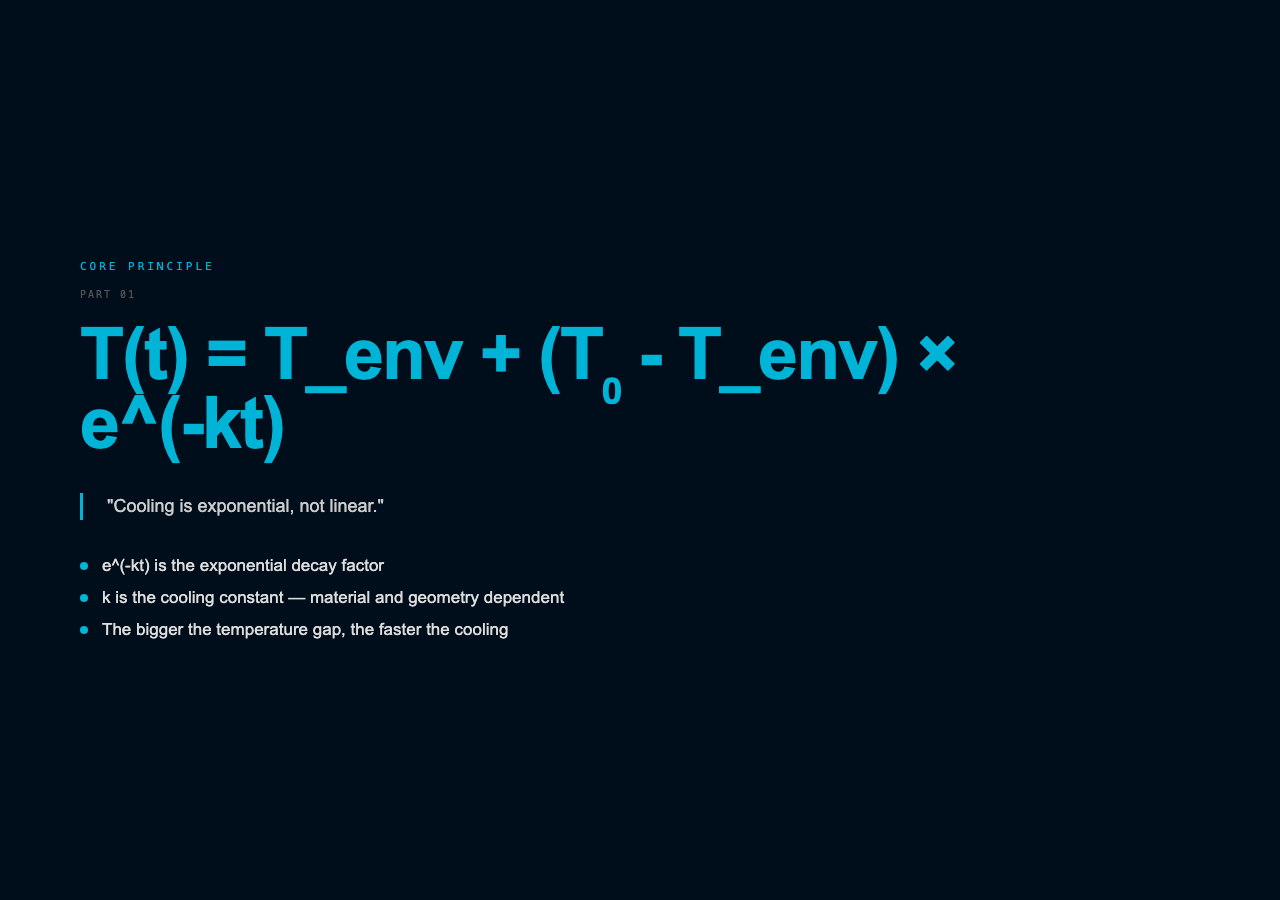
The actual physics doesn’t work that way. Newton’s law says the rate of cooling is proportional to the temperature gap. When the coffee is 60 degrees above room temperature, it cools fast. When it’s only 10 degrees above, it cools slowly. The curve isn’t a straight line — it’s an exponential decay.
The formula T(t) = T_env + (T₀ – T_env) × e^(-kt) makes this concrete:
- T₀ is the starting temperature
- T_env is the ambient temperature
- k is the cooling constant, determined by the object’s properties
- t is elapsed time
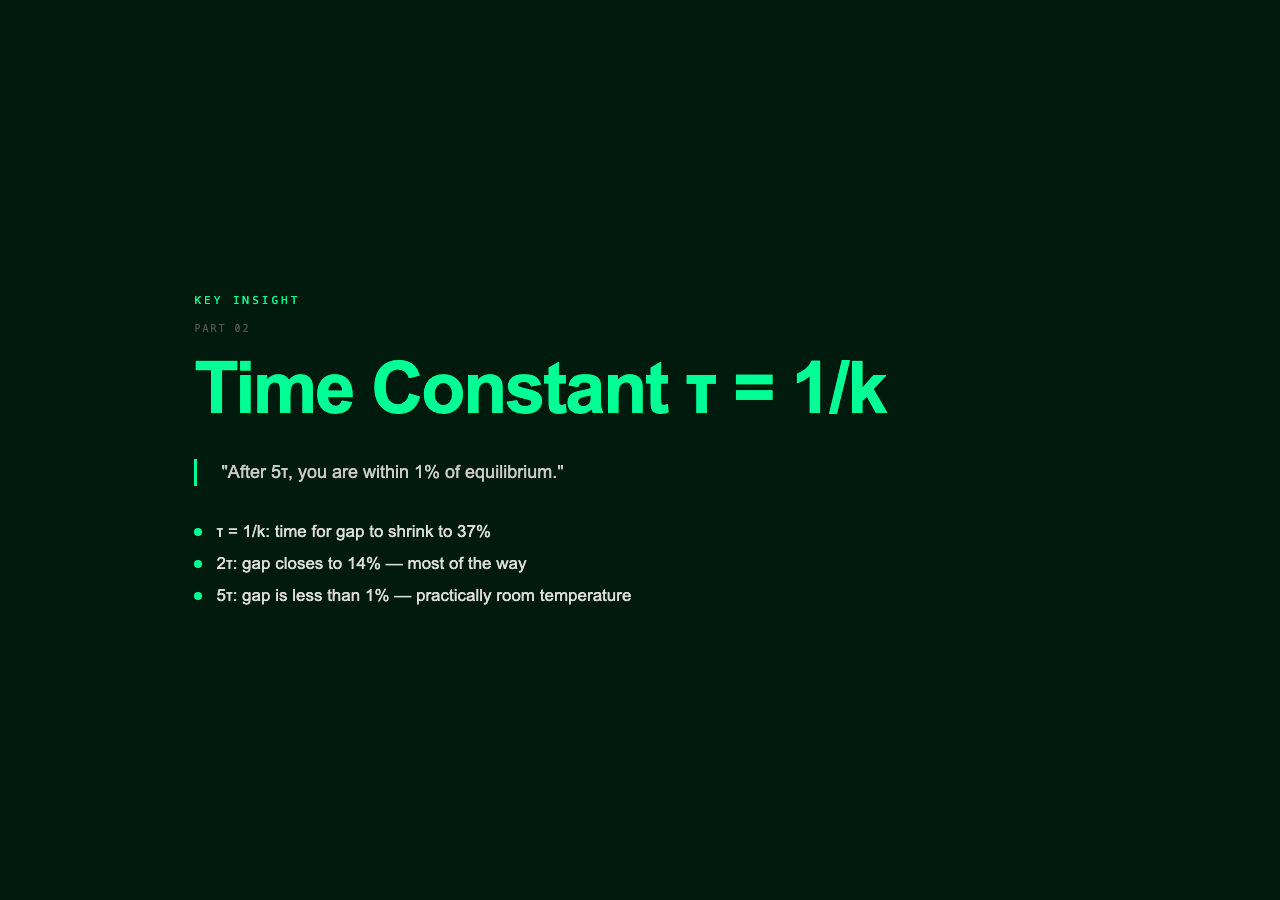
The exponential factor e^(-kt) is what creates the characteristic shape: rapid change at first, then increasingly slow approach to T_env. The time constant τ = 1/k tells you how long it takes for the temperature gap to shrink to 1/e (about 37%) of its initial value. Double that time (2τ) and you’re at 86% of the way to equilibrium. After 5τ, you’re within 1% — practically indistinguishable from room temperature.
Why Time Constants Matter More Than Starting Temperature
One practical consequence of the exponential law: the math doesn’t care where you start. Whether you pour coffee at 85°C or 70°C, the time to reach 50°C is the same — because that time depends only on the cooling constant k and the ratio of temperatures, not the absolute values.
This is why the “take it off the heat earlier” advice for cooking is real physics, not superstition. If a pot is already at 95°C and cooling toward a 20°C kitchen, it spends a disproportionate amount of time between 95°C and 80°C — because that’s where the temperature gap is largest and the cooling is fastest. The last few degrees take as long as the first twenty.
Forensic scientists use this principle to estimate time of death. A body cools according to Newton’s law. By measuring the current temperature and the rate of cooling, examiners can back-calculate when the body was at normal body temperature (37°C), giving an estimated time of death within a reasonable range. The assumption is that the body’s internal temperature follows an exponential decay toward ambient temperature — exactly Newton’s law.
The Same Law Governs Everything That Conducts Heat
Newton’s law applies whenever heat transfers by convection or conduction into a surrounding medium at constant temperature. Hot coffee in a mug. A warm engine block after you park. A metal rod removed from a forge. A cpu heat spreader after the fan kicks on.
The cooling constant k depends on the geometry, material conductivity, and surface area of the object, along with the heat transfer coefficient between the object and environment. A thin copper wire cools faster than a thick iron rod of the same shape because copper conducts heat more efficiently. A flat plate cools faster than a sphere of the same volume because it has a higher surface-area-to-volume ratio.
In the visualization, you can watch this in real time. Adjust the initial temperature, the ambient temperature, and the cooling constant k. The exponential curve updates instantly, showing exactly how long until the temperature difference becomes negligible. The asymptote — the temperature the object approaches but never quite reaches — is always T_env.
The Asymptote That Objects Never Quite Reach
One counterintuitive property of exponential decay: an object following Newton’s law never actually reaches T_env in finite time. The temperature difference (T₀ – T_env) × e^(-kt) shrinks toward zero but only equals zero at t = ∞.

In practice, after 5τ, the difference is less than 1% of the original gap — imperceptible to touch or measurement. But mathematically, equilibrium is only approached asymptotically. This is why a mug of coffee technically never reaches exactly room temperature, but after an hour it might as well have.
This same mathematical behavior appears in RC circuits (capacitor voltage decays exponentially toward supply voltage), in radioactive decay (unstable nuclei follow the same exponential form), and in many other physical systems where a quantity approaches a long-term equilibrium. Newton’s Law of Cooling isn’t just about coffee mugs — it’s a template for how most real systems relax toward stability.
What the Visualization Shows
The interactive graph plots T(t) against time. Three curves appear when you run the simulation:
1. The cooling curve — the exponential decay from T₀ toward T_env 2. The ambient line — the horizontal line at T_env, which the cooling curve asymptotically approaches 3. The temperature gap — the vertical difference between the cooling curve and ambient, itself an exponential decaying at the same rate
The heat particles in the visualization represent the thermal energy leaving the object. More particles means faster heat transfer — the particle emission rate is proportional to the temperature difference, exactly as Newton’s law describes.
Play with the cooling constant k to see how different materials behave. A higher k means faster cooling — a thin copper cup in a breeze. A lower k means slower — a thick ceramic mug in still air. The time constant τ = 1/k is the single number that tells you how fast any object cools, regardless of its starting temperature.