Why One Equation Connects Pressure, Volume, and Temperature Across Every Engine and Breath
In 1834, Émile Clapeyron wrote down a single formula that tied together three quantities engineers had been measuring separately for decades: PV = nRT. Pressure times volume equals moles times the gas constant times temperature. One line. Every scuba tank, every weather forecast, every engine cylinder suddenly made sense under the same framework.
The Ideal Gas Law is not an approximation of reality — it is the cleanest first description of how gas molecules behave when they are far enough apart that their own volume and mutual attractions become negligible. Under ordinary conditions — room temperature, atmospheric pressure — it works with uncanny precision.
What the Equation Actually Says
The equation PV = nRT contains four variables and one constant:
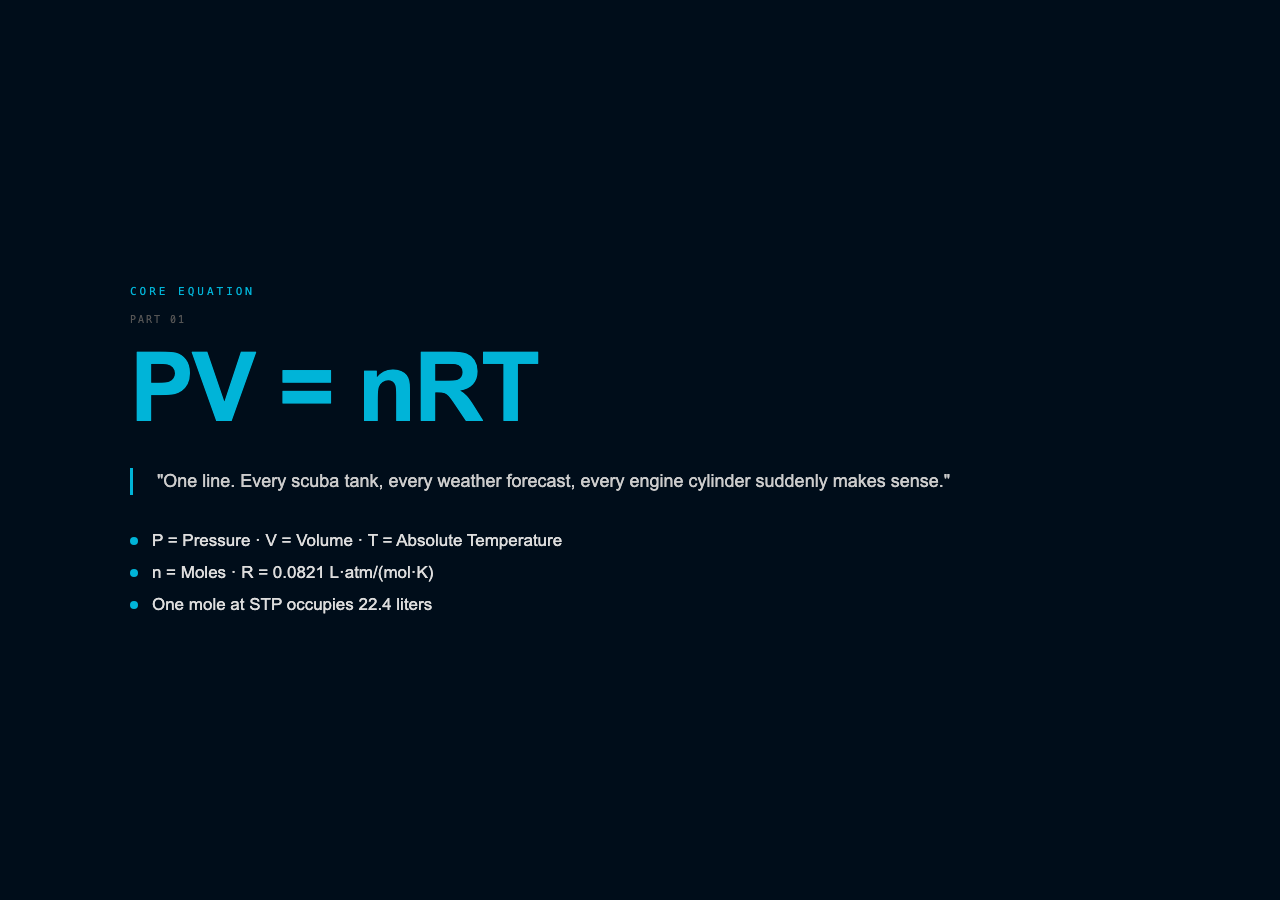
– P — Pressure (atmospheres, pascals, or psi) – V — Volume (liters for everyday use, cubic meters in physics) – n — Amount of gas in moles – T — Absolute temperature (Kelvin, not Celsius) – R — The ideal gas constant: 0.0821 L·atm/(mol·K)
To get a feel for the scale, one mole of any ideal gas at standard conditions (0°C, 1 atm) occupies 22.4 liters — roughly the volume of a beach ball. At room temperature (20°C, 293 K) and atmospheric pressure, one mole occupies about 24 liters.
The power of the equation is in what happens when you hold two variables fixed and watch the third respond.
The Three Processes: Watching the Gas React
A gas system that changes while keeping one variable constant reveals something fundamental about the others.

Isochoric Process: When Volume Is Locked
In an isochoric (constant-volume) process, the gas is trapped in a rigid container. If you heat the gas, pressure rises directly in proportion to temperature — because V and n are fixed, and PV/T = R is constant.
This is exactly what happens inside a rigid-body heat exchanger, or inside the cylinder of an engine during the combustion stroke when the piston is at top dead center and volume is briefly fixed.
Isobaric Process: When Pressure Holds Steady
In an isobaric (constant-pressure) process, the gas is allowed to expand or contract while an external mechanism — a moving piston with a constant counterforce — maintains constant pressure. The volume tracks temperature directly: doubling the absolute temperature doubles the volume.
This is the principle behind many thermal expansion joints in industrial piping — the pipe expands under heat but a bellows or loose fit accommodates the change while keeping internal pressure near-constant.
Isothermal Process: When Temperature Does Not Budge
In an isothermal (constant-temperature) process, a gas exchanges heat with its surroundings fast enough that T stays fixed. The pressure and volume then obey an inverse relationship: P₁V₁ = P₂V₂. Compress the gas to half its volume, and the pressure doubles.
This is the operating principle of the Carnot cycle’s isothermal expansion stroke — the gas does work against a piston while absorbing heat, without its temperature rising because all the added energy leaves as work.
Why It Works: Kinetic Theory in One Paragraph
Gases follow the Ideal Gas Law because the assumptions of kinetic theory hold under ordinary conditions:
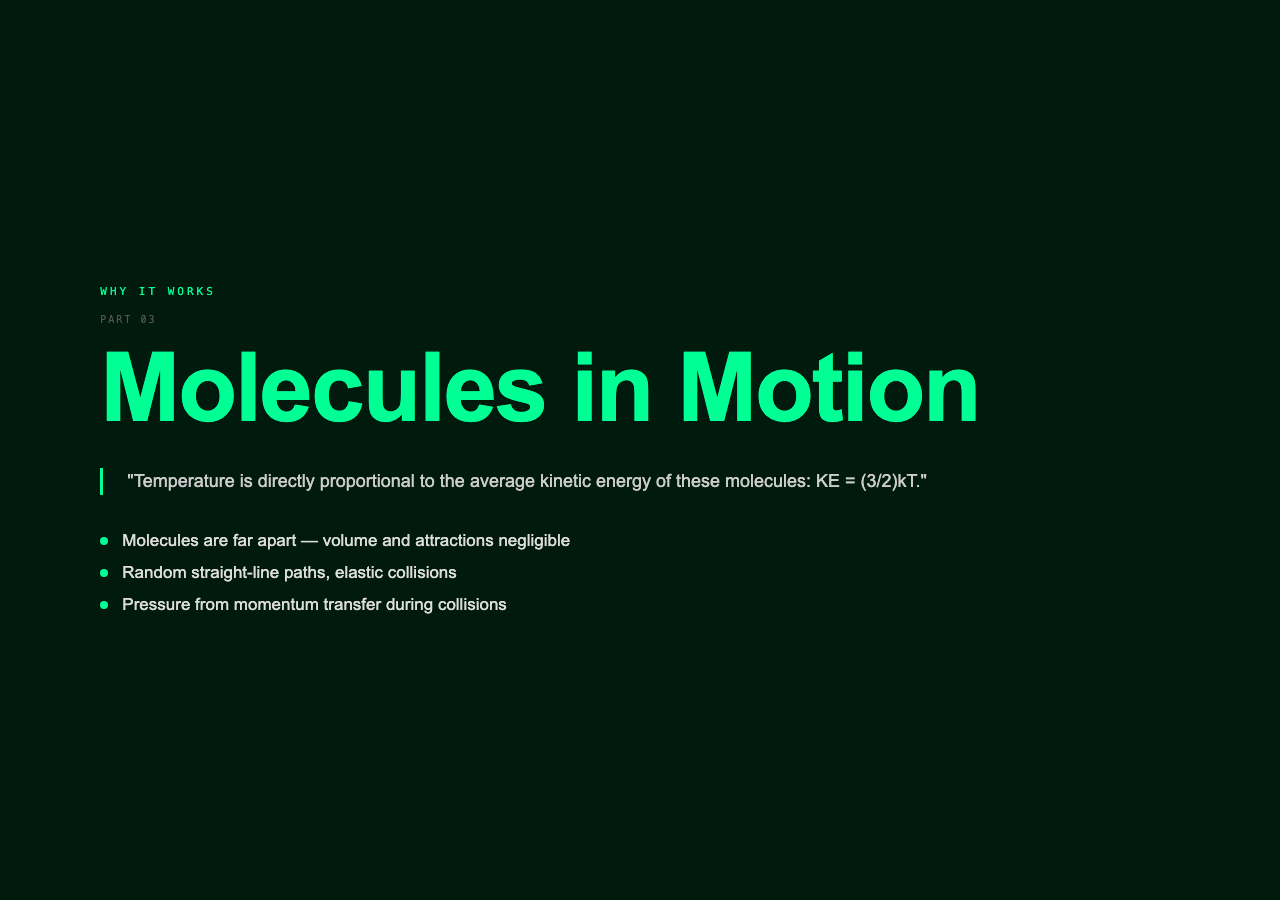
– Gas molecules are far apart relative to their own size (typically 10 diameters apart at 1 atm) – They move in random straight-line paths, colliding elastically with each other and the container walls – The pressure on the container walls comes from momentum transfer during these collisions — more molecules, faster molecules, or smaller volume all increase the collision rate and thus the pressure – Temperature is directly proportional to the average kinetic energy of these molecules: KE = (3/2)kT
Because the molecules themselves occupy negligible volume and interact only weakly, the ideal gas model is a good approximation for air, nitrogen, oxygen, and most real gases at atmospheric pressure and room temperature. It breaks down at high pressure (molecules get close enough to repel) and at low temperature (molecular attractions become significant).
What the Interactive Graph Reveals
The visualization above shows the three processes as traces on a P-V diagram — the standard way engineers read gas behavior. The x-axis is volume, the y-axis is pressure. A point on the graph is a state of the system. A curve between two points is a process.
The isochoric line is a vertical segment — volume constant, pressure changing with temperature. The isobaric line is a horizontal segment — pressure constant, volume changing with temperature. The isothermal curve is a hyperbola — PV = constant.
Watching the piston move in the cylinder animation while the corresponding point traces its path on the P-V diagram gives an intuitive feel for why these curves have the shapes they do. This dual representation — piston position and P-V graph — is how engineers develop qualitative mechanical intuition before they write a single equation.
Real-World consequences
The Ideal Gas Law is not just a textbook exercise. It is the reason we can:
- Calculate SCUBA tank duration: A standard tank holds about 11 liters of air at 200 atm. Using PV = nRT, the service pressure lets you estimate actual volume at surface pressure for a given depth and breathing rate.
- Predict weather pressure systems: Atmospheric pressure variations follow gas law behavior as air masses heat, cool, and change altitude.
- Design compression systems: Every compressor, supercharger, and turbocharger is sized using the ideal gas law and its extensions (Van der Waals equation for real gases near condensation).
- Understand respiration: The lungs expand to increase volume during inhalation, decreasing internal pressure below atmospheric pressure so air flows in. The ideal gas law, applied dynamically, governs every breath.
The Bridge to Real Gases
No real gas is perfectly ideal, but the deviation is small enough that the ideal gas law serves as the starting point for every real-gas equation of state. The Van der Waals equation adds two correction terms: one for molecular volume and one for intermolecular attraction. The Virial expansion expresses deviations as a power series in 1/V.
For most engineering work — HVAC, internal combustion, pneumatic tools, compressed air systems — the ideal gas law is sufficient. The correction terms matter most near phase changes, near condensation lines, and in cryogenic applications where molecular behavior deviates most from the ideal model.
The elegance of PV = nRT is that it is correct enough, simple enough, and broadly applicable enough that it has remained a foundational tool in every branch of engineering and physical science for nearly two centuries.