
Why Magnets Never Have Just One Pole: The Physics of Magnetic Fields
You can break a magnet in half. And in half again. And again. No matter how small the pieces get, you always end up with two poles — a north and a south. You cannot isolate a single magnetic pole. This isn’t a limitation of your cutting skills. It’s a fundamental property of how magnetic fields work.
The Dipole: Nature’s Smallest Magnetic Unit
Every magnet is a dipole — it has both a north and a south pole, always. Even an electron behaves as a tiny magnetic dipole. This isn’t an accident. Magnetic fields are generated by moving electric charges, and the geometry of that motion always creates a loop with both poles present.
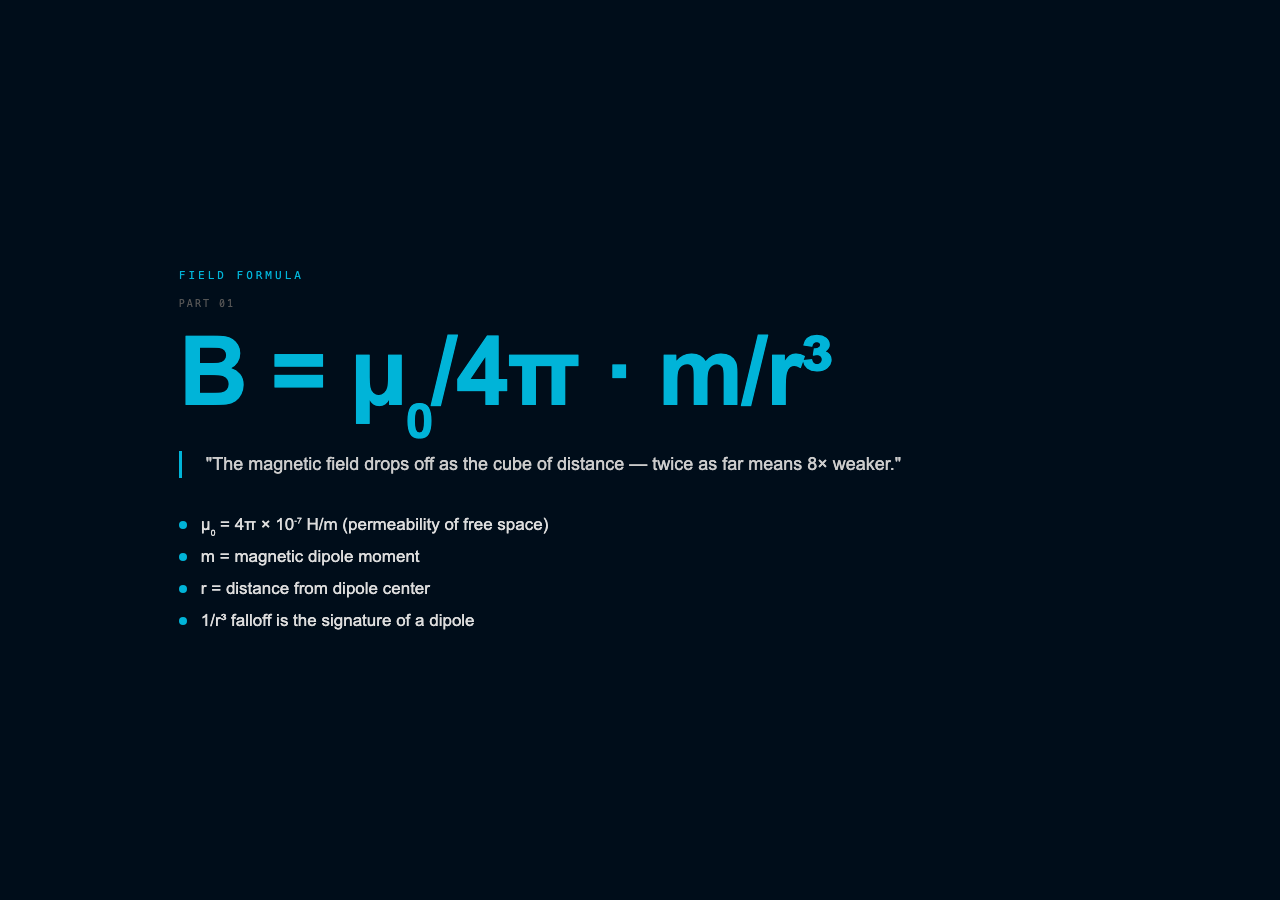
The magnetic field at any point in space is described by the dipole formula:
B = \mu0/4\pi · m/r^3
where μ₀ = 4π × 10⁻⁷ H/m is the permeability of free space, m is the magnetic dipole moment, and r is the distance from the dipole center.
What this equation tells us: magnetic fields drop off incredibly fast — as the cube of distance. Move twice as far away and the field becomes 8 times weaker. This is why refrigerator magnets stay put, but Earth’s magnetic field — generated by the fluid dynamo in its outer core — reaches all the way to the International Space Station.
Field Lines: Making the Invisible Visible
The visualization you’ve probably seen a hundred times — iron filings arranging themselves along curved lines emanating from a magnet’s poles — is actually a map of something invisible. Those field lines represent the direction a compass needle would point at every position in space.
Field lines emerge from the north pole and curve outward, re-entering at the south pole. The density of lines tells you field strength. Where lines are close together, the field is strong. Where they fan out, the field weakens.
What’s striking: field lines always form closed loops. They exit the north pole, arc through space, and re-enter the south pole. This is not just a drawing convention. It reflects the fundamental physics — magnetic monopoles don’t exist, so field lines must be continuous.
Why You Cannot Isolate a Pole
Cut a bar magnet in half and you don’t get one north and one south piece. You get two complete dipoles, each with its own north and south pole. This happens because the magnetic moments of individual electrons remain aligned within the material. Each fragment still contains aligned atomic dipoles, and the net effect is still a dipole.
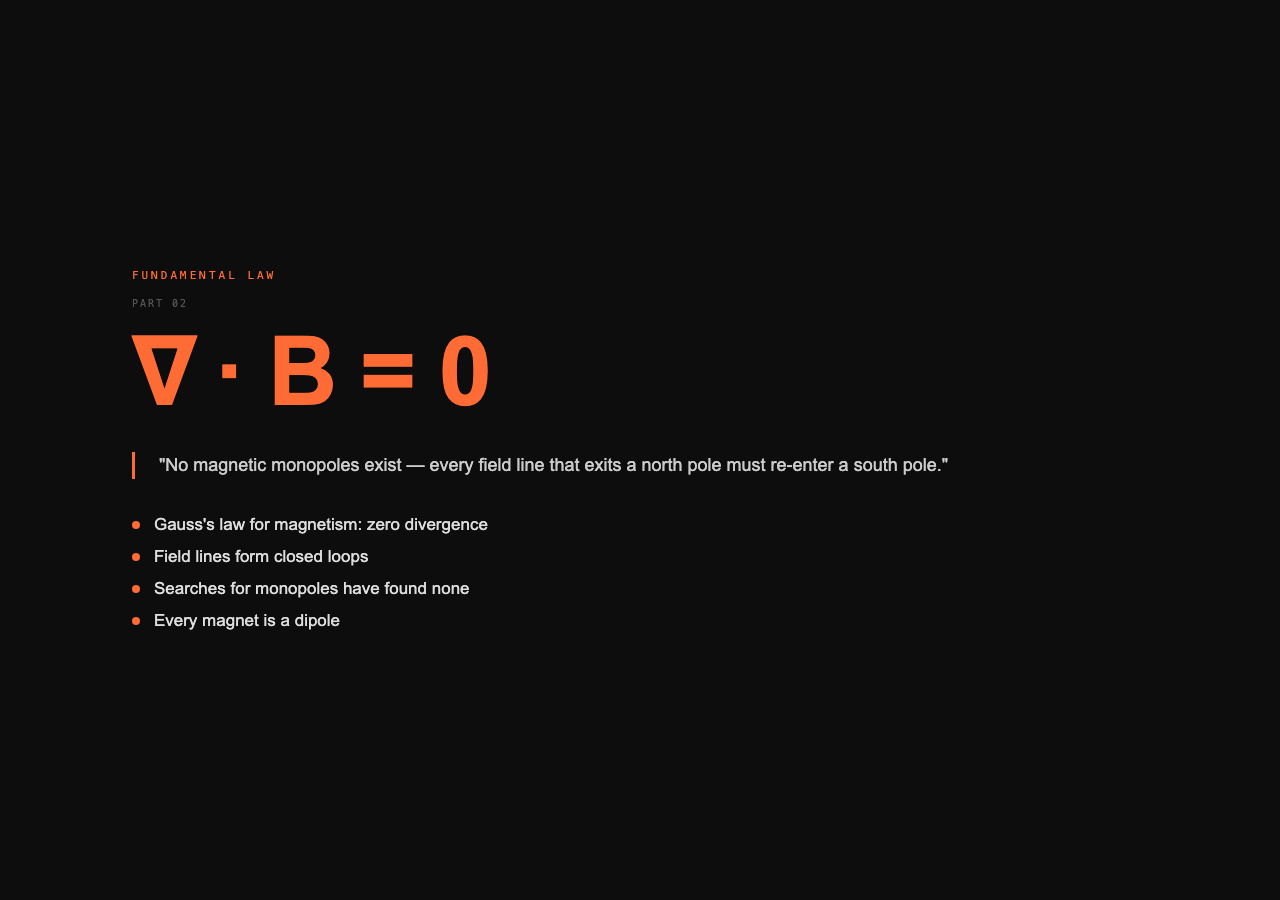
This property is encoded in Gauss’s law for magnetism:
\nabla · B = 0
In plain terms: the net magnetic flux through any closed surface is zero. There are no sources or sinks — no monopoles — for magnetic field lines. Every field line that leaves a north pole must somewhere re-enter a south pole.
Physicists have searched for magnetic monopoles for decades. If they existed, this equation would need a source term. None have been found. Every magnet, from the weakest fridge magnet to the strongest neutron star remnant, is fundamentally a dipole.
The Compass: Your Personal Field Detector
The most elegant application of magnetic fields is the compass — a small magnet suspended so it can rotate freely. The needle aligns with the local field direction. In Earth’s field, the needle points toward magnetic north.
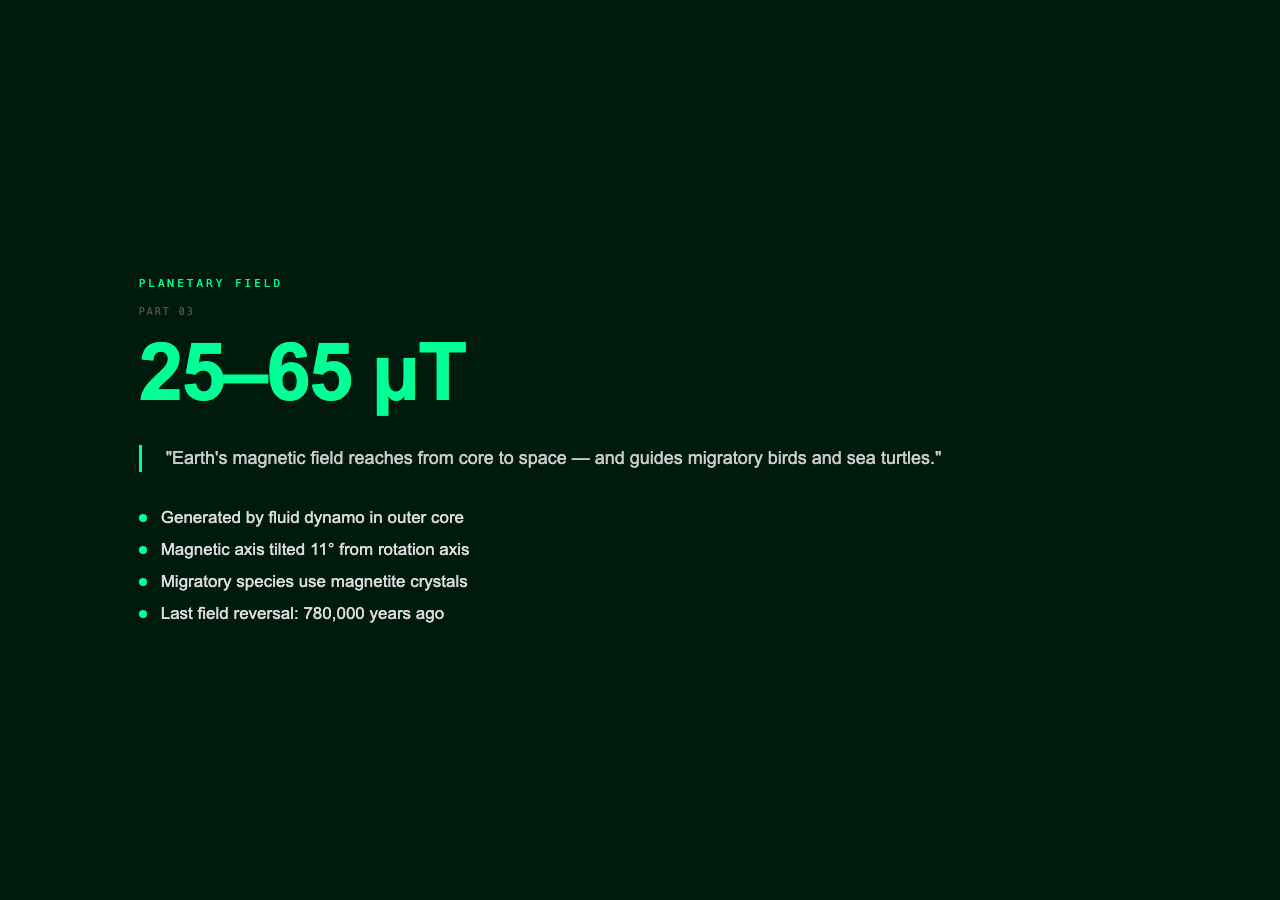
But here’s what’s interesting: the compass doesn’t point to the geographic North Pole. Earth’s magnetic axis is tilted about 11° from its rotational axis. In most of the United States and Europe, there’s a significant angular difference between where your compass points and where geographic north actually is. Navigators call this the magnetic declination, and it varies by location and slowly over time as Earth’s core dynamo evolves.
Field Geometry: Why the Dipole Shape Is Inevitable
The dipole field pattern isn’t just something magnets happen to do. It’s a direct mathematical consequence of the physical law that generates the field.
An electric current loop produces a magnetic field. The geometry of that loop — charges moving in a circle — creates a field that emerges from one side of the loop and returns to the other. That’s a dipole. Every magnetic field you’ve ever seen is generated by either electric currents (electromagnets, Earth, solenoids) or the quantum spins of electrons in materials (permanent magnets). Both produce dipole fields.
The dipole formula B ∝ 1/r³ is exact for point dipoles and approximately true for any finite-sized magnet at distances larger than the magnet’s own size. This 1/r³ falloff is the signature of a dipole in physics — the same scaling appears in electric dipole fields and gravitational fields for oblateness corrections.
The Field You Already Live Inside
Right now, your body is penetrated by Earth’s magnetic field — about 25 to 65 microtesla depending on latitude. You don’t feel it. Your biology doesn’t respond to it directly. But migratory birds, sea turtles, and certain bacteria do. They have evolved structures — magnetite crystals in some species — that couple to the local field and provide a sense of direction.
This is one of the quieter truths of everyday physics: you’re embedded in a magnetic field that stretches from the core of the planet to the edge of the magnetosphere. It fluctuates. It shifts. It occasionally reverses (the last reversal was about 780,000 years ago). And it shapes the navigation systems of creatures that never learned to read a map.