Why We See the Moon Change Shape Every Night
The Same Rock, a Different Face
Go outside tonight and look up. If it’s near the start of a lunar cycle, you’ll see a thin crescent hugging the western horizon just after sunset. Two weeks later, the Moon will be a brilliant pearl hanging opposite — fully lit, rising at dusk.
The Moon hasn’t changed. You have.
What shifts is the geometry between three bodies: the Sun, the Earth, and the Moon. This article unpacks the physics behind why the same rock produces an endless cycle of shapes — and why your intuition about moonlight is almost certainly wrong.
The Core Insight: Illumination, Not Shadow
Most people are taught that the Moon changes shape because the Earth’s shadow falls on it. That’s the explanation for a lunar eclipse — but eclipses are rare, happening at most a few times per year. The Moon goes through its complete cycle every 29.53 days, roughly once a month.
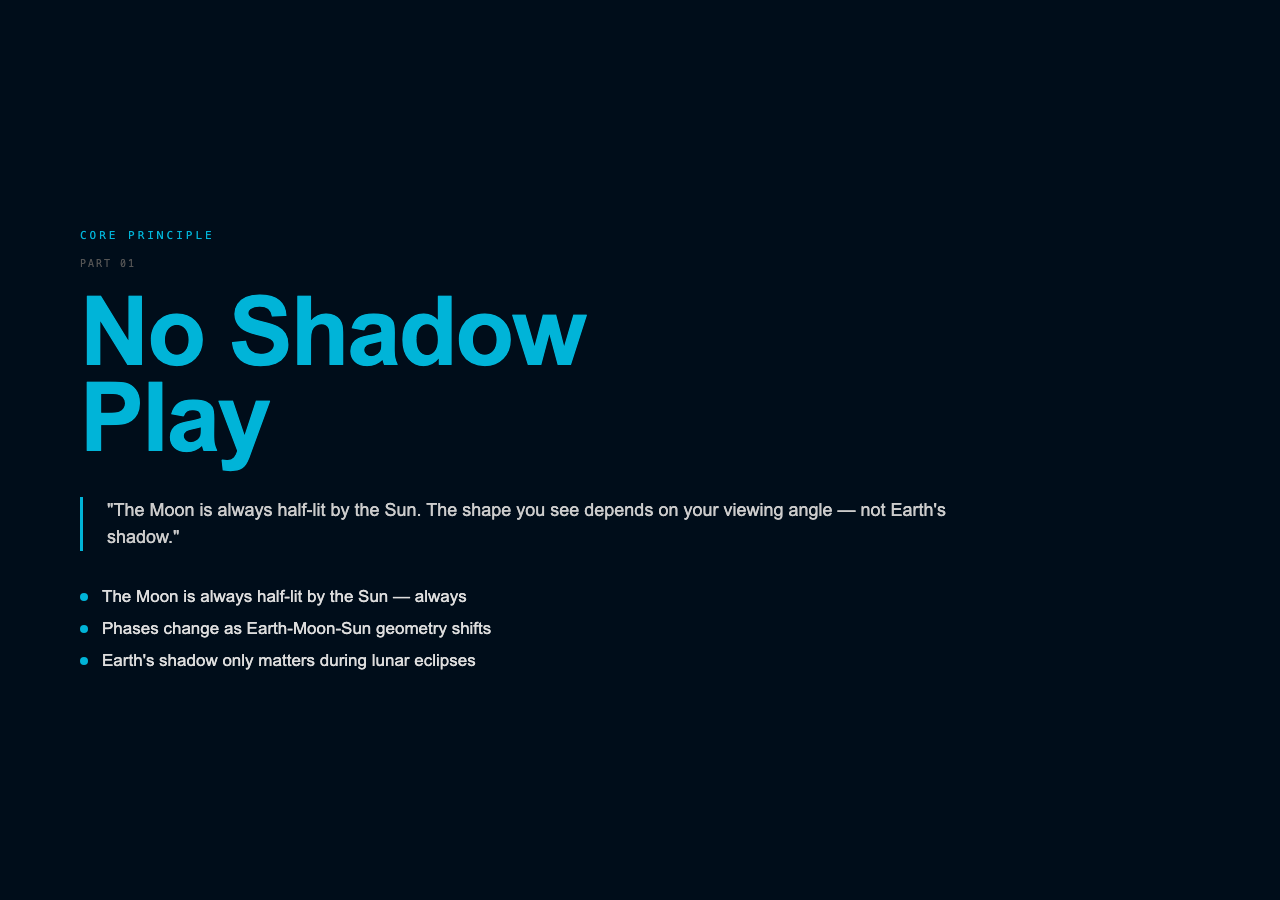
The actual mechanism is simpler and more elegant: the Moon is always half-lit by the Sun. From Earth, we see different fractions of that lit half depending on where the Moon sits in its orbit around us.
Imagine a ball raised in a dark room with a single flashlight pointed at it. Walk around the ball. From some angles, you see the full lit face. From others, you see only a sliver. From the side, you see a half-illuminated disk. The Moon works the same way — except the “flashlight” is the Sun, burning 150 million kilometers away.
The key point of confusion is this: the lit half always faces the Sun. It does not face Earth. When the Moon is between the Earth and Sun (new moon), the lit face points away from us. When the Earth is between the Moon and Sun (full moon), the lit face points toward us. Most positions fall somewhere between, giving us the familiar crescent, gibbous, and half phases.
The Synodic Month: Why the Cycle Takes 29.53 Days
The lunar cycle isn’t tied to the Moon’s actual orbital period around Earth. The Moon completes one orbit in about 27.3 days (the sidereal month) — how long it takes to return to the same position relative to distant stars.
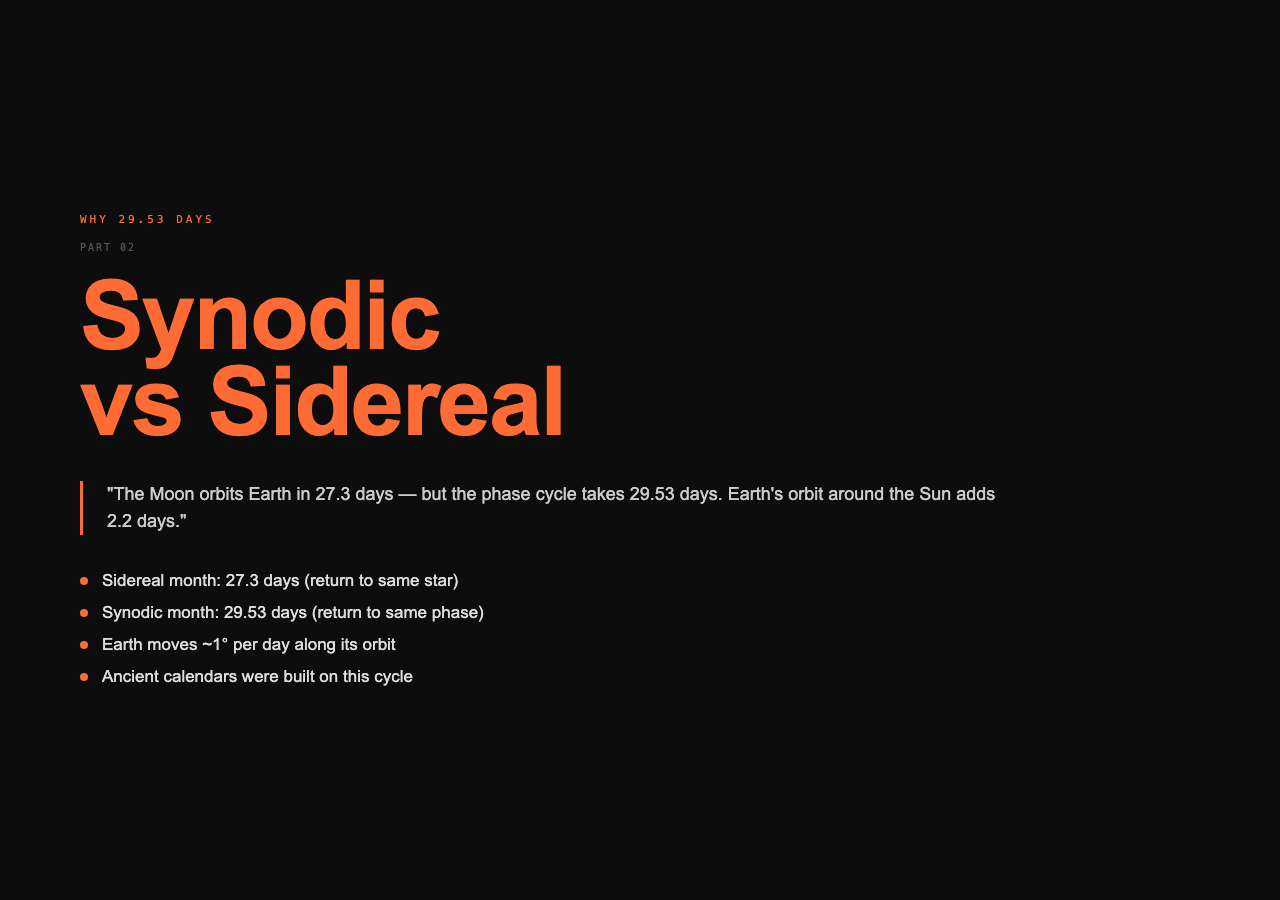
But the phase cycle is longer: 29.53 days. This is the synodic month — the time it takes for the Moon to return to the same position relative to the Sun.
Why the difference? Because while the Moon orbits Earth, Earth is also orbiting the Sun. The Sun’s position in our sky shifts slightly each day as Earth moves along its own orbit. To see the same illumination pattern — the same phase — the Moon needs to “catch up” and travel a little farther. That extra travel takes about 2.2 days.
This 29.53-day period is why a “month” and a lunar cycle are roughly the same length. Ancient calendars were built on this cycle; modern months are a pale imitation.
The Eight Phases, in Order
New Moon
The Moon sits roughly between the Earth and Sun. Its lit face points away from us, and the night side faces Earth. The Moon is invisible except during a solar eclipse, when its silhouette crosses the Sun.
Duration of this phase: The new moon itself is a single instant — when the Moon is precisely between Earth and Sun along their orbital plane. The “new moon period” of a few days before and after refers to the crescent being too thin to see easily.
Waxing Crescent
The Moon has moved east of the Sun. A small portion of its lit face — the right edge — is visible from Earth as a crescent. The name waxing means growing wider.
The crescent is thin when the Moon is young — just a few days past new. Each successive night, the crescent thickens as the Moon moves further from the Sun’s direction.
First Quarter
The Moon has traveled one-quarter of its orbit. From our perspective, the right half of the Moon’s face is lit. This is called First Quarter because the Moon has completed the first quarter of its cycle, not because it looks like a quarter of a circle.
The terminator — the line separating lit and dark — runs straight down the middle.
Waxing Gibbous
Gibbous means bulging. More than half the Moon is lit, but it isn’t full yet. The left edge is still in shadow. “Waxing” means the illuminated fraction is growing each night.
Full Moon
The Earth sits between the Sun and Moon. The lit face points directly at us, and we see the Moon as a complete circle.
This is the only time the Moon rises at sunset and sets at sunrise — it’s opposite the Sun in our sky. During a lunar eclipse, the Earth’s shadow sweeps across the full moon’s face, turning it a deep red (the “blood moon”).
Waning Gibbous
After full moon, the illumination begins to shrink. The Moon is now past full — waning. More than half is still lit, but the shadow is creeping onto the left edge.
Last Quarter
The Moon has completed three-quarters of its orbit. This time the left half is lit — the opposite half from First Quarter. The terminator runs down the middle again, but the illuminated side is reversed.
Waning Crescent
The final phase before the cycle resets. A thin crescent remains on the left edge, shrinking each night until the Moon disappears into the Sun’s glare at new moon.
The Moon now rises a few hours before sunrise. The crescent hugs the eastern horizon before dawn, often visible in the daytime sky.
Why the Moon Rises at Different Times
Every phase rises at a different time, and this follows a predictable pattern:
| Phase | Rises | Sets | Highest at | |——-|——-|——|————| | New Moon | Sunrise | Sunset | Noon | | First Quarter | Noon | Midnight | Sunset | | Full Moon | Sunset | Sunrise | Midnight | | Last Quarter | Midnight | Noon | Sunrise |
This table reveals the geometry: the full moon is always opposite the Sun. When the Sun sets, the full moon rises — and it sets when the Sun rises. This is why full moon nights are brightest: the moon is up all night, mirroring the Sun’s daily path with a 12-hour delay.
The crescent moons appear near the Sun — close to the horizon at sunrise or sunset — because they’re positioned close to the Sun in the sky. You can often see a daytime crescent moon if you know where to look.
The Moon Is Not Rotating — But It Is Locked
One persistent misconception: the Moon doesn’t rotate. The same face always points toward Earth, which seems to imply the Moon just floats there without spinning.
The reality is stranger: the Moon rotates once per orbit. It just rotates at exactly the same rate it orbits, so the rotation cancels out what we’d see from the surface. This is called tidal locking — the same gravitational effect that slows Earth’s rotation over billions of years.
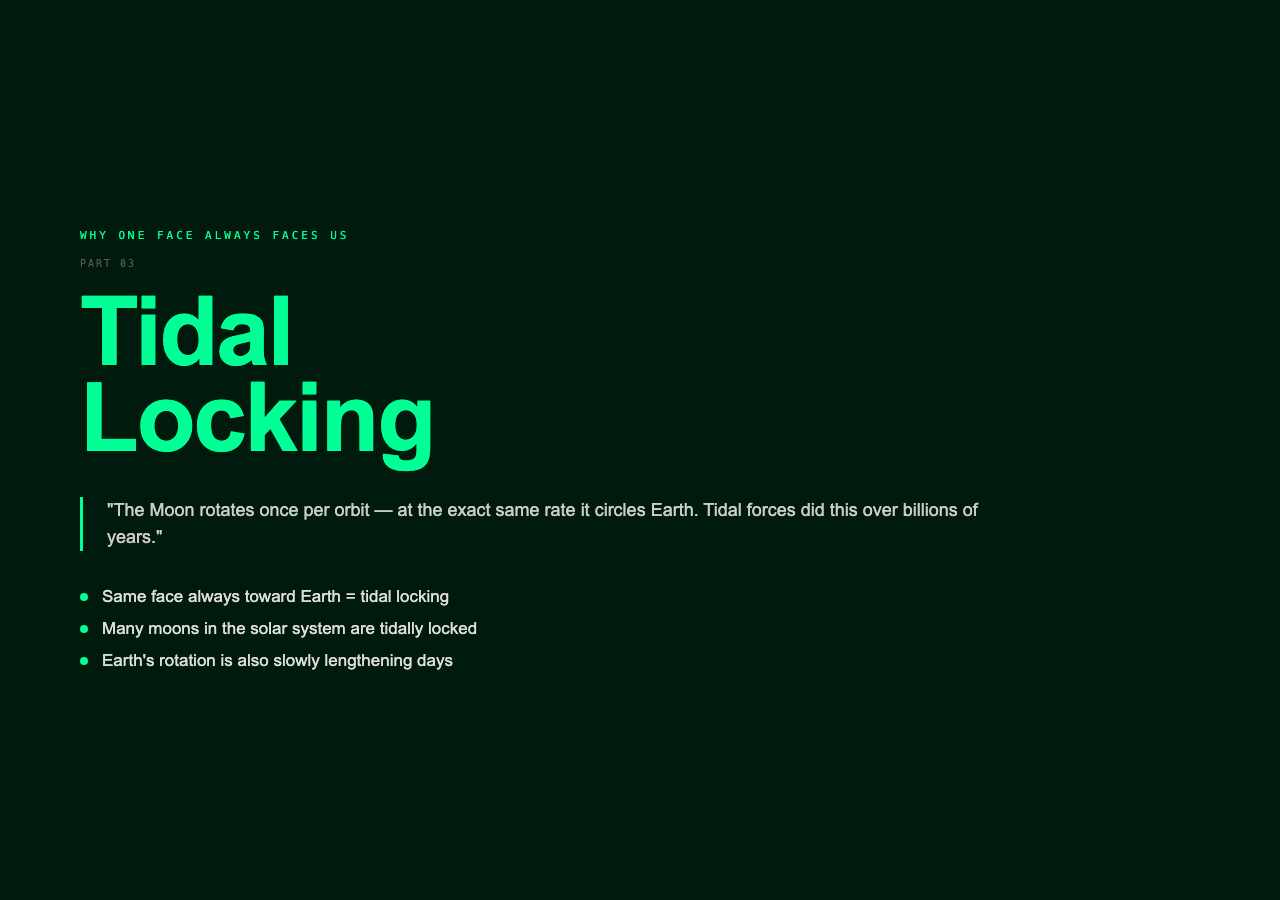
Tidal locking is why we call it the “near side” of the Moon. The far side — the half we never see from Earth — was unknown to humanity until the Space Age. The Soviet Luna 3 probe photographed it in 1959, revealing a heavily cratered surface distinctly different from the near side’s maria (the dark “seas”).
The Moon’s Orbit Is Tilted
The Moon’s orbital plane is inclined about 5 degrees relative to Earth’s orbital plane around the Sun (the ecliptic). This tilt means the Moon doesn’t perfectly line up with the Sun and Earth for eclipses — they require the nodes (where the two planes cross) to align.
This is why eclipses don’t happen every month. Most of the time, the Moon passes slightly above or below the Sun (for solar eclipses) or above or below the Earth’s shadow cone (for lunar eclipses). Only when all three bodies align near a node do we get the spectacular brief events that ancient cultures found terrifying.
What the Interactive Simulation Shows
The Moon Phases simulation lets you watch the entire 29.53-day cycle from three viewpoints simultaneously: the Earth-centered view (what you see in the sky), the space view (what an observer above Earth would see), and the orbit view (the big picture of the Sun-Earth-Moon geometry).
Drag the time slider and watch how the Moon’s illumination pattern changes in each frame of reference. Notice that the space view always shows the Moon as half-lit — the Sun doesn’t move, and the Moon’s orientation in space barely changes over one orbit. The apparent change in phase comes entirely from your viewing angle on Earth.
Pay attention to the terminator line — the moving boundary between light and dark. This is where shadows are longest, which is why astronomers love it: the low-angle sunlight reveals topography in sharp relief. Crater rims glow while floors remain dark.
The Takeaway
The Moon doesn’t change shape. The geometry between Sun, Earth, and Moon changes, and that changes what fraction of the Moon’s permanent day side we can see.
It’s a shadow play without a shadow — pure geometry, visible every clear night.
The 29.53-day synodic month is one of the most precise cycles in the solar system, and it was the foundation of humanity’s first calendars. Next time you check the date, remember: you’re using a rhythm set by a rock orbiting another rock, 384,000 kilometers away, illuminated by a star 150 million kilometers in the background.