Why Pressure at the Bottom of the Ocean Doesn’t Care How Wide It Is
Stand at the edge of a lake and lower yourself just three meters down. Your ears register it immediately — that uncomfortable squeeze. Go twice as deep, to six meters, and the pressure doubles. Go to thirty meters — a typical recreational dive limit — and your lungs would compress to half their normal volume if you breathed compressed air. The water doesn’t care about your comfort. It only cares about one thing: how far below the surface you are.
This is the quiet, uncompromising logic of hydrostatic pressure — the pressure exerted by a fluid at rest due to gravity. And unlike most physics that requires careful laboratory measurement to appreciate, hydrostatic pressure is something you can feel in seconds.
The One Equation That Rules All of It
The entire behavior of a still fluid under gravity is captured in one compact relationship:

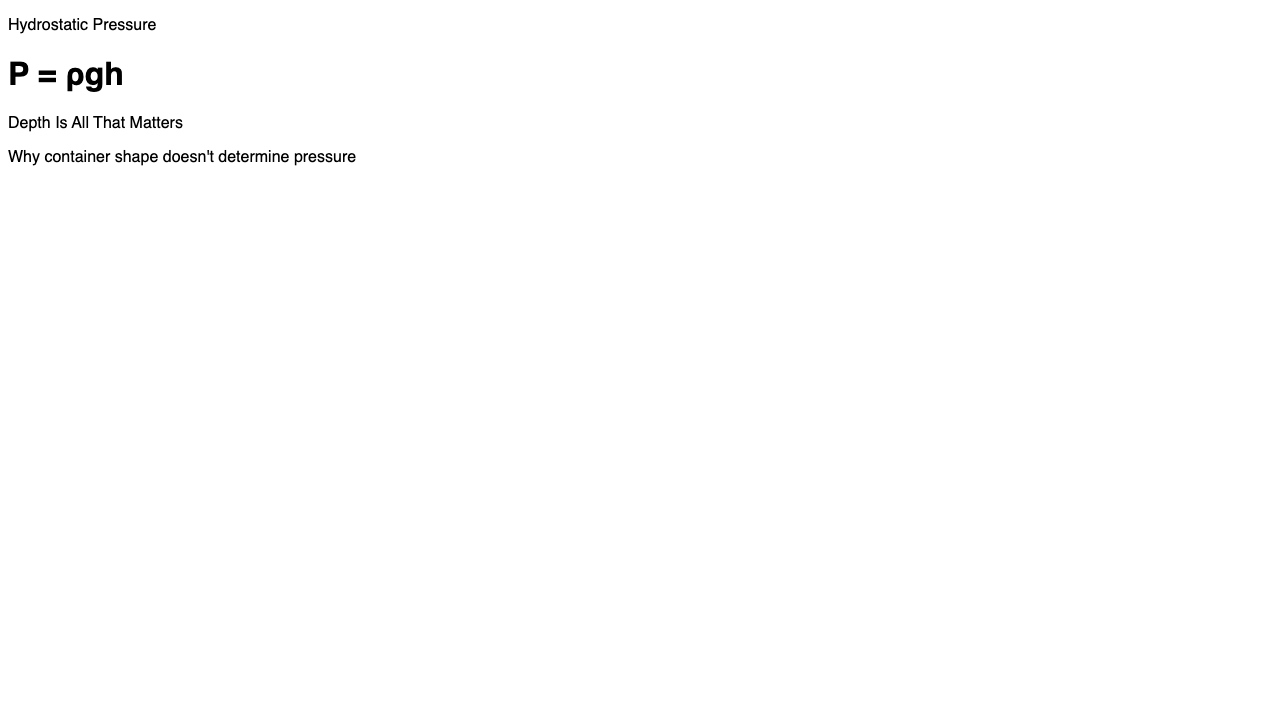
P = ρgh
Where: – P is the hydrostatic pressure (in Pascals, Pa) – ρ (rho) is the fluid’s density (kg/m³) – g is the acceleration due to gravity (≈ 9.8 m/s² on Earth’s surface) – h is the depth below the surface (m)
The remarkable thing about this equation is what it doesn’t depend on: the total amount of fluid, the shape of the container, or the width of the vessel. A narrow pipe and a wide lake at the same depth produce identical pressure. This independence from container shape is what we now call Pascal’s Law, and it has practical consequences that shape modern engineering.
Why Shape Doesn’t Matter (and Why That’s Strange)
Intuition tells us that a wider container holds more water, so it should exert more pressure at the bottom. But intuition is wrong — and the reason reveals something deep about how gravity and fluids interact.

Pressure at a depth h comes from the weight of the column of fluid above that point. A wide column and a narrow column, at the same depth, have the same height. Gravity acts on each column independently, and since pressure is force per unit area, what matters is the weight directly above a unit area — not the total weight in the container.
Think of it this way: if you stand on a mat, the pressure under your feet is your weight divided by the area of your feet. The mat’s total weight or the mat’s dimensions beyond your footprint don’t change that number.
This property is what makes hydraulic systems possible. A small piston pushing on a confined fluid can generate enormous force at a larger piston — because the pressure is transmitted equally throughout the fluid, and a larger area experiences a proportionally larger total force (F = PA). This is how a forklift lifts a 2-ton load with a foot pedal.
What the Interactive Simulation Shows
The liquid pressure simulation lets you vary three things: fluid density, gravity, and depth. Watch what happens:
– Increasing depth at constant density and gravity: pressure rises linearly. Double the depth, double the pressure. – Increasing density at constant depth and gravity: pressure rises proportionally. Seawater (ρ ≈ 1025 kg/m³) produces about 2.5% more pressure than fresh water (ρ ≈ 1000 kg/m³) at the same depth. – Changing gravity acts exactly as you’d expect from the equation. The same fluid at the same depth on the Moon (g ≈ 1.6 m/s²) generates about 1/6 the pressure it does on Earth.
The simulation visualizes pressure at the container walls and floor using a color gradient — darker red for higher pressure. You can see the gradient form a clean, predictable pattern: pressure is highest at the bottom and drops toward the surface, with equal-pressure lines running horizontally.
Applications That Can’t Escape P = ρgh
Water towers. The elevated tanks on rooftops and hilltops aren’t storing more water for a rainy day — they’re using height to generate pressure. A water tower 30 meters tall produces roughly 300,000 Pa (3 bar) of pressure at ground level, enough to push water up several floors without pumps. The taller the tower, the higher the pressure.
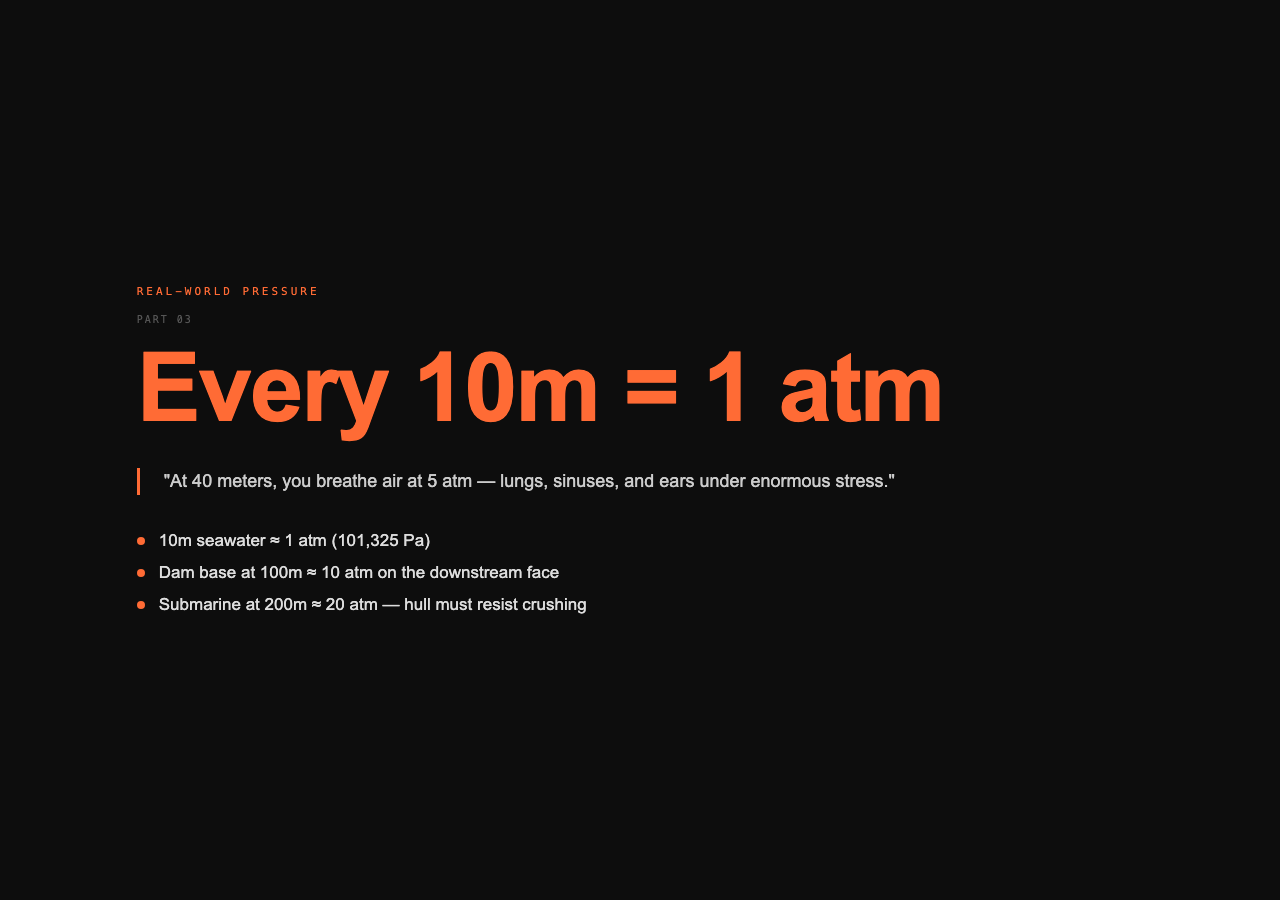
Dams. The pressure at the base of a 100-meter dam is P = 1000 × 9.8 × 100 = 980,000 Pa — nearly 10 times atmospheric pressure. A dam must be engineered not just to hold back water, but to withstand this force distributed across its entire submerged face. The pressure grows with depth, so engineers must design the downstream face to take increasingly massive loads as you go deeper.
Submarines. A submarine diving to 200 meters experiences pressures of nearly 2 MPa — roughly 20 times atmospheric pressure. The hull must maintain its volume under this crushing load. As depth increases, the structural demands grow linearly, which is why military submarines have rated crush depths and why they ballast carefully on ascent.
Scuba diving. Every 10 meters of seawater adds roughly 1 atm (101,325 Pa) of pressure. At 40 meters — a technical dive depth — a diver breathes air at 5 atm total pressure. The human body is mostly incompressible water, so we don’t crush at these pressures, but air-filled spaces (lungs, sinuses, ears) are under enormous stress. This is why descending too fast causes barotrauma.
The Deeper Intuition
What makes P = ρgh worth understanding deeply — beyond the engineering applications — is that it describes the equilibrium state of a fluid under a uniform force field. The equation emerges naturally from asking: how much weight of fluid sits above a unit area at depth h?
The answer is density × gravity × height: mass per volume times the force per mass times the height of the column. It’s not mysterious. It’s the weight of the fluid above, divided by the area.
Once you internalize that, the strange-seeming consequences become obvious. A wider container doesn’t change the height of the column above any given point. Changing the shape of a water tower’s tank doesn’t change how high it sits. And the pressure on a submarine’s hull at 200 meters is exactly the same whether the submarine is in a tiny lake or the Pacific Ocean — because both have 200 meters of water above the hull.
The depth is all that matters. And that’s not a limitation of the equation — it’s the physics itself.
Summary
| Concept | Key Takeaway |
|---|---|
| Hydrostatic pressure | P = ρgh — pressure depends only on depth, density, and gravity |
| Shape independence | Container shape doesn’t affect pressure at a given depth |
| Pascal’s Law | Pressure applied to a fluid is transmitted equally throughout |
| Depth effect | Pressure increases linearly with depth — double depth, double pressure |
| Hydraulic systems | Small force × large area = large force — basis of all hydraulic machines |
Real-world depth examples: 10 m ≈ 1 atm (seawater) · 100 m (dam base) ≈ 10 atm · 200 m (submarine) ≈ 20 atm · 1,000 m (deep ocean) ≈ 100 atm
The next time you fill a tall glass of water and notice the pressure at the bottom, you already know exactly what physics is at work. The equation isn’t describing something complicated — it’s describing something you can feel with your own ears.