
Why a Simple Stick and Fulcrum Can Lift Anything: The Lever Principle
The seesaw at a playground is one of the most elegant machines ever invented. Two children of different weights can balance perfectly — not by luck, but because of an immutable relationship between force and distance. Push the right formula into any lever, and physics does the rest.
This is the lever principle: one of the six classical simple machines, and the foundation of everything from crowbars to cranes.
The Core Idea: Torque Is What Matters
A lever doesn’t multiply force arbitrarily. It multiplies torque — the rotational equivalent of linear force.
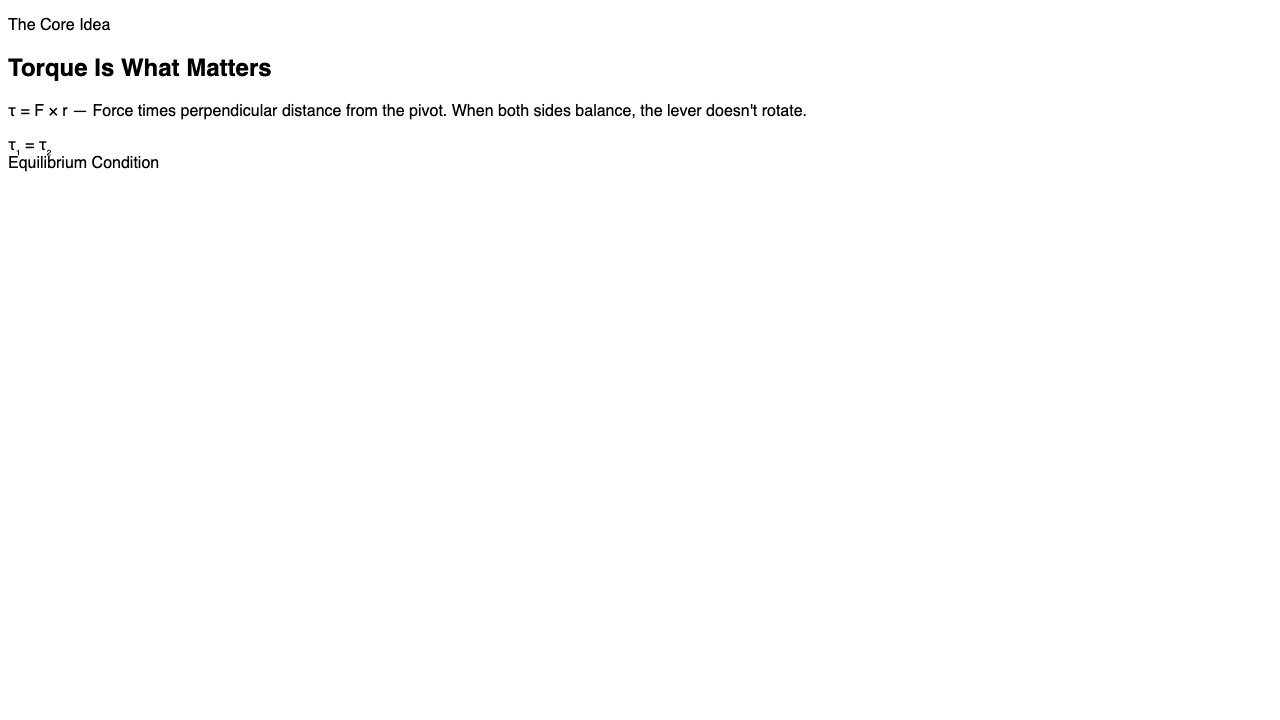
Torque = Force × perpendicular distance from pivot
τ = F × r
The pivot point is called the fulcrum. The arm extending from the fulcrum to where you apply effort is the effort arm. The arm from the fulcrum to the load is the load arm.
In the simulation, you can see this directly: adjust the force sliders and watch the torque displays update in real time. When F₁ × L₁ equals F₂ × L₂, the lever balances. Change either force or either distance, and the lever swings.
The Three Classes of Levers
Every lever in the world falls into one of three categories, depending on where the fulcrum sits relative to the effort and the load.
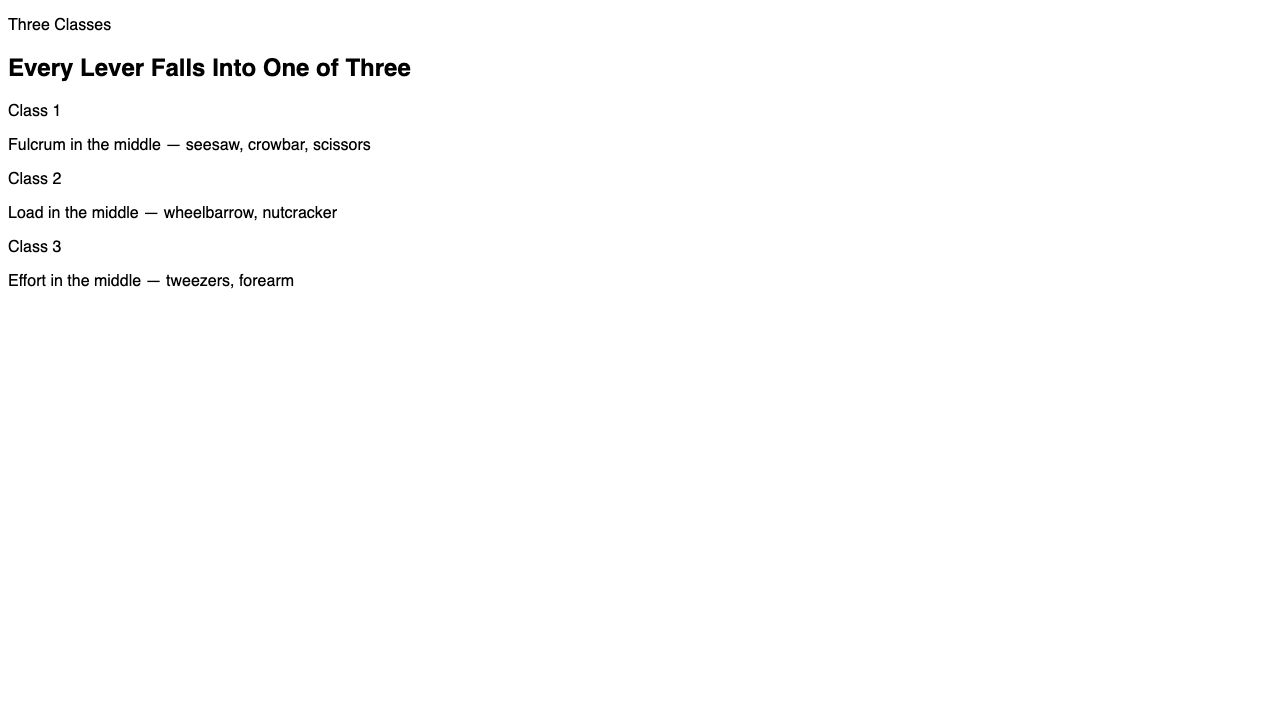
Class 1 — Fulcrum in the middle: The seesaw, the crowbar, the scissors. Effort applied on one side, load on the other, fulcrum between them. Mechanical advantage depends on which arm is longer.
Class 2 — Load in the middle: A wheelbarrow, a nutcracker, a bottle opener. The fulcrum is at one end, effort applied at the other, and the load sits between them. These always provide mechanical advantage — you lift a heavy load with less effort.
Class 3 — Effort in the middle: A pair of tweezers, the human forearm, fishing tongs. The fulcrum is at one end, the load at the other, and you apply effort in the middle. These don’t give mechanical advantage — they give precision and range of motion instead.
The simulation lets you switch between all three classes and watch how the balance point shifts.
Mechanical Advantage: The Real Multiplier
The mechanical advantage (MA) of a lever is the ratio of effort arm to load arm:
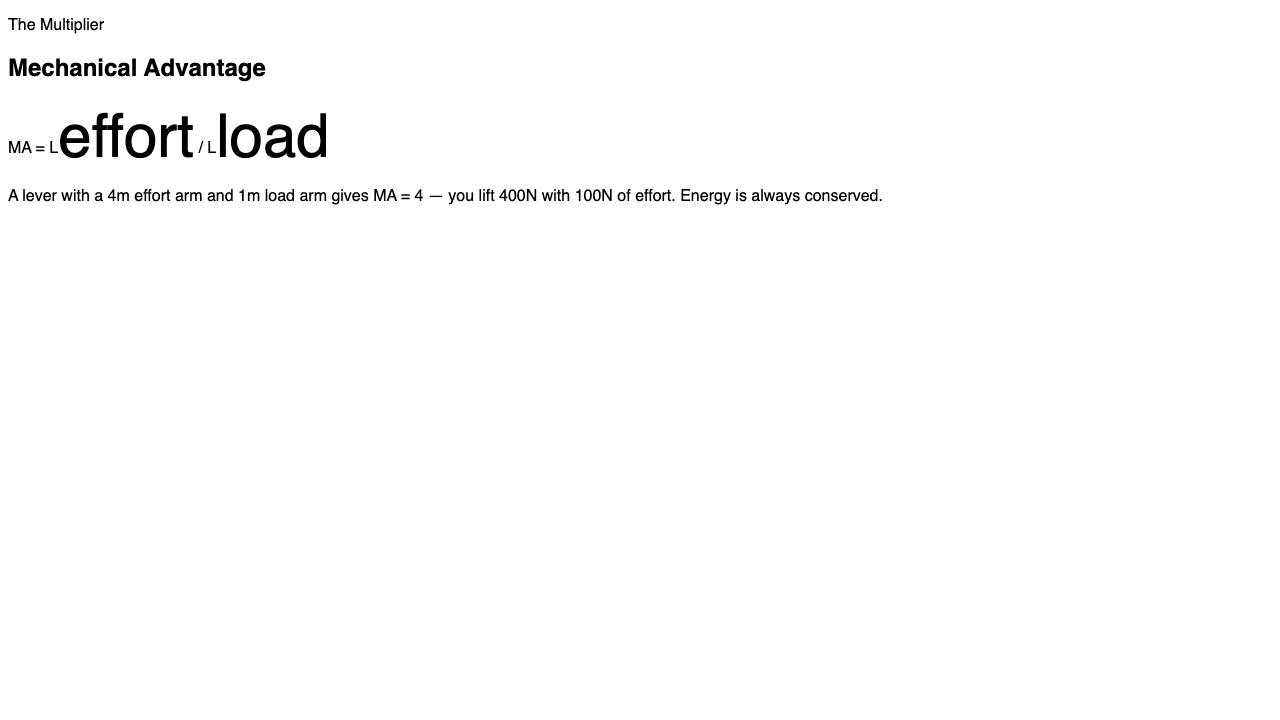
MA = Leffort/Lload
A lever with a 4-meter effort arm and a 1-meter load arm gives MA = 4. Apply 100 N of effort, and you can lift 400 N of load — with the caveat that you must apply that effort through a greater distance. Energy is always conserved.
In the simulation, the MA display shows this directly. Set F1 = 10 N at L1 = 2.0 m and F2 = 20 N at L2 = 1.0 m — torque from both sides is 20 N·m, so it balances, but the mechanical advantage shown is exactly 2.0 (the ratio of the two arms).
Why Levers Dominated Engineering for Millennia
Ancient Egyptians used lever-based machines to raise stones weighing tons. Archimedes reportedly said “give me a place to stand, and I can move the earth” — referring to the lever principle and the concept of mechanical advantage.
The reason levers are so powerful is that they convert a small force applied over a long distance into a large force applied over a short distance — and vice versa. This is why: – A claw hammer pulls a nail with less effort than your bare hand – A wheelbarrow lets one person move what three people couldn’t carry – Tweezers let you grab something too fine for your fingers
What the Interactive Graph Shows
The simulation’s real value is in the live torque balance visualization. As you drag the force and distance sliders, watch the torque bars on each side. When they’re at equal height, the system is in equilibrium — the lever won’t rotate. Push one side past the other, and angular acceleration kicks in.
This is why levers are the building block of all rotary machinery: gears, pulleys, and drive shafts all operate on the same torque-balance principle.
The Physics You Can Verify Yourself
Try this in the simulation: 1. Set F1 = 10 N, L1 = 2.0 m (torque = 20 N·m) 2. Set F2 = 20 N, L2 = 1.0 m (torque = 20 N·m) 3. The lever balances — MA = 2.0
Now try: 1. Set F1 = 5 N, L1 = 4.0 m (torque = 20 N·m) 2. Set F2 = 40 N, L2 = 0.5 m (torque = 20 N·m) 3. Same torque, same balance, MA = 8.0
The MA changed, but the equilibrium condition didn’t. This is the fundamental insight: levers balance when torque is equal, regardless of the individual forces or distances involved.
Every time you use a simple machine — a bottle opener, a pair of scissors, a wheelbarrow — you’re applying this principle. The lever principle doesn’t just describe a tool. It describes the most fundamental rule of rotational mechanics.