Why Squeezing a Crystal Makes Electricity: The Physics of the Piezoelectric Effect
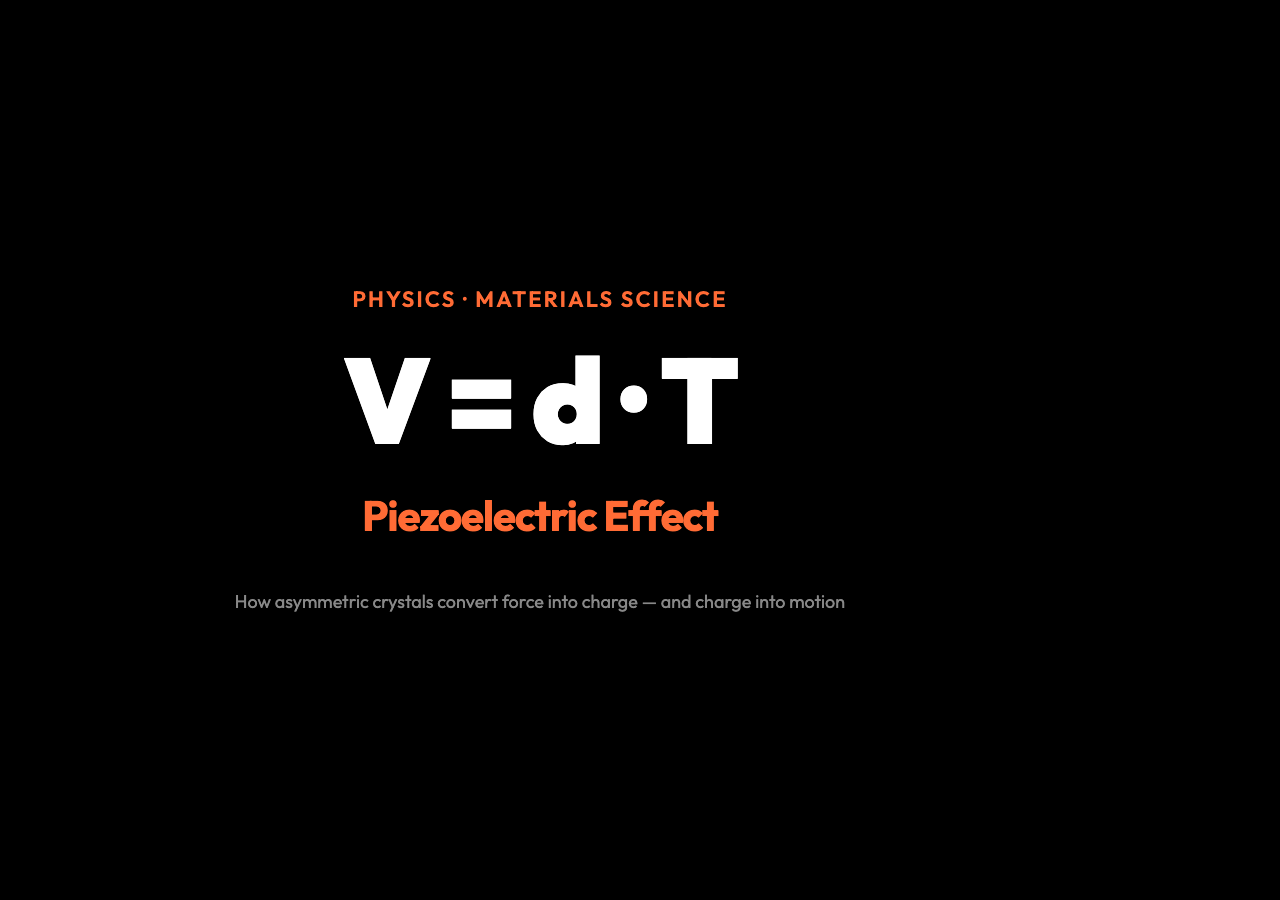
In 1880, Pierre Curie and his brother Jacques discovered something peculiar: if you squeezed certain crystals, they produced electricity. Not a tiny bit — enough to measure with the instruments of the day. They called it the piézo-électrique effect, and it quickly became one of the most practically useful phenomena in classical physics.
Today, piezoelectric materials are inside microphones, speakers, ultrasonic transducers, airbag sensors, inkjet printer heads, and atomic force microscopes. The global market for piezoelectric devices is measured in billions of dollars annually. Yet the mechanism — why asymmetric crystals produce charge when compressed — remains one of the most elegant stories in materials physics.
The Core Insight: Asymmetry Creates Polarity
A crystal is a lattice of atoms arranged in a repeating pattern. In most crystals — like table salt — the lattice has a center of symmetry: for any positive charge there is a symmetric negative counterpart nearby, cancelling out any net polarization. Squeeze such a crystal and nothing happens electrically: the symmetry is preserved at every deformation.
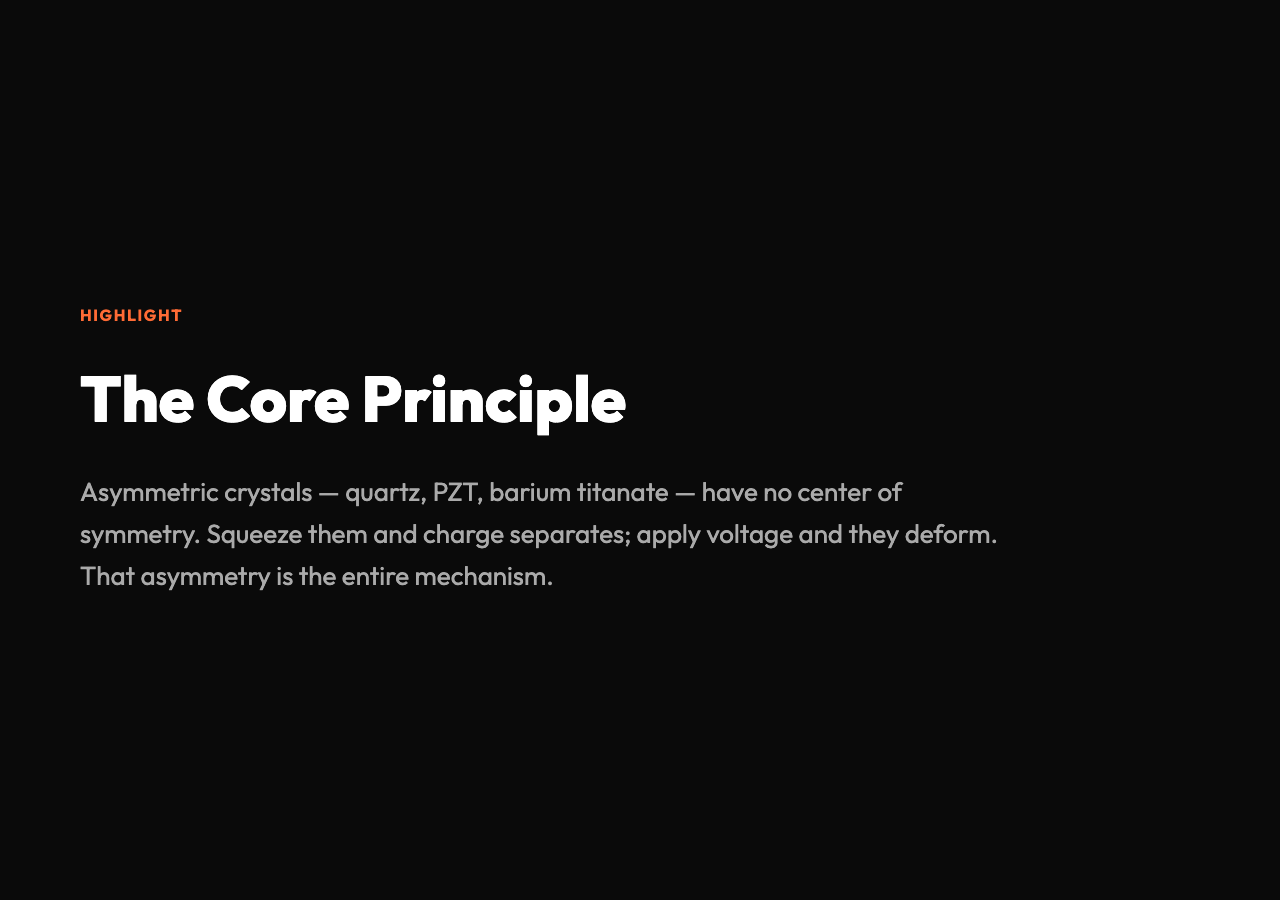
Piezoelectric crystals are different. Quartz (SiO₂), lead zirconate titanate (PZT), barium titanate — these materials have no center of symmetry. Their positive and negative charge centers do not coincide. When you apply mechanical stress — compress or stretch — the lattice deforms and the separation between charge centers changes. That changing separation produces a net electrical polarization, which shows up as a voltage across the crystal faces.
This is the direct piezoelectric effect: mechanical input → electrical output.
The inverse effect runs the other direction: apply an electrical voltage across the crystal and it deforms mechanically. An applied electric field pulls the charge centers in a specific direction, causing the entire lattice to shift slightly. That shift is observable as physical strain — the crystal bends or compresses in proportion to the applied field.
The Governing Equation
The two effects are described by a pair of coupled linear equations:

For the direct effect:
D = d · T + ε · E
For the inverse effect:
S = s · T + d · E
Where: – D = electrical displacement (charge per unit area) – T = mechanical stress (force per unit area) – E = electric field (voltage per unit thickness) – S = mechanical strain (dimensionless deformation) – d = piezoelectric charge constant (pC/N or m/V) – ε = permittivity of the material – s = elastic compliance
The coefficient d is the key figure of merit. It tells you how much electrical charge (in picocoulombs) the crystal produces per unit of applied force (in newtons), or conversely, how much strain (in meters) results from an applied electric field (volts per meter). Quartz has d ≈ 2.3 pC/N. PZT ceramics can reach d ≈ 500 pC/N — more than two hundred times more responsive.
The Simulation: Direct and Inverse Modes
The interactive visualization below lets you explore both modes of the piezoelectric effect.

Direct mode is what the Curie brothers discovered: adjust the applied force using the slider, watch the crystal compress or stretch, and observe the generated voltage appear on the meter. Positive force produces positive voltage on the top face — the direction of polarization follows the direction of the applied stress. The relationship is linear within the elastic limit: double the force, double the voltage.
The voltage output in direct mode is given by:
V = d · t · F
Where t is the crystal thickness and F is the applied force. Thicker crystals at the same stress produce higher voltage — this is why some piezoelectric igniters use layered stacks of many thin ceramic sheets, each contributing a small voltage that adds up.
Inverse mode shows the converse effect: apply a voltage and the crystal deforms. Increase the voltage and watch the crystal expand along its axis. The deformation is proportional to the field, not the voltage directly — a crystal that is half as thick will produce half as much strain at the same voltage, because the field (V/d) is twice as large.
Strain = d · Electric Field
Both effects are reversible: a crystal that generates voltage when squeezed will develop stress when you apply voltage to it. This reversibility is what makes piezoelectric materials so useful as both sensors and actuators.
Why the Inverse Effect Is Often More Useful
The direct effect generates high voltage at low current — excellent for ignition, but hard to use for precision actuation. The inverse effect gives you precise, proportional control of mechanical position at relatively low voltage. This is why most industrial and commercial piezoelectric devices — inkjet nozzles, fine-focus stages, vibration control systems — use the inverse effect.
The trade-off is that inverse piezoelectric actuation requires careful control: exceed the coercive field and the material depolarizes, losing its piezoelectric response until re-poled. Most commercial actuators operate well below this limit, using the linear range of the d coefficient for predictable, repeatable motion.
Applications: From Lighter to Lithography
The diversity of piezoelectric applications reflects how fundamentally the effect bridges mechanical and electrical domains.
Ignition and percussion: The click of a disposable lighter or a piezoelectric campfire starter. A spring-loaded hammer strikes a PZT element fast enough to generate the 10–15 kV needed to spark across a gap. No battery required — mechanical energy converted directly to high voltage.
Ultrasound imaging: Medical transducers use inverse piezoelectric elements to emit high-frequency sound pulses, then listen for echoes. The same element switches between transmit (inverse mode) and receive (direct mode) hundreds of times per second, building up an image from travel time and amplitude data.
Inkjet printing: Each nozzle has a tiny piezoelectric actuator. A voltage pulse causes the element to contract, displacing a precise droplet of ink. Drop volume is controlled by the voltage waveform with nanosecond precision.
Atomic force microscopy (AFM): A cantilever with a sharp tip is scanned across a surface. A piezoelectric element keeps the tip at a constant height above the surface by adjusting the force between tip and atoms. The result is a three-dimensional map of surface topography with sub-nanometer resolution.
Vibration damping: Adaptive vibration absorbers use sensors that detect structural motion (direct effect) and actuators that apply counter-forces (inverse effect) — often in the same piezoelectric ceramic element, switching modes at kilohertz rates.
The Limits of Piezoelectric Materials
Piezoelectric effects are temperature-sensitive. Above the Curie temperature (T꜀), the crystal structure transitions to a centrosymmetric phase and the piezoelectric response vanishes entirely. For quartz, T꜀ ≈ 573°C. For PZT, T꜀ ranges from 200–400°C depending on composition. This sets an upper temperature limit for any piezoelectric device.
Piezoelectric ceramics are also brittle — they work well under compression but fail under tensile stress. Designers often embed them in composite structures where a polymer matrix carries the tensile loads while the ceramic particles handle electromechanical conversion.
The Ongoing Search for Better Materials
The most common high-performance piezoelectric material — PZT — contains lead. Environmental regulations and market pressure are driving an intense search for lead-free alternatives: bismuth sodium titanate (BNT), potassium sodium niobate (KNN), polymer films like PVDF. None yet matches PZT’s combination of high d coefficient, acceptable loss tangent, and straightforward processing. The competition to replace lead in piezoelectric devices is a major materials science challenge with significant commercial stakes.
Piezoelectricity remains one of the most commercially successful classical physics phenomena — discovered in a 19th-century laboratory, now embedded in devices worth billions of dollars a year. The mechanism is simple: an asymmetric crystal converts force to charge and charge to force. What has grown complex is everything we have built around that simplicity.
What makes the piezoelectric effect remarkable is not just its usefulness, but its elegance: a crystal with no center of symmetry literally produces electricity when you squeeze it, and bends when you apply a voltage. That asymmetry — built into the atomic lattice — is the entire mechanism. Understanding it changes how you see everyday objects. Your kitchen lighter, your car’s airbag sensor, the ultrasound machine at a hospital — all of them depend on a crystal that generates charge in response to mechanical stress. The physics has been known since 1880. The applications are still multiplying.