The mirror is one of the oldest optical instruments in history — and somehow it still surprises. Every time you look into a plane mirror, you’re seeing light that never actually passed through the point where your reflection appears. The image is a ghost made of angles, distances, and the law of reflection. What makes plane mirrors particularly instructive is that their behavior is completely predictable: image distance equals object distance, image size equals object size, and the image is always virtual. There’s no magnification, no distortion, no focal point. Just a perfect, sideways reversal of a world that doesn’t exist.
That’s what makes plane mirrors the best starting point for understanding all of optics. Before you tackle lenses, telescopes, or fiber optics, look in the mirror. The physics hasn’t changed in centuries — and it will still be exactly the same a thousand years from now.
The Mirror You Look at Every Morning Has No Focal Point
Walk up to a plane mirror and place your hand 20 centimeters from the glass. Your reflection’s hand appears 20 centimeters behind the glass — the same distance, the same size, facing you. No magnification. No inversion top-to-bottom. Just a perfect, sideways ghost of the world in front of the glass.
This is the simplest case in optics, and it rewards close attention.
A plane mirror is a flat mirror with a perfectly smooth surface. Light bouncing off it follows one law: the angle of incidence equals the angle of reflection. This isn’t an approximation or a rule-of-thumb — it’s geometry, exact and inviolable. A ray coming in at 30° relative to the mirror’s surface leaves at 30°. Every time.
From this single rule flows everything else about plane mirror imaging.
Why Your Reflection Appears Behind the Glass
When light from your face hits the mirror, individual rays scatter in all directions. Some reach your eye directly. But for you to form a coherent image — for your brain to assemble a recognizable reflection — the rays must obey the law of reflection.
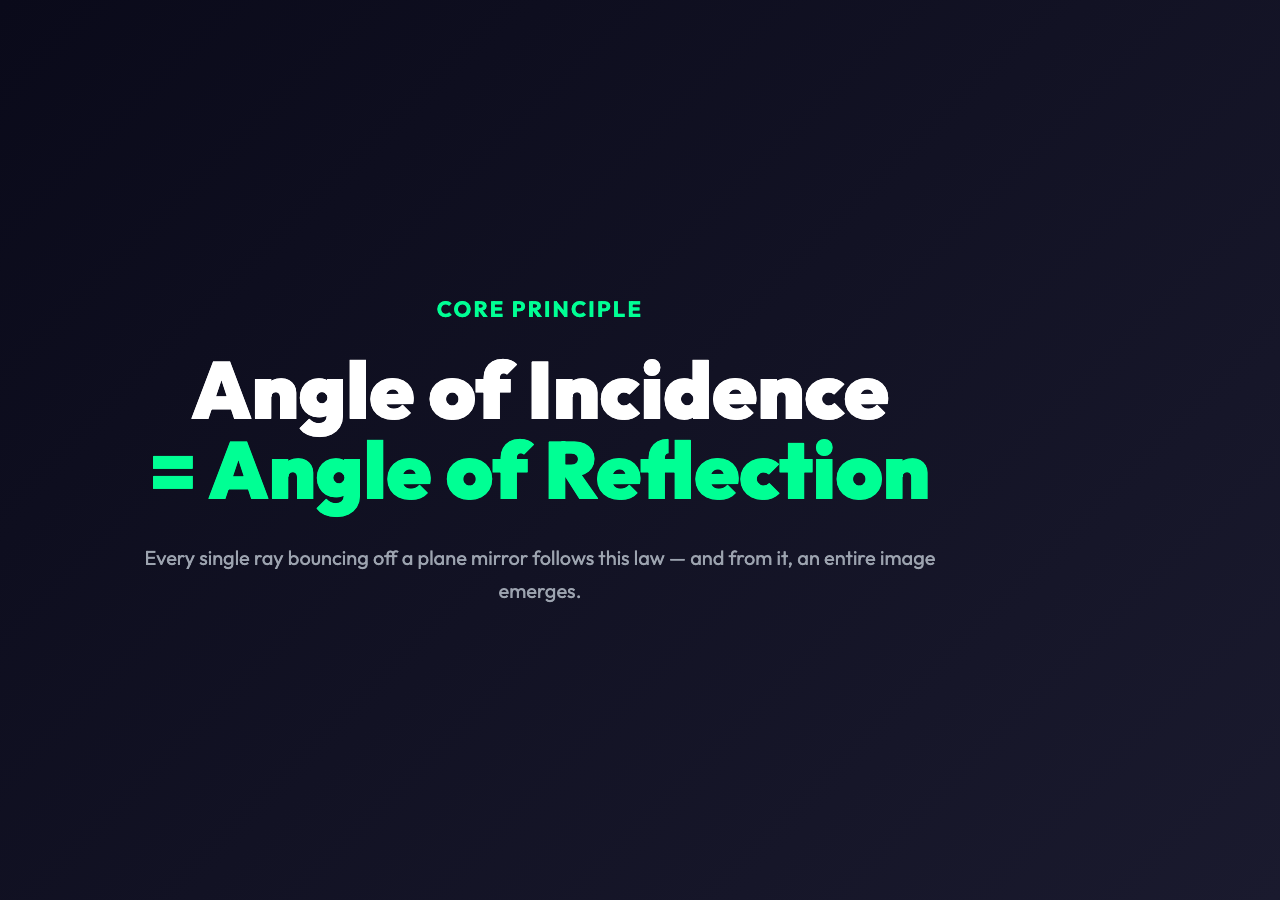
Draw a ray from your nose to the mirror at some angle. It bounces off at the same angle and enters your eye. Your brain, tracing that ray backward, projects it straight through the mirror surface at the same angle. Do this for several rays from several points on your face, and the backward extensions all converge at a point the same distance behind the mirror as your nose is in front. That’s your virtual image.
The image is called “virtual” because light doesn’t actually pass through it. The rays entering your eye never actually met at that point — they’re just directed so that your brain interprets them as having originated there. You can’t touch the image. You can’t project it onto a screen. But you see it clearly, because your eye focuses those rays as if they came from a real object at that location.
This virtual image is always: – The same distance behind the mirror as the object is in front – The same size as the object – Upright (not inverted top-to-bottom) – Laterally inverted (your left hand appears on the right side of the image)
The Geometry of Lateral Inversion
Lateral inversion — the left-right swap you see in a mirror — is one of the most counterintuitive things about plane mirrors, and it’s worth understanding carefully.
The mirror doesn’t swap left and right. Your left hand is still on the left side of your body. What the mirror inverts is the depth axis. When you face a mirror, your nose points toward the glass. Your reflection’s nose also points toward the glass — but relative to you, it points in the opposite direction, because the image is flipped along the axis perpendicular to the mirror surface (the z-axis in physics terms).
Think of it this way: stand facing north, with east to your right. Your reflection faces north too — but “east” for the reflection is “west” for you, because the reflection’s east direction is actually your west direction reversed. This is why text seen in a mirror appears reversed: letters are designed to be read left-to-right, and the mirror reverses the depth axis they depend on.
The Mirror Equation — Yes, It Exists
Despite their simplicity, plane mirrors have a formal relationship governing image formation. It’s not a traditional “equation” with a focal length — plane mirrors don’t have focal points. Instead:
do = di
Where do is the object distance (distance from object to mirror surface) and di is the image distance (distance from mirror surface to image). The image forms at a point symmetric to the object across the mirror surface.
And the magnification:
M = -di/do = 1
The magnification is 1 — the image is exactly the same size as the object. The negative sign indicates the image is upright (in the sign convention used for mirrors).
This simplicity is what makes plane mirrors so useful as a baseline in optics education. When you move to curved mirrors or lenses, magnification changes, image distance changes, and focal points appear. But all of that complexity is introduced against the baseline of a plane mirror. You can’t appreciate what a convex lens does to an image until you’ve first understood what a flat mirror does — which is: nothing, except produce a virtual image at equal distance.
What You Can and Can’t Do with a Plane Mirror
Because plane mirrors produce virtual images behind the glass, you can’t use one to project an image onto a wall. This limits their practical applications to direct viewing — bathroom mirrors, dressing mirrors, rear-view mirrors in cars (which are actually plane mirrors on the driver’s side).
But in optical instruments, plane mirrors are indispensable precisely because they redirect light without changing its properties. A mirror ray box in physics labs uses plane mirrors to steer light beams. Periscopes use two plane mirrors to let you see over obstacles. Beam splitters in interferometers use partially reflective plane mirrors to divide incoming light.
The lack of a focal point is actually an advantage here: a plane mirror doesn’t focus or defocus light, so it can be used to redirect beams in precision instruments without introducing spherical aberration or other distortions that curved surfaces bring.

The Interactive Simulation
The interactive visualization shows exactly this geometry in action. You can place an object at different distances from the mirror, adjust its height, rotate its orientation, and move your eye position. The simulation traces the actual rays using the law of reflection — watch how changing your eye position changes which rays you see, but never changes where the image appears.
The image’s location is fixed by the object and mirror geometry alone. Your eye position only determines whether you can see it.
This is worth emphasizing: the image forms at a specific location in space, determined entirely by the object distance. Whether your eye is at one position or another has no effect on where the image is — only on whether you can see it. The virtual image is always where it is, a fixed point behind the glass.
The virtual image is always behind the mirror — never in front. Only concave mirrors (curved mirrors that are thicker in the middle) can produce real images in front of the mirror, where light actually converges. Plane mirrors, by definition flat, always produce virtual images behind the surface.