Why a Single Qubit Defies Everything Your Classical Intuition Tells You
A classical bit is decisive. It is either 0 or 1 — nothing in between, nothing more. A qubit, the basic unit of quantum computing, refuses this simplicity. It can be 0, it can be 1, or it can occupy a combination of both states simultaneously, a condition called superposition. This is not a half-hearted compromise. The qubit genuinely exists in both states at once, weighted by probability amplitudes that determine what you will measure when you look.
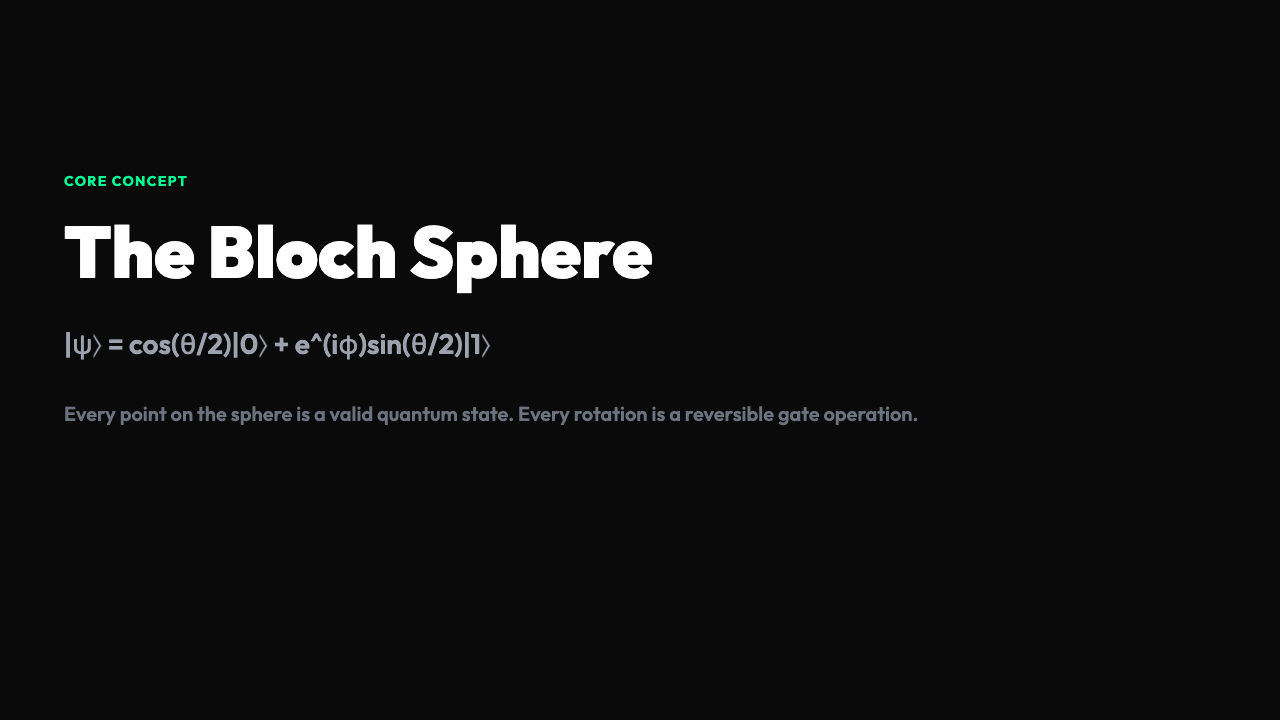
This is not merely theoretical. Run the interactive visualization and watch the Bloch sphere respond as you apply different gates. Each point on the sphere’s surface represents a possible pure state of a single qubit, described by two angles — θ (polar) and φ (azimuthal). The north pole is |0⟩. The south pole is |1⟩. Every other point is a genuine superposition. The mathematics that governs these positions is not an approximation or a computational shortcut. It is the exact state of a quantum system between preparation and measurement.
The Bloch Sphere: Where Quantum States Live
The Bloch sphere provides an elegant geometric representation of a qubit’s state. A pure qubit state is written as |ψ⟩ = cos(θ/2)|0⟩ + e^(iφ)sin(θ/2)|1⟩, where θ controls the probability of measuring 0 versus 1, and φ is a phase that has no classical counterpart. This phase is physically meaningful — it determines interference patterns when multiple qubits interact.
When you set the qubit to the |+⟩ state using the Hadamard gate, you place it exactly on the equator of the Bloch sphere, at the boundary between 0 and 1. A measurement here yields 0 or 1 with equal probability. The qubit is not secretly 0 or secretly 1 before you measure it. It is genuinely in both.
The Three Pillars: Superposition, Entanglement, Interference
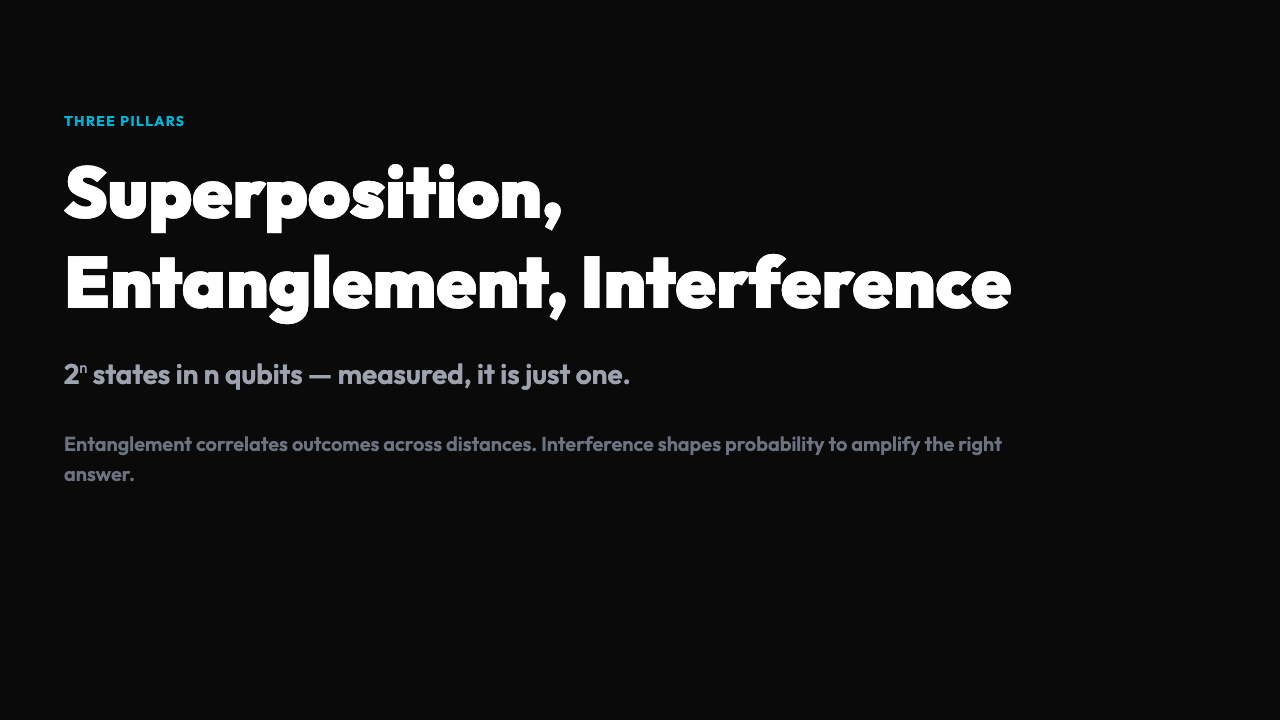
Superposition is the first pillar. It allows a single qubit to represent two states at once. It allows n qubits to represent 2ⁿ states simultaneously. A 50-qubit quantum computer holds 2⁵⁰ ≈ 1.125 × 10¹⁵ states in superposition simultaneously — a number that dwarfs the memory of any classical supercomputer. The catch: when you measure, all of that richness collapses into a single outcome.
Entanglement is the second pillar. When two qubits are entangled, measuring one instantly determines the state of the other, regardless of the distance between them. The visualization demonstrates this with the Bell state |Φ⁺⟩ = (|00⟩ + |11⟩)/√2. Measure the first qubit and find it in |0⟩ — the second qubit is immediately |0⟩. Find the first in |1⟩ — the second is |1⟩. This is not a message being sent. There is no signaling, no faster-than-light communication. The correlation is baked into the structure of the state itself.
Interference is the third and most subtle pillar. Quantum algorithms work by carefully shaping interference so that probability amplitudes for wrong answers cancel out while amplitudes for correct answers add constructively. This is what allows Grover’s search algorithm to find a target in √N steps instead of N, and Shor’s algorithm to factor integers exponentially faster than known classical methods.
Quantum Gates: The Logic of Quantum Operations
Classical computers perform logic with AND, OR, and NOT gates. Quantum computers use gates that rotate the qubit state on the Bloch sphere. The Hadamard gate H creates superposition from a definite state. The Pauli gates X, Y, and Z apply rotations: X is a bit flip, Z applies a phase flip, and Y does both.
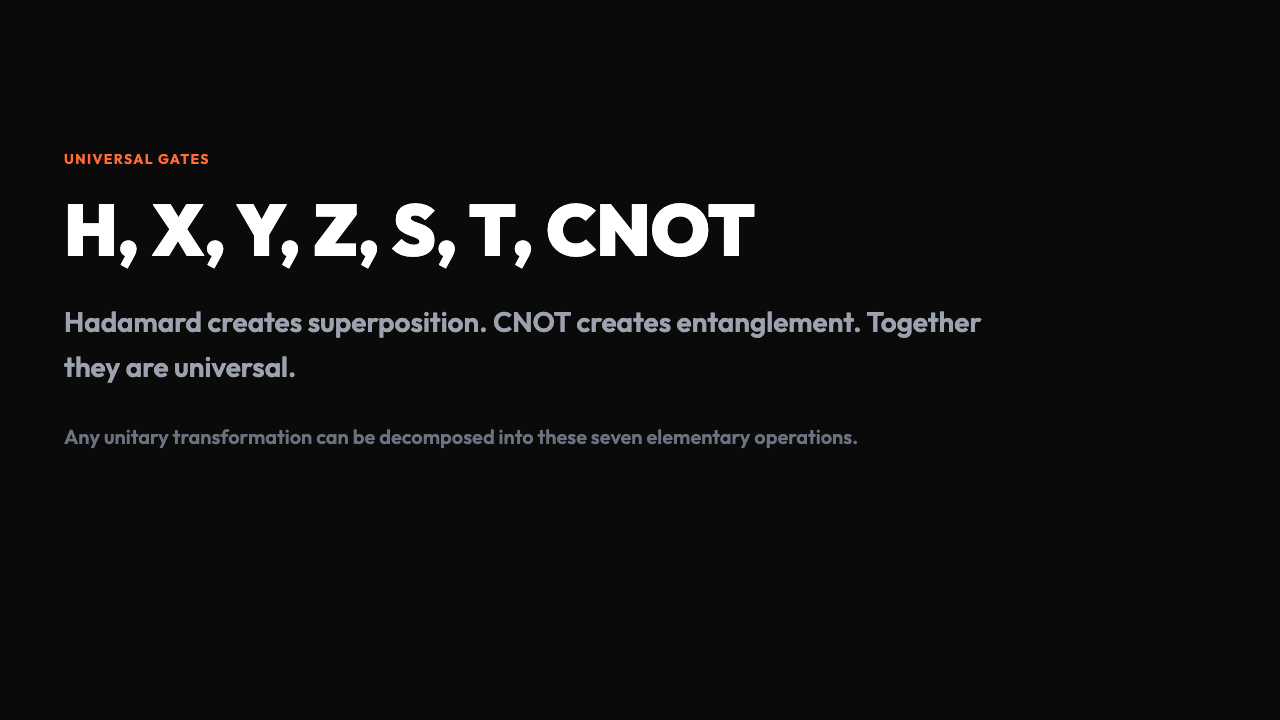
These gates are reversible — information is not lost during the operation, unlike classical logic gates that dissipate heat. The S gate introduces a π/2 phase shift, and the T gate adds a π/4 phase shift. Together, any unitary transformation on a single qubit can be decomposed into a sequence of these elementary operations.
The CNOT (Controlled-NOT) gate entangles two qubits. When the control qubit is |1⟩, it flips the target qubit. When the control is |0⟩, it does nothing. In combination with single-qubit gates, CNOT is sufficient for universal quantum computation.
What You Can Actually Do in the Visualization
The interactive tool gives you five working areas. The Bloch sphere tab lets you apply single-qubit gates and watch the state vector move across the sphere’s surface in real time. The superposition tab demonstrates how probability distribution changes as you apply gates. The measurement tab runs many trials and shows the observed frequency converging to the theoretical probability — watch the bar chart build toward the expected 50/50 split for a |+⟩ state.
The entanglement tab is perhaps the most striking. Apply gates to both qubits, then measure one. The measurement outcome and the correlation structure become immediately visible — the entangled pair never yields opposite results for the |Φ⁺⟩ state. The circuit tab lets you compose multi-gate sequences. The algorithms tab walks through specific examples of how interference enables speedup over classical methods.
Why This Matters Beyond the Laboratory
Classical computers underpin the modern world — from financial modeling to weather prediction to drug discovery. But certain problems scale exponentially on classical hardware, meaning they become intractable as the input grows. Quantum computers do not solve all problems faster. They solve a specific class of problems — those with quantum structure — with polynomial or exponential speedup.
Factoring large integers, simulating quantum chemistry, optimizing complex systems, and searching unstructured databases are the canonical applications. The visualization you can interact with demonstrates the building blocks of all of them: superposition as the raw material, entanglement as the correlating structure, and interference as the shaping force that extracts correct answers from quantum probability.
What makes quantum computing genuinely different is not any single gate or phenomenon — it is the cumulative effect of three phenomena working together. Superposition lets a qubit explore two states at once. Entanglement links qubits so that measuring one instantly determines the other, no matter the distance. Interference, the third pillar, shapes the quantum state during computation so that wrong answers cancel out while the right answer builds up. Together these allow a quantum computer to explore an exponential number of possibilities in parallel, in a way that no classical machine can replicate.
Whether quantum computers will soon outperform the best classical supercomputers at useful tasks — or remain laboratory curiosities for another decade — the underlying mathematics is already clear: a handful of quantum primitives, combined according to linear algebra, can perform computations that would take classical hardware longer than the age of the universe. That is not hyperbole. It is a direct consequence of the dimension of the Hilbert space that quantum mechanics requires.