A siphon is a tube that lifts water above its own source and then drops it into a lower container — and it does this with no pump, no electricity, and no moving parts. The reason is not a mystery. It is one of the cleanest demonstrations in physics that two invisible forces — gravity pulling a long column of liquid downward, and atmospheric pressure pushing a short column upward — can team up to move fluid uphill for a stretch. The 10.3-meter limit on water siphons is not arbitrary; it is the height at which the weight of a water column equals the air pressure at sea level. Everything else about how a siphon works follows from that single balance.
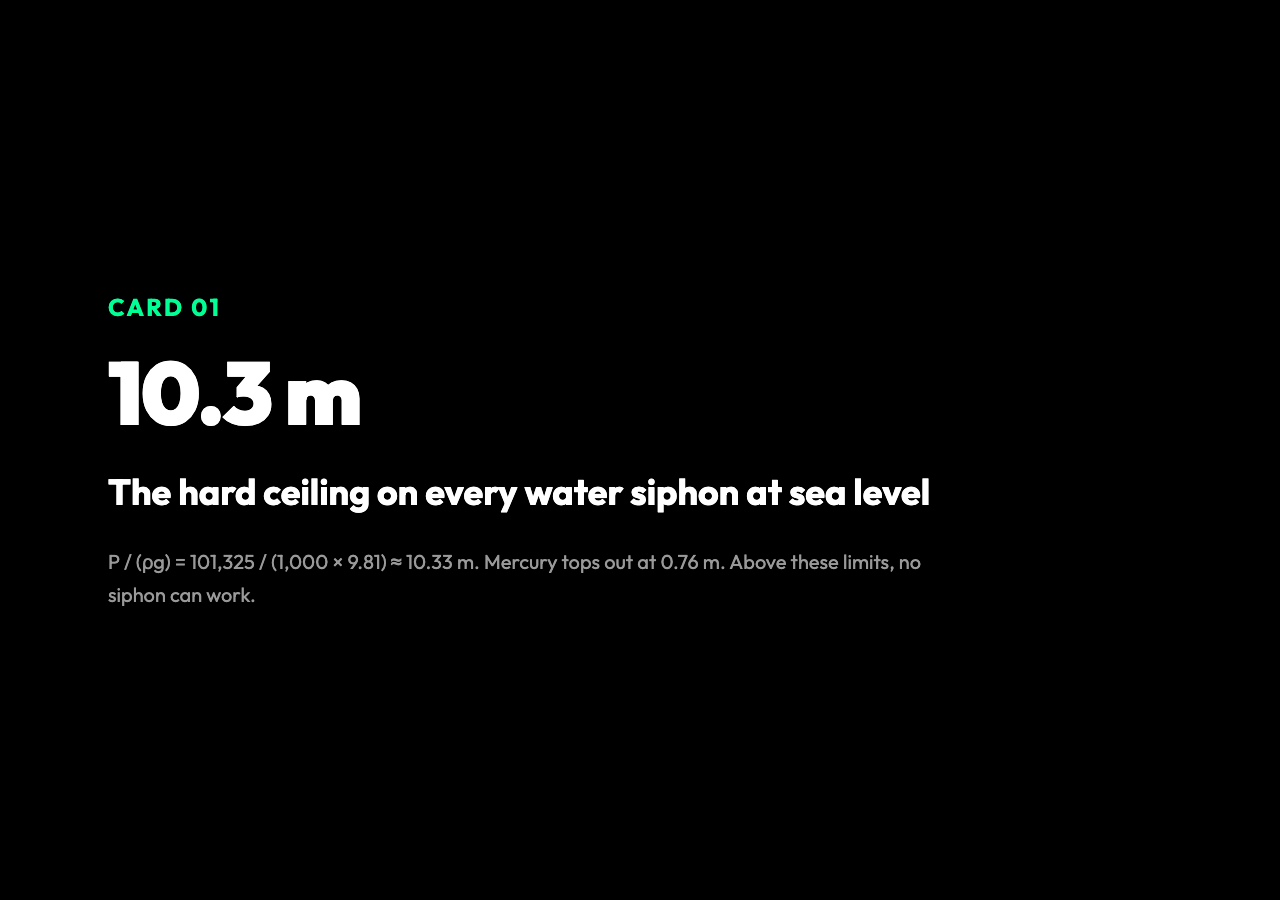
The 10.3-meter ceiling is, in fact, a measure of the atmosphere itself. At sea level, air presses down with about 101,325 pascals. That pressure can hold up a column of water whose weight per unit area matches the air. For water (density 1,000 kg/m³), that height is P / (ρg) = 101,325 / (1,000 × 9.81) ≈ 10.33 meters. Mercury, with density roughly 13,600 kg/m³, can only be lifted about 0.76 meters. That is why barometers use mercury — atmospheric pressure cannot push water much higher than 10 meters, but it can comfortably support a 76-centimeter column of mercury. The siphon limit, in other words, is the barometer limit; both phenomena are the same physics wearing different clothes.
A common intuition is that siphons work by “vacuum suction” or by some sort of pull. They don’t. The mechanism is push from atmospheric pressure on the source, combined with gravity on the long descending leg. Inside the tube, the pressure at the top of the siphon is actually below atmospheric — a partial vacuum — and that pressure deficit is exactly what allows atmospheric pressure to push liquid up from the source. Bernoulli’s equation makes this explicit: along a streamline from the source surface to the tube exit, the sum of pressure, kinetic-energy density, and gravitational potential density is conserved. The loss of pressure at the top is paid for by the gain in elevation as fluid falls through the descending leg.
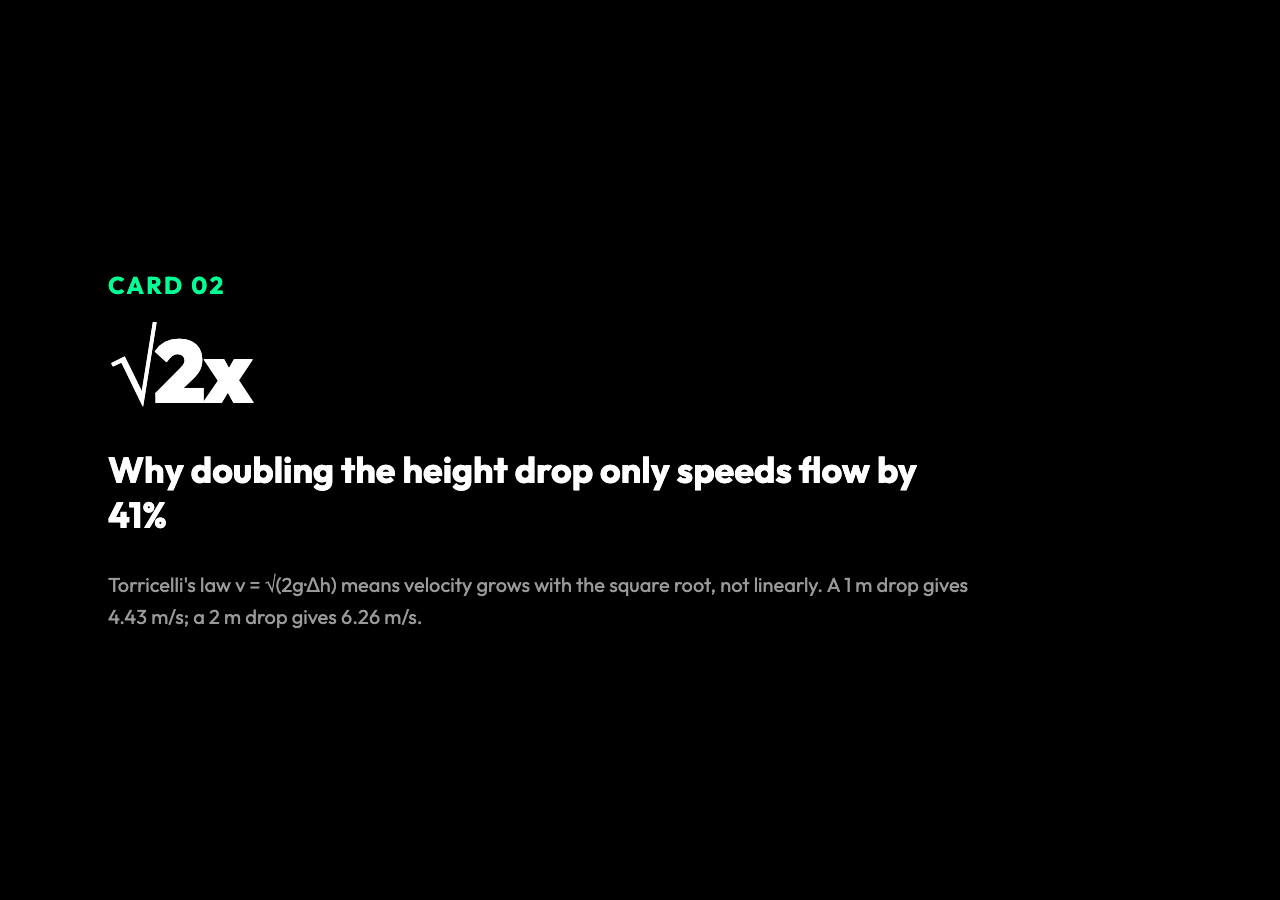
Torricelli’s law v = √(2g·Δh) governs the exit velocity. With a 1-meter height difference, water exits at about 4.43 m/s. Double the height difference, and velocity increases by only √2 — about 41% faster, not 100%. This is the same √-law that governs the speed of a falling body after falling a given distance, and it tells you that siphon velocity grows slowly with height difference. Most of the speed advantage of a tall siphon comes from the first meter of drop, not the next ten. Flow rate, by contrast, scales linearly with tube cross-sectional area: a 2-centimeter-diameter tube carries four times the volume of a 1-centimeter tube at the same exit velocity.
The “priming” step — filling the tube with liquid before letting it run — is not optional. Any trapped air bubble breaks the continuous liquid column that the pressure-difference mechanism requires. In a real water siphon, dissolved gases come out of solution as pressure drops at the top of the tube, which is why siphons in practice often lose lift and slowly fail after running for hours or days. Mercury siphons are even more demanding: the slightest contamination at the surface breaks the cohesion needed. This is one reason mercury siphons are rare in industry despite mercury’s high density. The siphon is a beautifully simple idea, but it lives within a narrow window of physical constraints.
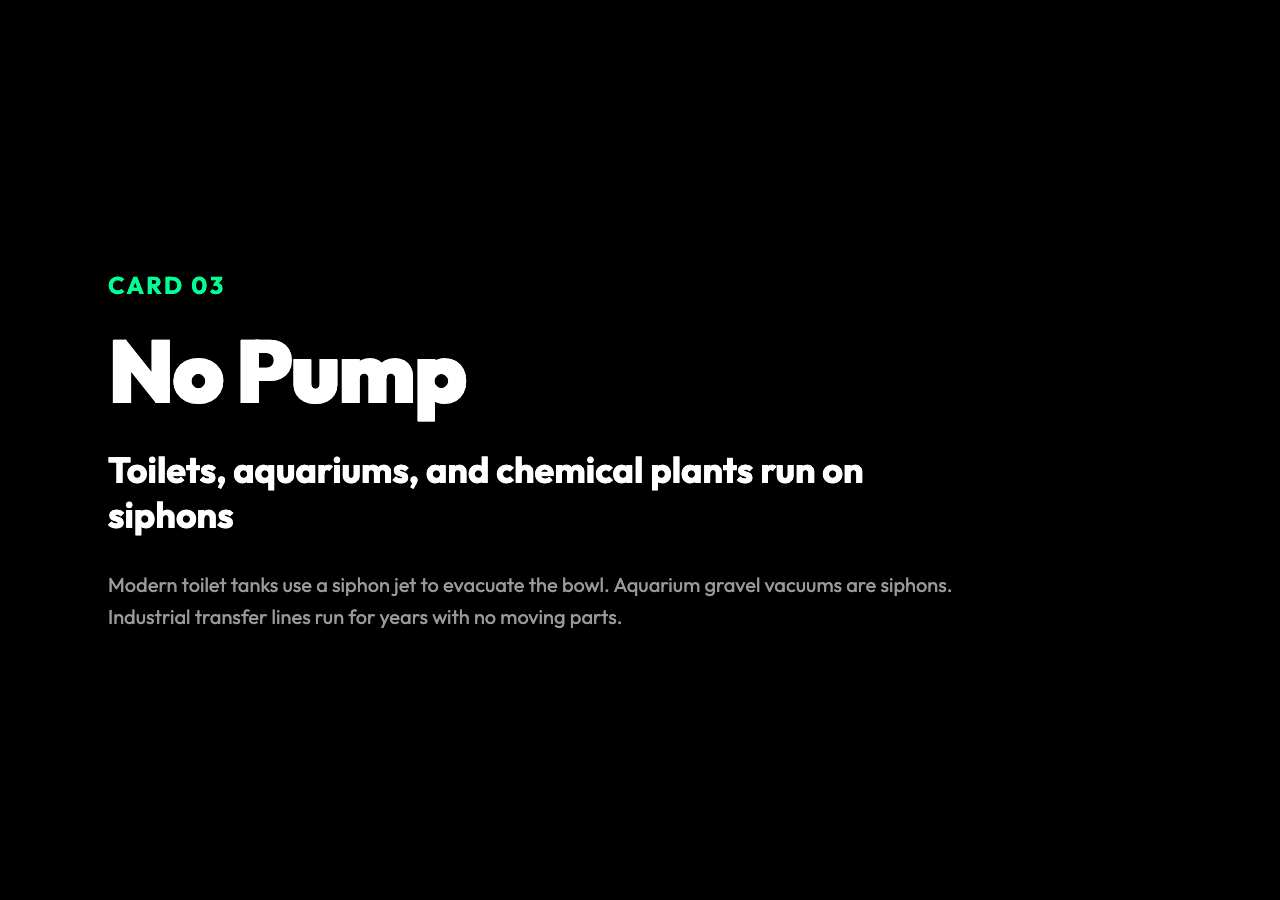
The constraints are why siphons appear in some surprising places. Modern toilet tanks rely on a siphon jet to evacuate the bowl: the tank fill line raises water just above the bowl rim, then the descending leg creates a strong burst of flow that carries waste through the trap. Aquarium gravel vacuums are siphons — the user primes the tube by mouth, then lets gravity do the work. Old-fashioned chemistry labs used siphons to move acids and bases between containers on different shelves, with no pump to corrode. And in industrial settings, siphons transfer liquid between tanks without any moving parts, often running continuously for years with nothing more than a periodic visual check. No power, no maintenance, no failure mode except a cracked tube or a bubble that didn’t get expelled.
A siphon is also a useful diagnostic tool: if a siphon is failing, you can immediately distinguish a priming problem (water column interrupted by air) from a height problem (the peak exceeds the atmospheric limit) from a viscosity problem (the liquid is too thick to flow under the available pressure difference). Each failure mode has a different fix — re-prime, lower the peak, switch liquids. This is the kind of structure that makes the siphon useful in physics education as well as in plumbing. A working siphon is a proof that fluid statics and fluid dynamics are not separate subjects; they are two views of the same conservation law. Pressure at the top of the siphon is below atmospheric, pressure at the source is at atmospheric, and pressure at the exit is at atmospheric again, with the difference between source and exit heights converted into kinetic energy at the exit. Every detail of the siphon’s behavior can be read off from that balance.
For a hands-on look at how changing the height difference, tube diameter, and peak height affects flow rate and exit velocity, see the Siphon Effect simulator. You can vary the height difference, tube diameter, and liquid density interactively to see how each parameter changes exit velocity and flow rate, with preset scenarios for fish-tank cleaning, toilet siphons, and industrial transfer. Or browse the wider library of physics visualizations at elysiatools.com.