Why Every Fence, Frame, and Border Hides the Same Old Math Problem
You probably learned perimeter in fifth grade, then forgot it. That’s a mistake — and one that costs builders, designers, and engineers real money every year. The act of measuring the edge of a shape turns out to drive some of the most important calculations in the real world: how much fence to buy, how much wire to cut, how much fabric to sew, how far a satellite travels per orbit, and how fast a tiny cell loses heat to the air around it. Every fence installer, every framer, every garment maker, every cartographer, every orbital mechanic is solving the same puzzle that Euclid wrote down 2,300 years ago. The formulas look different for every shape, but the question underneath never changes: how far is it around?
The Simplest Case: Polygons
If you have a polygon — a closed shape made of straight lines — the perimeter is the sum of the side lengths. That sounds almost too simple to be a formula, but it shows the foundation of how all perimeters work. A triangle with sides 3, 4, and 5 has a perimeter of 12. A rectangle 4 by 7 has a perimeter of 22. A regular hexagon with each side 2 has a perimeter of 12. No magic.

The reason it works is that the perimeter of any polygon — even an irregular one — is just the total length of its boundary. You measure each side, add them up, done. This is why a regular polygon’s perimeter is so clean to express: if the shape has n sides of length s, the perimeter is n × s. For a regular pentagon with sides 1.5, that’s 7.5. For a regular octagon with sides 2.3, that’s 18.4.
You can test this yourself with the free Perimeter Calculator at Elysia Tools — type in the shape and its dimensions, and the math appears instantly. It’s a useful escape hatch when the formula is the kind you have to look up because you only need it twice a year.
Where the Formulas Get Interesting: π and the Circle
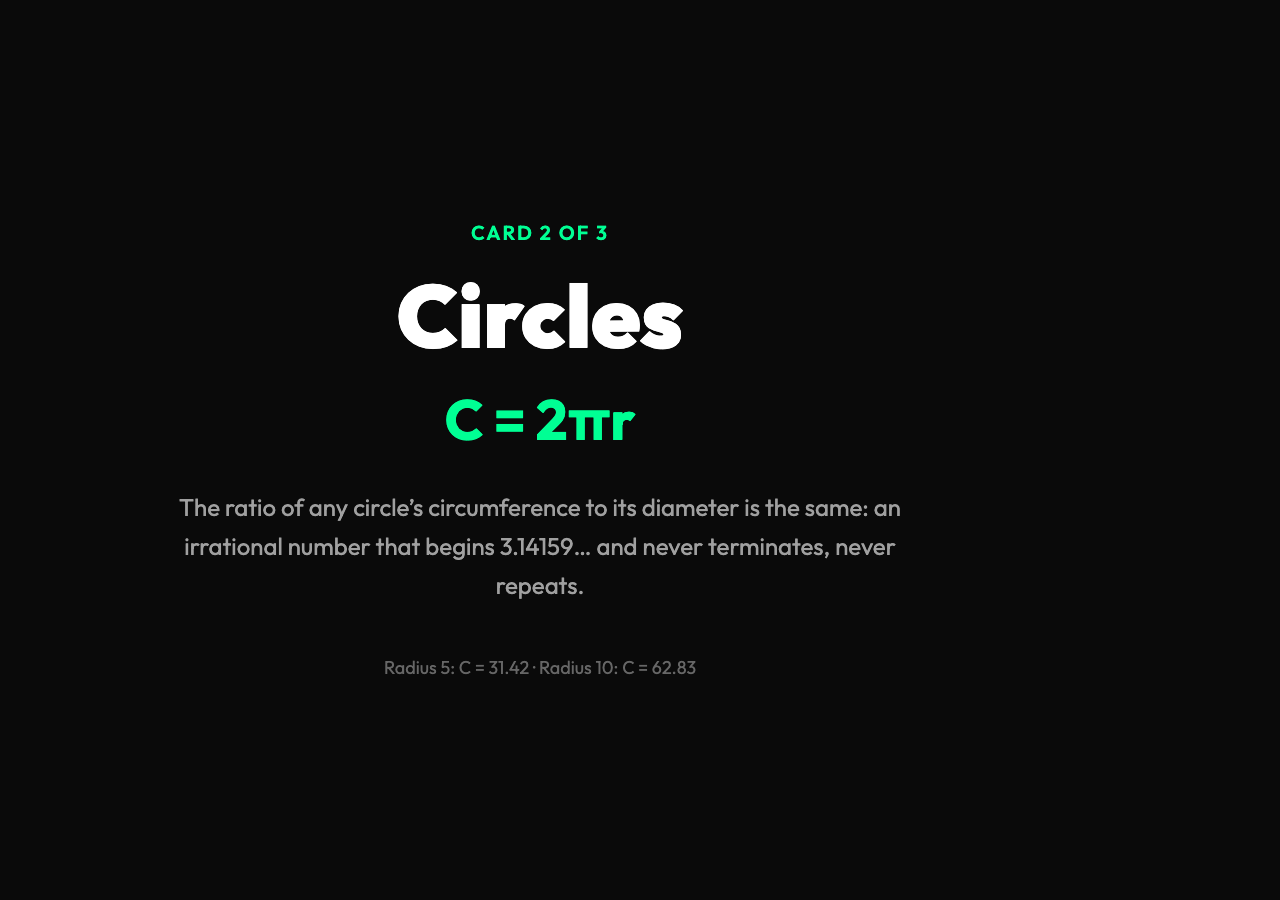
For a circle, the perimeter gets a name of its own: the circumference. The relationship is C = 2πr, where r is the radius. This is the first place in geometry where most students feel the formula is being imposed rather than derived — but it isn’t, not really.
The number π emerges naturally from the ratio of a circle’s circumference to its diameter. That ratio is the same for every circle, no matter how big or small. It’s a property of curves. For π ≈ 3.14159, a circle with radius 5 has a circumference of about 31.42. The deeper insight is that π is irrational: its decimal expansion never terminates and never repeats. You’ll never write down the exact circumference of any circle as a finite decimal — you can only approximate it.
This matters in practice because engineers and designers make rounding decisions every day. A pipe with circumference 100 mm might be quoted as 31.831 mm in diameter (using π), but the manufacturer will cut steel in metric or imperial units, and that rounding can compound across large projects.
The Curve Family: Ellipses, Sectors, and Arcs
Once you move past circles, the formulas get messy — but in useful ways. An ellipse (a stretched circle) has no closed-form perimeter. There’s no neat formula. Instead, mathematicians use an infinite series approximation or a numerical integration, both of which converge to a value you can round to the precision you need. For most practical purposes, Ramanujan’s approximation gives an answer accurate to within 0.04% using two inputs: the semi-major axis (a) and semi-minor axis (b). That’s good enough for nearly every real engineering case.
An arc is just a piece of a circle’s circumference, and its length is r × θ, where θ is the angle in radians. This is why radians exist as a unit: they make the formula work without an extra factor. A quarter-circle arc on a circle with radius 10 has length 10 × (π/2) ≈ 15.71. A semicircular arc on a circle with radius 4 has length 4 × π ≈ 12.57. Same pattern, different slice.
A circular sector — the pizza-slice shape — adds two radii to the arc, so its perimeter is 2r + rθ. A sector with radius 6 and angle π/3 has perimeter 12 + 6 × (π/3) ≈ 18.28.
Why Perimeter Matters More Than You’d Think
Perimeter is everywhere in the practical world. Fencing a yard is literally measuring perimeter: linear feet of fence equals the perimeter of the lot. The amount of trim around a rectangular room is the perimeter, doubled if you want baseboards on both sides. The length of piping in a circular heating loop is the circumference. The distance a satellite traces in a single orbit is the perimeter of an ellipse with Earth’s center at one focus.

In manufacturing, perimeter shows up as the length of material cut, the length of wire wound, the length of fabric sewn. In geography, the perimeter of a country or a watershed is a key input to logistics and environmental modeling. In biology, the perimeter-to-area ratio of a cell affects how it exchanges heat and materials with its environment — which is why small cells can starve or freeze faster than larger ones.
Even in software, perimeter is the runtime of any algorithm that walks the boundary of a shape. Polygon rendering, image segmentation, computer-aided design (CAD), and game collision detection all use perimeter-style operations on a regular basis. The geometry you learned in school is what runs in the background of half the software you use daily.
The Trap: Perimeter vs. Area
The most common mistake is confusing perimeter with area. Perimeter is one-dimensional: it measures length, in units like meters. Area is two-dimensional: it measures surface, in square meters. You cannot add them, compare them directly, or substitute one for the other.
A square with side 1 has perimeter 4 and area 1. A square with side 2 has perimeter 8 and area 4. As a shape grows linearly, its perimeter grows linearly but its area grows quadratically — and that’s the whole reason a small pizza’s edge costs more per square inch than a large one. The “edge-to-area” ratio is one of the most useful numbers in any geometric problem, and it appears whenever you ask “how much boundary does this region have, relative to its inside?”
Putting It All Together
The cleanest way to think about perimeter is this: it’s the answer to the question “how far is it around?” — and every shape has a slightly different way of answering. Polygons add up their sides. Circles invoke π. Arcs and sectors slice the circle into manageable pieces. Ellipses don’t have a clean closed form at all, and that’s a feature of the math, not a bug.
The right tool for the job is whichever shape you’re working with. The formulas are short enough to memorize for the common cases and short enough to look up for the rare ones. A perimeter is just a sum — but the geometry behind that sum is what makes the calculation work for any shape, from a triangle in your notebook to an elliptical satellite orbit a hundred kilometers up.
If you want to skip the arithmetic and get an answer directly, the Perimeter Calculator at Elysia Tools handles all of these shapes — polygons, circles, ellipses, sectors, arcs — in one place. It’s the kind of tool you forget about until you need it, and then it pays for itself the first time you use it. Explore more geometry and math utilities at elysiatools.com.