Why One Equation Rules Acoustic, Radio, and Visible Light
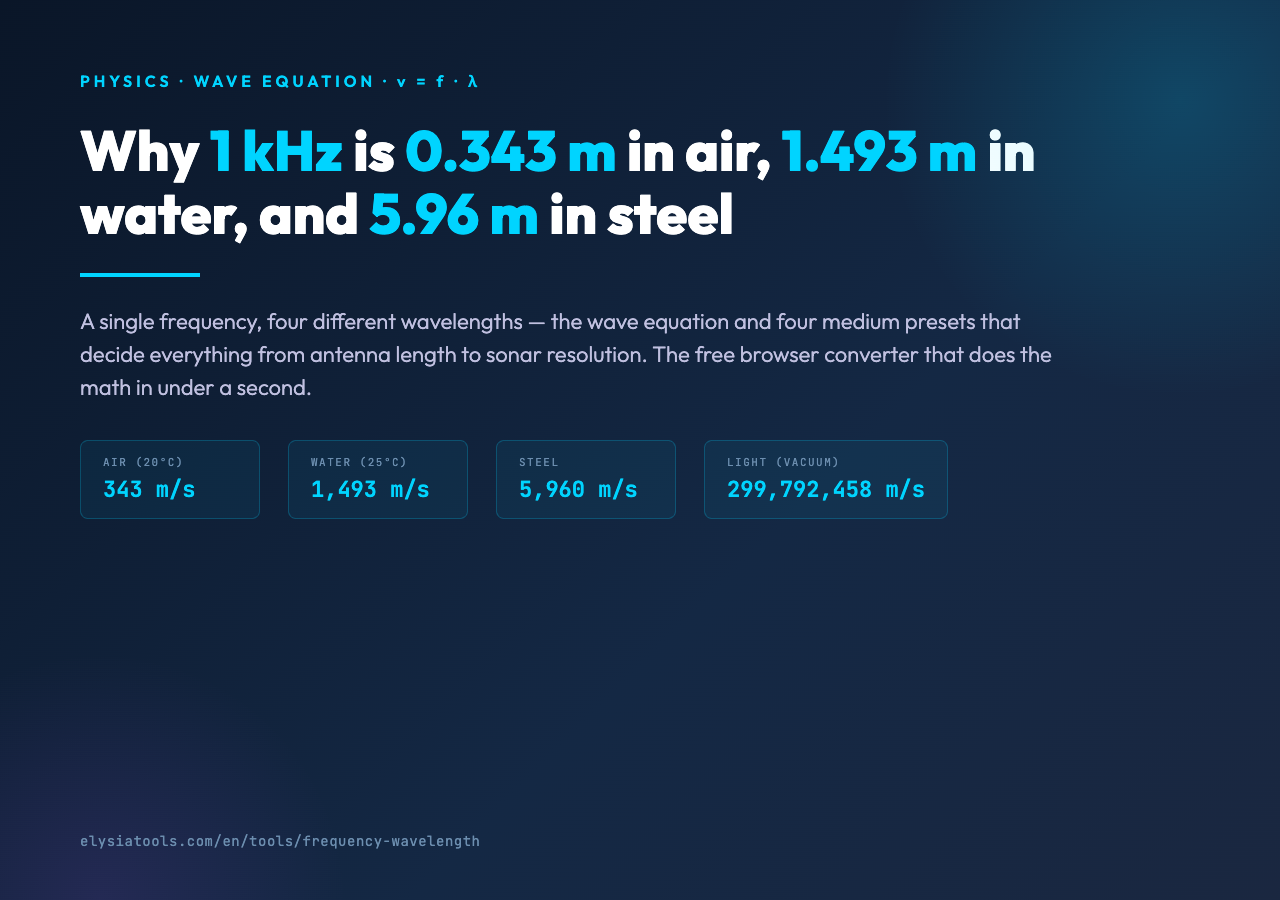
A 1 kHz tone is not “the same length” as a 1 kHz radio wave. The number is identical; the wavelength is not, because the medium is different. Sound at 1 kHz in 20 °C air stretches about 0.343 meters; the same 1 kHz electrical oscillation on a transmission line behaves like a wave whose wavelength depends on the line’s effective velocity, not on air. Visible green light at 560 THz measures 535 nanometers. Three numbers, three media, one equation: v = f · λ.
If you build RF filters, align antennas, troubleshoot an audio crossover, or calibrate an optical interferometer, you spend your working day translating between frequency and wavelength. Doing it on a napkin is fine once. Doing it 200 times on a lab bench, with four media and six unit prefixes, is where the Frequency ⇄ Wavelength Converter earns its place. This article walks through what the converter actually does, why a single wave-equation call is not the whole story, and the four traps that catch engineers and students the most often.
The Wave Equation v = f · λ in Three Lines
For any periodic wave, three quantities always coexist:
- v — wave speed in the medium (meters/second)
- f — frequency (Hz, cycles per second)
- λ — wavelength (meters, peak-to-peak)
Rearrange freely:
- λ = v / f (wavelength from frequency)
- f = v / λ (frequency from wavelength)
- T = 1 / f (period, also reported by the converter)
That’s the entire physics. Everything else — the unit prefixes, the medium presets, the surprising result when you switch from air to water — is bookkeeping around these three lines.
The converter at elysiatools.com/en/tools/frequency-wavelength implements exactly this: pick a medium, type a number, choose input unit, and it returns wavelength (and frequency and period) in every common prefix at once. No spreadsheet, no off-by-ten mental error at the kHz-to-GHz boundary.
Four Medium Presets Cover 90% of Real Work
The medium is the variable that most people forget. v is treated like a constant, but it’s a property of the material the wave is traveling through. The converter ships four presets that cover most engineering, audio, and optics use cases:
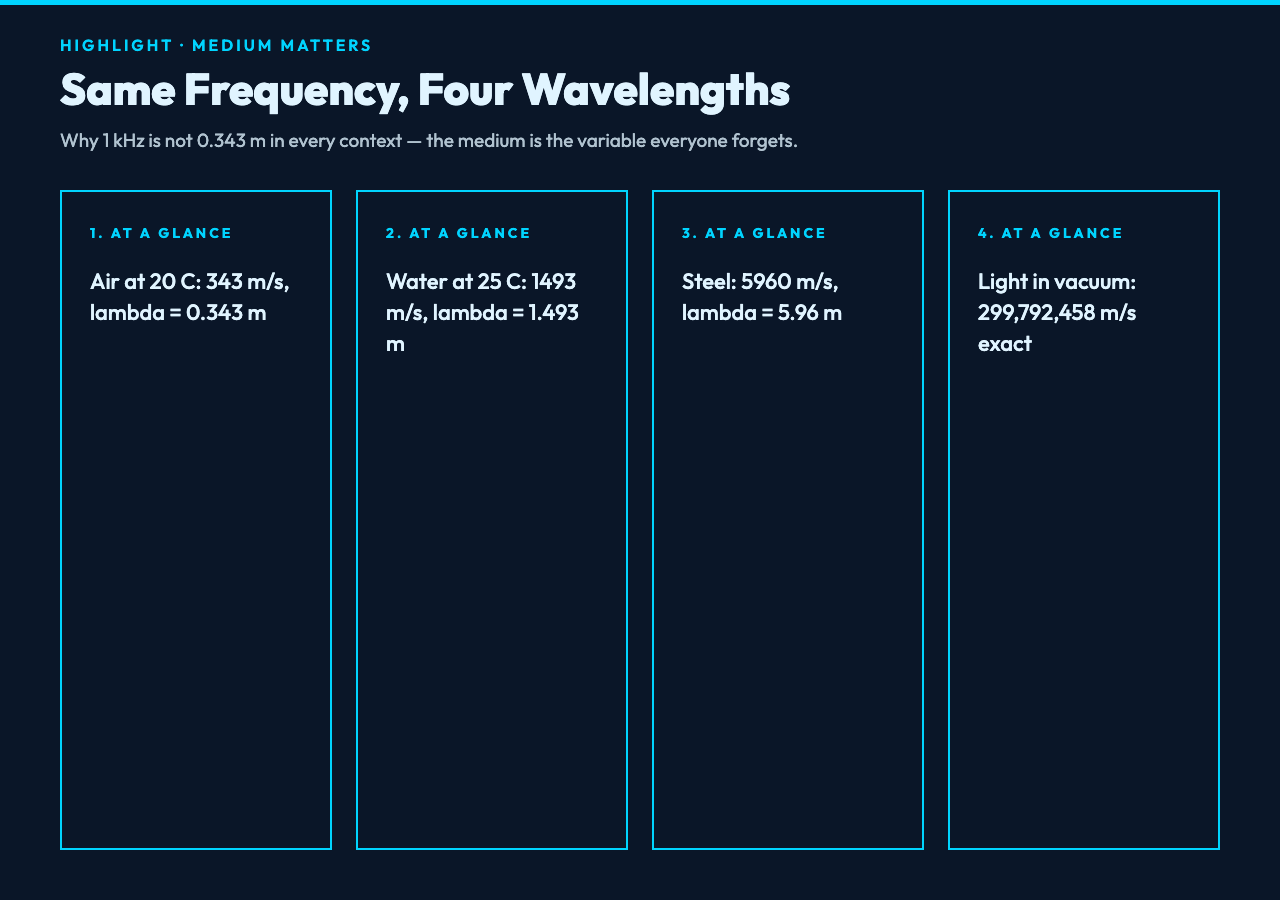
- Air (20 °C): v ≈ 343 m/s — speech, room acoustics, ultrasonics in air
- Water (25 °C): v ≈ 1493 m/s — sonar, hydrophones, underwater acoustics
- Steel: v ≈ 5960 m/s — ultrasonic flaw detection, structural health monitoring
- Light (vacuum): v = 299,792,458 m/s exactly — RF, microwave, optics, photonics
Note that light in vacuum is the only one of these that is defined — it’s an SI constant, not a measurement. The other three are temperature-dependent and material-dependent, so a 5 °C shift in water changes v by about 0.6% — not catastrophic, but enough to matter for precision sonar work.
The 1 kHz Trap: Why the Same Frequency Is Three Different Wavelengths
Take a 1 kHz signal and ask the converter three times:
| Medium | v (m/s) | λ at 1 kHz | Real-world context |
|---|---|---|---|
| Air (20 °C) | 343 | 0.343 m | Audio crossover point; room modes start here |
| Water (25 °C) | 1,493 | 1.493 m | Sonar wavelength at 1 kHz |
| Steel | 5,960 | 5.96 m | Ultrasonic NDT typically uses higher f, but here it’s audible-range f used for illustration |
Same frequency, four-and-a-half-times the wavelength. If you’re sizing an anechoic chamber wedge, designing a sonar array, or laying out an ultrasonic test, picking the wrong medium preset makes your geometry wrong by a factor of 4.5x — not a rounding error. The Frequency ⇄ Wavelength Converter defaults to Air because that’s the most common starting point, but the dropdown is one click away.
Six Frequency Prefixes, Six Wavelength Prefixes, Zero Off-by-Tens
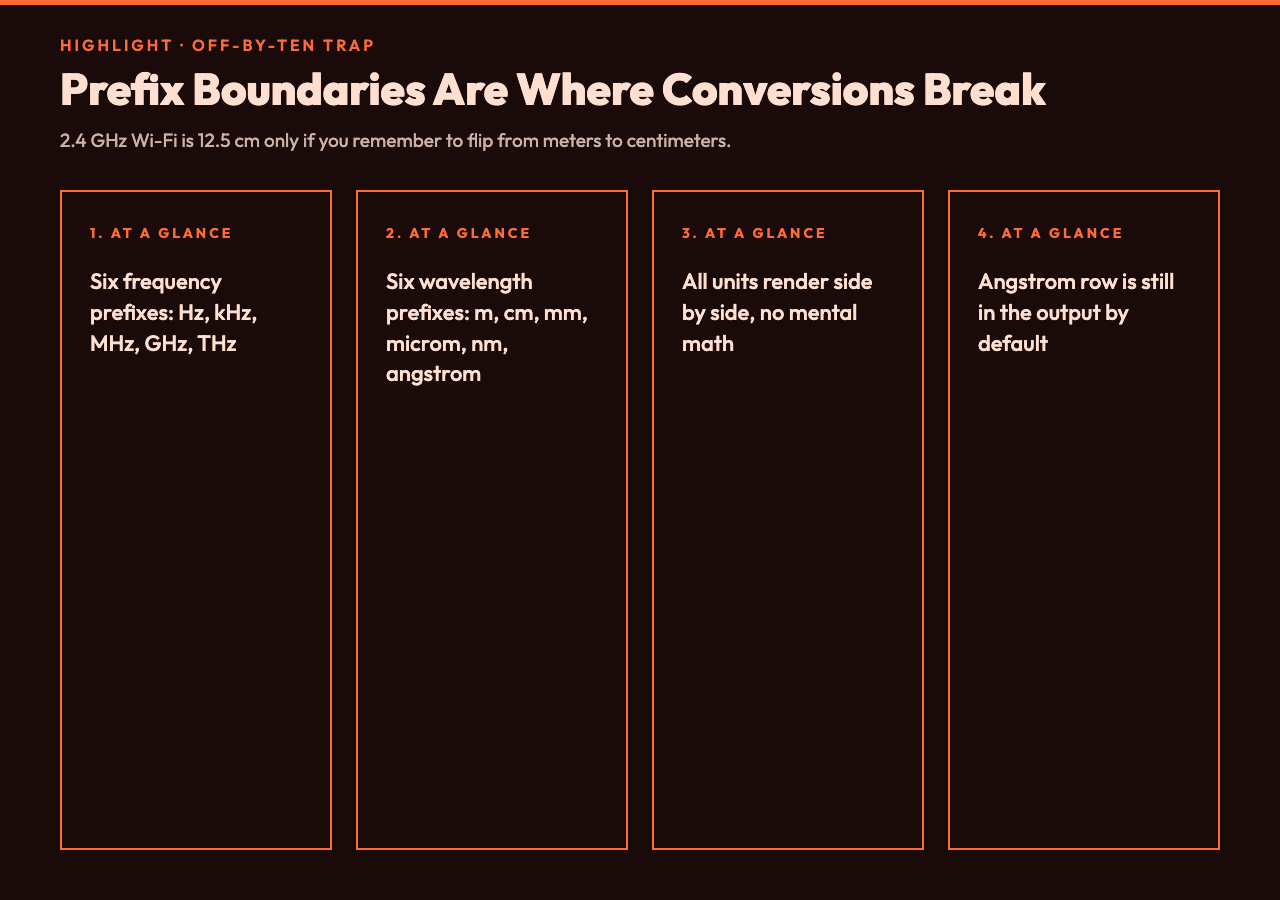
The most common bug in hand-rolled conversions is the prefix boundary. A 2.4 GHz Wi-Fi signal at the speed of light is roughly 12.5 cm — but if you accidentally keep the answer in meters instead of centimeters, you report a “wavelength” that’s 100× too small and your antenna dimensions are suddenly nonsense.
The converter exposes all common units side by side, so you see the answer in Hz, kHz, MHz, GHz, THz, and the matching m, cm, mm, µm, nm, Å (angstrom) on the wavelength side, simultaneously. You don’t have to pick one and trust your decimal shift. The Å row in particular is easy to forget — it’s still used in crystallography, X-ray diffraction, and older optics papers — and the converter renders it by default.
The Five Real Use Cases
These are the workflows where a converter pays for itself in saved mistakes:
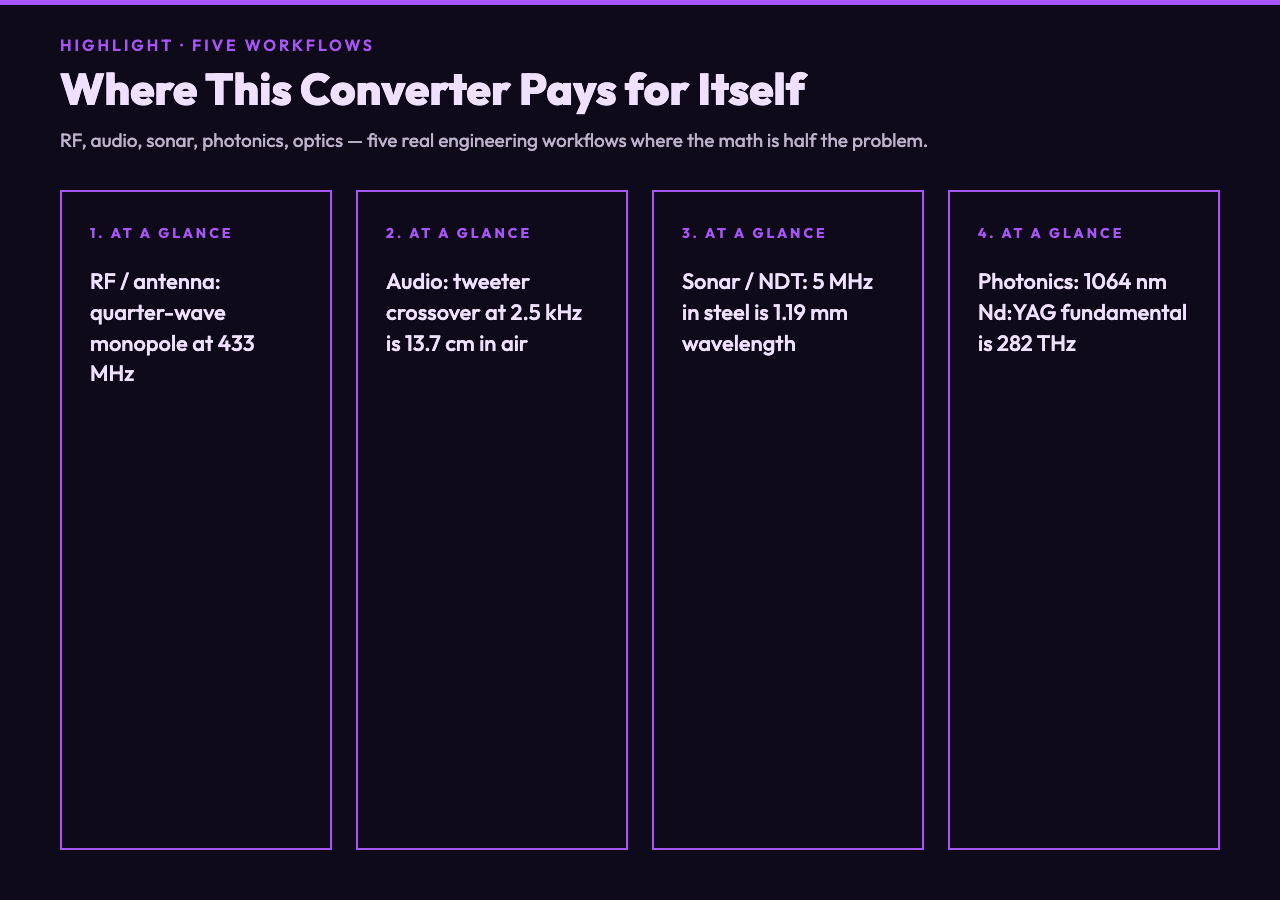
- RF / antenna design. Quarter-wave monopole at 433 MHz → λ/4 in vacuum ≈ 17.3 cm. The converter returns 0.173 m directly; no power-of-ten arithmetic needed.
- Audio crossover points. Tweeter crossover at 2.5 kHz → λ ≈ 13.7 cm in air. Useful for cabinet dimensioning and diffraction control.
- Sonar / ultrasonic NDT. 5 MHz longitudinal wave in steel → λ ≈ 1.19 mm. The resolution of your flaw detector is bounded by this number.
- Photonics / laser safety. 1064 nm Nd:YAG fundamental → f ≈ 282 THz. The converter lets you sanity-check a laser manufacturer’s datasheet in seconds.
- Optics lab & interferometry. HeNe at 632.8 nm → f ≈ 474 THz. Cross-check against wavemeter readings.
What the Converter Deliberately Does Not Do
Three things are out of scope by design, and you should not try to use the tool for them:
- Dispersion. The four presets are non-dispersive media — v does not depend on f. Real materials (especially optical fibers, plasma, and seawater at high frequency) are dispersive. The converter cannot model that.
- Non-linear media. High-intensity ultrasound, saturable optical fibers, and shock waves have v that depends on amplitude. Not modeled.
- Anisotropy. Crystal acoustics (quartz, lithium niobate) have direction-dependent v. Use a tensor-aware tool for those.
If you need any of these, you’re past the “quick converter” stage and into full physics simulation territory — COMSOL, k-Wave, or a domain-specific solver.
Pairs That Make This Tool Stronger
Frequency and wavelength are the most translated pair in physics, but they sit inside larger workflows. Five tools on Elysia Tools naturally extend what this converter can do:
- Period calculation: T = 1/f. The converter already returns period, but if you need just the timing without wavelength, pair it with the Time Unit Converter for ns / µs / ms conversions of the period.
- Sound pressure level (dB SPL): When wavelength tells you where the room modes are, you also want how loud they are. The Decibel Calculator handles dB SPL, dBm, dBu, and voltage ratios in one place.
- RF power & impedance: For antenna work, wavelength alone isn’t enough — you need voltage, current, and impedance matching. The Ohm’s Law and Power Triangle Calculator handles the electrical side.
- Light-specific work: For photonics and laser wavelengths, the Wavelength Calculator adds wave number, angular frequency, and photon energy on top of plain λ.
- Doppler-shifted signals: Radar, sonar, and astronomy all involve a moving source or observer. The Doppler Effect Calculator gives you the shifted f and λ directly from relative velocity and a medium preset.
Putting It Together
The wave equation is short, but the prefixes and media make manual conversion brittle. Three rules of thumb keep you out of trouble:
- Always name the medium when reporting a wavelength. “The wavelength is 0.34 m” is incomplete; “λ = 0.343 m in air at 20 °C” is a measurement.
- Sanity-check by orders of magnitude. Light at any visible wavelength is sub-micron. Sound at any audible frequency is sub-100 m. Steel ultrasound at MHz is sub-mm. If your answer is off by 10× or 100×, you’ve crossed a prefix boundary.
- Use the converter as a sanity check, not a primary source. For final engineering numbers, you’ll still measure v in your actual medium. The converter gets you within 1% of the answer in under a second, which is enough to spot the mistake in your spreadsheet before it propagates.
The full converter — including all four media presets, both directions (frequency → wavelength and wavelength → frequency), all six frequency prefixes, all six wavelength prefixes, and the period side-output — lives at elysiatools.com/en/tools/frequency-wavelength. It’s free, runs entirely in the browser, and copies cleanly into lab notebooks because the output is plain text.
When you inevitably need the next quantity down the chain — period in nanoseconds, sound pressure level in dB SPL, or the Doppler shift from a moving target — the sibling tools above pick up exactly where this one stops. That’s the value of having a coordinated suite of physics converters: each tool does one thing well, and the math between them is the wave equation you already know.