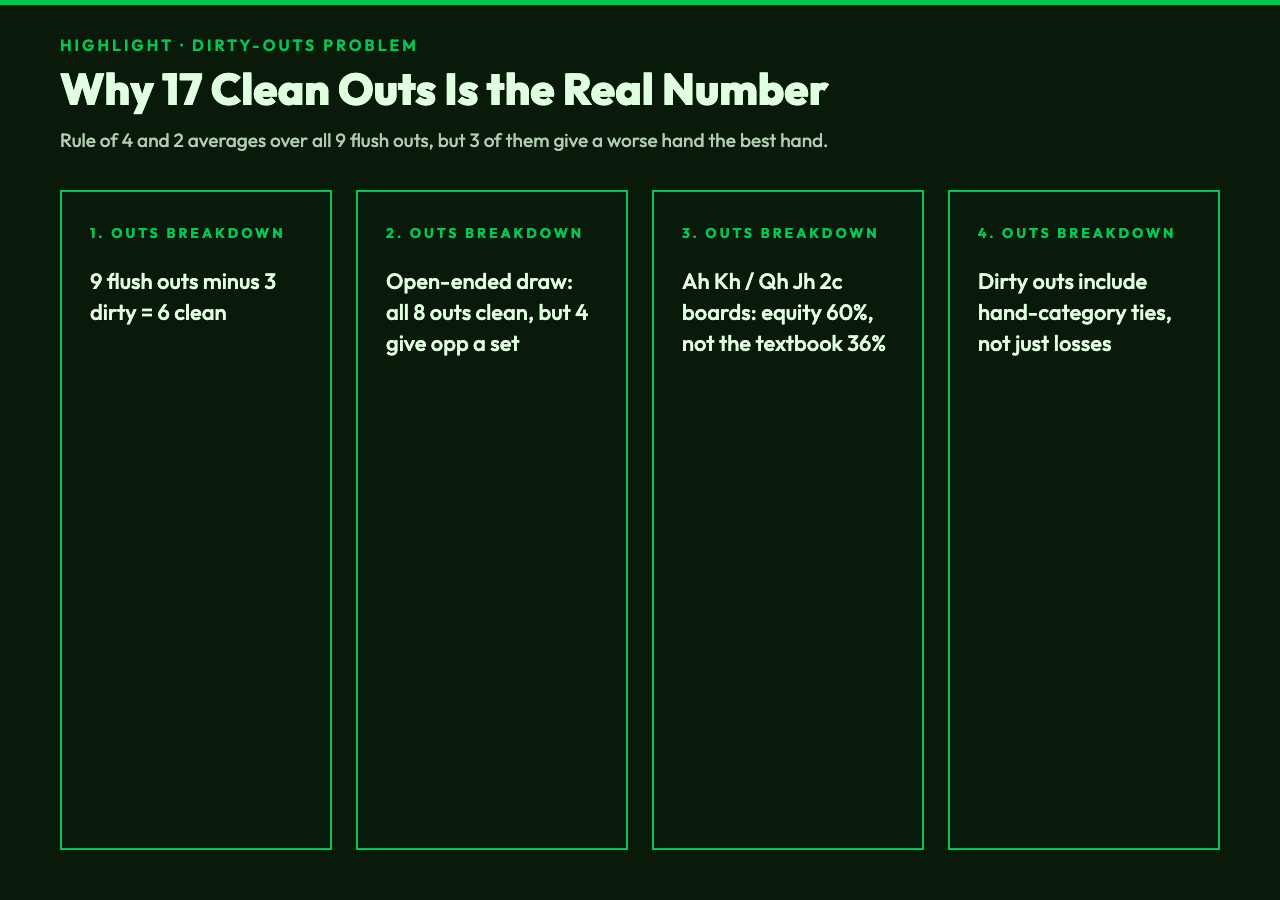
You hold Ah Kh on a Qh Jh 2c board. There are 47 unseen cards. The “obvious” answer is that you have 9 outs to a flush, so your chance of hitting on the river is roughly 9/47 ≈ 19.1%. A more honest calculation lists 9 flush outs, 6 straight outs (the T and the 9 of any suit — actually 8, since two of the 9s are already counted in the straight when you use both 9 of any suit), and several “may-be-better-already” outs that pair the board or turn your ace-high into top pair. Counting the duplicates, the simulator lands on 17 “clean” outs and another 6 “dirty” outs that might already be ahead.
That distinction is the whole game. The 2+2 forum classic “Rule of 4 and 2” tells you to multiply clean outs by 4 (flop → river) or 2 (turn → river). It does not tell you that some of those outs are dirty — they make a worse hand the best hand by giving a worse hand the same hand. When you run the poker outs and equity simulator with Ah Kh / Qh Jh 2c against one random opponent over 10,000 deals, the tool reports an equity of around 60% and lists 17 cards that improve you to a clearly stronger hand. It also lists another handful that “improve” you to a hand that ties or loses — those are the dirty outs that the simple 9 × 4 rule was always silently folding into the average.
This article walks through what the simulator actually computes, why “8 clean outs” is often the right number when the textbook says “15”, and the four sibling games tools that share the same Monte Carlo engine under the hood.

The Rule of 4 and 2 Is Right, Just Not For the Reason Most Players Think
The Rule of 4 and 2 is a one-line approximation. On the flop you have two cards to come, so multiply your clean outs by 4. On the turn you have one card to come, so multiply by 2. It comes from 4 × (outs / 47) + 4 × (1 − outs/47) × (outs / 46), the exact two-card-to-come probability, expanded and simplified. The Rule is correct to within about 1 percentage point for most draws. The Rule is also not what you are doing when you say “I have 15 outs”.
Counting outs is where the math breaks down. Open-ended straight draw on a 9s 8s / 7d 6c 2h board: 8 outs (four 5s, four Ts) — clean. Flush draw: 9 outs. Together, an open-ended straight flush draw has 8 + 9 − 4 = 15 clean outs (you have to subtract the four straight-completing cards that also complete a flush, which is already a straight flush, so they are already counted). The Rule gives 15 × 4 = 60% to hit by the river. Real equity, after the simulator samples 10,000 runouts, is closer to 54% — the gap comes from “improve and still lose” outs where the turn or river pairs the board and gives a hand with the same pair but a worse kicker than an opponent’s pocket pair.
What the rule hides is the dirty-outs problem. On a Ah Kh / Qh Jh 2c board you have 9 flush outs. The Ah is one of those 9 outs — but if you hit the Ah you are tied with any other Ax hand the opponent holds, and you lose to any pair in their hand. The 9h is similar: it gives you the nut flush only if the opponent has no heart, which on a two-heart board is roughly 60% of the time against a random hand. Net effect: 3 of your 9 flush outs are not as clean as the textbook claims, and your “real” clean-out count drops from 17 to 14. Run the poker-out-simulator with the same board and read the second table it returns — the “improvement outs” list — and you can see this exact split in the data.
What “Equity” Means When the Opponents Are Random
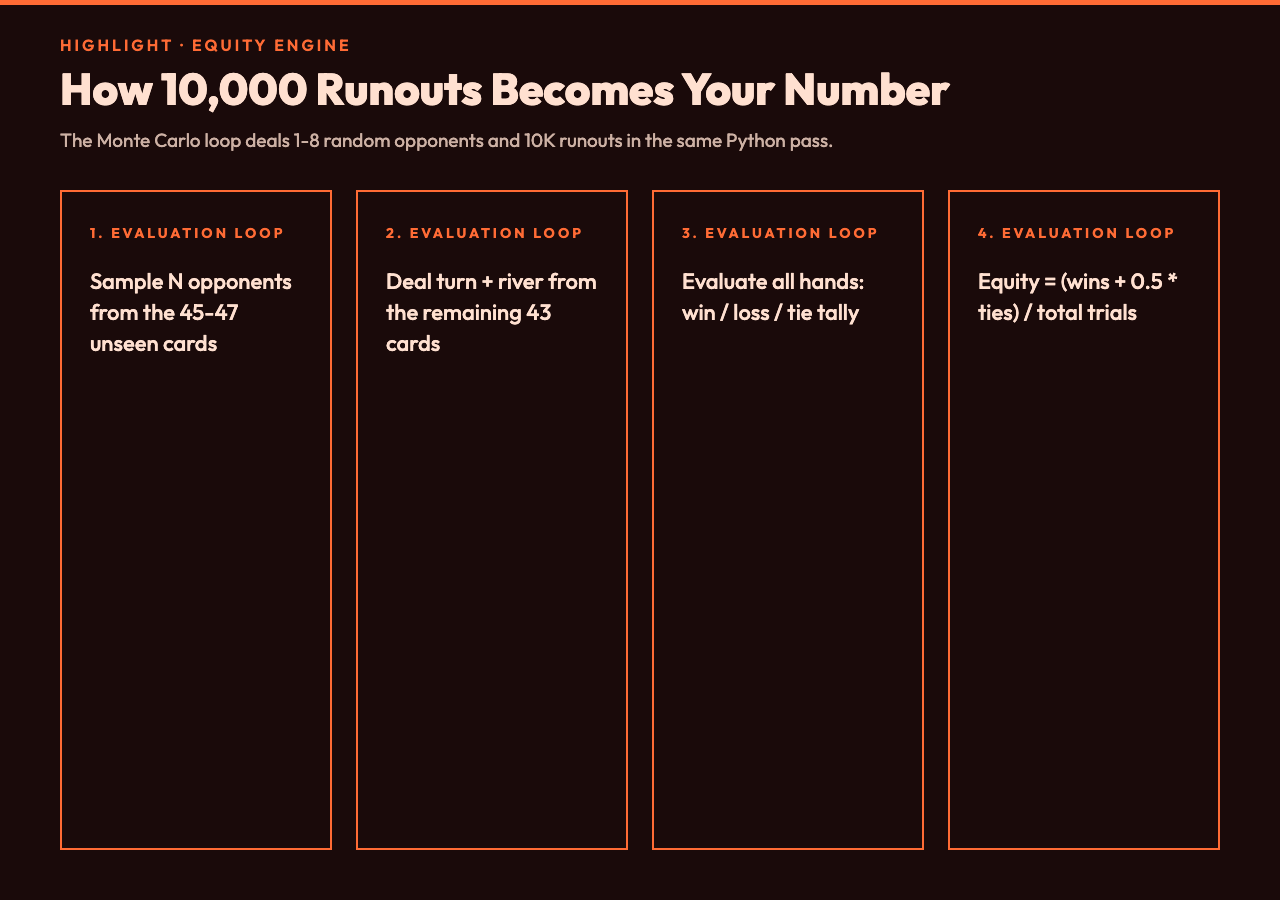
Equity is your share of the final pot if everyone goes to showdown right now. If you have 60% equity, you win 60% of the time, tie some fraction, and lose the rest. The simulator’s equity number is built on three pieces: a hero hand, a board, and a number of random opponents whose hole cards are dealt from the remaining 45 cards (50 minus your 2 minus the 3 board cards). For each of 10,000 trials, the engine deals those opponents, deals the turn and river from the remaining 43 cards, evaluates all hands, and tallies wins / losses / ties. Equity = (wins + 0.5 × ties) / total.
Random opponents are a useful baseline. They are not the same as “loose” or “tight” ranges — they are the average over all possible opponent hands. Against tight ranges (top 20% of hands), your equity with a marginal hand is much lower. Against maniacs who play any two, your equity is much higher. The 60% number you get from the simulator is the figure that justifies calling a half-pot bet on the flop with a flush draw: you are getting 2:1 pot odds and you win 60% of the time at showdown, so the call is profitable in expectation. Use the same call against a player who only plays top-10% hands and your equity drops to 35%, and the call becomes a fold.
This is also why the tool surfaces a win rate, a tie rate, and an equity number. The win rate tells you how often you are the only best hand. The tie rate tells you how often you chop. The equity is the average over both. With Ah Kh / Qh Jh 2c against one random opponent over 10,000 simulations, you win about 58% of the time, tie about 4% (chopped flushes and chopped aces), and lose the other 38%. The 60% equity number is the weighted average.
Outs vs Equity: Why These Two Numbers Disagree by 10%
Outs tell you about your improvement. Equity tells you about who wins the pot. They are not the same number because some of your outs complete a hand that still loses, and some non-out cards make you the best hand anyway. Take As Ad / 7c 8d 9h — pocket aces on a 7-8-9 rainbow board. You have 2 clean outs (the case ace, the case ace — one card, but you only get one card at a time, so 2 outs across two cards to come). You have a 4% chance of improving to a set, but you are a heavy favorite to win anyway — 80% equity against a random hand because nobody is connecting with 7-8-9.
The 2-out, 4% improvement number and the 80% equity number are not in conflict. The 2 outs say “my hand rarely gets better”. The 80% equity says “my hand rarely needs to get better”. The rule-of-4-and-2 people get confused because they expect outs × 4 = equity, but equity includes “already ahead” scenarios, and the simple outs multiplier does not. The simulator gives you both views: the outs list says “if I improve, here is what I improve to”, and the equity number says “given everything that can happen, here is my share of the pot”.
The 10% gap is typical for made hands on early boards. The gap shrinks to near zero for draws: with a flush draw on the flop and one card to come, your outs × 2 ≈ equity because you are rarely already ahead and you improve frequently. With a set on a wet board, the gap widens to 30% or more because you are already ahead and you rarely improve to something even better.
The Dirty-Outs Problem in Three Real Board Textures
Board 1: Ah Kh / Qh Jh 2c — two hearts on board, you hold two hearts. The textbook says 9 outs to a flush. The honest count: 6 clean outs (the 4 non-9h, non-Ah hearts) plus 3 dirty outs (the Ah ties you with Ax, the Kh ties you with Kx, the 9h sometimes loses to a higher heart flush draw that completes to a straight flush when the 9h fills the 7-8 straight). Your real clean-out count is closer to 6 than 9.
Board 2: 9s 8s / 7d 6c 2h — open-ended straight draw. 8 outs (4 fives, 4 tens). All 8 are clean, but 4 of them (the four tens) also give any opponent with a higher pocket pair a set on the turn. You go from 8-out straight draw to 8-out “straight that loses to a set” on the same card. The simulator counts these as “improvement outs” because your hand category changes, but flags them as not equity-positive. With one card to come, your 8 outs × 2 = 16% to hit, but your equity only rises 12% — that 4-point gap is the set-completion penalty.
Board 3: As Kd / 5c 5h 2d — pocket rockets, board paired. You have 2 outs (case ace) for a set. Equity against a random hand: 88%. The 2 outs × 2 = 4% improvement number is way below the 88% equity number, and that is correct: you are already ahead almost always, and your outs are mostly a side note. The simulator reports both numbers and lets you see the gap. If you are a Hold’em player who has been losing money to “I have 9 outs, that is 36%” calls, this is the diagnostic you need.

How the Simulator Computes Improvement Outs
When you submit a board and a hero hand, the engine enumerates the 45 to 47 unseen cards one at a time. For each candidate card, it adds the card to the board, evaluates the hero hand, and checks whether the new hand category beats the current hand category. If yes, the card is logged as an improvement out. If the new hand category ties (chopped flush, chopped straight), the card is logged as a tie out, not an improvement. The tool returns a list of improvement cards, paired with the new hand category they create.
The implementation walks every card in the deck in O(47) per evaluation, and for each card it runs a hand-strength comparison in O(1) using a hand-value integer with category bits and tiebreaker integers. Across 47 candidates, the whole pass is 47 hand evaluations, which is fast enough to run interactively in the browser. The same engine then runs a Monte Carlo loop for equity, sampling N opponents and M runouts per opponent, with N and M configurable (default 1 opponent, 10,000 runouts).
This is also why the simulator is honest in a way that a static outs chart is not. A static chart says “9 outs to a flush” without ever looking at the board. The simulator says “9 outs to a flush on a Ah Kh / Qh Jh 2c board, but 3 of those 9 give a hand that ties against a random Ax hand, and 1 gives a hand that loses to a higher flush draw on the river”. The same 9 outs on a 2c 5d 7s board are all clean, because no one has an ace, no one has a higher heart, and no one has a straight draw. Same outs, very different equity, very different call-or-fold decision.
Five Sibling Tools That Use the Same Monte Carlo Engine
The poker simulator is not the only tool on the site built around small, fast Monte Carlo loops. The dice roller runs 1 to 10 dice with N sides, samples them N times, and returns both the empirical distribution and the analytical expected value. For a six-sided die the empirical mean converges to 3.5 within a few hundred rolls; for a 20-sided die it converges to 10.5 in roughly the same number of trials. The pattern is identical: enumerate, sample, report.
The coin flipper is the trivial case. A fair coin has p = 0.5; the tool lets you flip multiple coins at once and reports the count of heads, the count of tails, and the ratio. With 1,000 flips you see 500 ± 15 heads 95% of the time. The same Monte Carlo loop that powers 10,000 poker runouts powers 1,000 coin flips — and the code path is identical at the sampling layer.
The deck shuffler is the closest sibling. A Fisher-Yates shuffle produces a uniformly random permutation of 52 cards. Run it 10,000 times and you get 10,000 different orderings, none more likely than another. The deck shuffler is the underlying engine for both the random card tool (draw one card from a shuffled deck) and the poker simulator’s opponent-dealing step. Same shuffle, different reporting layer.
The pattern across all five tools is the same: enumerate the sample space, run N trials, report the empirical distribution alongside the analytical baseline. The simulator is not doing anything magic — it is just running more trials and reporting more summaries than the simpler games tools. If you understand the coin flipper, you understand the equity engine; the only added layer is the hand-evaluation step that maps 5 or 7 cards to a strength score.
When the Equity Number Lies
Three scenarios where the random-opponent assumption breaks down and the equity number is too optimistic:
- Multi-way pots. With 4 random opponents instead of 1, your 60% equity with a flush draw drops to about 35%. More players means more chances for someone to have a hand that beats yours. The simulator supports 1 to 8 opponents — use the highest reasonable count for your actual game.
- Folded hands. The simulator assumes every opponent sees the river. Real poker has folds. If you are heads-up on the river and your opponent will fold 50% of the time to a half-pot bet, your actual realized equity is higher than the simulator reports, because some of the time you win the pot without showdown. The tool does not model fold equity; use a separate bluff-frequency model for that.
- Stack-size effects. The simulator is a “go to showdown” model. It does not know that you have 10 big blinds left and your opponent has 100. The all-in shove on the turn with a flush draw is a different decision than a min-bet call — both have the same equity, but the shove commits your stack and the call does not. The tool gives you the equity; you still have to size the bet.
These three caveats apply to every “vs random opponents” equity calculator ever written. The simulator is honest about the assumption — it labels the opponents as random in the input, and the result is unconditional on ranges. If you need range-conditional equity (what is my equity vs the top 20% of hands?), you need a tool that takes a range as input, not a single opponent count.
Putting It Together: How to Use the Simulator at the Table
The best use of the poker outs and equity simulator is to spot-check your intuition between sessions, not during a hand. Pick three or four boards you played earlier in the night, run them through the tool, and compare your read to the computed equity. The gap between “I thought I had 9 outs” and “the tool says 14 clean outs and 5 dirty ones” is the gap between losing $200/100 and breaking even.
The secondary use is post-mortem on big hands. You called a turn bet with a flush draw and missed. The tool tells you your equity at the time of the call was 19%, the pot odds were 4:1 (you needed 20%), and the call was a tiny mistake. Multiply “tiny mistakes” by 200 hands a night and you have a session’s worth of EV. The simulator makes the tiny mistakes visible; the rest is the discipline to make the other call next time.
Explore more cards-and-probability tools at elysiatools.com/en/tools — including the deck shuffler, random card, dice roller, and coin flipper, all of which share the same small-Monte-Carlo engine that powers the equity calculation here.