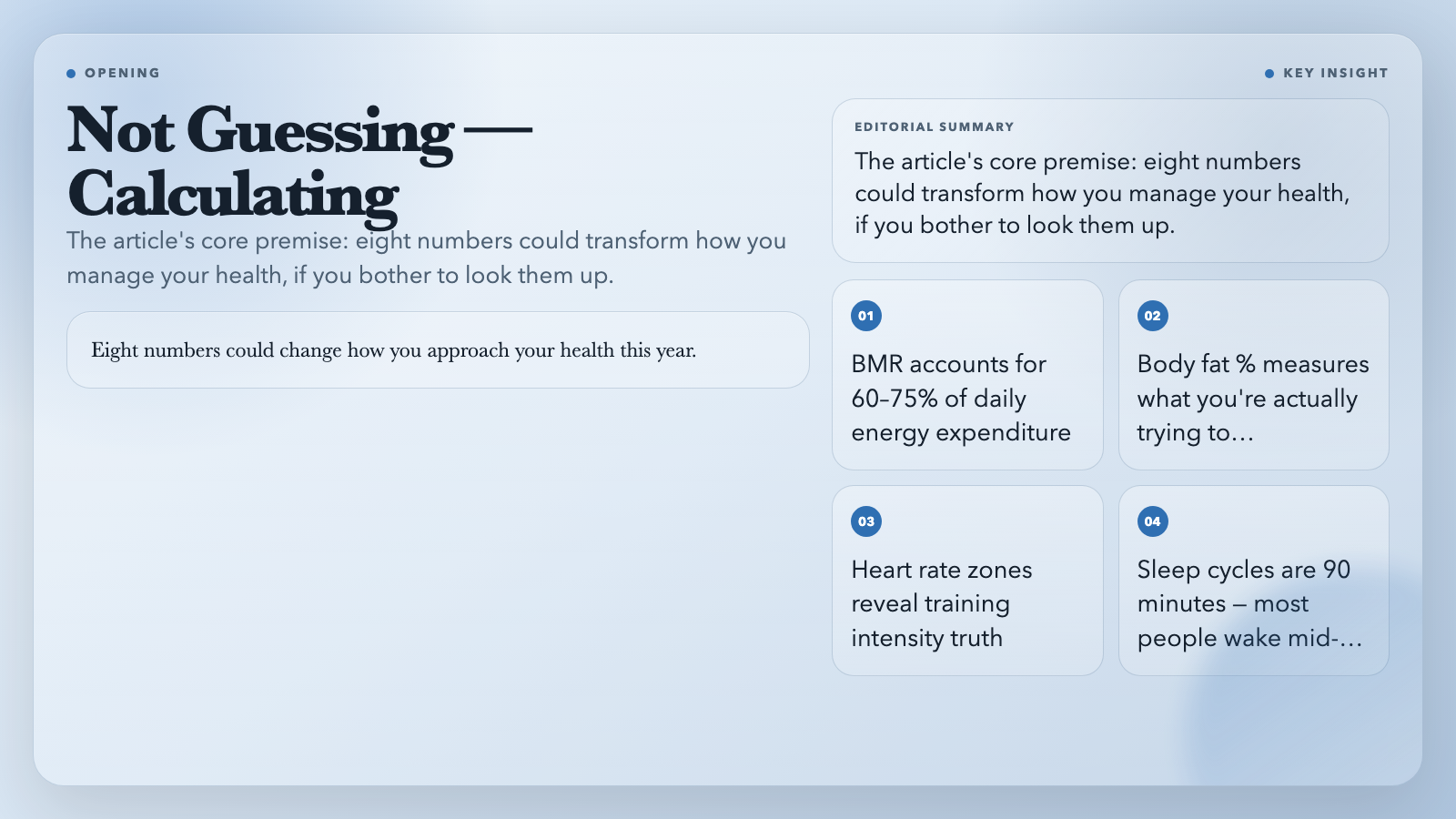
不是猜的,是算的——八个数字就能改变你今年管理健康的方式。基础代谢率、体脂率、目标心率区间、睡眠周期对齐。大多数人从来不计算这些。这意味着,不可测量就不可管理:你无法管理看不见的参数。
8 Free Health & Fitness Calculators That Actually Work in 2026
—
1. BMI Calculator
Your body mass index is the most common screening tool for categorizing weight status worldwide. The formula divides weight in kilograms by height in meters squared, producing a number you can compare against population references in seconds. It doesn’t distinguish between muscle and fat — that’s a legitimate limitation — but it gives you a standardized starting point that healthcare providers have used for decades because it works at scale.
This means BMI’s real value is as a common language, not a final verdict. It’s a conversation starter, not a diagnosis.
Use it when: You’re starting a fitness journey and want a baseline category (underweight, normal, overweight, obese) to benchmark against.
Tool: BMI Calculator
—
2. BMR Calculator
Basal Metabolic Rate is the calories your body burns at complete rest — just keeping your heart beating, lungs breathing, and brain functioning. This single number typically accounts for 60–75% of your total daily energy expenditure. Most people discover they need far more food than they thought to maintain or change their body composition, which is exactly why BMR is the foundation of any serious nutrition plan.
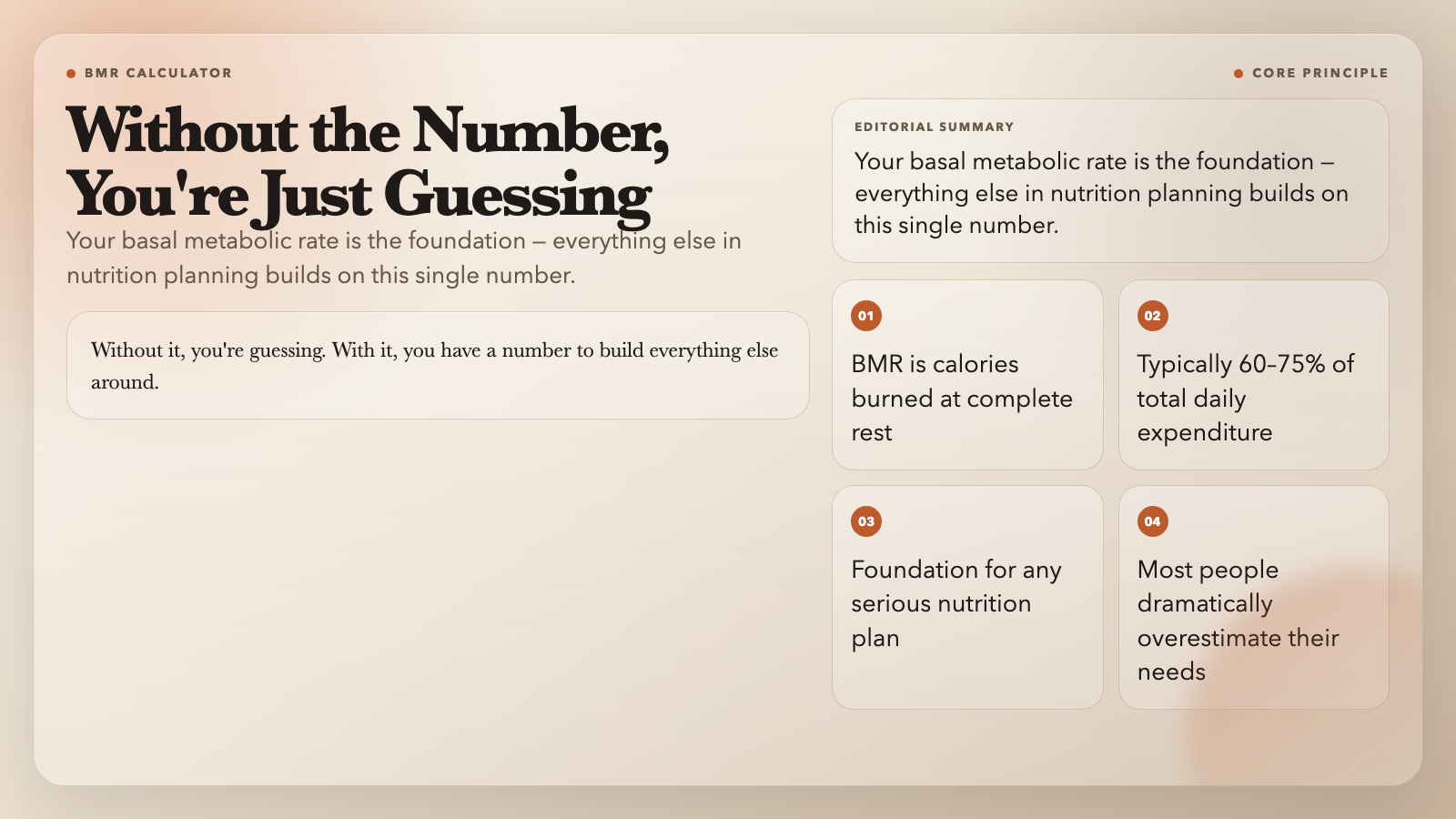
Without it, you’re guessing. With it, you have a number to build everything else around.
Use it when: You’re building a calorie-controlled diet and need to know your baseline energy requirement before adding activity.
Tool: BMR Calculator
—
3. Body Fat Calculator (US Navy)
The US Navy developed this method during WWII when precise measurement equipment wasn’t accessible in the field. It uses neck and waist measurements — plus hip circumference for women — to estimate body fat percentage, validated against hydrostatic weighing with surprisingly good accuracy for a tape-measure approach.
This is a more useful fitness metric than BMI because it measures what you’re actually trying to change: the proportion of fat tissue in your body, not your total weight relative to height.
Use it when: You want a more accurate fitness metric than BMI and don’t have access to DEXA scans or bioimpedance scales.
Tool: Body Fat Calculator (US Navy)
—
4. Calorie Burned Calculator
Every activity burns calories — the question is how many, not whether. This tool uses MET values (Metabolic Equivalent of Task) assigned to hundreds of activities by exercise physiologists. Running at 7 mph carries a MET of 11.0. Sleeping carries a MET of 0.95. Multiply MET by your weight in kilograms and duration in hours, and you get a precise estimate of what a specific activity actually costs you.
This is why some people run for an hour a day and don’t lose weight — their calorie burn estimate didn’t match reality.
Use it when: You want to know exactly how much a workout consumed so you can plan your nutrition accordingly.
Tool: Calorie Burned Calculator
—
5. Daily Calorie Needs Calculator
BMR tells you what you burn at rest. TDEE tells you what you burn when you account for everything: walking to the coffee machine, climbing stairs, your 30-minute jog, even standing fidgeting at your desk. Most people dramatically underestimate their actual needs, which is why “eating less” backfires so often.
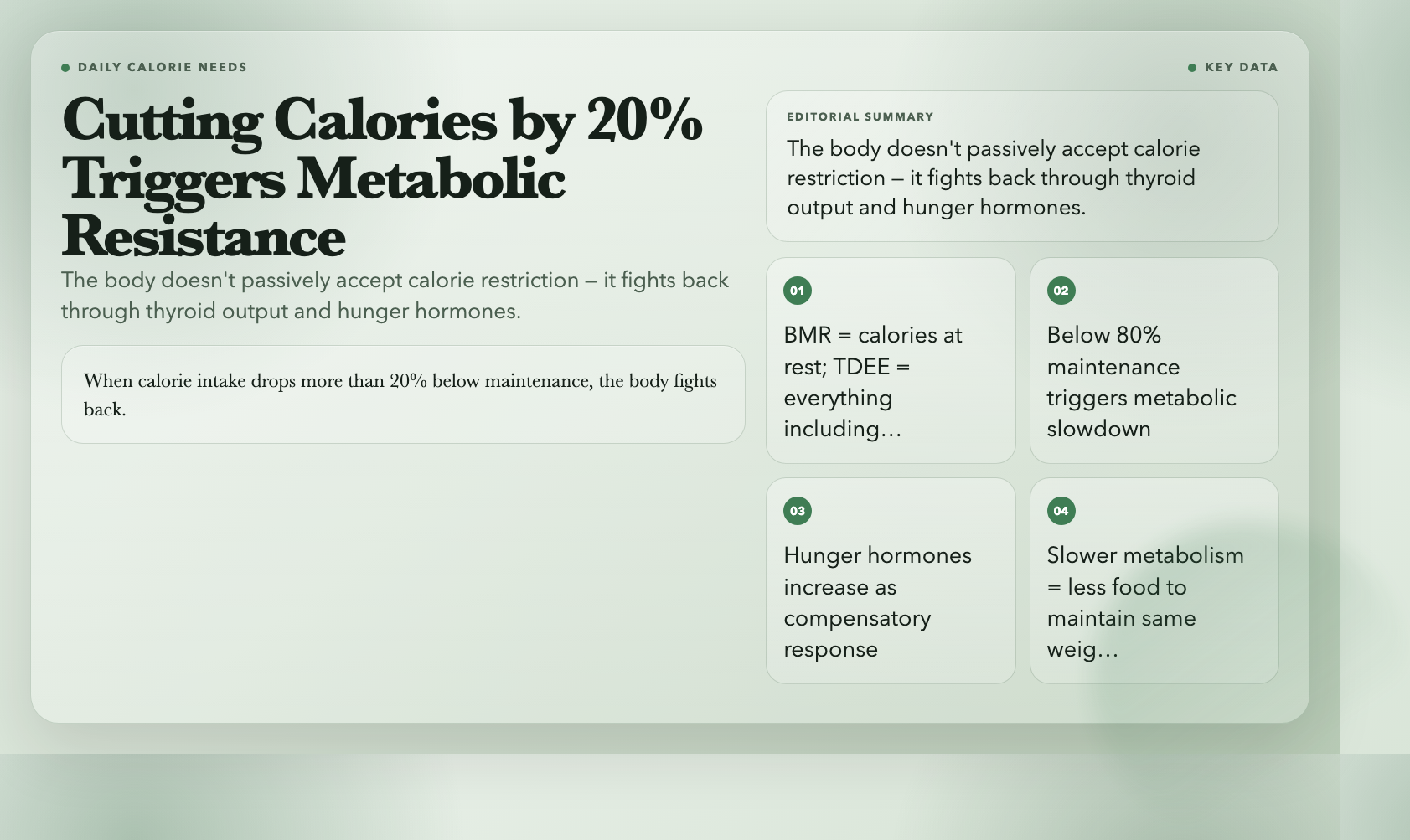
When calorie intake drops more than 20% below maintenance, the body fights back by lowering thyroid output and increasing hunger signals. The slower your metabolism, the less you can eat without gaining fat — a vicious cycle that starts with bad math.
Use it when: You’re deciding whether to bulk, cut, or maintain and need a number to build a meal plan around.
Tool: Daily Calorie Needs Calculator
—
6. Target Heart Rate Calculator
Heart rate during exercise is the most honest measure of training intensity. “Talk test” and “feeling tired” are subjective — heart rate zones give you objective bands: fat burn zone, cardio zone, peak zone, each with distinct physiological adaptations. Many people train for months and see no results because their perceived effort doesn’t match their physiological reality.
220 minus your age is the standard max heart rate estimate, though individual variation can be ±15 beats per minute, which is why the zones shift meaningfully based on your actual maximum.
Use it when: You’re following a training program and need to know if your workout intensity matches your goal.
Tool: Target Heart Rate Calculator
—
7. 4-7-8 Breathing Exercise
Not a calculator in the traditional sense — it’s a guided breathing technique developed by Dr. Andrew Weil based on ancient yogic pranayama. Inhale for 4 seconds, hold for 7, exhale for 8. Four cycles before a presentation. Six before sleep. The mechanism is concrete: extended exhalation triggers the parasympathetic nervous system, directly slowing your heart rate and reducing cortisol. Research shows slow deep exhalation inhibits amygdala activity, the brain’s fear center.
This means you have a free, immediate tool for acute anxiety that works within seconds — no app, no subscription, no equipment.
Use it when: You need to calm pre-performance anxiety, fall asleep faster, or reset between high-stress situations.
Tool: 4-7-8 Breathing Exercise
—
8. Sleep Cycle Calculator
Sleep isn’t continuous — it cycles through 90-minute stages: light sleep, deep sleep, REM, then repeat. Waking mid-cycle leaves you groggy even if the total hours look fine on paper. Sleep debt compounds. Two weeks of sleeping 6 hours per night produces cognitive impairment equivalent to 48 hours of total sleep deprivation.
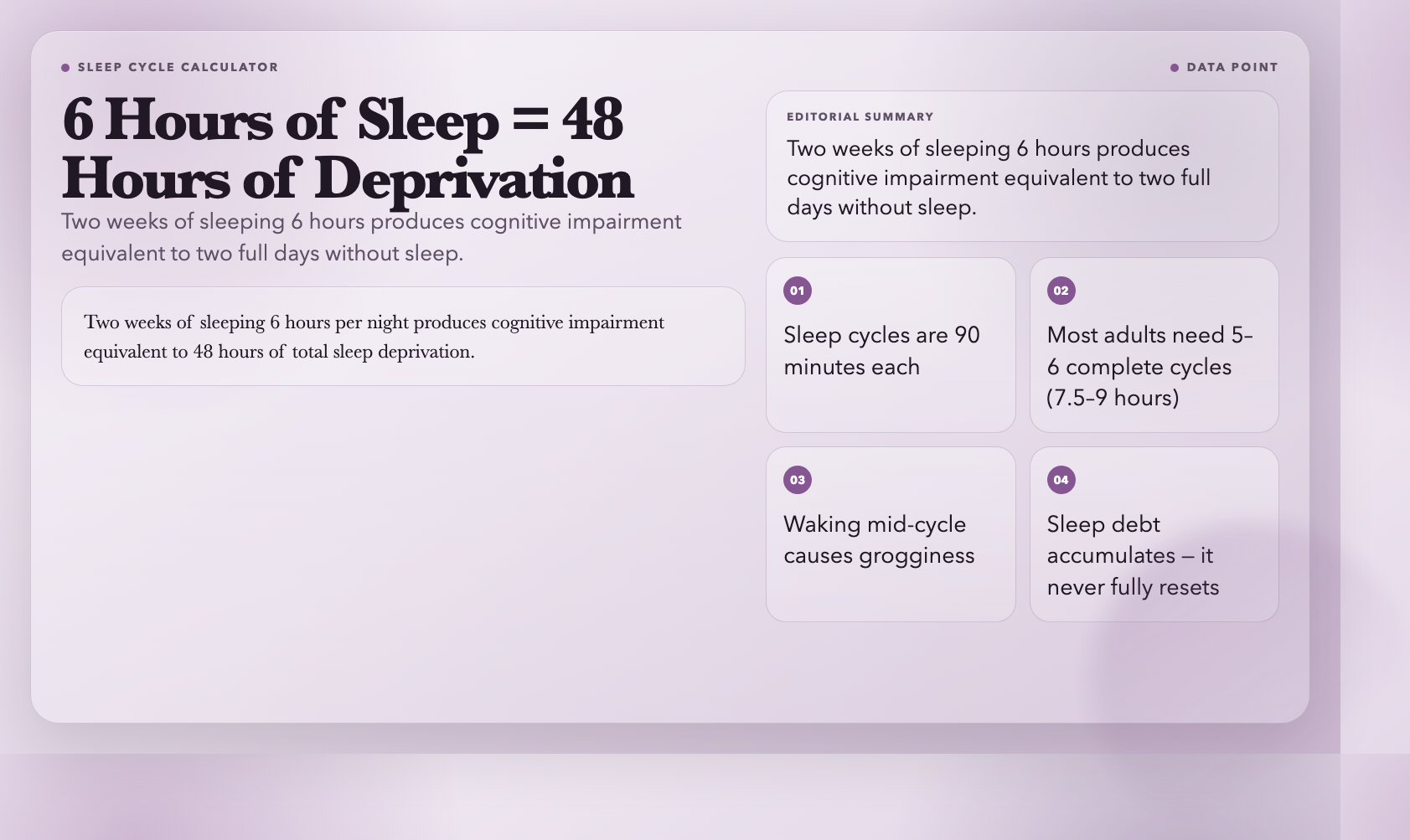
Most adults need 5–6 complete cycles per night, which means 7.5 or 9 hours — not the “I got 6 hours, that’s enough” self-deception that passes for normal in productivity culture.
Use it when: You’re optimizing your sleep schedule or trying to recover from a late night without ruining the next day.
Tool: Sleep Cycle Calculator
—
The Underlying Principle
These eight tools share one logic: your body has measurable parameters, and decisions made around numbers beat intuition every time. Not because the numbers are perfect — BMI doesn’t distinguish muscle from fat, calorie estimates are population averages, sleep cycles vary by individual — but because a rough number you actually use beats a perfect number you never calculate.
The problem with not measuring was never a lack of data. It’s never looking it up. Every one of these eight numbers is available to you right now, for free, in under a minute.