The closing argument: a 64-character hex string isn’t always stronger than “CorrectHorseBatteryStaple”
You paste a key into a tool and you get back a label — Weak, Medium, or Strong. The label feels like it closes the question. It does not. A 64-character hex string made of repeating nibbles looks long and looks random, and many strength meters will rate it Strong. A four-word passphrase chosen from a 2048-word list will look short and look sloppy, and many strength meters will rate it Medium or Weak. Flip the inputs — a six-character password and the passphrase — and the conclusion inverts. That single observation is what an entropy calculator is for: it strips the bias out of character count and asks the only question that matters: how unpredictable is this string, really? Inside the new Entropy Calculator on Elysia Tools (entropy-calculator), that question gets an answer in bits, a duplicate-rate percentage, and a rated crack time at the attacker’s chosen hash rate. The rest of this article walks the math behind those numbers — because once you see why Shannon entropy can flatter a Skewed password, you stop trusting rules-of-thumb and start measuring.
Why entropy is the only honest yardstick
Length is not a security metric. “Twelve characters” tells you nothing about an attacker; it tells you about a policy writer’s comfort level. Three passwords of identical length can have radically different strength. Consider:
aaaaaaaaaaX has twelve characters. So does Q7$pL9!rT4z. So does tr0ub4dor&3. Yet the first can be guessed by an attacker who tries the most common character on average; the second takes ~10¹² guesses; the third, drawn from a memorable phrase structure, takes longer. Length was identical. Strength was not.
Entropy captures this. Measured in bits, it’s the logarithm of the search space an attacker actually faces — the smaller the most likely symbol is in your string, the larger that space. A six-character password built from lowercase English letters has at most ~6 × log₂(26) ≈ 28.2 bits of entropy, regardless of how the user capitalizes. A 64-character key drawn from the entire 256-byte alphabet can approach 64 × 8 = 512 bits — but only if the underlying bytes are uniform.
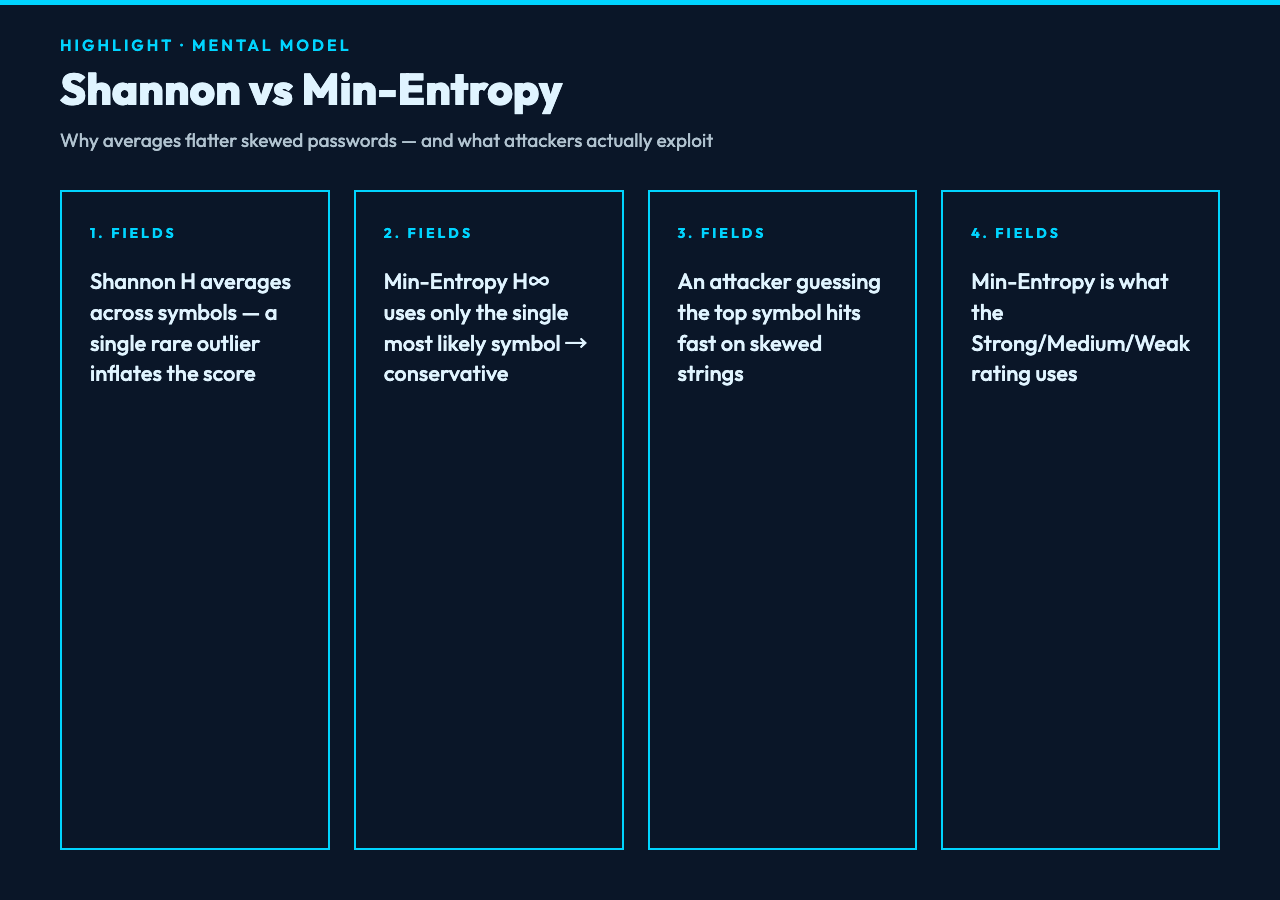
The trouble with naive entropy — what textbooks call Shannon entropy, the formula `H = −Σ p·log₂ p` over symbol probabilities — is that it’s an average. It rewards strings that mix common and rare symbols, even when those mixes are predictable to an attacker. The string aaaaaaaaaaX has 10 repeated a characters and one outlier X: Shannon sees that outlier and reports a moderate entropy score, because on average each symbol is somewhat surprising. But an attacker doesn’t play averages. The attacker plays the most likely symbol, and a is overwhelmingly likely here.
Min-Entropy: the security-grade answer
Min-Entropy (H∞ = −log₂(max p)) takes the worst-case view: it looks only at the single most probable symbol and asks, “if an attacker just keeps guessing this symbol, how many guesses until they succeed?” For aaaaaaaaaaX, p = 10/11, so H∞ = −log₂(10/11) ≈ 0.14 bits. The string collapses. For a uniformly random 256-bit key, H∞ ≈ 256 bits.
Why does this matter for rating? Because an attacker who knows nothing else about the distribution will, by default, exploit the most likely symbol first. That’s the definition of an optimal single-guess strategy. Min-Entropy upper-bounds its success rate and converts the question into a concrete cracking-time estimate: average time = 2^H∞ / guessRate / 2. The factor of two appears because on average an attacker sweeps through half the keyspace before hitting the target.
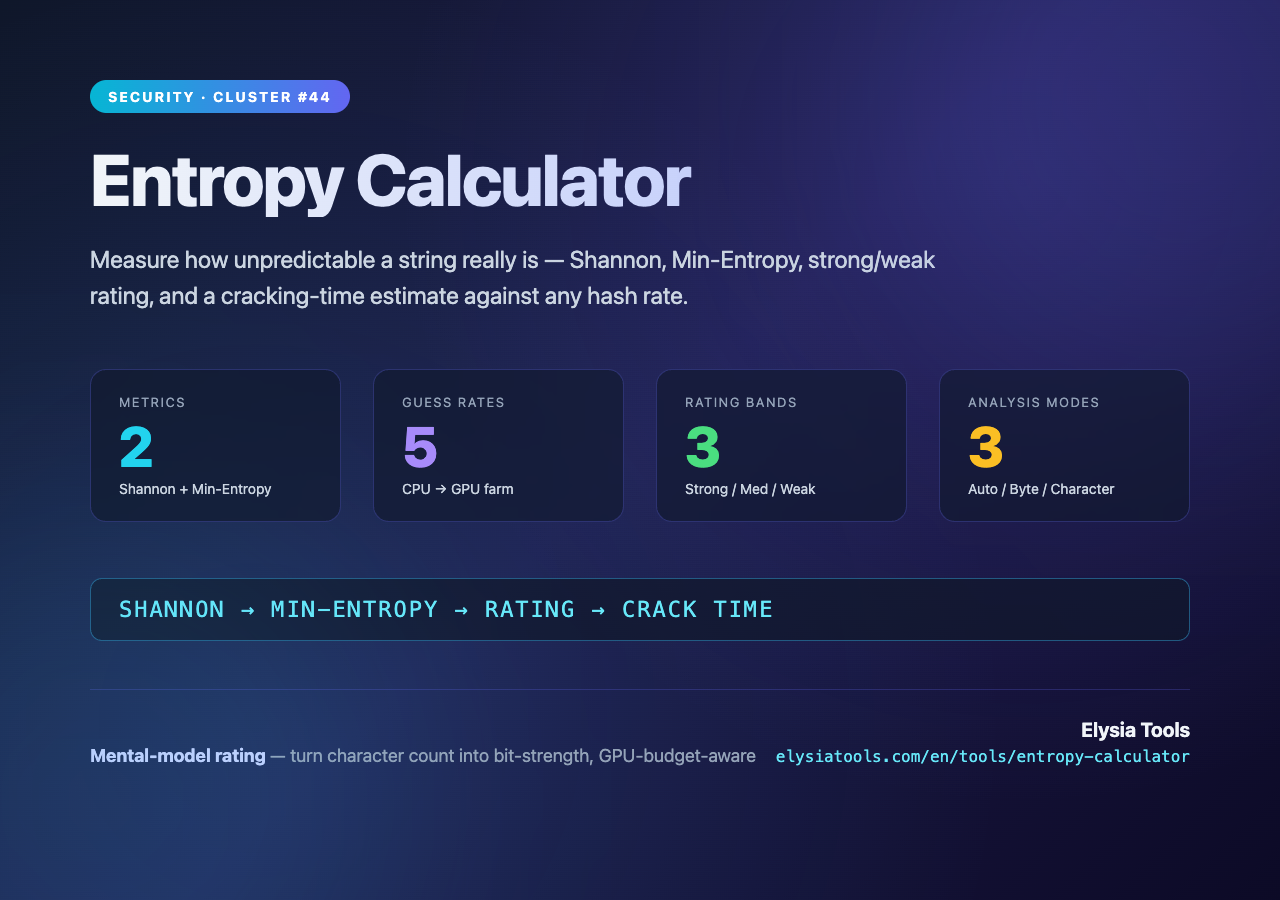
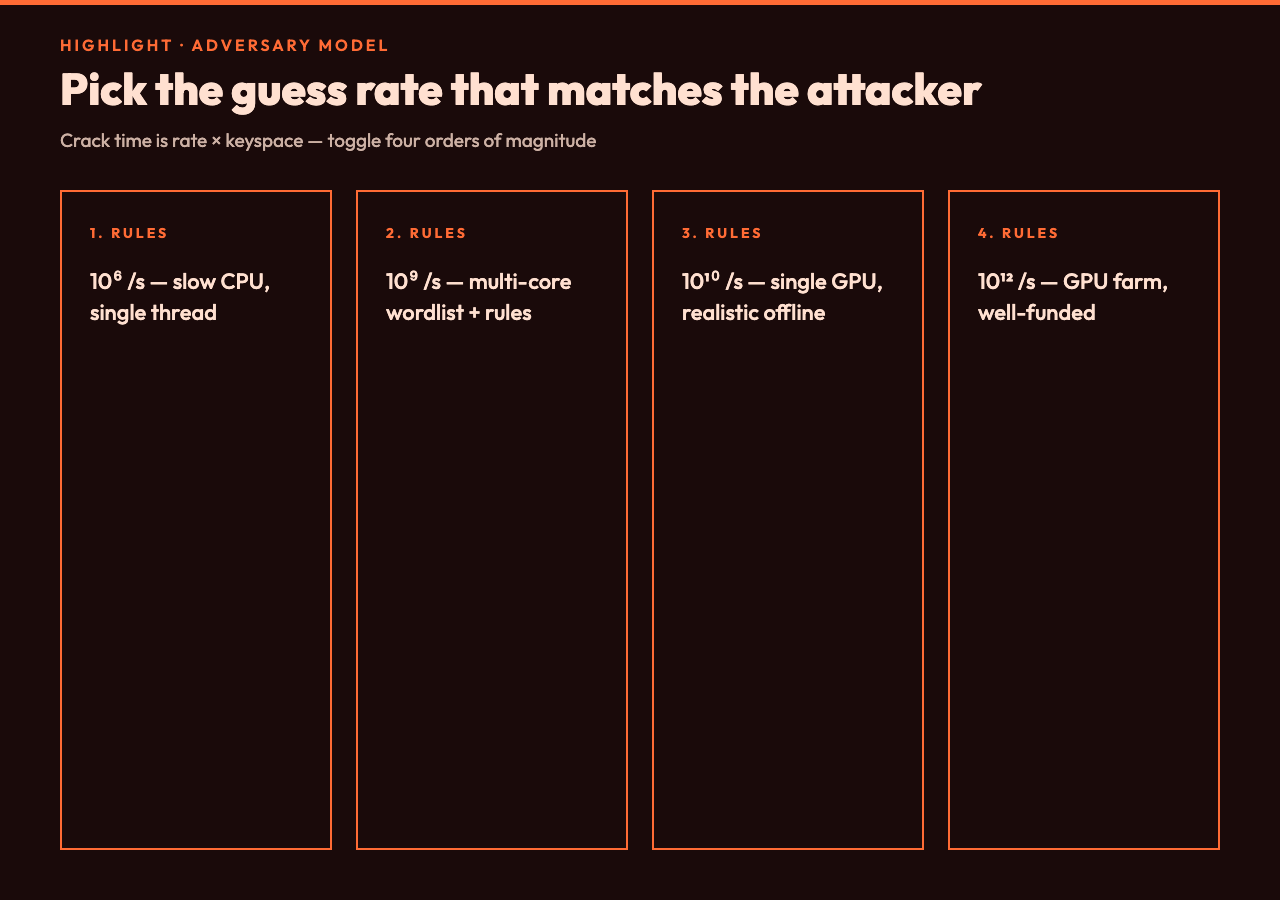
The Entropy Calculator on elysiatools.com/en/tools/entropy-calculator uses Min-Entropy for its Strong / Medium / Weak rating, and shows the average cracking time at four different guess rates plus a custom rate you supply:
- 10⁶ /s (slow CPU) — a single thread on an old laptop mining rainbow tables
- 10⁹ /s (fast CPU) — modern multi-core workstation, wordlist plus rules
- 10¹⁰ /s (single GPU) — the realistic threshold for offline hash cracking with one device
- 10¹² /s (GPU farm) — what a well-funded adversary runs, with dedicated ASIC adjacency or rented cloud
Toggle the guess rate and watch the cracking time drop by orders of magnitude without changing the input. That’s the point: your password isn’t strong against hashes you can’t control but against an adversary’s budget. The Min-Entropy measure feeds both into one number.
A practical four-case walk-through
Numbers in isolation are abstract. Take a concrete sequence and rate it through the tool:
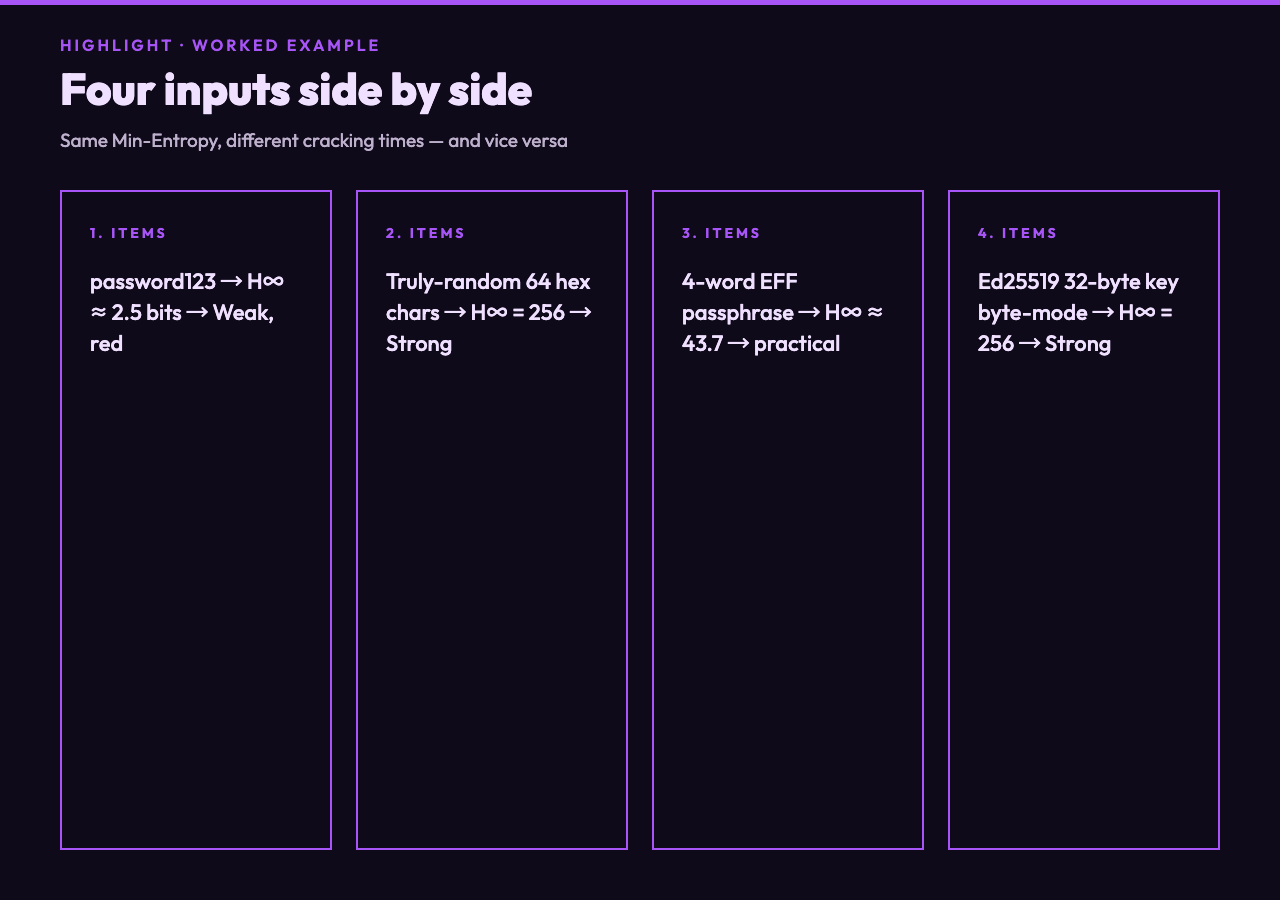
Case 1 — “password123” character-level, single GPU (10¹⁰ /s). Twelve characters, ten distinct symbols, one duplicated pair (s, 2, 3) and three singles. p_max ≈ 0.18, so H∞ ≈ 2.5 bits. Average crack time: ~10⁻⁷ seconds. Rating: Weak, shown in red. This is what most meters grade Strong — Shannon here would happily report ~3.4 bits and miss the point entirely.
Case 2 — A 64-character hex key character-level, single GPU. Truly random hex has p_max = 1/16, so H∞ = 4 bits per character × 64 chars = 256 bits. Cracking time: 2²⁵⁶ / 10¹⁰ / 2 ≈ 10⁶⁷ years. Rating: Strong. Note: this assumes the source is actually a CSPRNG. The same string constructed by hand-rolling hex digits to remember them collapses immediately.
Case 3 — A four-word passphrase from the EFF large wordlist. 2048⁴ ≈ 1.7 × 10¹³ — log₂ = 43.7 bits. Not Strong, but solid. Crack time at 10¹⁰ /s: ~85 seconds. The catch: that keyspace assumes uniform random selection over a known dictionary, which passphrase managers actually provide. If your passphrase comes from a small personal phrase dictionary, the keyspace shrinks dramatically.
Case 4 — A 256-bit Ed25519 private key byte-level. Random bytes from a CSPRNG. p_max = 1/256. H∞ = 8 bits/byte × 32 bytes = 256 bits. Rating: Strong. This is the same conceptual answer as Case 2 — the byte-level mode makes the difference visible at the symbol boundary, while character-level mode collapses it into unicode codepoints.
What the rating actually proves
The Strong/Medium/Weak label is not a score you bank. It’s a snapshot of two specific facts: the most-likely-symbol probability in your data, and the cracking rate you’re willing to assume. Change either input and the label moves. The tool doesn’t maintain a dictionary of weak passwords — rating is purely algorithmic, based on the actual symbol distribution of whatever you paste. That makes it three things at once:
- A sanity check. Run your generated keys, OTPs, JWT secrets, and password manager exports through it before trusting them in production.
- A what-if simulator. Toggling the guess rate from 10⁶ /s to 10¹² /s shows the same Min-Entropy score on different threat models — useful in security reviews when the audience is “an enterprise asset, GPU-budget adversary” vs “an offline cold-storage dump”.
- A teaching surface. Watch how quickly the rating drops when you replace a single character with its duplicate. The visual histogram of symbol frequency makes the math intuitive in a way text cannot.
Want a takeaway you can apply today? When you generate a credential, paste it into the tool once and confirm two things: rating is Strong (≥128 bits) and the average crack time is > 10¹⁵ seconds at GPU-farm rate. If either fails, the credential is performing hope, not security. The full breakdown — symbol histogram, Shannon vs Min-Entropy side-by-side, byte-level vs character-level mode — is on the page at elysiatools.com/en/tools/entropy-calculator.
Where this matters in real systems
Three adjacent password generators are useful companion tools: the Entropy Calculator lets you verify their output, the bcrypt generator shows how that raw entropy gets folded into a real password hash (so Min-Entropy score matters less once you add a work factor), and the JWT generator produces tokens whose signature randomness directly drives how hard the resulting token is to forge. Live entropy-rating examples for the sister-hub corpi — see the strong-password validation samples, cryptography encryption samples, and JWT signature samples for raw inputs you can paste in.
The closing thought is the opening thought: length is not strength, and Shannon entropy is not Min-Entropy. A measurement-grade answer — what the Entropy Calculator gives you in two seconds — beats an opinion-grade answer every time.