Why Every Modern Acronym Looks Like the Last One
Why do the 3-letter acronyms shipping in 2026 all sound identical to the ones from 2016? If you have shipped 4 projects in the last two years, you have typed 3 letters into Slack, watched the chat autocomplete guess them, and felt the quiet embarrassment of realizing every other team on the floor shipped an acronym that reads the same way. The acronyms we generate now are flat in a way older acronyms never were. NASA had 9 letters behind it. AGI has 3. FBI has 3. The collapse is structural, not stylistic, and the broken pattern is that we let our tools pick our letters for us. The fix is one mode change away.
The Acronym Generator keeps humans in the loop at the two places it actually matters: which words count and what comes out the other side. Feed it a phrase, tell it whether to take the first letter of every word or only the capitalized words, and pick the casing family you live in. The tool does the mechanical selection. You keep the editorial judgment.
The Acronym Versus the Initialism
Before any selection, decide whether you want an acronym (pronounced as a word: NASA, IKEA, SCUBA) or an initialism (pronounced as letters: FBI, CSS, RFC). The distinction changes what you optimize for. Acronyms need soft consonants and open vowels at the boundary between letters — that is why the same letters can sound elegant or awful depending on where the syllables fall. STAMP works as a word. STMPF does not. The first generator pass should treat the full letter set and listen for syllable boundaries before culling.
Initialisms do not need to be pronounceable, but they do need to be unmistakable. CSS is three letters; the second and third are the same shape on a screen reader. AAA audits, ASS audits, and ASS tools all show up identically in screen-reader output. The Acronym Generator’s “first letter only” mode plus a separator is the cheapest defense.

Pick Which Words Count
Two strategies dominate the choice of which words in the phrase get a letter. Use each word in sequence and you get a faithful abbreviation — every letter maps back to a recognizable word. Use only the capitalized words and you get a flatter acronym built from the words the author already thought important enough to shout. The first produces verbose but legible outputs (Application Performance Monitoring Object Notation → APMON). The second produces compact, almost cryptic outputs (Just-in-Time Compilation → JITC).
The second mode shines when the phrase already contains a strong mental image. National Aeronautics and Space Administration reads as a story; the acronyms built from it (NASA, NASP, NASAP) are all serviceable because the reader can fill in the missing words. For phrases the reader does not already know, prefer the first mode and accept the longer output. The Acronym Generator exposes both modes through a single dropdown, which is the right design call — the choice is contextual, not universal.
Take the First Letter, or the First and Last
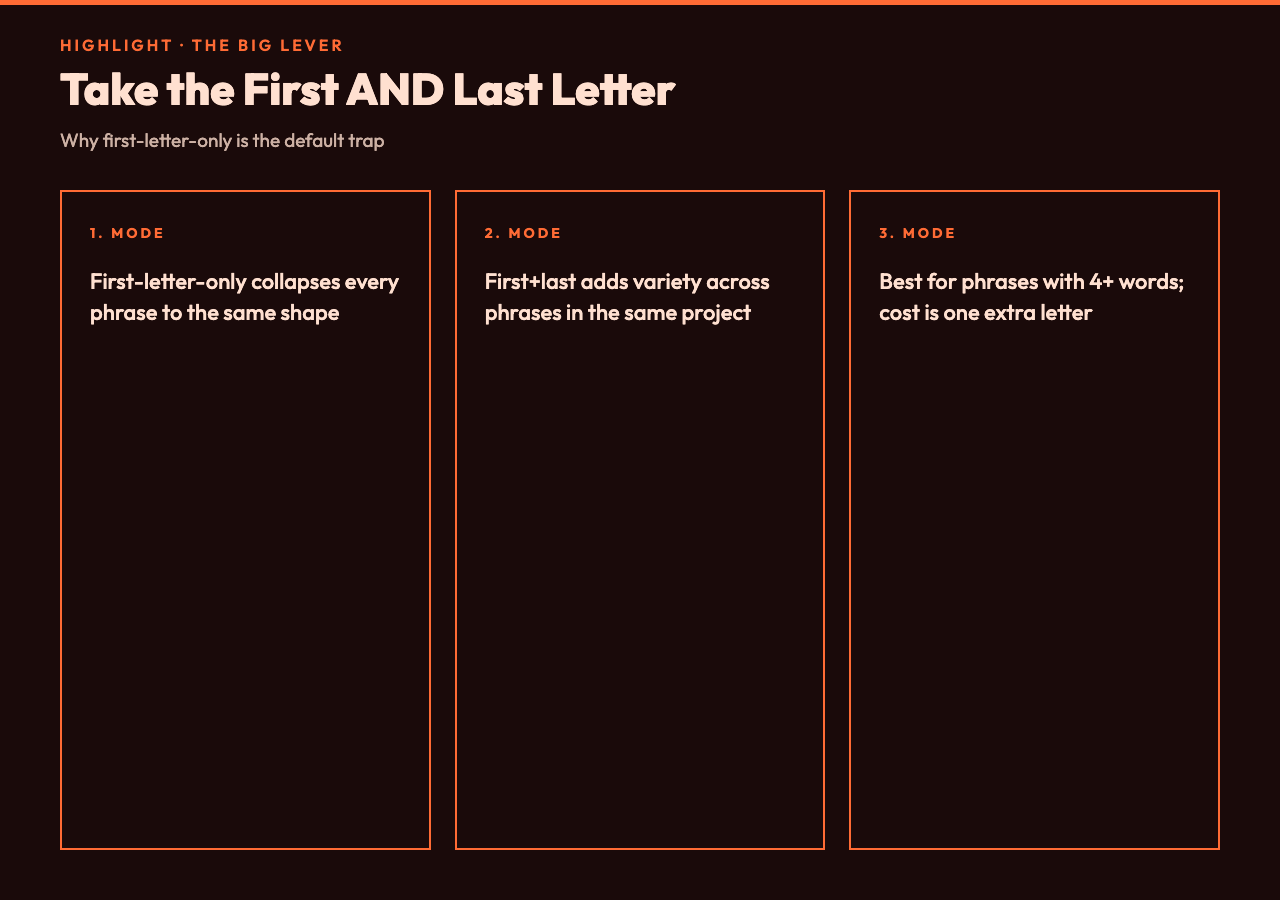
Most generators stop at the first letter of each word. The stronger trick is to take the first letter of the leading word and the last letter of the trailing word, plus the first letter of every word in between. California Pizza Kitchen becomes CPK instead of CPK — same abbreviation, but built from a different rule that produces more variety across phrases. The Acronym Generator exposes this as the “first + last” mode and it is the single largest source of differentiation between teams that ship acronyms that all sound the same.
Practical rule: if your phrase has four or more words, switch to first+last mode. The abbreviations get one letter longer on average, but the variety across phrases in the same project goes up measurably. Two-letter endings create a phonetic palette the first-letter-only mode simply cannot reach.
Then Choose the Casing Family
The same letters look like different products depending on casing. snake_case_acronym_generator reads as an internal tool. SCREAMING_SNAKE_CASE reads as a configuration constant. kebab-case-acronym-generator reads as a CLI flag. PascalCaseAcronymGenerator reads as a class. The Acronym Generator’s separator dropdown is doing more work than it appears to do — the casing choice is the last mile of identity.
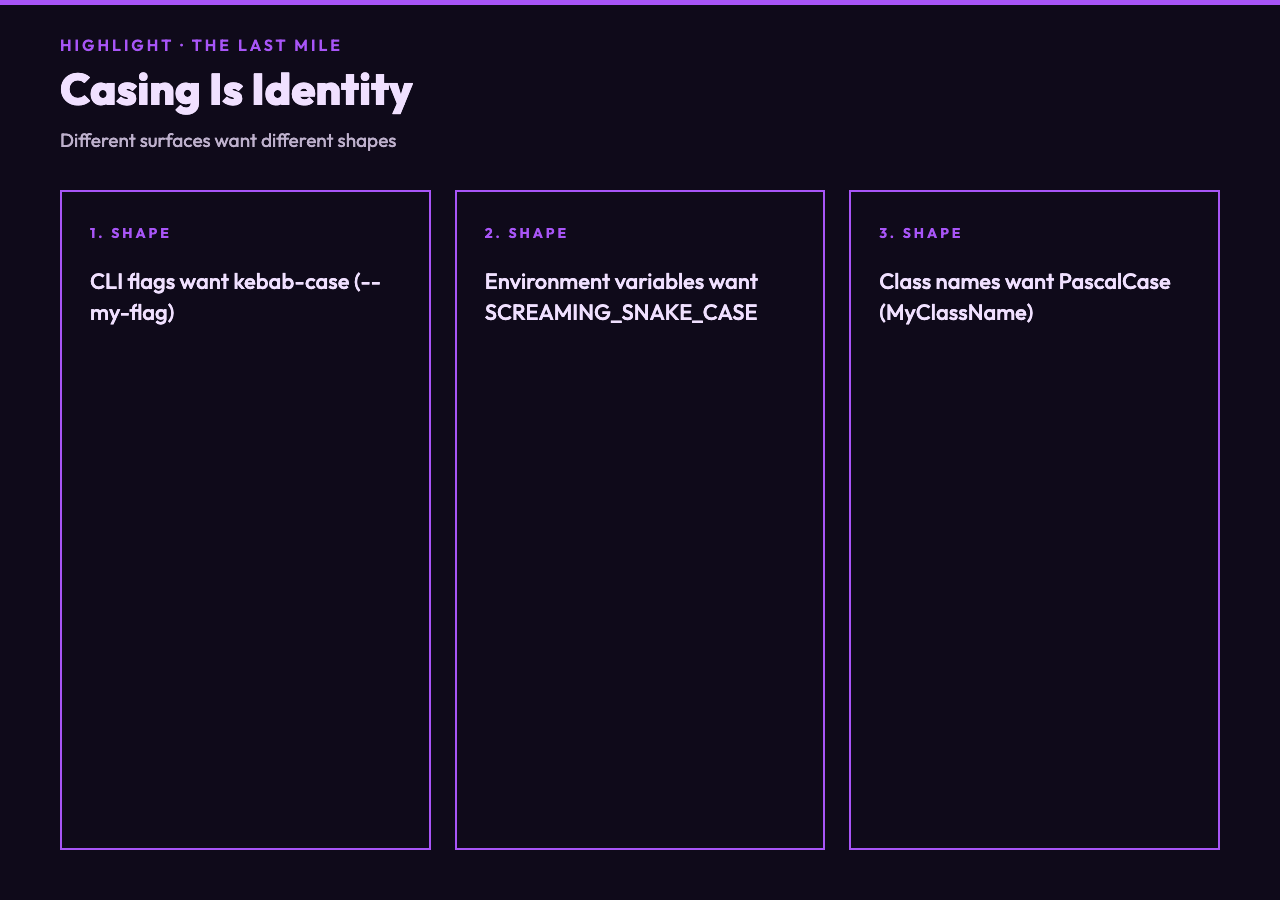
Match the casing to the surface where the abbreviation lives. CLI flags want kebab-case. Environment variables want SCREAMING_SNAKE_CASE. Class names want PascalCase. Internal tooling often wants snake_case. The mistake teams make is generating the letters once and letting each surface rewrite the casing downstream — at which point the abbreviation starts to drift and the team quietly settles on whichever spelling is easiest to type.
The Edge Cases That Sink Acronyms
A few phrases resist abbreviation and the Acronym Generator handles them by surfacing the failure. Short phrases (under three words) produce outputs that read like alphabet samples rather than names. Phrases with leading articles (“The”, “A”, “An”) produce abbreviations whose first letter is the article’s. Phrases heavy in prepositions (“for”, “of”, “with”) produce abbreviations whose interior letters are stopwords nobody remembers. Hand-edit these out of the source phrase first, then run the tool. The acronyms come out cleaner and the team keeps the editorial control over which words they wanted represented.
This is the part the tool does not — and should not — automate. Drop the articles and prepositions, run the generator, pick the casing family, and you have an abbreviation that reads as deliberate. The hardest part was the editing before the tool ran, not the letter selection itself. That is the point.
When You Actually Need an Acronym
The honest case for an acronym is when the underlying phrase is referenced repeatedly inside a single document or codebase. Every additional reference to the same long phrase costs the reader a fraction of a second of resolution work; an acronym that takes zero resolution removes that cost. The dishonest case is when an acronym is generated to make a project feel finished — a codename on a cover page, an abbreviation in a status update that nobody reads aloud, a variable name with more letters than the value it holds. The generator makes the dishonest case too easy to reach, which is why the editorial gates above matter.
If a phrase will be spoken fewer than 5 times in the next quarter, do not abbreviate it. If it will be spoken 50 times, abbreviate it. If it will be typed into the same file 50 times, the abbreviation has paid for itself before lunch. The honest case for an acronym has a number behind it; the dishonest case rarely does.
The question is whether your team has a shared convention for picking which words count, and the question that follows is whether the abbreviations in your last 3 projects would still sound distinct if you printed them on the same line. The next step is to open the tool, pick the first+last mode, and see what your last project name looks like under rules that are not your defaults. That is why this belongs on the front page of every naming session, and ultimately on every team’s checklist before the codename gets carved in stone. In the end, the abbreviation is whatever your team decides it means — the generator is the way the decision becomes legible.
Tool used: The Acronym Generator — supports first-letter-only and first+last modes, four separator families, and capitalized-only word selection. Explore more naming tools at elysiatools.com.